Disclosure: this article contains affiliate links. If you buy through them, DIGITAL WOXTER TECHNEWS may earn a commission at no extra cost to you. Our picks are based on specifications, prices and published reviews, not on payments. As an Amazon Associate I earn from qualifying purchases.
Four small gadgets can make a weekend in the woods easier and safer: a compact power station, a folding solar panel to refill it, a pocket water filter and a good rechargeable headlamp. None of them replaces common sense, a map or a first-aid kit, but together they solve the three classic camping problems: flat batteries, doubtful water and darkness at 7 pm.
This guide explains what each gadget actually does, the numbers worth checking, and the safety limits that the shiny product photos leave out.
How we compared: we did not test these products ourselves. This guide is based on manufacturer specifications and manuals, published tests by independent outlets such as OutdoorGearLab, CleverHiker and Tree Line Review, and public-health guidance from the US CDC, all linked below. Price ranges: Budget = under $100, Mid-range = $100-300, Premium = over $300. Prices change often, so use the Amazon links in each section to see today’s price.
Quick picks
| Job | Model | Key numbers | Weight | Price range |
|---|---|---|---|---|
| Power for a weekend | EcoFlow RIVER 3 | 245 Wh, 300 W AC, 100 W USB-C | 3.5 kg | Mid-range |
| Refill it with sunshine | EcoFlow 110W Portable Solar Panel | 110 W rated, folds in half, waterproof | about 4 kg | Premium (often discounted) |
| Safe(r) drinking water | Sawyer Squeeze (SP129) | 0.1-micron filter, rated 1.7 litres a minute | about 85 g | Budget |
| Hands-free light | Petzl ACTIK CORE (2025) | 625 lumens, red light, USB-C or AAA | about 88 g | Budget |
Specs come from the manufacturers’ manuals and listings and from the reviews linked in each section.
1. Power station: EcoFlow RIVER 3
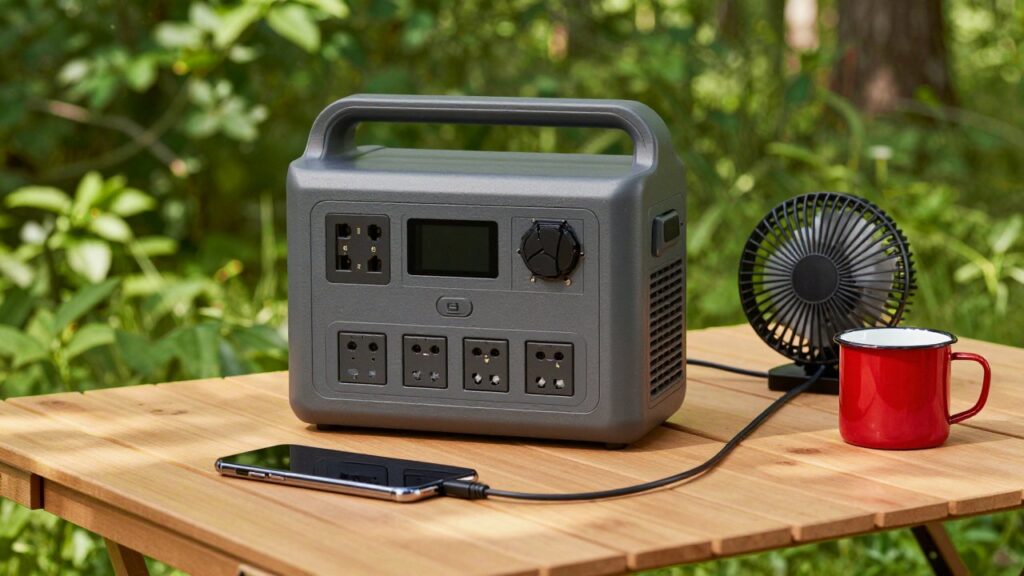
A portable power station is a big rechargeable battery with real sockets on it: a household-style AC socket, USB ports and a car-style 12 V outlet. Think of it as a power bank that grew up and can run a small fan, a camera charger or a laptop.
The EcoFlow RIVER 3 stores 245 Wh (watt-hours, the energy in the tank) and weighs about 3.5 kg, according to its user manual. It gives up to 300 W from AC (two sockets on the US model, one on the European model), up to 100 W from its USB-C port, two 12 W USB-A ports and a 12 V car outlet. It recharges from a wall socket in about an hour and accepts up to 110 W of solar power. The cells are LFP (lithium iron phosphate), a chemistry known for long life: EcoFlow rates them at 80 % health after 3,000 cycles.
What 245 Wh means in practice: divide by the power your device draws. A 10 W camping fan would run for roughly 20 hours, and a phone with a 4,500 mAh battery holds about 16 Wh (mAh × 3.6 ÷ 1,000), so you could top it up around ten times. Real results are lower because converting battery power to AC wastes some energy: The Solar Lab measured about 83 % efficiency on AC in its tests.
Pros: light for its class, quiet, fast wall charging and an accurate 100 W USB-C port (Mighty Gadget). Cons: 300 W is not enough for kettles, hair dryers or a fridge compressor; The Solar Lab saw it shut down under a 350 W load after about 10 seconds and found the “X-Boost” mode for bigger loads unconvincing. There is no built-in light and no USB-C charging input.
Who it’s for: weekend campers, vanlifers on short trips, festival-goers, and anyone who wants a quiet backup for a router or a laptop at home. Not for: backpackers (3.5 kg is heavy on your back) or anyone hoping to run a cooler, heater or cooking appliance.
2. Solar panel: EcoFlow 110W Portable Solar Panel
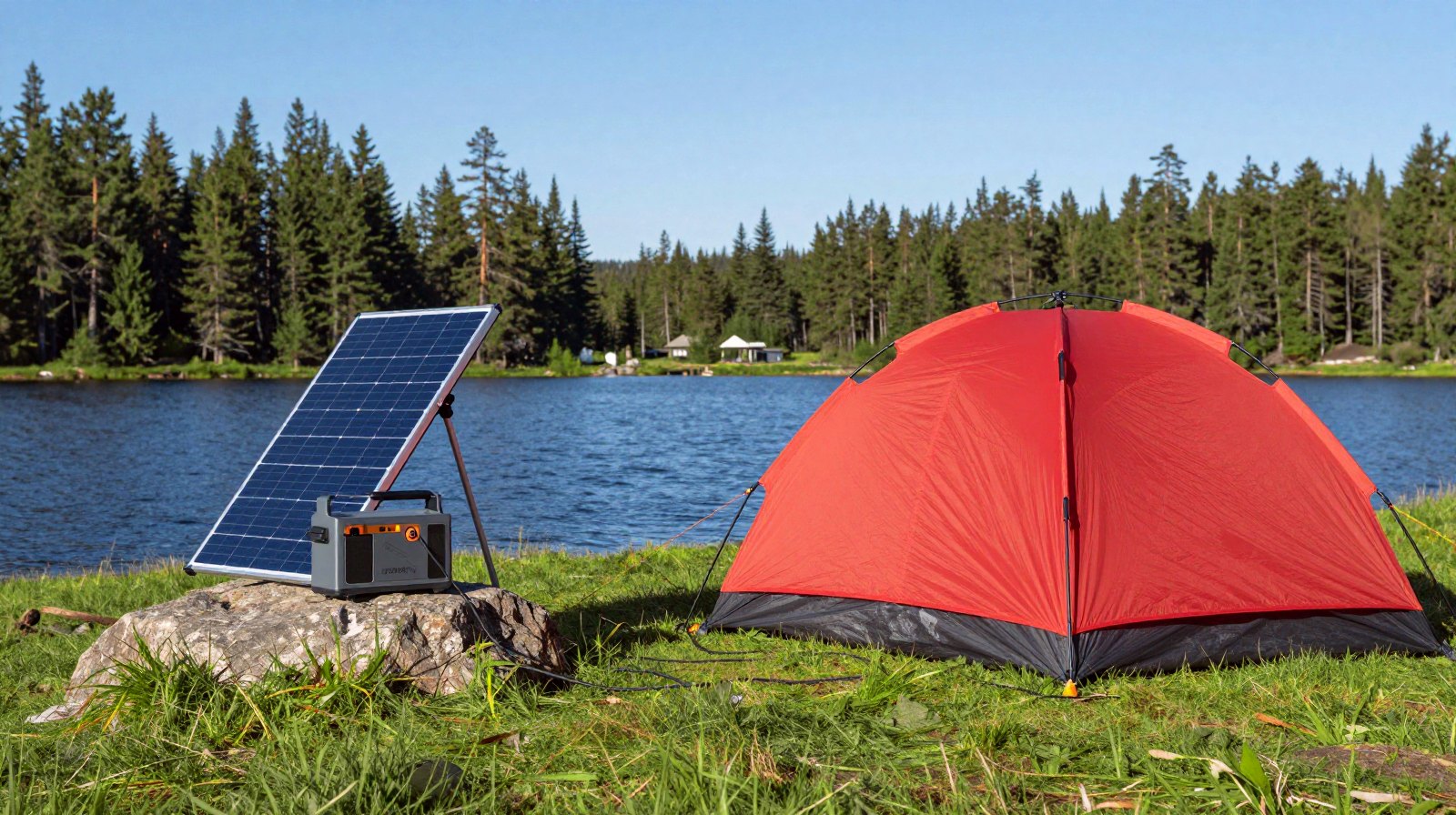
A solar panel turns your power station into a small off-grid system. The EcoFlow 110W Portable Solar Panel folds like a big book, weighs about 4 kg and uses universal MC4 connectors. It matches the RIVER 3’s 110 W solar input exactly.
Here is the number that matters most: 110 W is the best-case rating, measured in lab conditions. In the real world you get less. OutdoorGearLab measured an average of about 38 W in peak sun on its long-term panel, which had lost output over a few years of use, and noted that it was the strongest in its group when new. The Gadgeteer filled a 210 Wh EcoFlow battery from empty in about seven hours of full sun and still got useful charge on cloudy days. The Solar Lab found that refilling a RIVER 3 from a 110 W input takes over three hours.
Pros: rugged, waterproof, packs flat, works with many brands thanks to MC4 plugs (OutdoorGearLab, The Gadgeteer). Cons: the carry case doubles as a kickstand and is not as steady as a proper stand, and the charging cable is not included. Check that you have the right solar cable for your station: EcoFlow’s manual says the RIVER 3 does not ship with one either.
Who it’s for: campers staying two or more nights in one sunny spot. Not for: shaded forest pitches, short one-night trips (a full wall charge before you leave is simpler) or anyone counting grams.
3. Water filter: Sawyer Squeeze
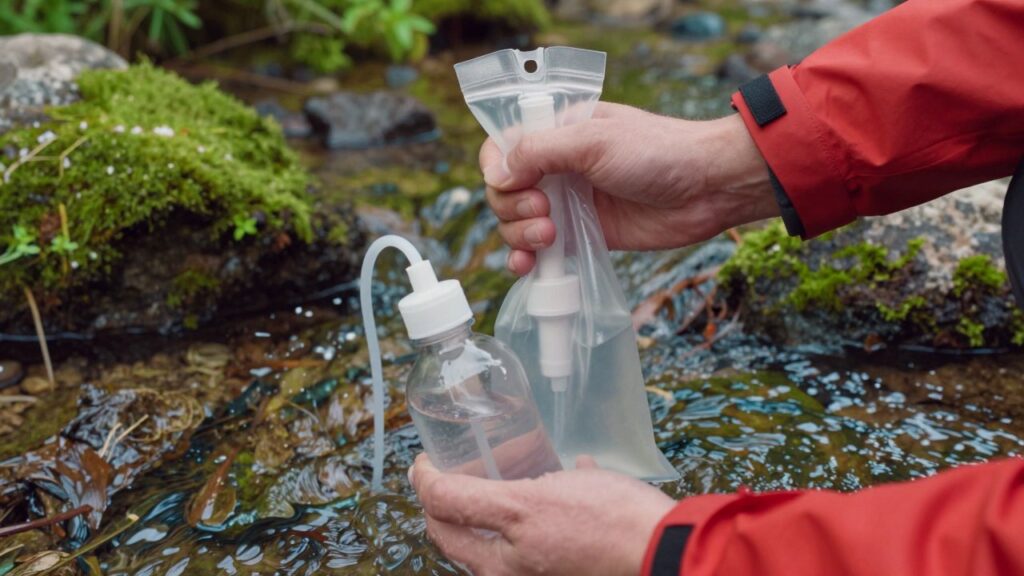
The Sawyer Squeeze is a hollow-fibre filter: a bundle of tiny straws whose walls have holes just 0.1 micron wide, about a thousandth of the width of a human hair. You fill a soft pouch from a stream, screw the filter on and squeeze clean water into your bottle. It weighs about 85 g, is rated at 1.7 litres a minute, and Sawyer rates the cartridge for hundreds of thousands of litres.
Independent testers like it a lot. CleverHiker praises its speed, light weight and value, and Tree Line Review reports no failures over hundreds of miles of long-distance trails. Both say the included pouches are the weak point: they are hard to fill and not very durable.
Safety first, because this matters:
- It does not remove viruses. CleverHiker and Tree Line Review both list viruses as not covered, and the CDC explains that ordinary portable filters, even fine ones, do not remove viruses. Near farms, villages or anywhere sewage could reach the water, filter first and then disinfect (chlorine dioxide tablets, for example), or boil.
- It does not remove chemicals. Heavy metals, pesticides and other chemicals pass through, CleverHiker notes. The CDC adds that even boiling or disinfecting cannot make chemically polluted water safe: choose another source.
- Boiling is the most reliable backup. The CDC recommends a rolling boil for 1 minute, or 3 minutes above about 2,000 metres (6,500 feet).
- Never let it freeze. Ice can crack the fibres invisibly and the filter then stops protecting you. Both reviews recommend keeping it in your sleeping bag on cold nights.
- Backflush it. Flow drops as the fibres clog; pushing clean water backwards with the included syringe restores most of it, according to CleverHiker.
Who it’s for: hikers and campers who drink from rivers, lakes and springs and want to carry less water. Not for: travel where tap water may carry viruses (pick a purifier instead) or winter trips below freezing.
4. Headlamp: Petzl ACTIK CORE
A headlamp keeps both hands free for pitching a tent, cooking or finding the path to the toilet block. The 2025 version of the Petzl ACTIK CORE reaches 625 lumens on its brightest setting, throws light up to about 115 metres and weighs about 88 g, CleverHiker reports. It runs on Petzl’s rechargeable CORE battery, now with a USB-C port, or on three ordinary AAA batteries if you run out of charge far from a socket. It also has a red light, which keeps your night vision and does not dazzle your neighbours.
Runtimes show the usual trade-off: about 2 hours at full power, about 7 hours at 100 lumens and up to 100 hours on the lowest setting, according to CleverHiker. Medium is plenty for camp chores.
Pros: bright, comfortable, simple one-button control, USB-C, and the AAA backup is a real safety feature (CleverHiker, Live for the Outdoors). Cons: pricey, and rated only IPX4, which means it handles rain and splashes but not a dunk in a river.
Who it’s for: nearly every camper, plus runners and cyclists in winter. Not for: paddlers or anyone needing a fully waterproof light.
Lithium battery care outdoors
- Mind the temperature. The RIVER 3 charges between 0 °C and 45 °C and works best between 20 °C and 30 °C, its manual says. Do not charge it on a frosty morning or leave it in a closed car in summer sun.
- Keep it dry. The power station is not waterproof: keep it inside the tent or under cover. If it gets wet, stop using it, EcoFlow advises.
- Store it half full. For long-term storage EcoFlow asks you to discharge the RIVER 3 to 0 % and recharge it to 60 % every three months; leaving it untouched for more than six months can void the warranty.
- Retire damaged batteries. If any battery swells, smells odd or gets very hot, stop using it and take it to a recycling point.
Buying tips
- Do the watt-hour sum first. Add up what you want to charge per day. Phones and lights need little; a laptop needs 50-100 Wh per full charge.
- Size the panel realistically. Expect a portable panel to deliver a fraction of its rating, depending on sun angle, cloud and heat.
- Check the cables. Panel-to-station cables are often sold separately. Make sure the connector matches your station’s solar port.
- Know your water. Clear mountain streams and a muddy river next to a village need different treatment. A filter plus tablets covers most cases.
- Buy from the brand’s official store or Amazon directly. Battery products and filters are often copied, and fakes may skip safety protections.
FAQ
Can I take a power station on a plane? Usually not. At 245 Wh the RIVER 3 is well above the 160 Wh upper limit for spare lithium batteries in passenger baggage, according to the FAA. Plan it for car trips.
Is filtered stream water always safe? No filter makes every source safe. The Sawyer Squeeze removes bacteria and protozoa such as Giardia, but not viruses or chemicals. When in doubt, filter and then disinfect, or boil.
Can I charge the power station while it powers my devices? Yes. The RIVER 3 can charge from the wall or a panel while it supplies power, which is how its backup (UPS) function works.
Do I need all four? No. For a single night, a charged headlamp and a water filter are the essentials. The power station and panel pay off on longer stays or when you need to keep cameras, phones and a laptop going.
Read next
- Zinc-air batteries that recharge: new catalyst runs 300 hours
- Self-powered glasses sensors read your pulse, blinks and bites
- Washable circuit fibres: threads that glow, compute and sense
Show sources (11)
- RIVER 3 Portable Power Station user manual – EcoFlow, 11 September 2024
- EcoFlow River 3 Portable Power Station review – Mighty Gadget, 13 November 2024 (updated 21 March 2026)
- EcoFlow River 3 review – The Solar Lab
- EcoFlow 110 review – OutdoorGearLab, 15 August 2025
- EcoFlow 110-Watt Solar Panel review – The Gadgeteer, 6 April 2022
- Sawyer Squeeze water filter review – CleverHiker, updated 12 March 2025
- Sawyer Squeeze water filter review – Tree Line Review, 27 August 2025
- Water treatment for hiking, camping and traveling – US CDC, 30 January 2025
- PackSafe: Lithium Batteries – FAA, updated 11 August 2026
- Petzl ACTIK CORE headlamp review – CleverHiker, updated 6 April 2026
- Petzl Actik Core headlamp review – Live for the Outdoors