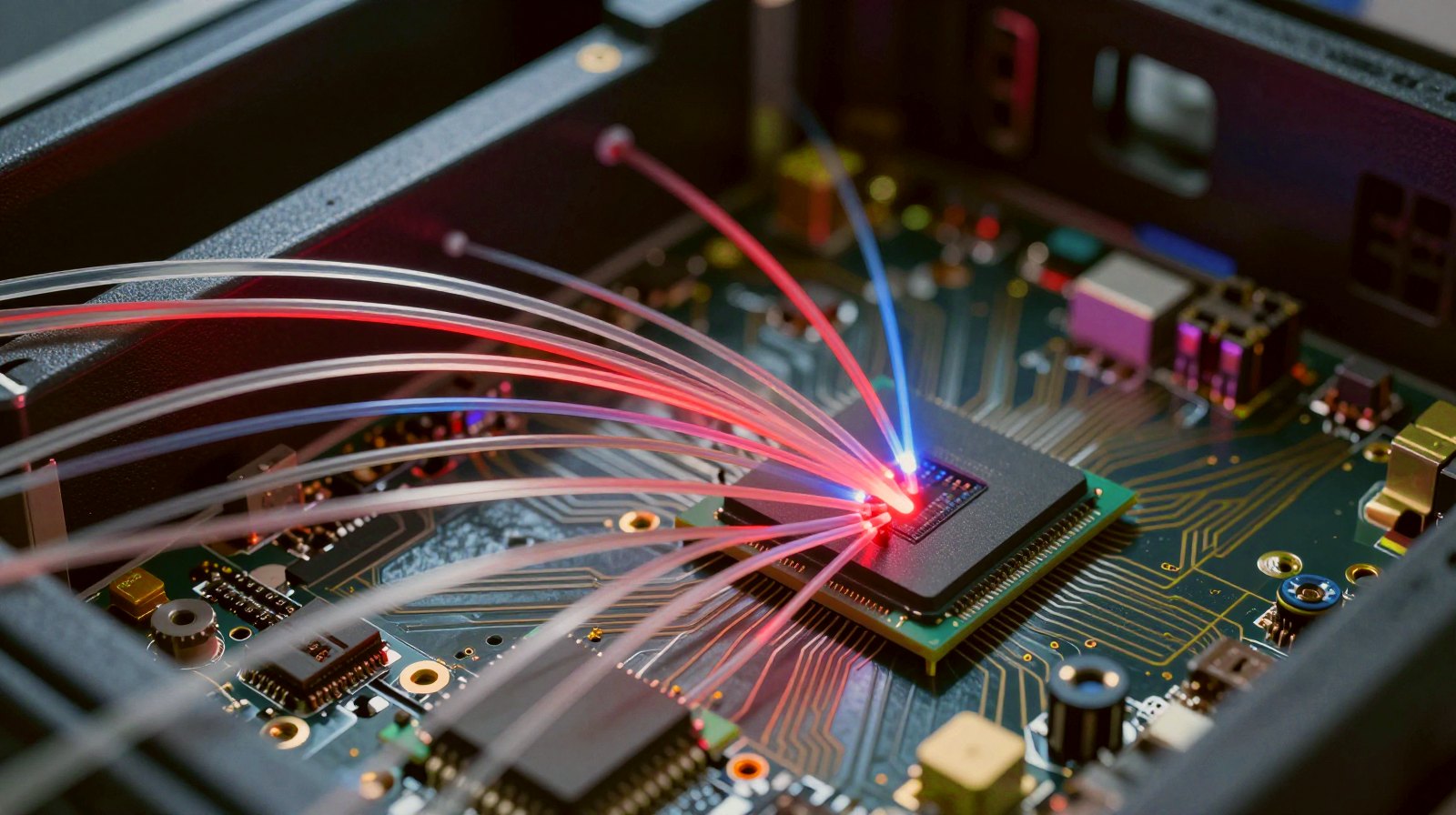
Inside every data centre, billions of bits race between chips and boards as tiny pulses of electricity along copper wires. The faster they go, the more power those wires burn and the more heat they make. Japan’s telecom giant NTT wants to swap many of those electrical paths for pulses of light, step by step, from the network all the way into the chip. And it says the first big product of that plan goes on sale this fiscal year.
Why it matters: AI is making data centres hungrier than ever. Moving data, not just computing it, eats a big part of the energy. If light can carry the data for a fraction of the power, the same building can run more AI on the same electricity bill, with less heat to remove.
Why light beats wires
An electrical signal in a copper trace loses strength and wastes energy as heat, and the losses grow as speeds rise and distances get longer, NTT explains on its technology page. Light travelling in an optical fibre or a tiny waveguide barely notices distance or speed, and many colours of light can share the same path. The catch: chips still compute with electricity, so you need a small optical engine that turns electrical bits into light pulses and back again. NTT calls putting those engines right next to the chips photonics-electronics convergence, or PEC.
The plan, from network to chip
NTT’s programme is called IOWN (Innovative Optical and Wireless Network). At its R&D Forum in November 2025, CEO Akira Shimada laid out the stages in his keynote:
- IOWN 1.0 (since 2023): the All-Photonics Network, which keeps data as light across the telecom network instead of converting it at every hop.
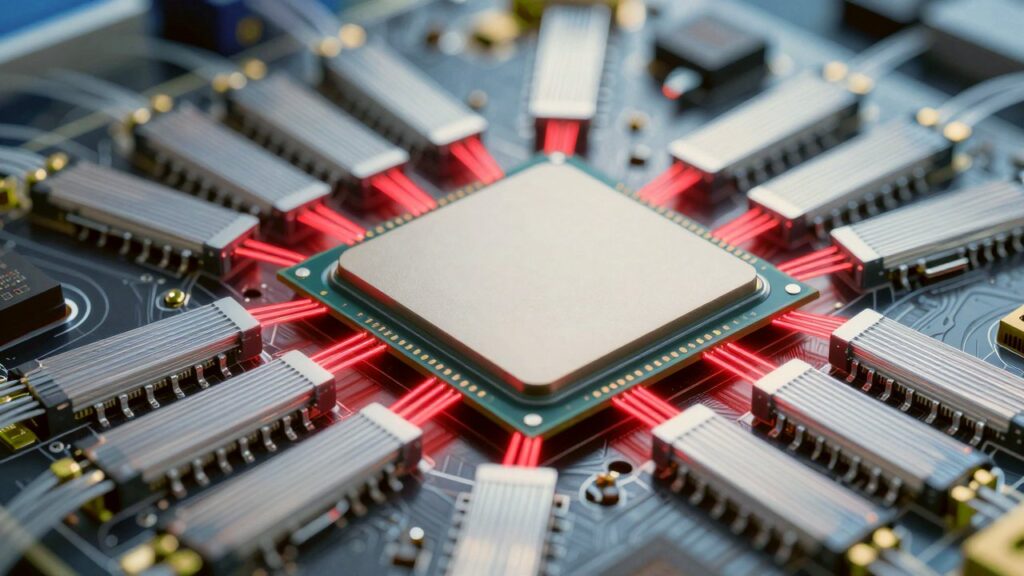
- IOWN 2.0 (now): light between the boards inside computers. NTT’s second-generation device, PEC-2, goes into a switch with 16 optical engines that moves 102.4 terabits per second, enough for big AI clusters. Placing the optics next to the switch chip cuts the electrical wiring from about 300 mm to about 30 mm.
- IOWN 3.0 (samples from 2028): light linking CPUs and GPUs directly at the package level.
- IOWN 4.0 (around 2032): light inside the chip package itself, with a target of cutting power a hundredfold.
Independent reporting in IEEE Spectrum confirms the same roadmap: board-to-board links first, chip-to-chip from 2028 and on-chip from 2032. In one demonstration NTT linked stages in Osaka and Taipei, about 1,700 km apart, with only 17 milliseconds of delay.
From lab to shop
In February, NTT said it plans to begin commercial deployment of switches using these light-based devices during its fiscal year 2026, which ends in March 2027, with Broadcom and Accton as supply-chain partners. Its chip unit, NTT Innovative Devices, is automating assembly and inspection so it can make up to 30,000 units a month. NTT did not disclose expected revenue, citing ongoing price negotiations. As far as we could find, NTT has not yet announced first shipments.
It is not alone. At the OCP Global Summit in San Jose this week, Lightmatter showed co-packaged optics (light engines built right beside the chip) in standard data-centre racks. The idea of moving data with light is quickly becoming the industry’s direction, not just NTT’s.
A healthy dose of realism
Not everything can become light. Electronics are still needed to control, modulate and process signals, so fully “all-optical” computers may not be feasible yet, Keio University researcher Takasumi Tanabe told IEEE Spectrum, although he considers IOWN’s core ideas realistic. NTT’s own targets, like the hundredfold power cut by 2032, are goals rather than results.
What happens next
Watch for NTT’s first commercial switch shipments before March 2027, the first data centres that adopt them, and package-level samples in 2028. If the plan works, the internet’s backbone and the AI behind your favourite apps will quietly run on light, using a lot less power to do it.
Read next
- Rapidus 2nm: Japan’s bid to build the world’s tiniest chips
- Boiling coolant inside chips: a safer way to tame AI heat
- Washable circuit fibres: threads that glow, compute and sense
Sources
- Innovation in Computing Powered by Photonic Technology (keynote, NTT R&D Forum 2025) – NTT, November 2025
- Financial Results for the Third Quarter of FY2025 (CEO press conference) – NTT, 5 February 2026
- Silicon Photonics Data Center Slashes Latency – Tim Hornyak, IEEE Spectrum, 16 December 2025
- Photonics-Electronics Convergence (PEC) – NTT
- Lightmatter and Flex bring 204.8 Tbps co-packaged optics into open racks – Futurum Group, October 2026