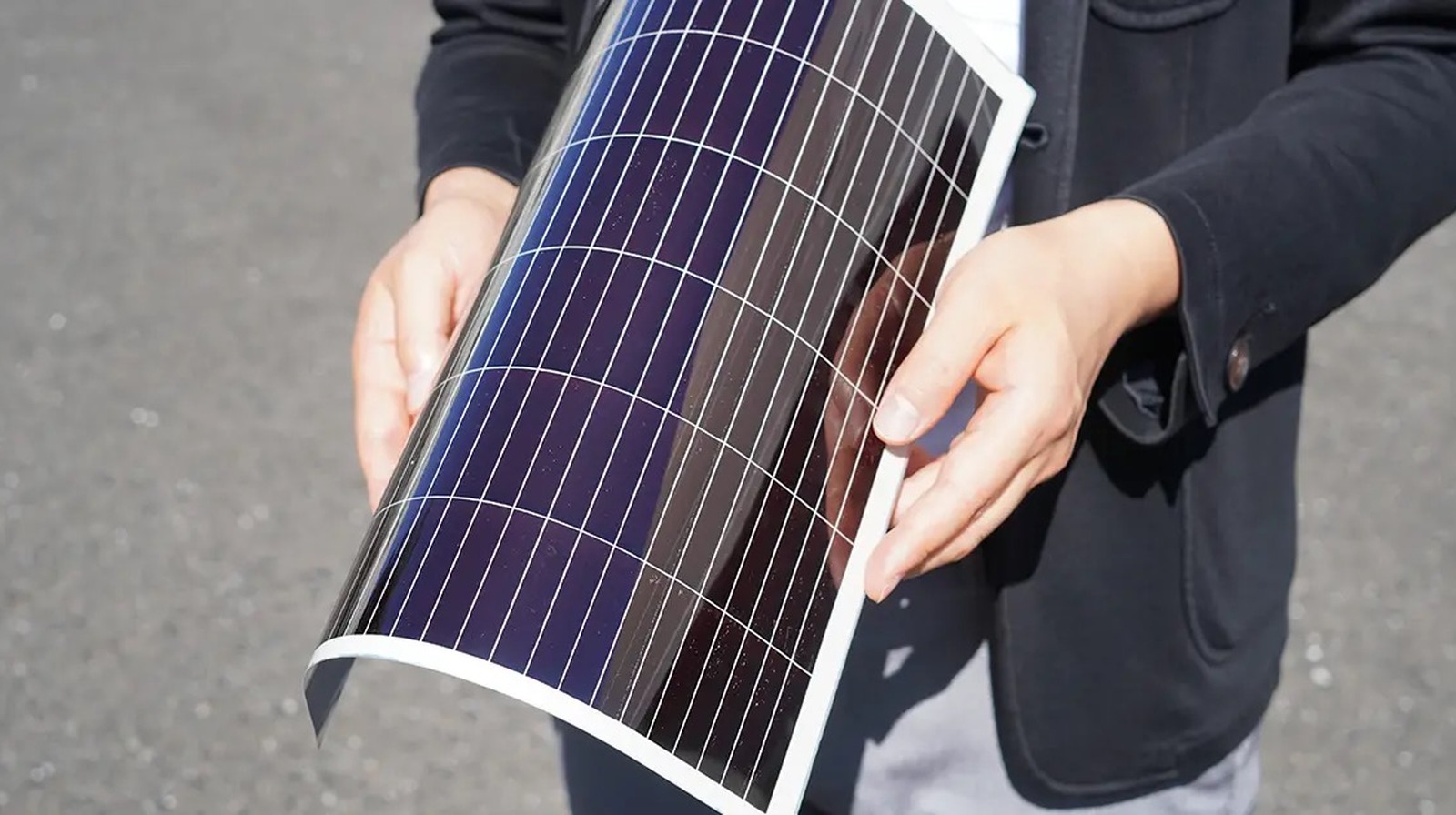
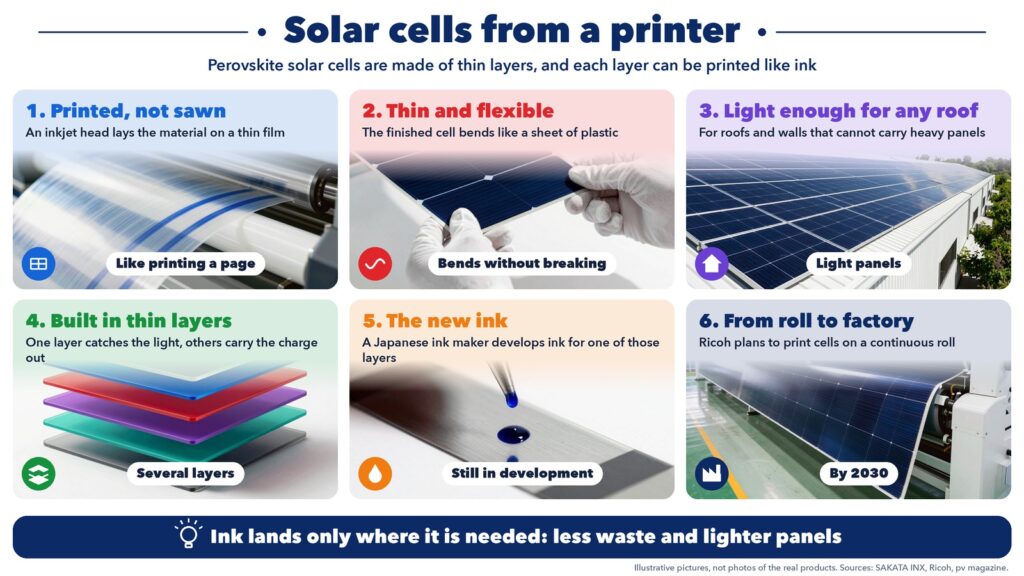
Japan is betting on solar cells that come out of a printer. In the space of two weeks, a Japanese ink maker said it is developing a printable ink for one layer of these cells, and Ricoh said it will mass-produce cells with every layer printed by inkjet. If the idea works at factory scale, solar power could reach roofs and walls that are too weak to carry today’s heavy panels.
What happened
On 19 October 2026, SAKATA INX CORPORATION and Sofab Inks, Inc. announced that they are working together on a special ink. SAKATA INX is a Japanese printing-ink maker founded in 1896. Sofab is a perovskite materials developer based in Kentucky, in the United States.
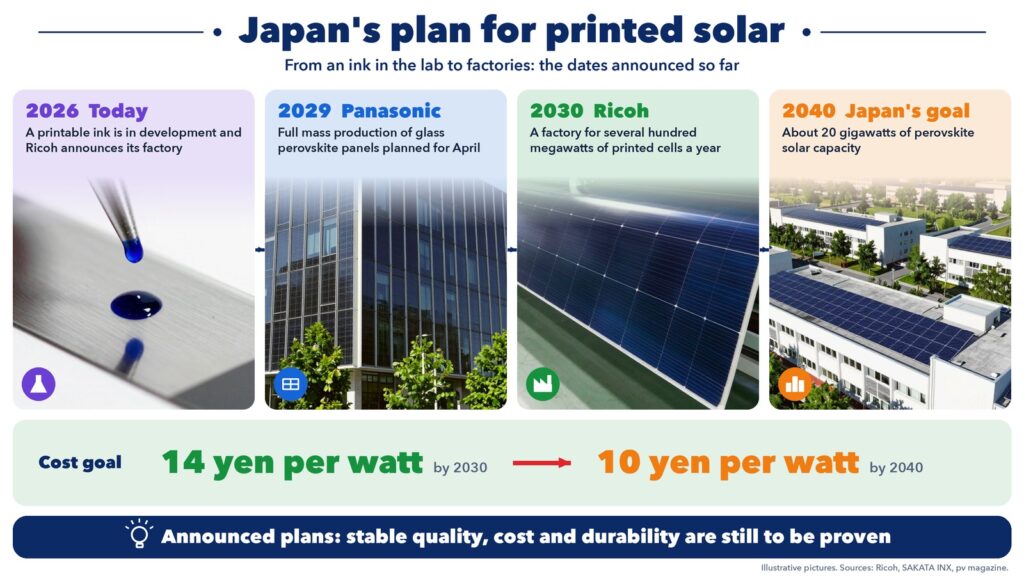
On 27 October, Ricoh announced a production site for inkjet-printed perovskite solar cells at Ricoh Industry’s Tohoku Site in Shibata, Miyagi Prefecture. The target is an annual capacity of several hundred megawatts (MW) by 2030, with later growth to gigawatt (GW) scale. One gigawatt is a thousand megawatts.
What is a perovskite solar cell?
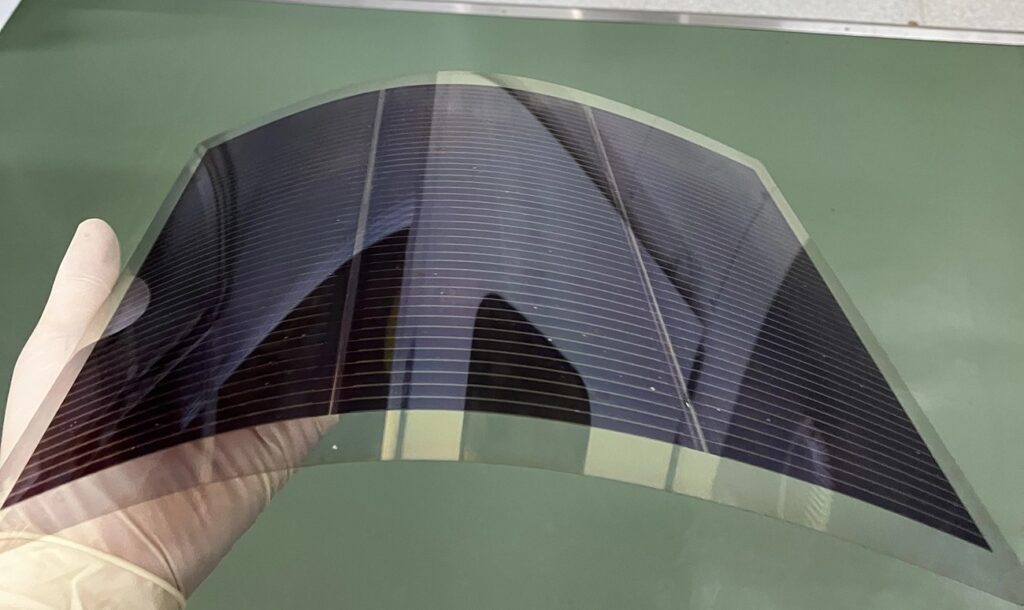
Most solar panels today use stiff silicon wafers behind glass. A perovskite cell uses a different family of materials, named after a particular crystal structure, that can be laid down as very thin films. That makes the cells thin, light and even flexible.
A solar cell is a stack of layers. One soaks up sunlight. Others carry the electric charges out. The electron transport layer (ETL) is one of those helper layers: it guides electrons, the tiny negative charges that make up electric current, out of the light-absorbing layer.
How the new ink works
The SAKATA INX and Sofab ink is meant for that electron transport layer. It combines Sofab’s tin oxide (SnO2) ETL materials with SAKATA INX’s know-how in nano-dispersion (spreading extremely small particles evenly through a liquid), ink recipes and thin films, built up in its industrial inkjet business.
The companies say the ink is “designed with consideration for reducing damage to the perovskite layer”. Their aims are more precise printing, less wasted material, better durability and more efficient production. It could be used in single-junction cells, which have one light-absorbing layer, and in tandem cells, which stack two kinds of absorber to catch more of the light.
The ink is still under development. No efficiency or other performance numbers were published, and there is no date for sale. The companies planned to present it at the Sofab booth at the Perovskite Connect conference in Berlin on 21-22 October 2026, as Perovskite-Info reported.
Ricoh wants to print every layer
Ricoh’s plan goes further. It aims to pattern-print all the functional layers of the cell, placing the right amount of material only where it is needed. To do this it uses the printheads, ink-supply and printing-system technology it has long developed for its printing businesses. It also draws on organic photoconductor technology, the light-sensitive material inside its multifunction printers. According to pv magazine, Ricoh also plans continuous roll-to-roll processing, where a long flexible sheet runs through the machines like paper through a press.
The project is supported by the Japanese industry ministry (METI) through its GX Supply Chain Development Support Program. In September 2025 it was also selected for NEDO’s Green Innovation Fund, in a group with Daiwa House Industry and NTT Anode Energy. They are looking at the roofs of logistics buildings and the outer walls of data centres.
Ricoh’s cells have already been to space. They flew on the Denden-01 satellite, launched in 2024 for a six-month evaluation, and on JAXA’s HTV-X1 cargo spacecraft for a two-month test announced in November 2025. Ricoh has worked with JAXA, Japan’s space agency, on these cells since 2017.
Investment, efficiency and durability figures were not disclosed.
How much sunlight becomes electricity?
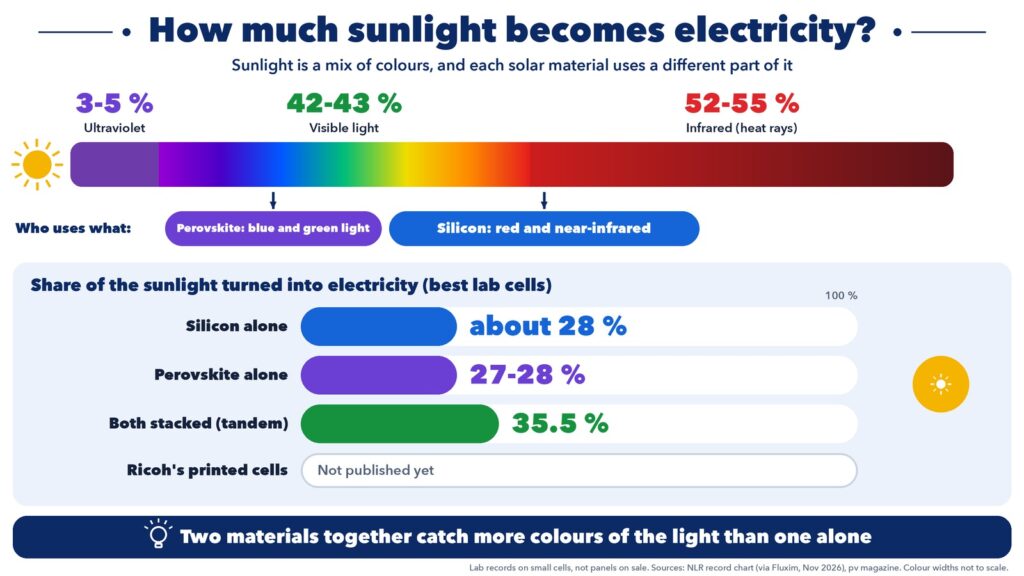
Sunlight is a mix of colours. At ground level, about 42 to 43 percent of its energy is visible light, 52 to 55 percent is infrared (the rays we feel as heat) and 3 to 5 percent is ultraviolet. No solar cell can use all of it, and each material is good at a different part. Perovskite works best with the blue and green part of the light. Silicon works best with red and near-infrared light.
That is why the two are often stacked in one cell, called a tandem. The best silicon cells in the laboratory turn about 28 percent of the sunlight into electricity, and the best perovskite cells reach 27 to 28 percent, according to a summary of the official record chart updated in November 2026. Stacked together they catch more: the record is 35.5 percent, announced by the Chinese maker Longi in July 2026 and reported by pv magazine.
These are records for small laboratory cells, not for panels on sale. Ricoh has not published the efficiency of its printed cells.

Why printing matters
Printing puts material only where it is needed, so less is wasted, and fewer steps can mean lower costs. Thin, light panels also fit roofs and walls that cannot carry heavy silicon panels.
Japan wants this to happen at scale. According to pv magazine, METI targets about 20 GW of perovskite capacity by 2040, with cost goals of JPY 14 per watt by 2030 and JPY 10 per watt by 2040. Panasonic began commercial sales of glass-based perovskite panels shortly before Ricoh’s news, with full mass production planned for April 2029. METI is also reportedly preparing about JPY 100 billion (about US$633 million) in subsidies for perovskite mass production, with Ricoh and Choshu Industry among the recipients, Perovskite-Info reported. This has not been officially confirmed.
What is still unsolved, and what comes next
None of this means printed panels are on sale for your home tomorrow. Ricoh itself names the open problems: stable quality in mass production, lower production costs, and better power output and durability. The SAKATA INX ink has no published results yet, and Ricoh’s factory is a plan for 2030. The next milestones to watch are performance data for the ink and the first cells from the Tohoku Site.
Read next
- White aerogel keeps roofs cool in full sun without electricity
- Spanish team builds a rechargeable battery with vitamin B12
- Rubber blades that bend could make tidal power cheaper
The week's best tech stories, free
One email a week with the stories that matter, explained simply. No spam.
Sources
- SAKATA INX: SAKATA INX and Sofab Collaborate to Develop Inkjet-Printable ETL Ink for Perovskite Solar Cells
- Perovskite-Info: report on the Sofab Inks and SAKATA INX ETL ink
- Ricoh: Ricoh to establish manufacturing capabilities to advance mass production of inkjet-printed perovskite solar cells
- pv magazine: Ricoh announces GW-scale perovskite solar cell production in Japan
- Perovskite-Info: Japan plans 100 billion yen in subsidies for perovskite solar cell mass production
- Fluxim: Highest perovskite solar cell efficiencies (updated 12 Nov 2026)
- pv magazine: Longi sets new world record with 35.5%-efficient perovskite-silicon tandem cell (15 Jul 2026)
- Wikipedia: Sunlight (share of ultraviolet, visible and infrared at ground level)