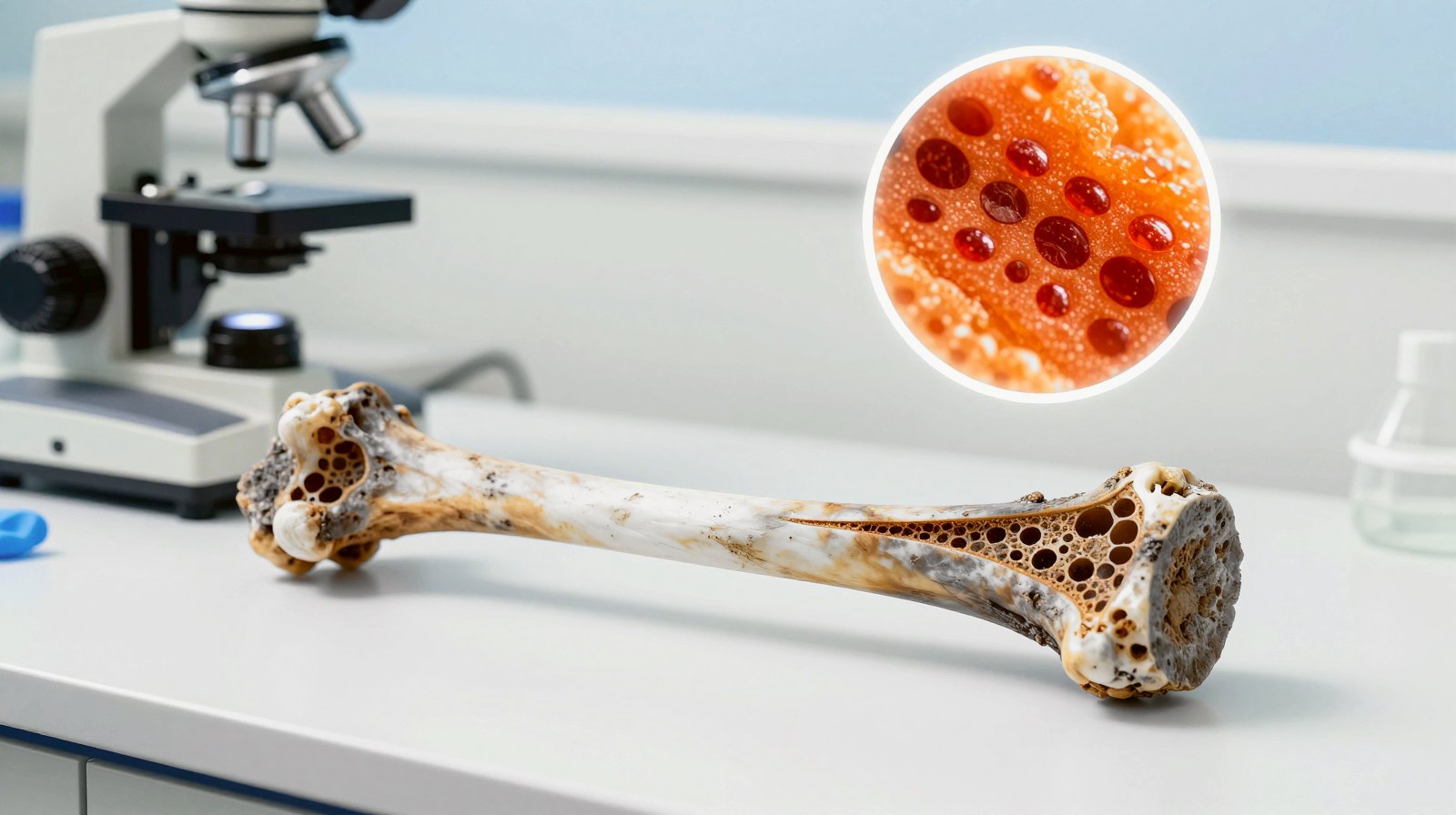
Inside the leg bone of a small meat-eating dinosaur that lived 115 million years ago, scientists have found traces of its blood: tiny mineralised red blood cells, still holding chemical pieces of the molecule that once carried oxygen. The team, led by Kliti Grice of Curtin University in Australia, says it is the first time this kind of blood chemistry has been confirmed inside dinosaur blood cells, the university announced on 3 November.
Why it matters: fossils usually keep only shapes, stone copies of bones and shells. Real molecules from an animal’s body are a different kind of evidence. They can hint at how an extinct animal lived, from its metabolism to how active it was, and they help scientists know where to look for traces of ancient life.
The dinosaur
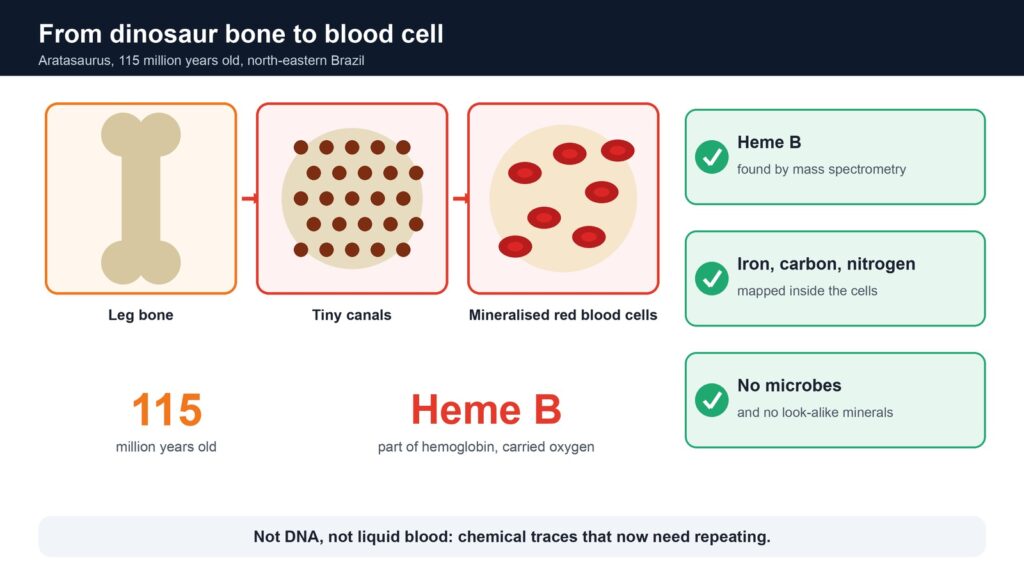
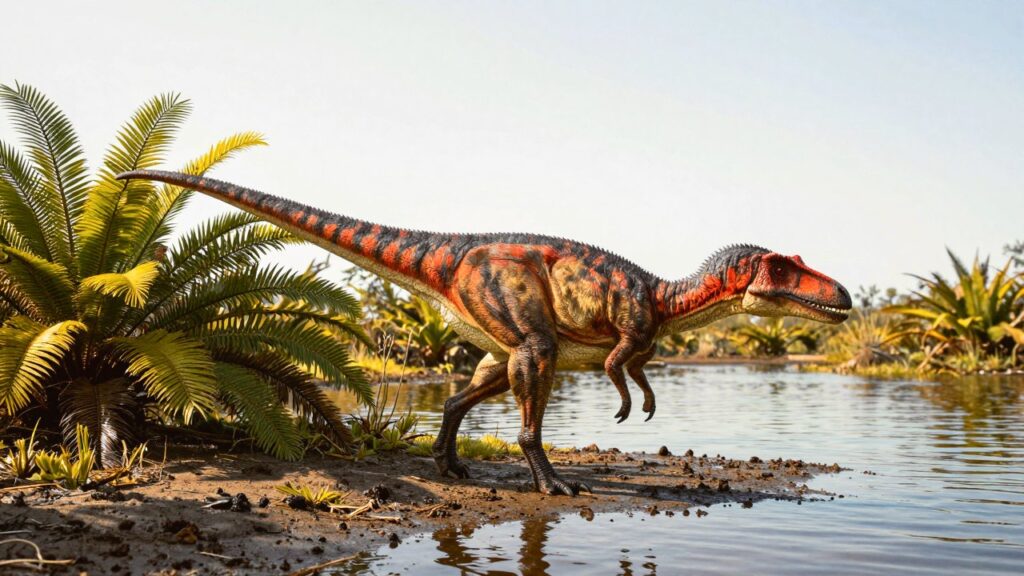
The bone belongs to Aratasaurus museunacionali, a small theropod, the same family of two-legged meat eaters as the much later T. rex. Its right leg bone was dug out of a mine in north-eastern Brazil in 2008, ScienceAlert reports. Inside the bone’s tiny canals, where blood vessels once ran, the team saw many small oval structures the size and shape of red blood cells.
How they checked it was blood
Looking like blood cells isn’t enough, so the team tested the chemistry:
- The molecule: using liquid chromatography and mass spectrometry, machines that sort molecules and weigh them very precisely, they found the bone extract was dominated by heme B, the part of hemoglobin that holds iron and carries oxygen in blood. The surrounding rock did not show the same signal.
- The elements: chemical maps showed the cell-like shapes were rich in iron, carbon and nitrogen, the ingredients of heme, while the rest of the bone was mostly calcium and phosphorus.
- The look-alikes: they found no threads, spores or slime that would point to microbes, and no grains or crystals that could mimic cells.
They also detected building blocks of collagen, the protein in bone. The work is published in the journal PNAS.
How could anything survive 115 million years?
The team thinks the dinosaur was buried quickly in shallow water with little oxygen and lots of microbes, and that a manganese mineral, hausmannite, coated the cells and helped keep them stable. “To detect intact heme derived molecules in 115-million-year-old red blood cells is astonishing,” says Grice. “These findings challenge longstanding assumptions that certain biomolecules such as haemoglobin cannot survive deep time.”
What it doesn’t mean
- No dinosaur DNA, and no cloning. The finding is about heme and protein fragments, not genes.
- Not liquid blood. The cells are mineralised, turned largely to stone, and the study did not find the hemoglobin protein itself, only molecules derived from it.
- It needs repeating. Earlier claims of dinosaur proteins and cells have been hard to confirm, and Grice herself says replication is the next priority.
What happens next
If other labs confirm it, the same chemical toolkit could be used on other fossils to compare blood across extinct animals. Martin Van Kranendonk, head of Curtin’s School of Earth and Planetary Sciences, adds that knowing how such molecules survive could help in the search for signs of ancient life, even beyond Earth.
Read next
- Bennu samples reveal a hybrid asteroid born near the ice line
- Molecular motor: an Archimedes’ screw made of one molecule
- Is there really such a thing as empty space?
The week's best tech stories, free
One email a week with the stories that matter, explained simply. No spam.
Sources
- Dinosaur blood: oldest discovery rewrites what fossils can reveal about the past, Curtin University, 3 November 2026
- Scientists just found dinosaur blood that survived 115 million years, ScienceDaily, 6 November 2026 (PNAS paper, DOI 10.1073/pnas.2614248123)
- Dinosaur blood cells detected in 115-million-year-old fossil, ScienceAlert, November 2026
- Blood chemistry found preserved in 115-million-year-old dinosaur bones, Interesting Engineering, November 2026