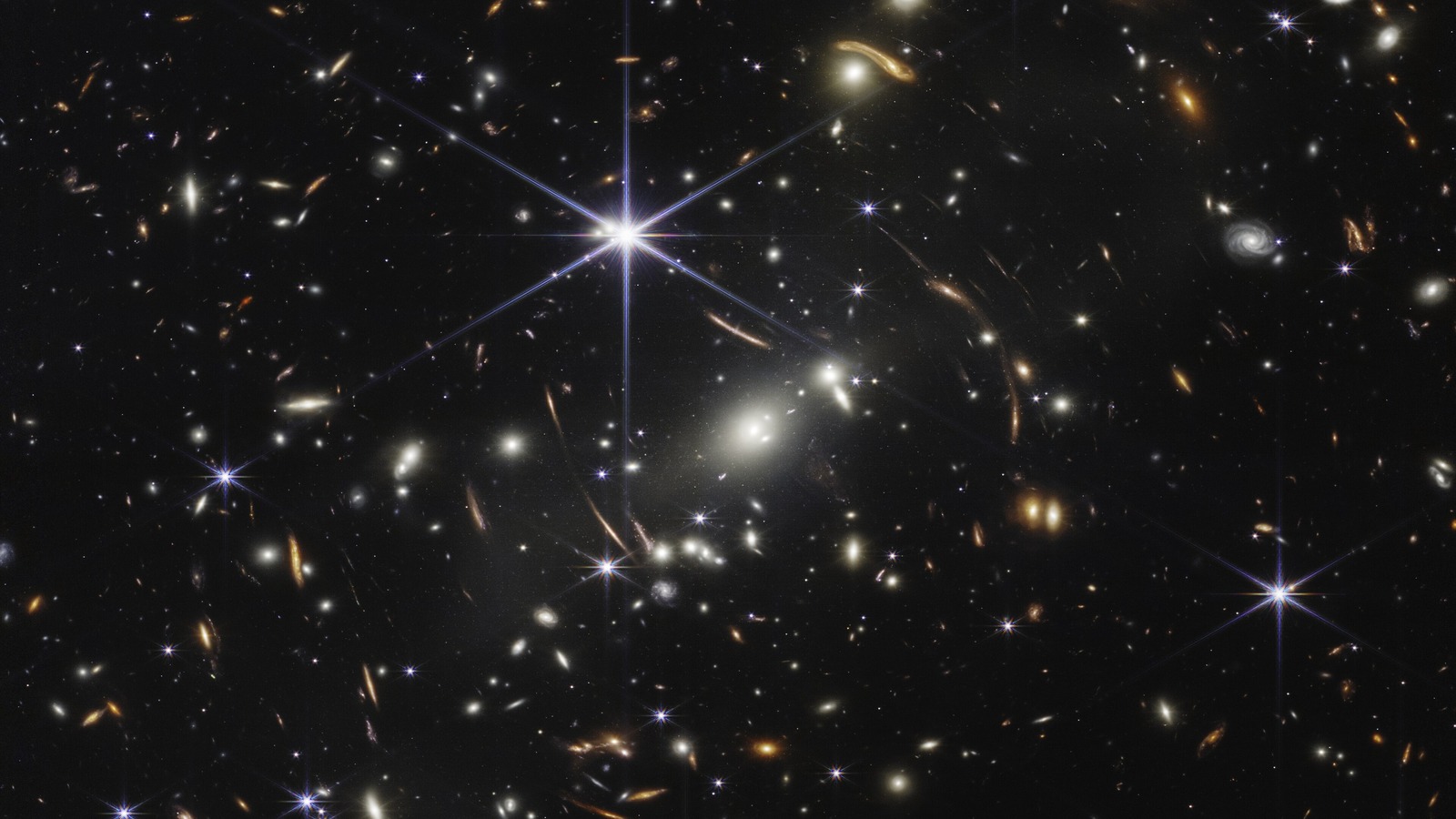
Look up at the night sky: between the stars, there seems to be nothing at all. But does truly empty space exist, with absolutely nothing inside? The short answer is no. Not even the loneliest corner of the universe is completely empty, and finding out why takes us from the air you breathe to one of the biggest mysteries in physics.
Why it matters: a “vacuum” isn’t just a gap. It holds particles, ancient light, invisible fields and even an energy of its own that may be pushing the whole universe apart.
First, how much “nothing” is there?
Let’s count particles in a cube one centimetre wide, about the size of a small dice.
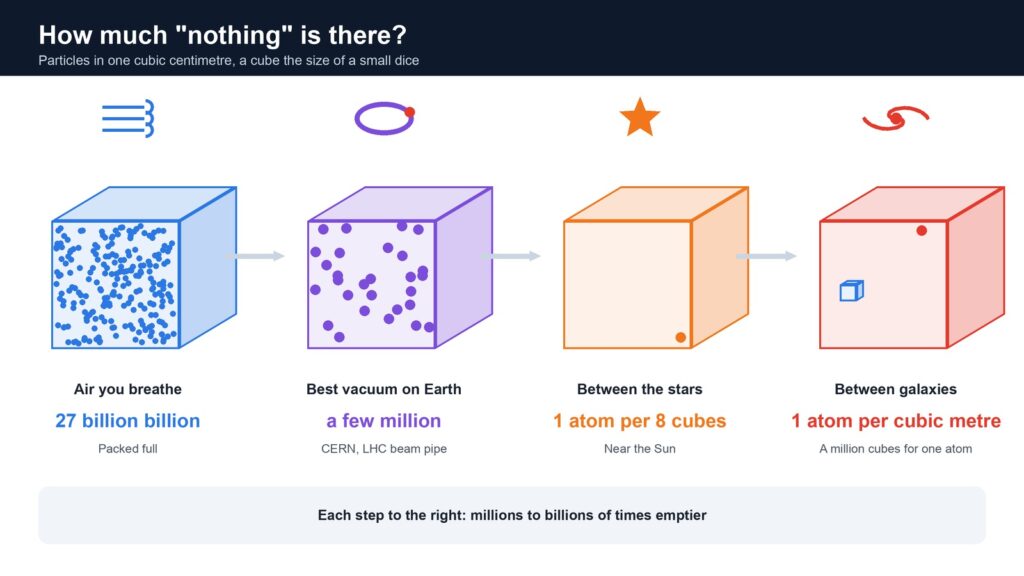
- The air you breathe: about 27 billion billion molecules, a 27 followed by 18 zeros, according to NIST’s Loschmidt constant.
- CERN’s best vacuum: the beam pipes of the LHC particle accelerator are at a pressure ten million million times lower than air at sea level. By our calculation, a few million particles per cubic centimetre still remain.
- Between the stars, near the Sun: NASA measured about 0.13 particles per cubic centimetre, roughly one atom for every eight dice.
- Between galaxies: about one atom per cubic metre, less than a billionth of a billionth of the density of air, says the Center for Astrophysics, Harvard & Smithsonian.
So yes: the space between galaxies is far emptier than anything we can make. But very empty isn’t the same as completely empty.
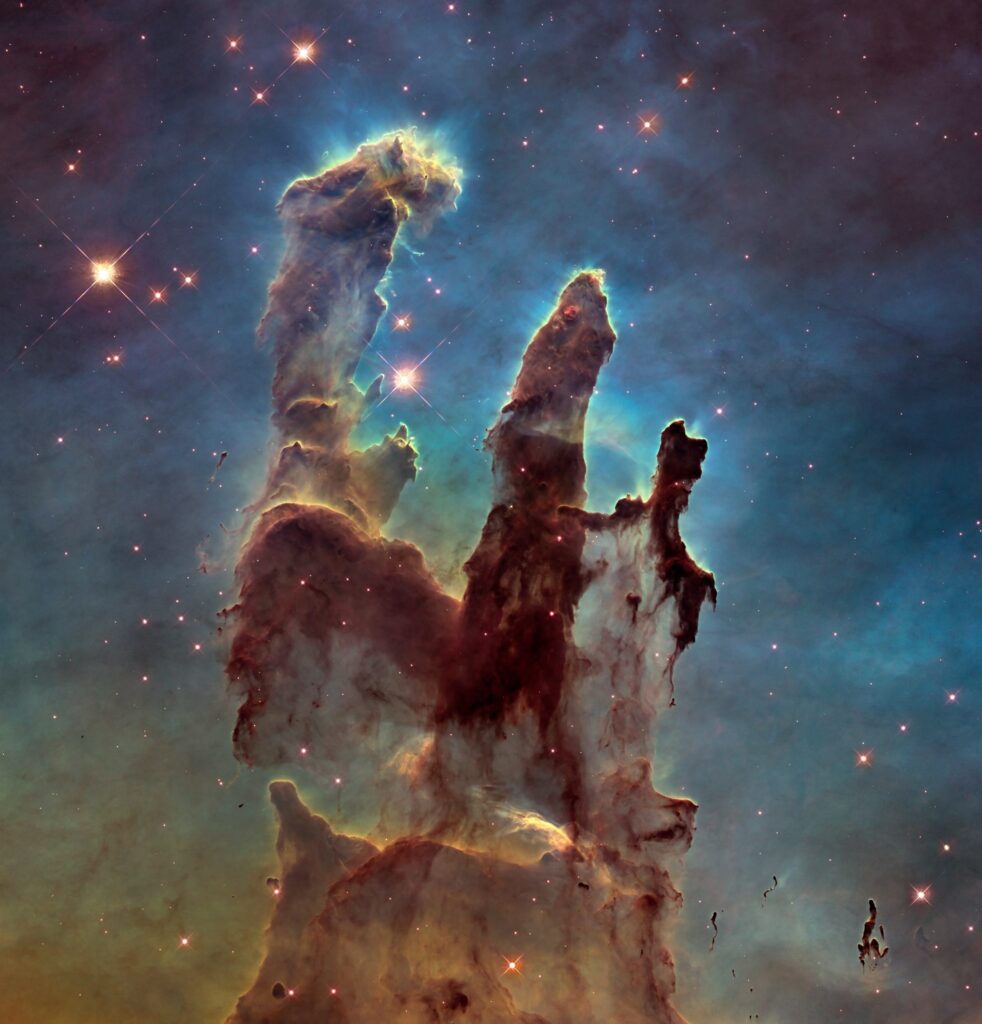
What’s left when you take the atoms away
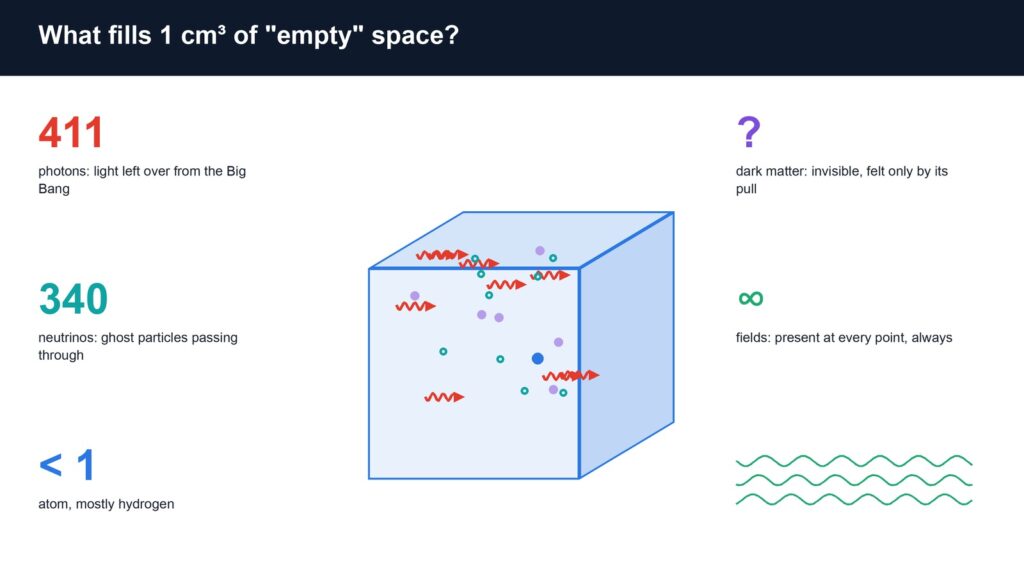
Even with not a single atom, that cubic centimetre would still be full of things:
- Light from the Big Bang: about 411 photons of the cosmic microwave background, the afterglow of the young universe.
- Neutrinos: about 340 ghostly particles, also from the Big Bang, that pass through almost everything without hitting it.
- Dark matter: something invisible we only notice by its pull. NASA puts it at 27% of the universe, and we still don’t know what it is.
- Fields: the electromagnetic field and others fill every point of space, even where there are no particles.
The quantum vacuum: a sea that’s never still
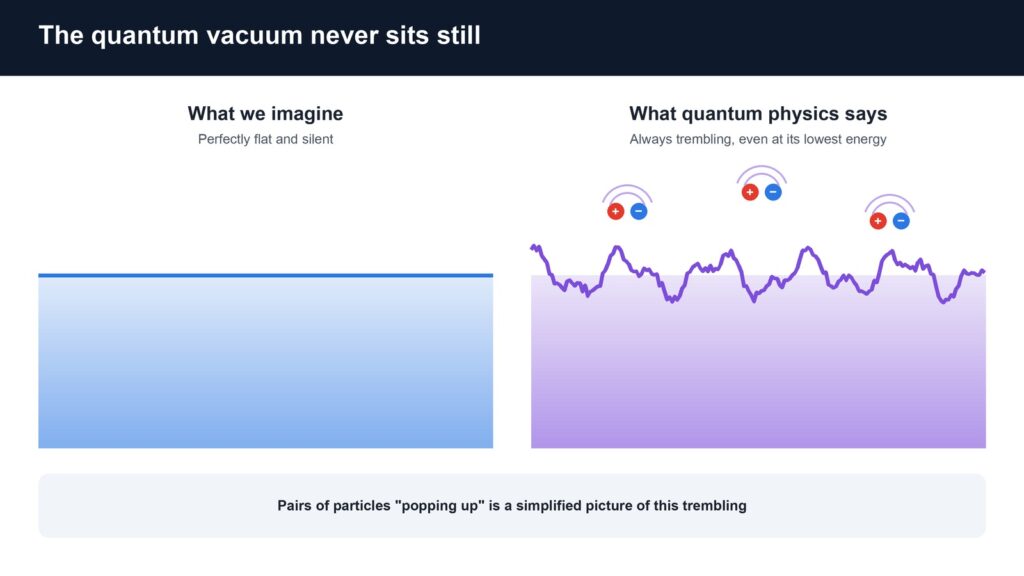
Here comes the most surprising part. According to quantum physics, a field can never be perfectly still, not even at its lowest possible energy. It always trembles a little. Physicists call this the quantum vacuum.
It’s often explained as pairs of particles popping in and out of existence. That’s a useful picture, but a simplified one, and physicists debate how literally to take it. What can be measured are its effects.
Proof: the vacuum can push
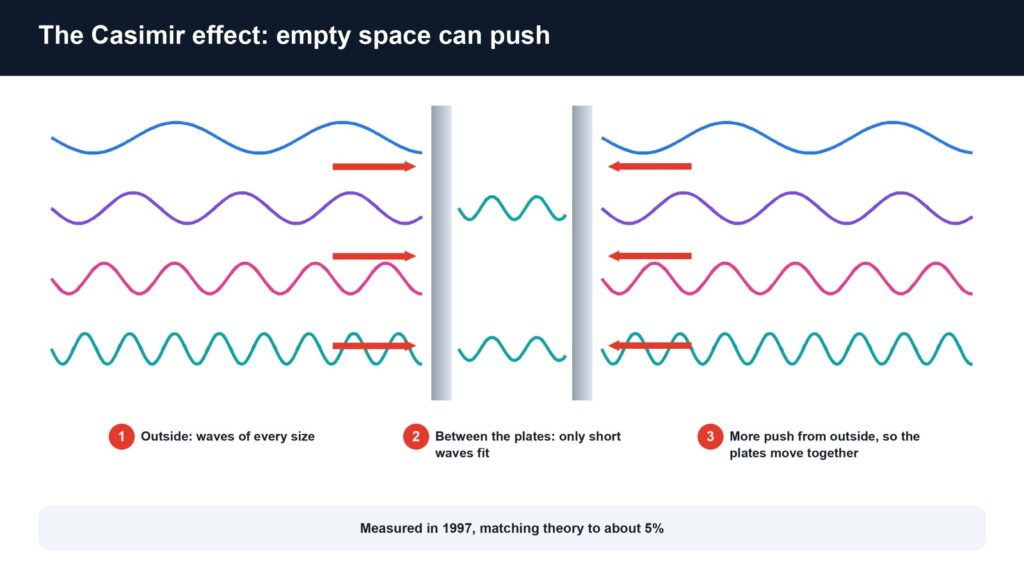
Put two metal plates very, very close together in a vacuum and a tiny force pulls them together. It’s called the Casimir effect. Only certain waves “fit” between the plates, so there’s less trembling inside than outside, and that pushes them together.
Physicist Steve Lamoreaux measured it precisely in 1997, and the result matched theory to about 5%. Some physicists argue it can also be explained without talking about the vacuum, so the debate is still open.
The big mystery: the energy of empty space
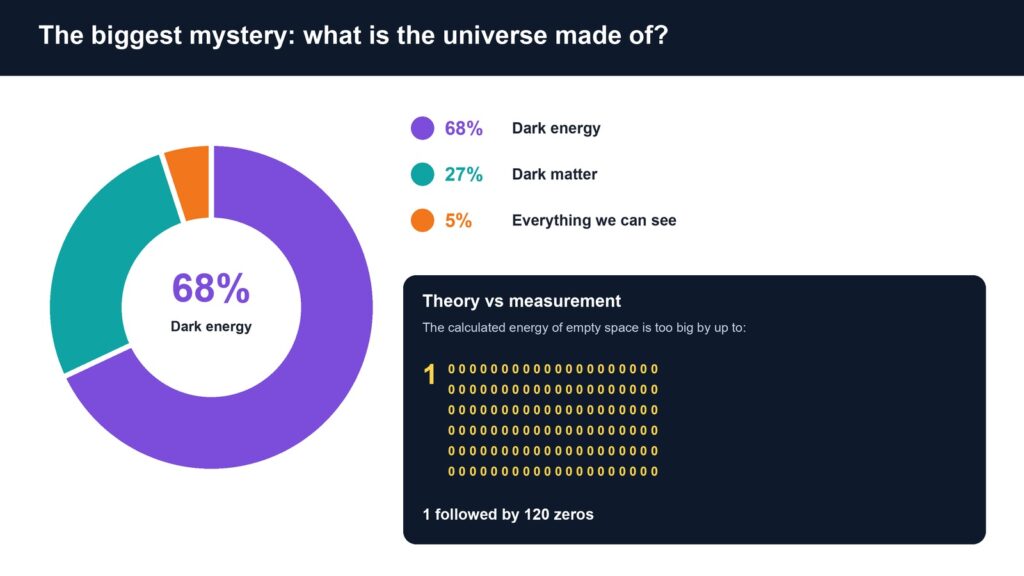
The universe isn’t just expanding: it’s speeding up. What drives that is called dark energy, and NASA estimates it makes up 68% of everything there is. One possible explanation is that it’s the energy of the vacuum itself.
The trouble is that when physicists calculate that energy with quantum theory, they get an absurd number: up to 120 zeros too big compared with what’s measured. That’s why it’s called one of the most embarrassing problems in physics, and nobody has solved it yet.
So, does empty space exist?
An almost perfect vacuum, with hardly any atoms, does exist, and it’s enormous: it fills most of the universe. But a perfect vacuum, with nothing at all, doesn’t seem to exist. There’s always ancient light, ghostly particles, trembling fields and an energy we don’t yet understand. In physics, “nothing” turns out to be full of something.
Read next
- How the universe lit up after the Big Bang: the Lumina simulation
- NASA’s Swift telescope falls to Earth after 22 years
The week's best tech stories, free
One email a week with the stories that matter, explained simply. No spam.
Sources
- Intergalactic medium – Center for Astrophysics, Harvard & Smithsonian, consulted 7 November 2026
- New evidence our neighborhood in space is stuffed with hydrogen – NASA Goddard, 2020
- A vacuum as empty as interstellar space – CERN, consulted 7 November 2026
- Loschmidt constant – NIST, consulted 7 November 2026
- Lecture Notes in Cosmology – arXiv, 2018
- The Cosmic Neutrino Background – arXiv, 2024
- The Casimir Effect and the Quantum Vacuum – R. L. Jaffe, arXiv, 2005
- What is Dark Energy? – NASA Science, consulted 7 November 2026
- Dark Matter – NASA Science, consulted 7 November 2026
- The Cosmological Constant Is Physics’ Most Embarrassing Problem – Scientific American