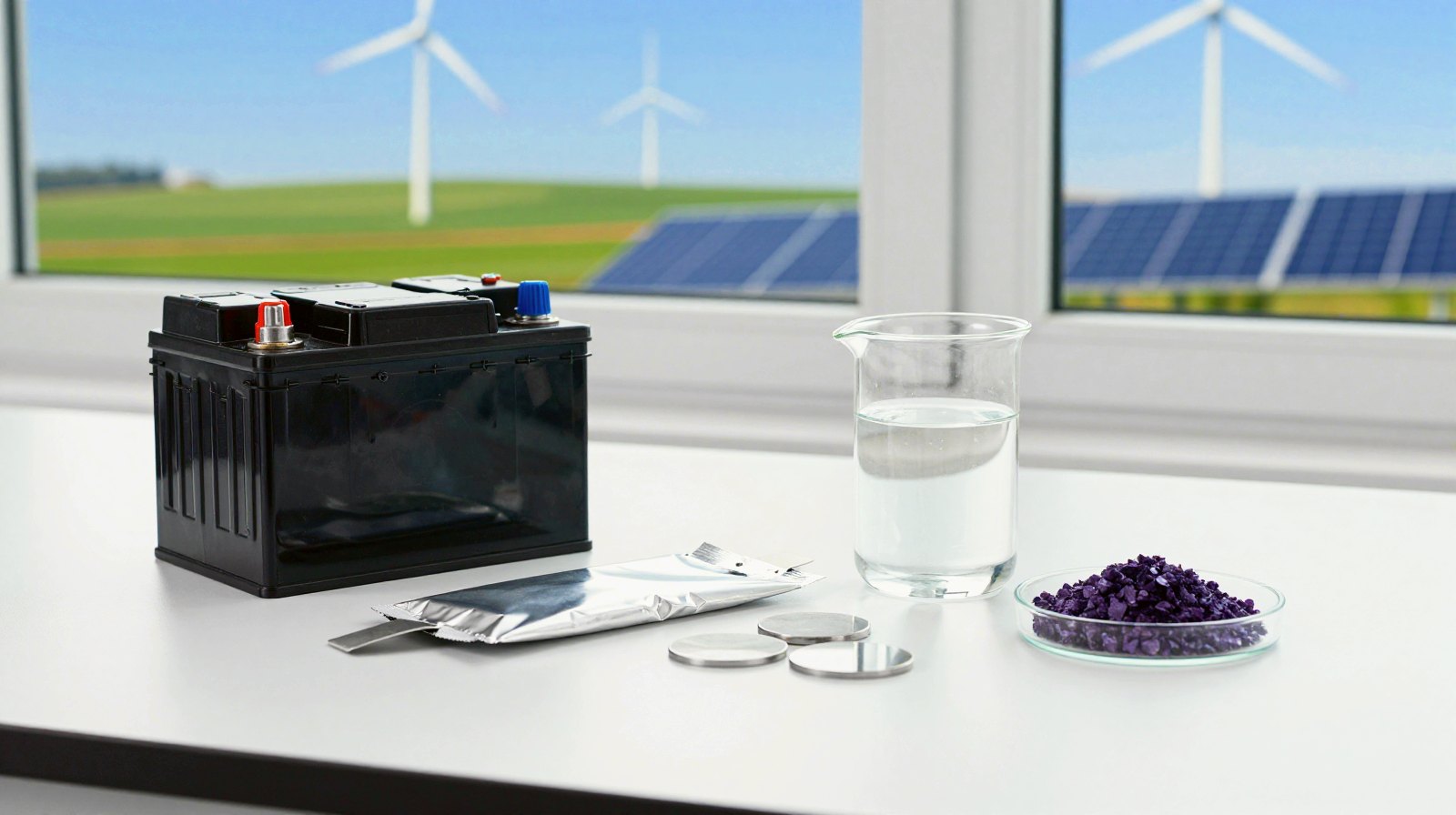
Batteries that use water instead of flammable liquids are safer and greener, but they hold too little energy to be really useful. A team at University College London (UCL) has found a way to make the iodine inside such batteries work twice as hard, so the battery can store more. It is a lab result for now, but it could matter for storing wind and solar power.
What was done
The study was published in the journal Nature and announced by UCL on 13 November 2026. It was led by Professor Guanjie He of UCL Chemistry, the corresponding author. Dr Ruwei Chen, also of UCL Chemistry, is the first author.
The team designed a new electrolyte that lets iodine pass four electrons each time the battery charges and discharges, instead of two. In tests, batteries built with it lasted for thousands of cycles.
First, some basics
A battery has two sides, called electrodes, and a liquid or paste between them called the electrolyte. When the battery charges and discharges, electric charge moves from one side to the other through the electrolyte, and electrons flow through the wires outside to power your device.
In most lithium-ion batteries, like the ones in phones and electric cars, the electrolyte is a flammable liquid. That is why a damaged lithium-ion battery can catch fire. An aqueous battery uses an electrolyte based on water instead. Water does not burn, so these batteries are safer, and they are also seen as more sustainable.
The catch is energy density: how much energy a battery can store for its size or weight. In water-based batteries it is relatively low, and that has limited their practical use.
Why four electrons beat two
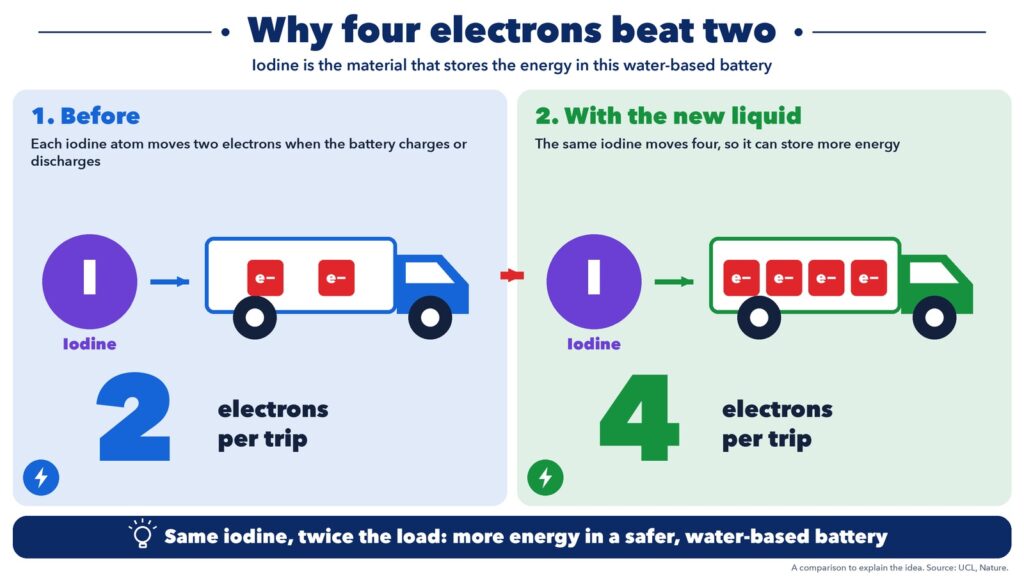
In this kind of battery, iodine is the main material that stores energy. Electrons are the tiny charged particles that carry electricity. Each time an iodine atom gives up or takes back electrons, it stores or releases a bit of energy.
Normally, iodine in these batteries passes two electrons. The UCL team got it to pass four. Think of a delivery van that used to carry two boxes per trip and now carries four: the same van does more work. In the same way, the same iodine can store more energy.
Why it was hard
To pass four electrons, iodine has to go through a more highly charged form, written I+. That form reacts strongly with water, which is a big problem in a battery full of water.
Earlier research held I+ back with highly concentrated electrolytes containing halogens, a family of chemical elements that includes chlorine and bromine. Those mixtures worked, but they were corrosive, costly and hard to manufacture.
The new electrolyte avoids those corrosive materials. It uses a mix of molecules with two jobs. Some keep water away from the iodine. Others bind to the reactive forms of iodine, keeping them in check.
How well it worked
The team tested zinc-iodine batteries, which pair zinc with iodine. They ran for thousands of charge-discharge cycles and kept almost all of their original capacity. The release does not give an exact number of cycles or a percentage.
The chemistry worked in pouch cells, the flat format used in laptops and phones, and in coin cells, the small round batteries used in low-power devices. The researchers say the same approach may also work for aluminium-iodine batteries.
Some important numbers were not reported in the release: the battery’s voltage, its energy density, the temperatures it can work at and its cost.
What it means for you
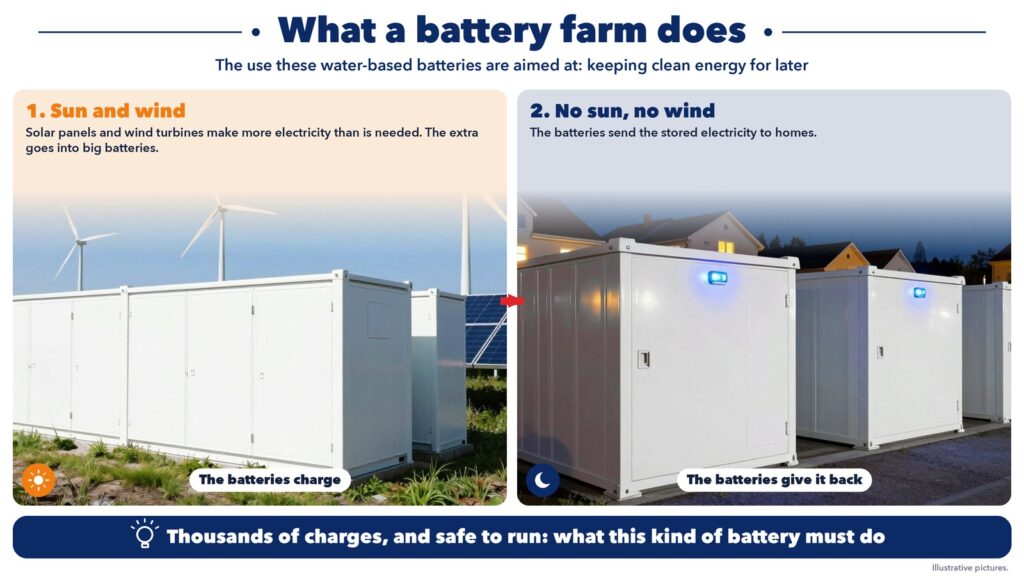
The main target is not your phone. It is large-scale grid storage, sometimes called “battery farms”. These are big banks of batteries that store surplus electricity from wind and solar farms, then release it when there is no wind or sun. Those batteries must soak up and release power again and again, so a long life is essential, as Interesting Engineering points out. A safe battery that lasts thousands of cycles would be a good fit, if it can also store enough energy.
“I am excited that our new chemistry can help aqueous batteries move one step closer to commercialisation and wide deployment,” said Professor He.
What comes next
This is still laboratory work. The battery has not been tested at a larger scale yet. Its performance under realistic operating conditions still needs to improve. And the team says more study is needed on how the electrolyte and the different forms of iodine interact as the battery charges and discharges. As Interesting Engineering notes, those larger tests will show whether the lab results carry over to a real installation.
The work was funded by a European Research Council (ERC) Starting Grant, underwritten by UK Research and Innovation (UKRI).
Read next
- Spanish team builds a rechargeable battery with vitamin B12
- Rubber blades that bend could make tidal power cheaper
- Old wind turbine blades turned into graphene in seconds
The week's best tech stories, free
One email a week with the stories that matter, explained simply. No spam.
Sources
- UCL: Breakthrough opens new possibilities for safer, water-based batteries (13 Nov 2026)
- EurekAlert!: the same UCL release
- Nature: the research paper (DOI 10.1038/s41586-026-11282-0)
- Interesting Engineering: independent report on the study