On Wednesday 28 October a Renfe AVE ran into the back of a stopped Iryo train near Urda, in Toledo, on the Madrid–Seville high-speed line. At least 69 people died, according to the official figure confirmed on 30 October, and the authorities have not ruled out that it may still rise (Infobae, La Comarca de Puertollano). Our thoughts are with everyone who lost someone, and with the injured.
The cause is under investigation, and it is not our place to guess it. But the technology at the heart of the story is public, and many readers are asking the same questions: what keeps a 300 km/h train from hitting another one, what failed that morning, and what Europe is building next. This article explains every layer, from a German cable system born in the 1960s to satellites that may one day tell trains exactly where they are.
What we know about that morning
According to the timeline reconstructed by Railway Gazette and Euronews:
- At about 08:30 a computer fault knocked out the line’s train protection system, called LZB, along roughly 63 km. Six trains stopped automatically.
- At 08:36 the control centre in Madrid allowed the AVE driver to continue under the backup block system “at normal running”, which allows far higher speeds than the 40 km/h of driving on sight.
- At 08:41 and 08:48 the Iryo driver reported that her train was stopped near Urda and could not restart LZB. The AVE, about 25 km behind, was not told to stop.
- The collision happened around 08:53.
Transport Minister Óscar Puente called the decision to let the train continue “inexplicable” (The Local, Euronews). The Guardia Civil is questioning control-centre staff and both trains’ data recorders are being analysed. Responsibility has not been established.
Why a fast train needs a computer in the cab
A train at 300 km/h needs roughly 3 to 4 kilometres to stop in an emergency (JR East, Chang’an University). That is far beyond what a driver can see. At those speeds a coloured light beside the track flashes past too fast to read reliably, which is why Germany invented in-cab signalling for its first 200 km/h trains (LZB history, Xataka).
So every high-speed line has an automatic train protection system: a computer on board that knows how far the train may go and how fast, shows it to the driver, and brakes by itself if the driver doesn’t. Spain uses four generations of these systems. Here they are, oldest first.
LZB: a 1960s cable still guiding 300 km/h trains
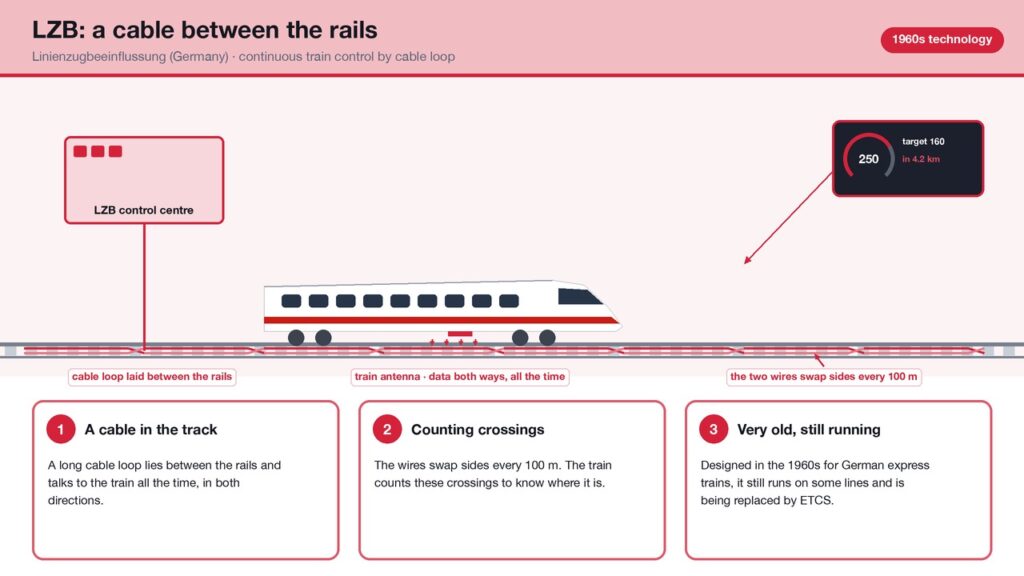
LZB (Linienzugbeeinflussung, “continuous train control”) was developed by Deutsche Bundesbahn and Siemens. A prototype ran in 1963, and in 1965 it allowed 200 km/h demonstration runs between Munich and Augsburg (Wikipedia, IRSE-NL). In other words, it is a very old technology: it was designed before the first microprocessor existed.
The idea is clever. A cable runs along the middle of the track, and its two wires swap sides every 100 metres. Coils under the train pick up the signal, count those crossings to know where the train is, and exchange speed and distance data with a central computer that covers 30 to 40 km of line (Xataka, Computerwoche).
Spain’s first high-speed line, Madrid–Seville, has used LZB since it opened in the 1990s, and it is now the only Spanish high-speed line that still does (Euronews, Al Jazeera). Railway Gazette reports that a 2019 Ineco study flagged reliability problems with the ageing equipment, and that the line recorded train-protection failures in June and July 2025 and July 2026. Just 23 days before the crash, Iryo’s chief executive told a parliamentary hearing that LZB restarts were the most common problem on the line.
ASFA: Spain’s safety net at the signals
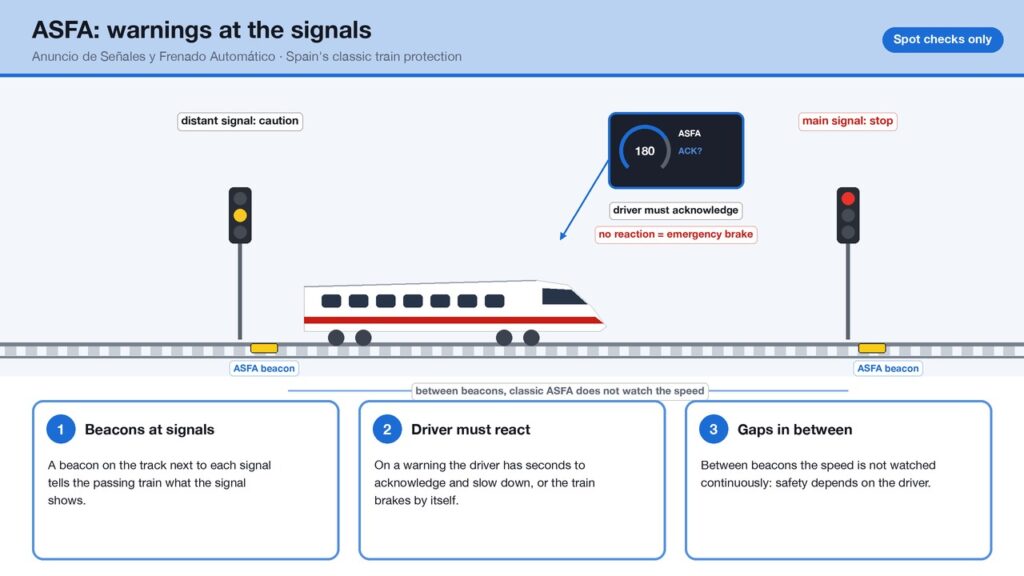
ASFA (Anuncio de Señales y Frenado Automático) is Spain’s classic national system, and on Madrid–Seville its digital version is the second layer behind LZB, good for up to 200 km/h (Al Jazeera, Railway Gazette). Beacons on the track next to each signal tell the passing train what the signal shows. If the signal warns, the driver must acknowledge it and slow down within seconds, or the train brakes by itself.
Its weakness is in the gaps. Classic ASFA checks the train at fixed points, not continuously. Spain learned that painfully in 2013 at Angrois, near Santiago de Compostela, when an Alvia took an 80 km/h curve at about 180 km/h and 80 people died. That stretch had only ASFA, with no automatic speed check at the curve (Railvolution, Elderecho.com). In 2024 a Santiago court sentenced both the driver and Adif’s former head of traffic safety to two and a half years; in January 2026 the provincial court of A Coruña upheld the driver’s sentence and acquitted the former Adif official, with one judge dissenting (Spanish judiciary, elDiario.es).
ETCS: Europe’s common language for trains
The European answer is ERTMS: the ETCS train control computer plus a dedicated railway radio, GSM-R today and FRMCS, based on 5G, tomorrow (European Commission, Le Dico Ferroviaire). The goal is that any train can run on any European line with the same safety system on board.
The first lines arrived in the mid-2000s. Italy opened Rome–Naples, the first high-speed line run with ETCS Level 2, in December 2005 (Railway Gazette, Wikipedia). Spain’s first ERTMS line was Madrid–Zaragoza–Lleida: it opened in October 2003 limited to 200 km/h under ASFA, with ETCS still only in testing, and ERTMS Level 1 entered service in May 2006, first allowing 250 km/h (Railway Gazette, Consumer).
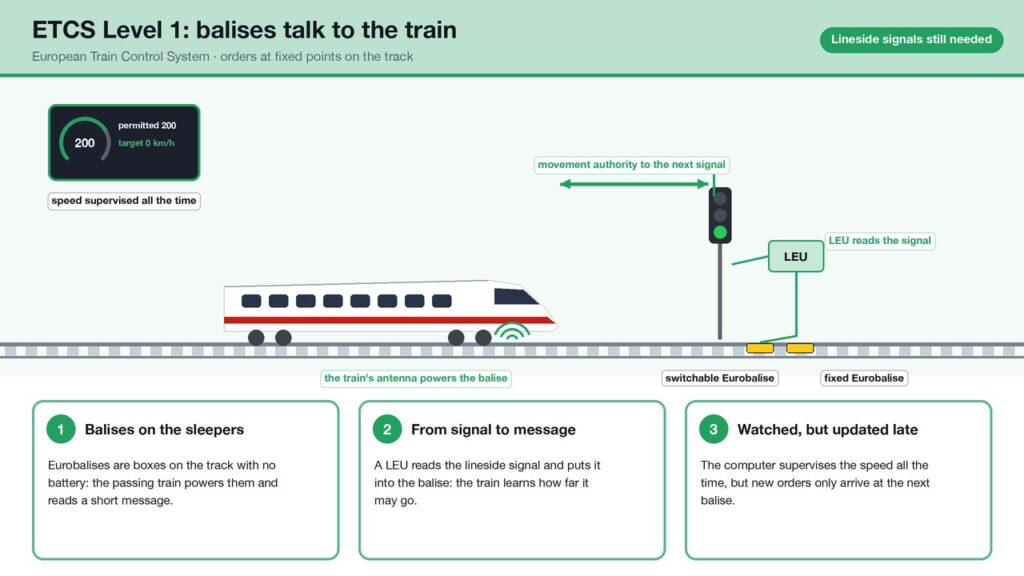
Level 1 uses Eurobalises: yellow boxes on the sleepers with no battery. The passing train powers them with its antenna and reads a short message, including how far it may go. The on-board computer then supervises the speed all the time, but new orders only arrive at the next balise, and lineside signals are still needed.
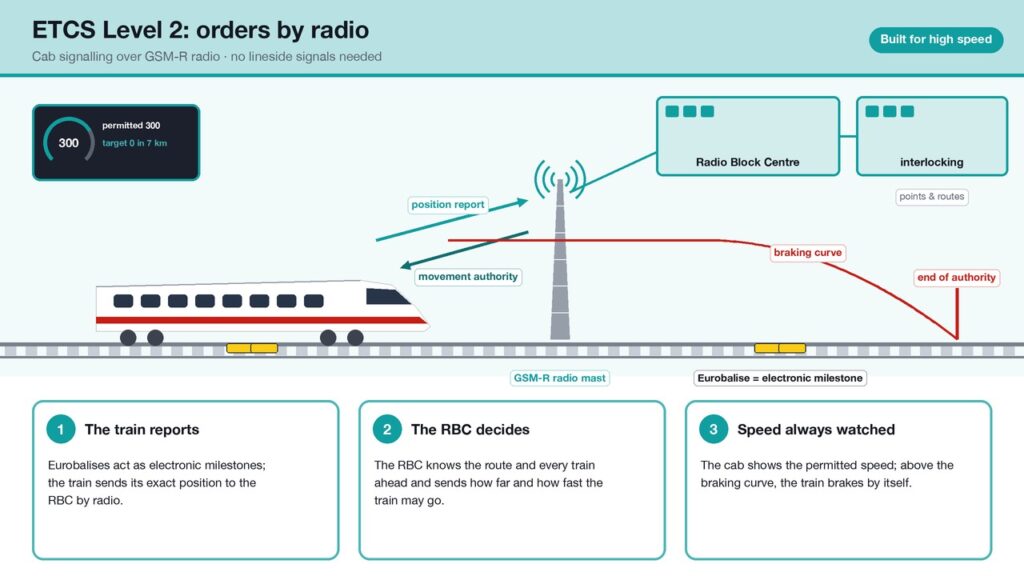
Level 2 is the high-speed version. Balises become electronic milestones that tell the train exactly where it is; the train reports its position by radio to a Radio Block Centre, which knows the route and every train ahead and sends back a “movement authority”: how far and how fast this train may go. The driver sees it all on a screen in the cab, and the train brakes by itself above its braking curve (European Commission).
Spain is actually a European leader here, with around 3,000 km of line equipped with ERTMS according to Adif (ERA conference, 2024). The European Union has set deadlines: ERTMS on the core network by the end of 2030 and the old national systems removed by 2040 to 2050, depending on the network (ERA, 2026, RailFreight).
The replacement that was already late
Madrid–Seville was supposed to get ETCS Level 2. In 2021 Adif awarded Thales a contract worth about 94 million euros and 52 months of work to renew the line’s train control, with LZB staying in service until the new system takes over (Thales, Europa Press). The work was first expected in 2025; in March 2026 the government said installation was “still in progress” (Xataka, Railway Gazette).
Would a finished ETCS Level 2 have changed what happened at Urda? That is for the investigators to say. What is certain is that Europe’s standard system was available, certified and contracted, and Spain’s busiest high-speed corridor was still running on 1960s technology.
It has been a terrible year for Spanish rail. In January, 46 people died at Adamuz, in Córdoba, when an Iryo train derailed and was hit by an Alvia; investigators point to a broken rail weld, a track problem rather than a signalling one (CTIF, Noticias de Navarra).
A shield that acts before any human decision
All these systems share one design idea: on a high-speed line, protection is a solid layer that sits before and above any human decision, and any human error. The driver drives and the control centre manages traffic, but the computer only lets them do what is safe. If the driver goes too fast, misses a warning or heads towards the end of the permitted route, the train brakes by itself; nobody has to react in time (European Commission). It works a bit like the automatic systems of a modern airliner: the autopilot flies the plane, and built-in protections refuse commands that would take it outside safe limits.
The second rule is called fail-safe: when something breaks, the system falls back to the safe state, which on a railway means stopping. That is exactly what happened at Urda at 08:30: when LZB failed, six trains stopped (Railway Gazette, Euronews). The risk begins afterwards, in “degraded mode”, when the automatic layer is out and trains move again on people’s instructions, under rules such as driving on sight at no more than 40 km/h. That is the moment when a single human decision can still decide everything, and it is where engineers work hardest to keep the machine in charge.
Japan’s Shinkansen: more than 60 years without a single fatal crash
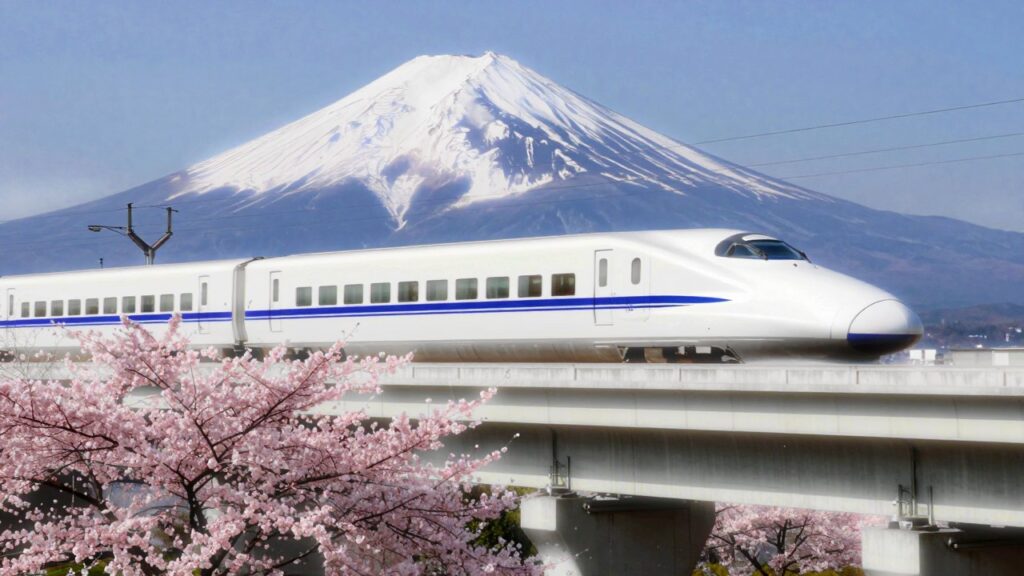
The best proof that this approach works is Japan. The Tōkaidō Shinkansen opened on 1 October 1964 with automatic train control from the start: when a train approaches another train or a stop, the ATC reduces its speed automatically, and the driver only makes the fine adjustments (nippon.com). Since that first day, no passenger has died in a derailment or collision anywhere on the full Shinkansen network: more than 60 years (nippon.com, Japan’s transport ministry). An early earthquake detection system also halts the trains as soon as a quake is detected (Japan’s transport ministry).
The lesson is not that Japanese drivers or controllers never make mistakes. It is that the technology was built to protect passengers even when people do, and that it has been kept up to date for six decades.
The next layer: satellites that know where the train is
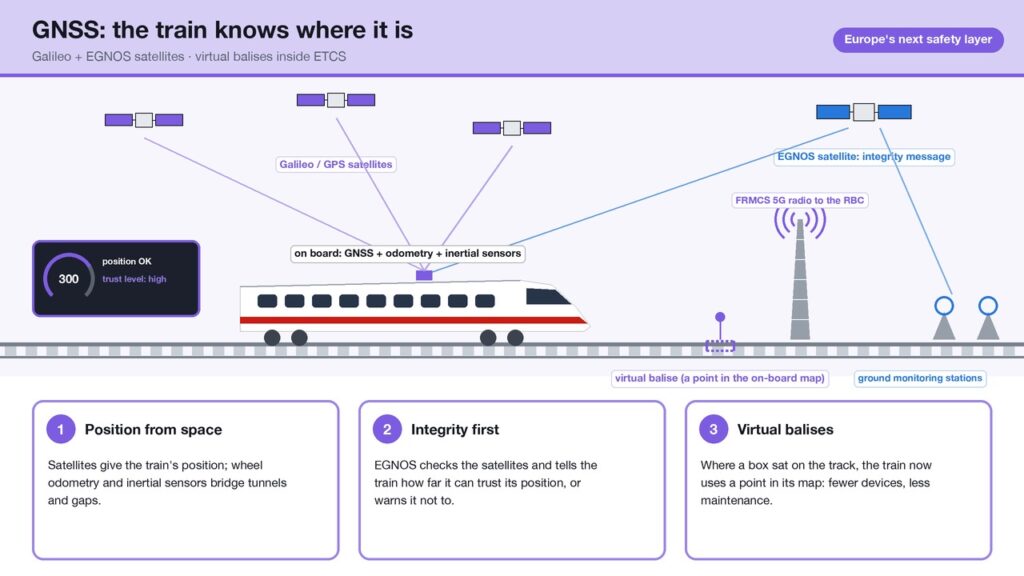
Every system above needs equipment on the track: cables, beacons or balises, all of which must be installed, powered, checked and protected from theft and weather. Europe’s next step is to let the train find its own position from space, using Galileo and GPS satellites (together called GNSS, global navigation satellite systems).
The key ingredient is not accuracy but integrity: a train must know how far it can trust its position, and be warned within seconds when it can’t. That is the job of EGNOS, Europe’s satellite system that checks the GPS and Galileo signals and broadcasts warnings. On board, the GNSS receiver is combined with wheel odometry and inertial sensors, which bridge tunnels, deep cuttings and jamming. Instead of physical balises, the train’s map contains virtual balises: points where the computer acts exactly as if it had driven over a real box. Research targets ask for the same top safety level as today’s balises (EUSPA EGNSS-R, ENAC).
It is not ready yet, and honesty matters here. Europe’s Rail, the EU research partnership, reported in September 2024 that a virtual balise worked inside a real ETCS system on the Novara–Rho line in Italy, with errors around five metres, but that a “fully suitable EGNOS version for railway applications” is not yet available, with first results expected by 2027 (Europe’s Rail, EGNOS). The next generation of EGNOS, with dual-frequency signals, is due around 2026 to 2028 (Inside GNSS). In February 2026 the European Union Agency for Railways, the space agency EUSPA and Europe’s Rail set up an expert group to bring satellite services into signalling (ERA, Global Railway Review).
Heading into early 2027, these are the ones already testing or implementing it:
- Italy (RFI): virtual balises inside a real ETCS system on the Novara–Rho line (Europe’s Rail).
- France (SNCF, with Alstom, Airbus and Exail): train geolocation trials in Nouvelle-Aquitaine and the EGNOS4RAIL project, which aims for certified top-safety-level positioning around 2028 (Europe’s Rail, SNCF).
- France, Germany and Switzerland (SNCF, DB and SBB): the CLUG project, a fail-safe positioning unit combining satellites, inertial sensors, odometer and a track map (CORDIS).
- Spain (Adif, with Alstom): ERTMS with satellite-assisted positioning on the La Asunción–Guardo line, in testing since November 2025 (Global Railway Review).
- Europe as a whole: Europe’s Rail expects first results with a rail-ready version of EGNOS by 2027 (Europe’s Rail).
Our view: Spain is late, twice
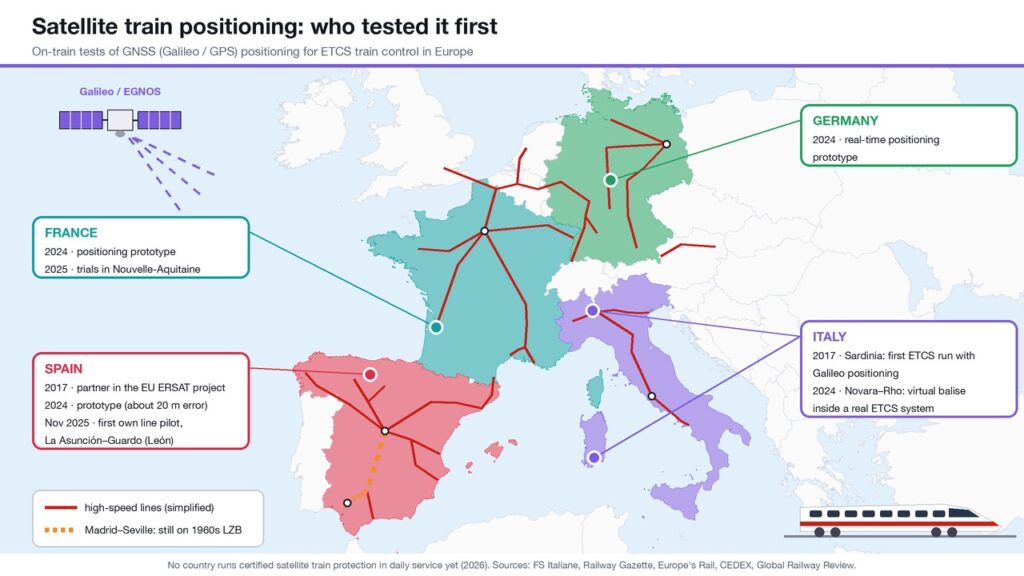
No country runs certified satellite train protection in daily service yet, Italy included. But the countries that started early will be ready first, and Spain did not start early.
Italy ran Europe’s first rail journey with Galileo positioning in ETCS in February 2017, between Cagliari and Decimomannu in Sardinia (FS Italiane, Railway Gazette). Spain’s Adif, CEDEX and Ineco took part in the European ERSAT GGC project from 2017 (CEDEX), but Spain’s own pilot with satellite-assisted positioning only began in November 2025, on the regional La Asunción–Guardo line in León (Global Railway Review, Diario de León).
So Spain is late twice: late replacing a 1960s system with the European standard that already exists, and late preparing for the satellite layer that comes next. Spain should have started serious trials of satellite positioning around five years ago, when the technology had proven itself in Italy, so that it would arrive ready, not last, when the rules allow it.
What happens next
Three things to watch. First, the investigation into Urda, which will take time and should not be rushed by leaks or politics. Second, the date when ETCS Level 2 finally replaces LZB between Madrid and Seville. Third, the European rulebook: planning documents point to satellite positioning entering the official ETCS specifications between 2027 and 2032 (EUSPA, 2024, SNCF).
Trains remain one of the safest ways to travel in Europe. Keeping them that way means not running 300 km/h trains on 60-year-old ideas any longer than necessary.
Read next
- Tesla renames Full Self-Driving to ‘Assisted Driving’ in Europe
- New series Spanish Geniuses: Torres Quevedo, the forgotten genius
The week's best tech stories, free
One email a week with the stories that matter, explained simply. No spam.
Sources
- Última hora del accidente de trenes en Toledo · Infobae, 30 Oct 2026
- Se mantiene la cifra oficial de 69 fallecidos en el accidente ferroviario de Urda · La Comarca de Puertollano, 30 Oct 2026
- Safety and Convenience: How the Shinkansen Changed Japan · nippon.com, 25 Oct 2024
- Railway Bureau: the Shinkansen · Ministry of Land, Infrastructure, Transport and Tourism (Japan)
- Nouvelle-Aquitaine, a key region for European train geolocation · Europe’s Rail, Feb 2025
- CLUG 2.0 project · CORDIS, European Commission
- Confidence grows as ETCS Level 2 beds in on Roma–Napoli line · Railway Gazette, May 2006
- Rome–Naples high-speed railway · Wikipedia
- Civils and signals block speed-up on world’s fastest line · Railway Gazette
- El AVE Madrid-Lleida circula desde hoy con una velocidad máxima de 280 km/h · Consumer, 16 Oct 2006
- Control centre communication in focus as Spain faces rail safety reckoning · Railway Gazette, 29 Oct 2026
- Spain train crash: what happened in the 17 minutes before the collision · Euronews, 29 Oct 2026
- What we know about Spain’s second high-speed rail tragedy this year · Al Jazeera, 29 Oct 2026
- Spain’s transport minister blames rail crash on “inexplicable” human error · The Local, 28 Oct 2026
- Qué es LZB · Xataka, 28 Oct 2026
- El sistema LZB debería haber sido sustituido por ERTMS 2 en 2026 · Xataka, 28 Oct 2026
- Linienzugbeeinflussung · Wikipedia
- ATP/ATC examples · IRSE Netherlands
- Linienförmige Zugbeeinflussung · Computerwoche
- Braking performance of high-speed trains · JR East
- Emergency braking distance of high-speed trains · Journal of Traffic and Transportation Engineering, Chang’an University, 2011
- Verdict reached on Angrois derailment · Railvolution, 26 Jul 2024
- Condenados el maquinista y el exdirector de seguridad de Adif · Elderecho.com, Jul 2024
- La Audiencia de A Coruña confirma la condena al maquinista del Alvia y absuelve al exdirector de Seguridad en la Circulación de Adif · Poder Judicial, Jan 2026
- La Audiencia de A Coruña absuelve al exjefe de seguridad de Adif · elDiario.es, Jan 2026
- What is ERTMS and how does it work? · European Commission
- ERTMS/ETCS · Le Dico Ferroviaire
- ERTMS as facilitator for railway liberalisation · ERA ERTMS Conference, 2024
- ERTMS Conference 2026 presentation · European Union Agency for Railways, 2026
- New TEN-T: extra ERTMS deployment deadlines · RailFreight, 26 Apr 2024
- Thales signs two new contracts modernising the Madrid–Seville high-speed line · Thales, 2021
- Adif adjudica a Thales, Ferrovial y Azvi la renovación de la línea Madrid-Sevilla · Europa Press / Bolsamanía, Sep 2021
- Spain’s deadliest railway crash in a decade left 46 dead near Adamuz · CTIF, 2026
- Una rotura del carril produjo el accidente de Adamuz · Noticias de Navarra, 28 Apr 2026
- Satellite positioning set to enhance train localisation · Europe’s Rail, 20 Sep 2024
- EGNOS for rail · EGNOS / EUSPA
- EGNSS-R results · EUSPA
- GNSS for train localisation: safety requirements · ENAC (HAL)
- Dual-frequency, multi-constellation signals coming to EGNOS · Inside GNSS
- Space-enabled rail: EU partners drive interoperability and safety · ERA, 19 Feb 2026
- Space-enabled rail partners advance interoperability and safety · Global Railway Review, 2026
- Satellite technology tests for regional railway traffic concluded · FS Italiane, 16 Mar 2017
- ERTMS with satellite positioning trial completed · Railway Gazette, 2017
- Proyecto ERSAT GGC · CEDEX
- Alstom launches innovative signalling technology for Spain’s secondary lines · Global Railway Review, 25 Nov 2025
- Pruebas en la línea La Asunción–Guardo · Diario de León, 4 Nov 2025
- Space for rail · EUSPA, Dec 2024
- EGNOS4RAIL project · SNCF, Oct 2025