More than a century ago, a Spanish engineer steered a boat full of people by radio, built the world’s first cable car for passengers, taught a machine to win at chess and described the computer decades before it existed. His name was Leonardo Torres Quevedo, and outside Spain almost nobody remembers it.
Why it matters: the remote in your hand, the cable car on your ski trip and the way your computer handles decimals all carry a little of him. Our new documentary, SPANISH GENIUSES · Episode 1, tells his story; here is your quick guide.
The film recreates historical scenes from period photographs and documents. Prefer Spanish? Watch the original Spanish version, GENIOS ESPAÑOLES.
A boy from a green valley
Torres Quevedo was born on 28 December 1852 in Santa Cruz de Iguña, a valley village in Cantabria, northern Spain. He grew up in Bilbao, studied in Paris and trained as a civil engineer in Madrid, according to his biography at Spain’s research council, CSIC.
He finished fourth in a class of seven. But an inheritance from relatives let him skip a safe government job and do what he loved most: invent machines.
A boat with nobody at the helm
In the early 1900s he was designing airships, and testing one meant risking a crew. His answer: control machines from the ground with radio waves. He called it the Telekino (“movement at a distance”), patented it in 1902-1903 and demonstrated it in Paris on 3 August 1903.
The clever part was the code: instead of a simple on/off signal, it could send different orders, such as go, turn or stop. In September 1906, in the port of Bilbao, a boat with people on board obeyed those invisible orders before King Alfonso XIII and a large crowd, as the Museo Torres Quevedo recounts.
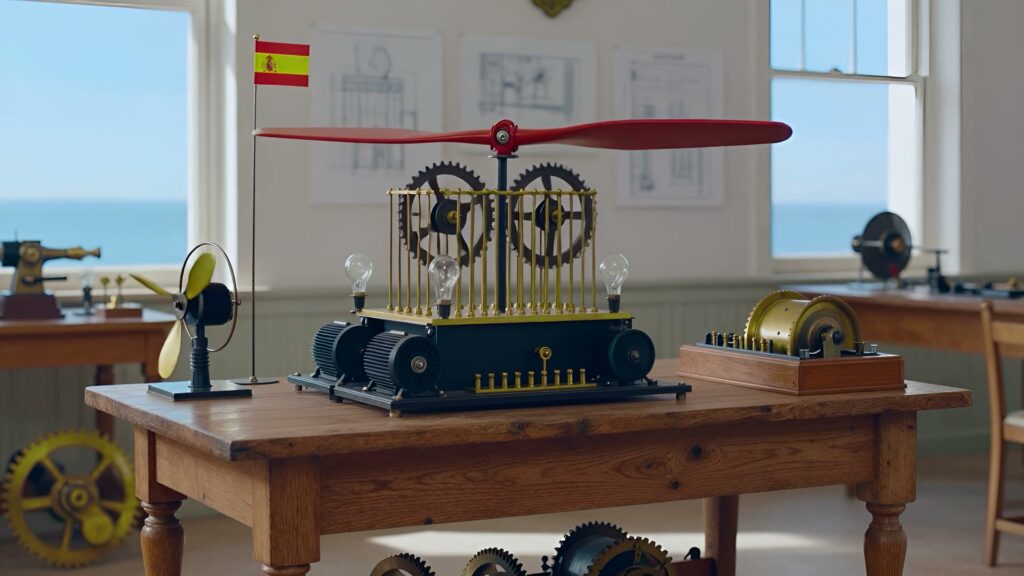
It was one of the first radio remote controls in history. Nikola Tesla had already guided a boat by radio in 1898, but Torres Quevedo’s coded system is honoured today as an IEEE Milestone.
The cable car Switzerland said no to
His first obsession was cable. He patented a cableway in 1887 and took it to Switzerland, the land of mountains. Swiss engineers turned it down.
He kept working. On 30 September 1907, on Monte Ulía in San Sebastián, his aerial ferry became the first cable car in the world open to the public for passengers.
A Spanish car over Niagara, still running
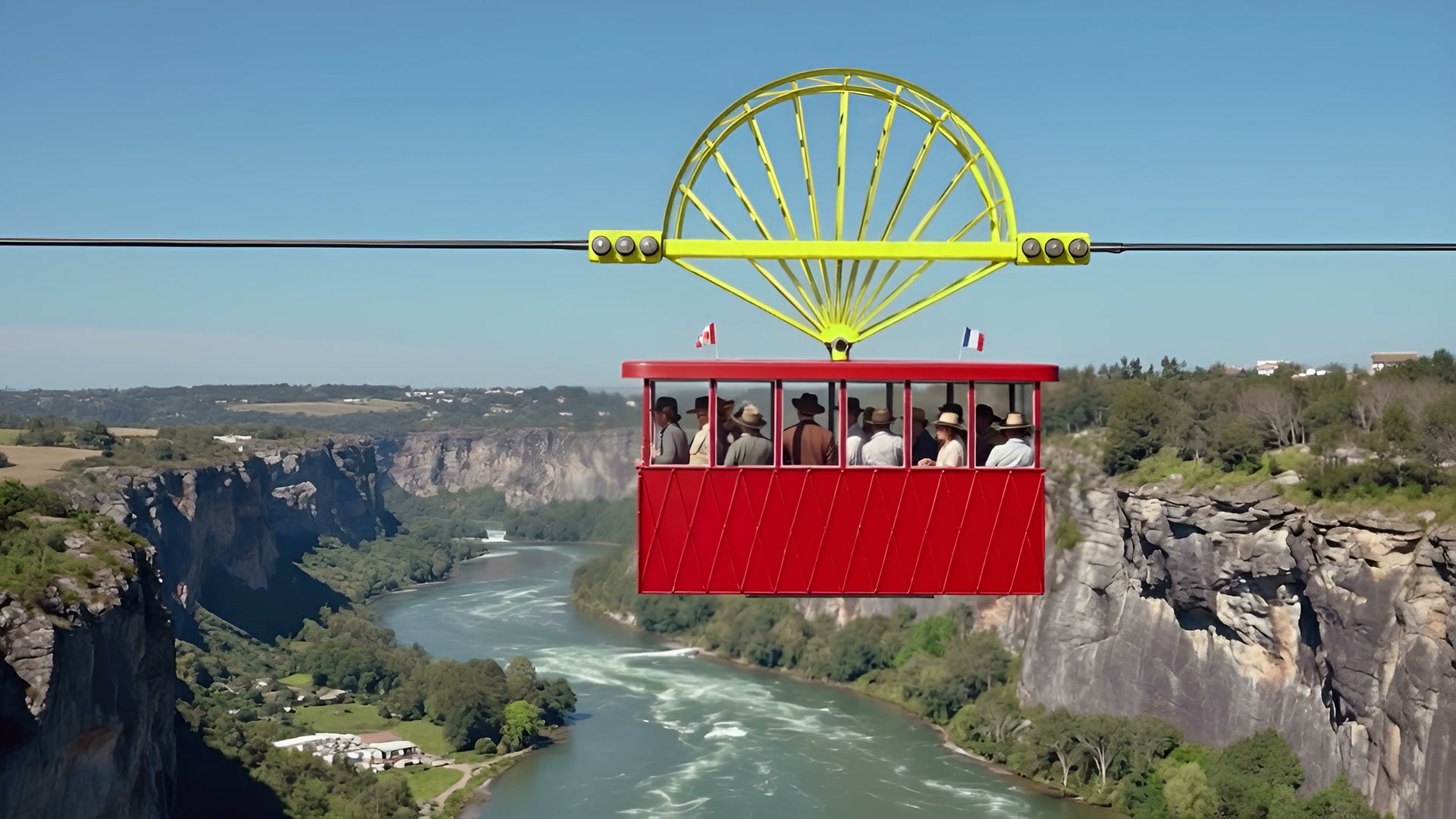
His most famous ride crosses the Niagara whirlpool, downstream of the falls. The Spanish Aero Car opened on 8 August 1916, in the middle of the First World War. It spans more than 500 metres, about five football pitches end to end, and hangs 76 metres above the water, roughly the height of a 25-storey building. Spanish money paid for it, and his son Gonzalo directed the work.
The secret is balance: each cable is fixed at one end and runs over pulleys to a counterweight at the other, so tension stays constant whatever the load, the Real Academia de la Historia explains. The best part? It still runs every season from spring to autumn, refurbished several times but true to his design. Niagara Parks says it is believed to be the only one of its kind still operating.
A machine that always wins at chess
He also built El Ajedrecista (“the chess player”). It knew just one endgame, king and rook against a human’s lone king, and it always delivered checkmate. No one hid inside: electrical contacts sensed the pieces and a mechanical arm moved the rook. He showed it in Paris in 1914; in 1951 Norbert Wiener, the father of cybernetics, played its successor.
The computer before computers
In his “Essays on Automatics”, published around 1914, he described machines that store numbers and pick their next step from a result. He also proposed floating-point arithmetic: a few digits plus a note of where the decimal point goes, which is how today’s computers handle huge and tiny numbers. In 1920, in Paris, he showed an electromechanical calculator run from a typewriter: you typed a sum and the machine typed back the answer.
Computing historian Brian Randell sees him as a precursor of the computer and wrote that his career “deserves much wider appreciation outside Spain”.
Why “forgotten”?
In his lifetime he was celebrated, especially in France. He died in Madrid on 18 December 1936, aged 83, during the Civil War, and his death went almost unnoticed. When others built the first computers, few outside Spain knew his name.
Watch the film
Today a CSIC research institute carries his name, and his car still crosses Niagara. Watch Chapter 1 above, and next time you press a remote, think of a boat in Bilbao with nobody at the helm.
Read next
- Federico Faggin: the microprocessor pioneer on consciousness
- Can AI be conscious? How scientists try to tell, and why we doubt
- Thermal noise wireless: sending data with static, not radio
The week's best tech stories, free
One email a week with the stories that matter, explained simply. No spam.
Sources
- Milestones: Early Developments in Remote-Control, 1901 – IEEE / Engineering and Technology History Wiki, accessed October 2026
- Biography of Leonardo Torres Quevedo – ITEFI, CSIC, accessed October 2026
- From Analytical Engine to Electronic Digital Computer: The Contributions of Ludgate, Torres, and Bush – B. Randell, Annals of the History of Computing, October 1982
- History of the Aero Car – Niagara Parks, accessed October 2026
- El Ajedrecista – Wikipedia, accessed October 2026
- Telekino – Museo Torres Quevedo, Universidad Politécnica de Madrid, accessed October 2026
- Leonardo Torres Quevedo – Diccionario Biográfico, Real Academia de la Historia, accessed October 2026