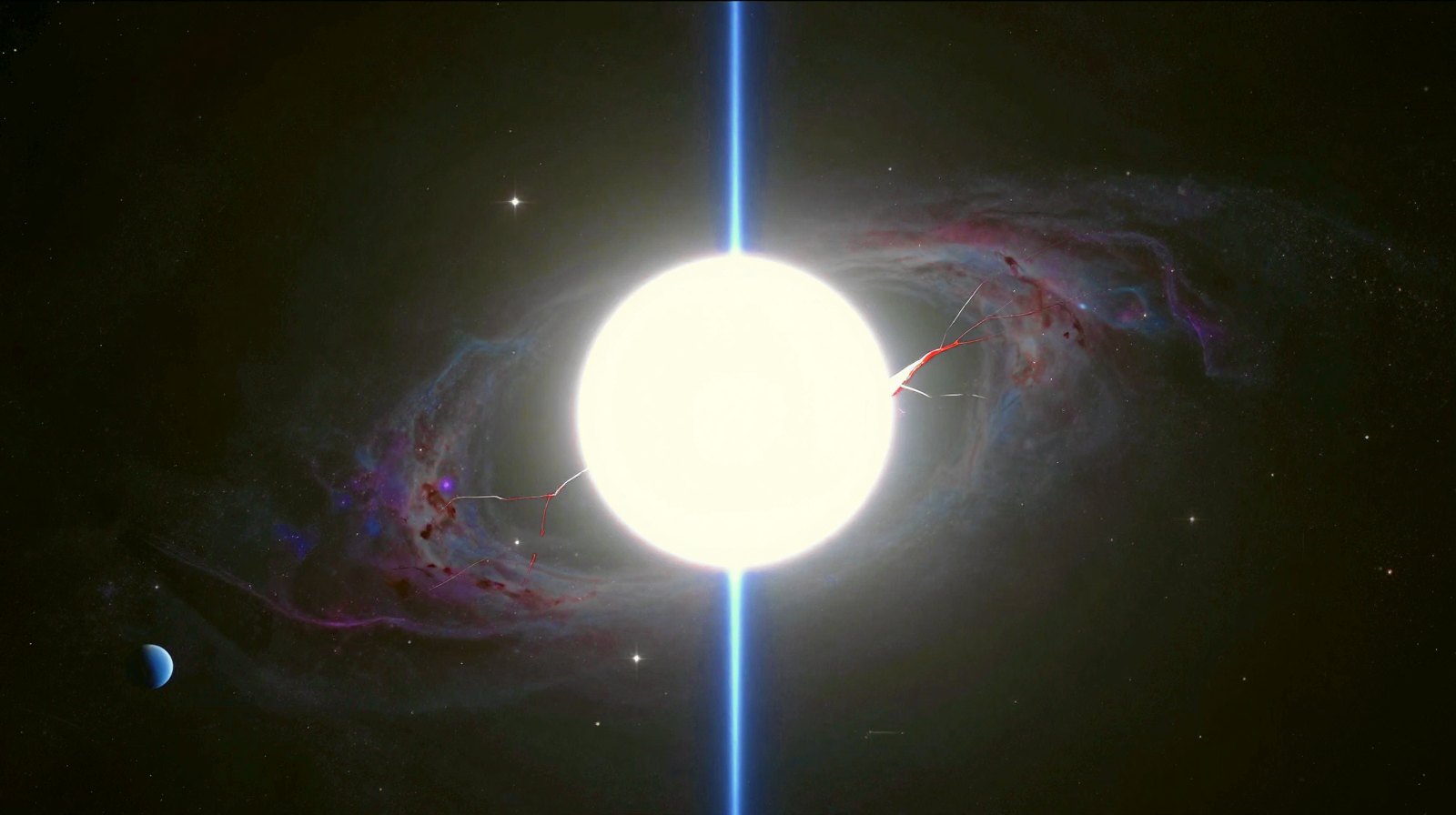
If the universe is hiding tiny black holes left over from the Big Bang, some of them may be eating stars from the inside, and the star’s death could give them away. That is the idea in a new study led by MIT physicist Ore Gottlieb, published in The Astrophysical Journal on 19 November 2026.
Why it matters: nobody has ever seen one of these “primordial” black holes. If they exist, they could make up a significant part of dark matter, the invisible stuff that holds galaxies together. The study gives astronomers something specific to look for: a star that blows up when it shouldn’t.
What is a primordial black hole?
The black holes we know were made by dying giant stars. Primordial black holes would be much older. Scientists think they may have formed in the first fraction of a second after the Big Bang, when tiny, extra-dense pockets of the young universe collapsed under their own gravity.
The smallest ones would have evaporated long ago through Hawking radiation, a quantum effect proposed by Stephen Hawking that makes black holes slowly leak away. Bigger ones should still be around. According to MIT News, these leftovers would be about the size of an atom but as massive as an asteroid: roughly a millionth of the mass of the Earth, squeezed into something smaller than a grain of dust.

How a star could swallow one
The team combined theoretical calculations with three-dimensional computer simulations, using the equations of general relativity, fluid flow, stellar evolution and particle physics.
The first finding is a surprise: a single star on its own cannot catch a passing primordial black hole. Its gravity is not enough. But if the star has a companion, such as a second star or a planet, the three-way gravitational pull can trap the black hole efficiently. Each time the black hole passes through the star, it loses a little speed, its orbit shrinks, and within thousands to millions of years it sinks to the star’s core. On cosmic timescales, that is almost instant.
From quiet parasite to explosion
Once at the centre, the black hole starts feeding. The simulations show it grows faster than earlier studies assumed, swallowing about 1 % of a Sun-like star’s mass within several million years.
What happens next depends on how fast the star spins:
- Slow spin: no disk forms, and the black hole keeps eating the star slowly and quietly.
- Fast spin: gas piles up into a whirling disk around a black hole now just a few metres across. The disk’s twisted magnetic field powers two jets from the black hole’s poles. “Once the disk forms, this is essentially a death sentence for the star,” Gottlieb says. The jets punch through the star and blow it apart within a few dozen seconds.
What telescopes would see
The explosion would first shine in X-rays and gamma rays, then in visible and infrared light, and later in radio waves. The researchers say the blue and ultraviolet flash should be bright enough for today’s telescopes, and it could be spotted many galaxies away, not just in our cosmic neighbourhood. The study does not name a specific telescope or survey.
There is a catch: other cosmic events can make similar flashes. To tell them apart, astronomers would need extra clues. Gottlieb’s example is a star whose mass is too small to explode on its own. If such a star blows up anyway, it would hint at “a sort of parasite” eating it from the inside.
Context: an idea months in the making
The work first appeared as a preprint earlier this year, when Universe Today, via Phys.org described the same scenario of a star capturing a primordial black hole. The peer-reviewed version is now out. Co-authors include Matteo Cantiello (Flatiron Institute), Cameron Norton and Matthew Kleban (New York University) and Ken Van Tilburg (Stanford University).
It is important to be clear about what this is: a prediction from calculations and simulations, not an observation. No such explosion has been seen yet.
What happens next
The study turns a hard question (“do primordial black holes exist?”) into something telescopes can test. If sky surveys find odd explosions of small stars, or never find them, either result would tell scientists how much of dark matter could be made of these tiny black holes. As Gottlieb puts it, researchers can now use observations to “place constraints on primordial black holes, and their contributions to dark matter.”
Read next
- Is there really such a thing as empty space?
- Hubble twist: supernova winds may not have cleared the cosmic fog
- NASA’s Swift telescope falls to Earth after 22 years
The week's best tech stories, free
One email a week with the stories that matter, explained simply. No spam.
Sources
- MIT News: If tiny “primordial” black holes exist, here’s how we might find them (19 Nov 2026)
- EurekAlert!: the MIT release (20 Nov 2026)
- The Astrophysical Journal: The Life and Death of Stars that Capture Primordial Black Holes (DOI 10.3847/1538-4357/aeb7e1)
- Phys.org: What happens to a star that captures a primordial black hole? (June 2026)