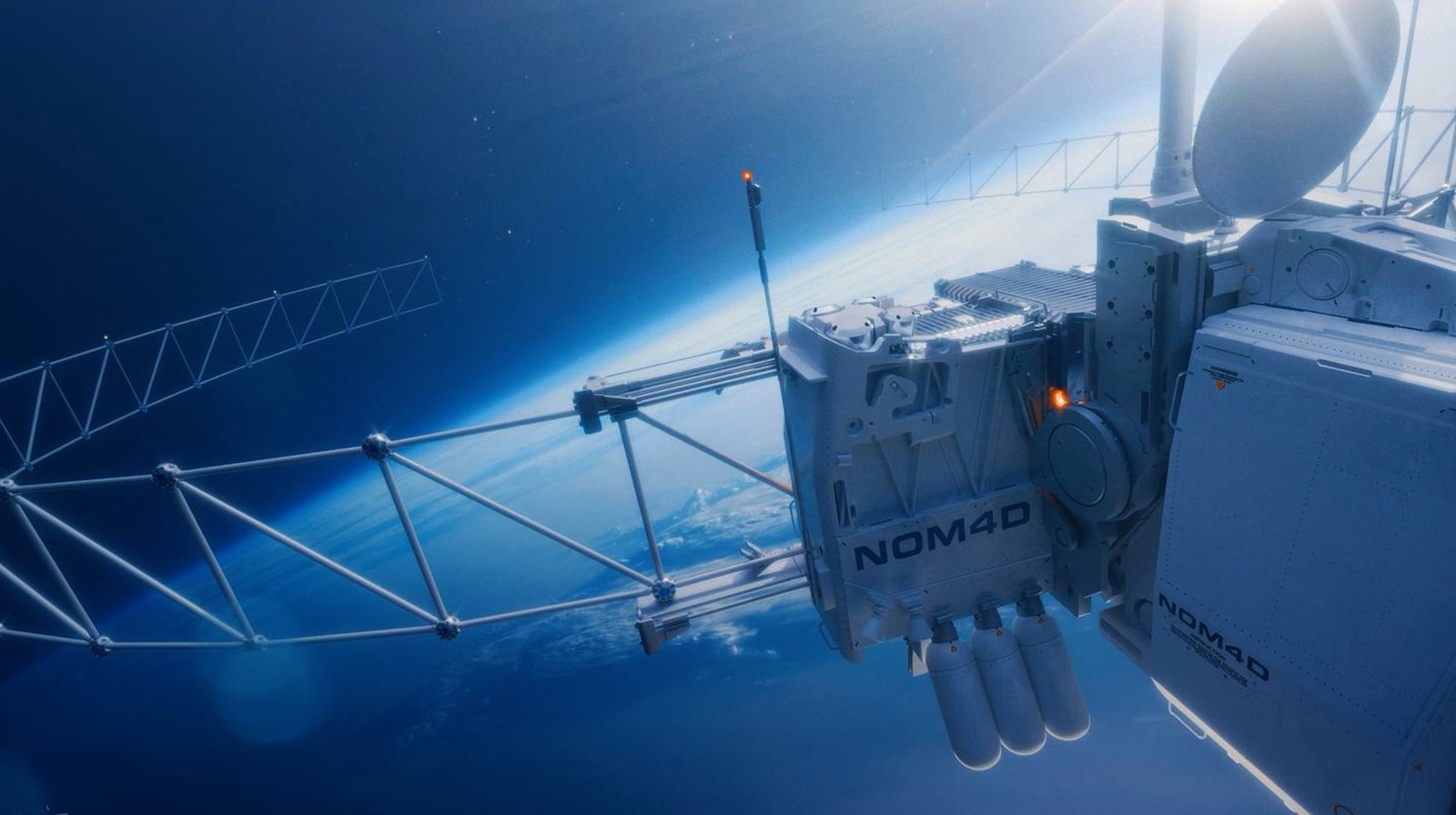
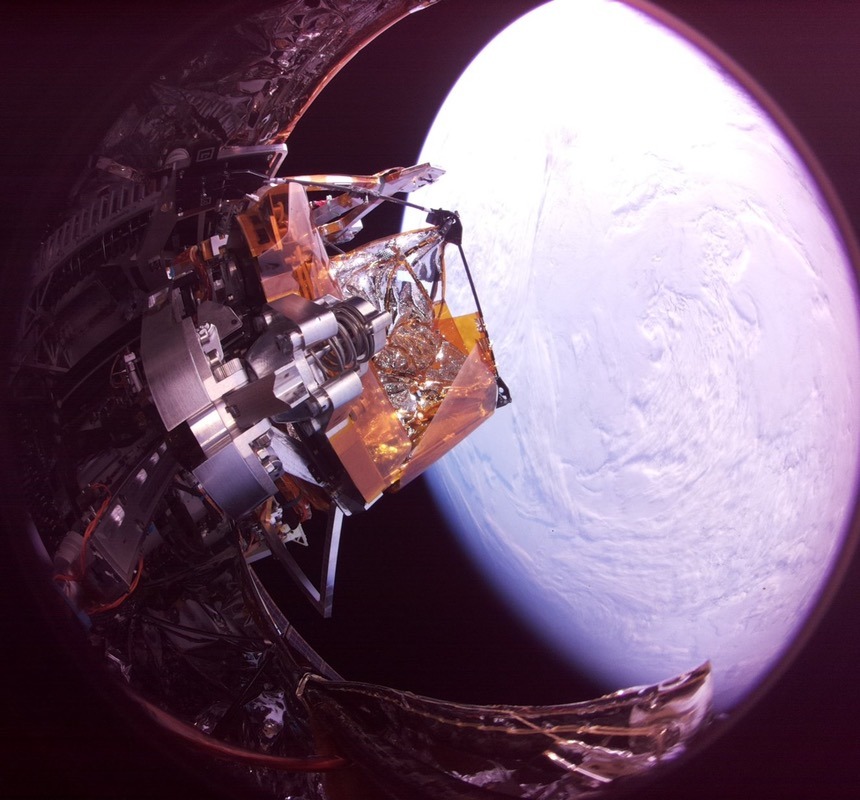
A robot has built part of a structure in orbit, piece by piece, with no astronauts on board. Caltech’s ASTRA payload assembled one section of an antenna frame while circling the Earth. It is a small step, but it tests an idea that could one day let us build huge antennas and solar arrays in space instead of squeezing them into a rocket.
What was done
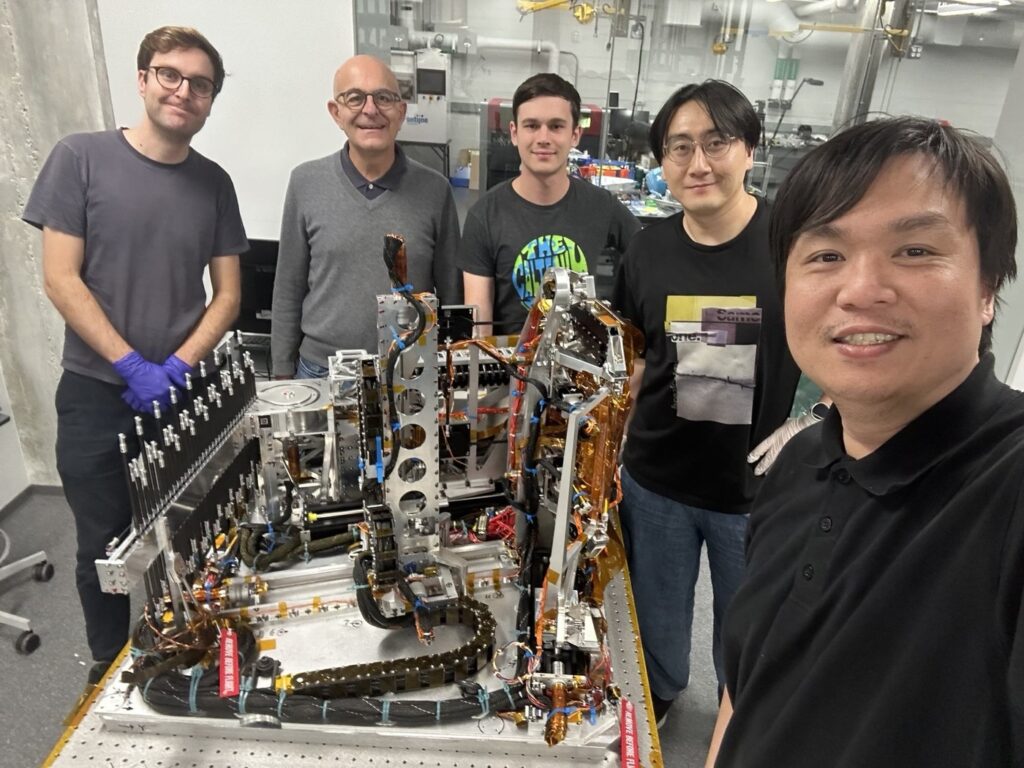
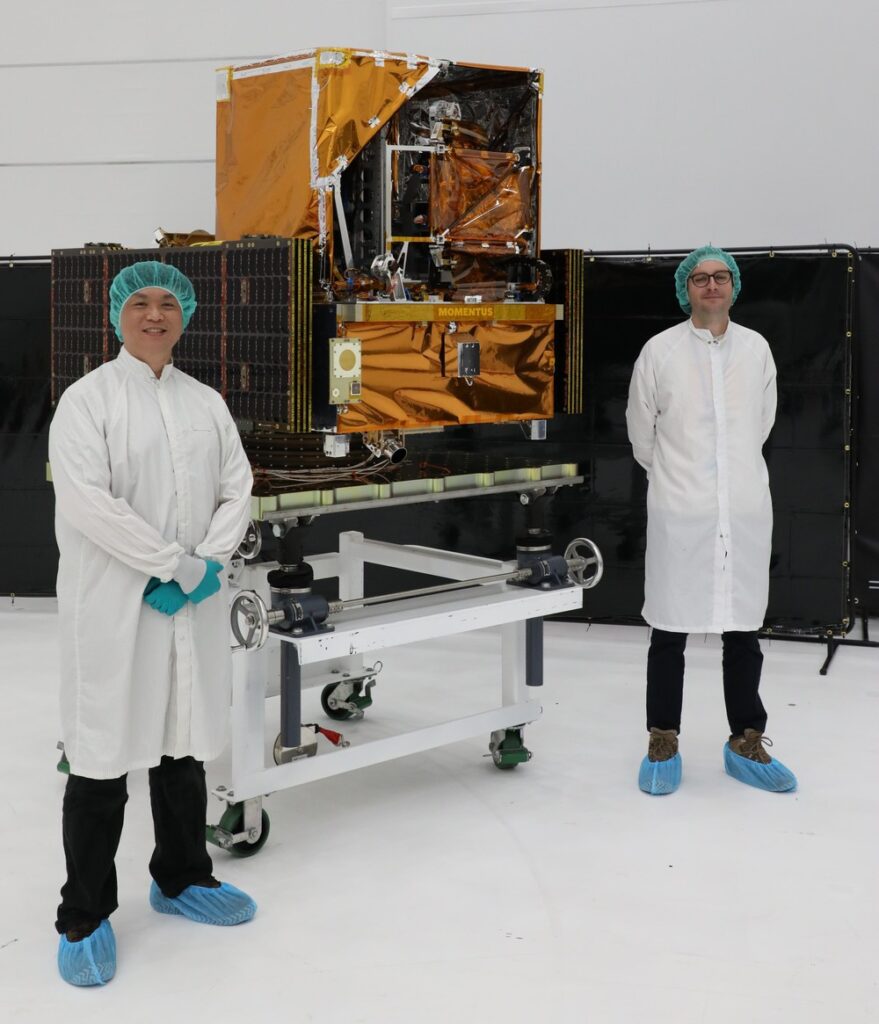
ASTRA stands for Autonomous In-Space Tensioned Reflector Assembly. It was built at the California Institute of Technology (Caltech) by a team led by Professor Sergio Pellegrino. The work is funded by DARPA, the US Defense Advanced Research Projects Agency, through Phase 3 of its NOM4D programme. The name is short for Novel Orbital and Moon Manufacturing, Materials, and Mass-efficient Design.
“This is the first time that a structure has been autonomously constructed in space,” Pellegrino said, as reported by Caltech.
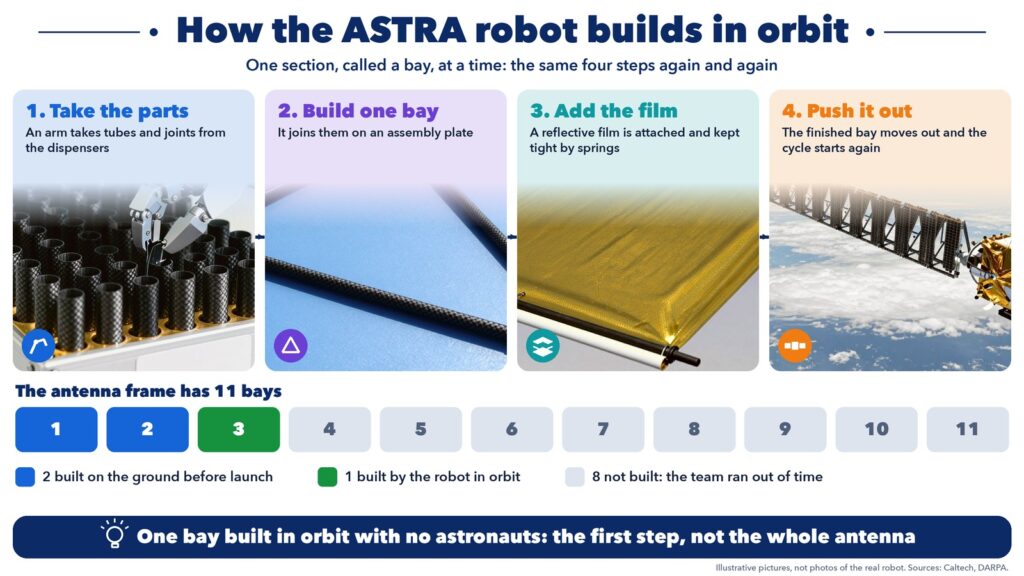
It is important to be exact about how much was built. The goal was a reflector antenna 1.4 metres across. Its frame, called a truss, is a light skeleton of tubes and joints, divided into 11 sections called bays. Two bays were built on the ground and launched already assembled. In orbit, the robot built a third bay. The team only had time for this first section, so the full truss was not completed. Exact build dates were not given.
How it got there
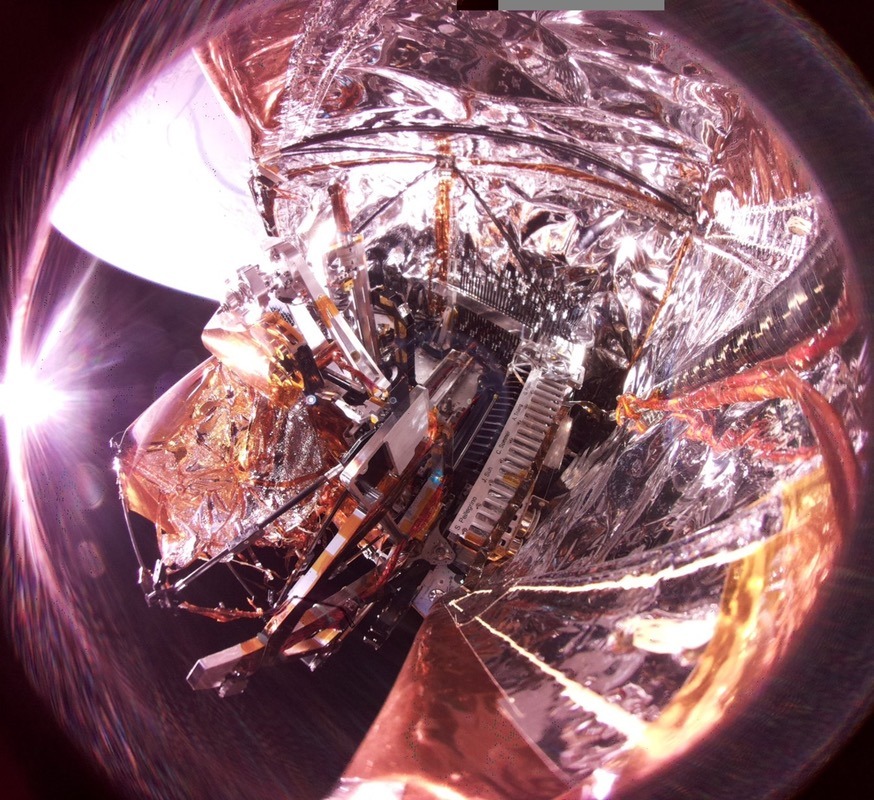
ASTRA launched early on 30 March 2026 from Vandenberg Space Force Base on SpaceX’s Transporter-16 mission. It was one of 10 payloads riding on Momentus Inc.’s Vigoride 7 vehicle, in low-Earth orbit. The payload is about one cubic metre in size. Inside are an arm-like manipulator (a robotic arm that grabs and places parts), motorised parts dispensers and 11 cameras.
How it works
The antenna is made of composite fibre tubes, aluminium joints and a reflective surface made of Kapton, a thin, tough plastic film. The building cycle is simple:
- The manipulator takes parts from the dispensers.
- It builds a bay on an assembly plate.
- It attaches a perforated film that forms two reflective cable nets, kept tight by springs.
- The finished bay is pushed out, and the cycle starts again.
The reflective material was co-invented by a team led by Igor Bargatin at the University of Pennsylvania.
DARPA’s programme manager, Andrew Detor, stresses how plain the method is. “There are no complicated robotics or advanced algorithms; it’s just solid engineering from the Caltech team,” he said in a DARPA statement. DARPA compares it to building with Tinkertoys or K’Nex construction toys: join simple parts at nodes, one section at a time.
Automated, but not unsupervised
The word “autonomous” needs some care. As New Atlas points out, “automated” does not mean unsupervised. The team on the ground could only talk to it in windows of about 15 minutes, seven or eight times a day. When something went wrong, engineers reproduced the problem on a twin unit in Pellegrino’s lab, worked out a fix, and then sent it up.
“There are always lots of little surprises,” said Jaden Suh, a former Caltech postdoctoral researcher who is now at the University of Texas at Austin.
What it means for you
Today, almost everything in space is built on the ground and folded to fit inside a rocket. That puts a hard limit on size. If robots can assemble big structures from a box of parts once in orbit, the limit shifts. Detor’s goal is much bigger than this antenna: “By ‘very large,’ I mean hundreds of meters or kilometers in scale.”
Large antennas could mean better communications and science. Large solar arrays could collect more power. None of that exists yet. What ASTRA has shown is that one repeatable building step can work in orbit.
What comes next
The mission is planned to end in December 2026. The team says the approach works, but it wants to simplify the design for future versions. The jump from one bay to structures hundreds of metres wide is still a very long one, and it has not been tried.
Read next
- NASA loses a junk-inspecting spacecraft to its own software
- Trunk-like robots bend, grab and link up into bigger machines
- NASA’s Swift telescope falls to Earth after 22 years
The week's best tech stories, free
One email a week with the stories that matter, explained simply. No spam.
Sources
- Caltech news story on the ASTRA demonstration (5 Nov 2026)
- DARPA: NOM4D program demonstrates automated in-space assembly
- New Atlas: A robot just built a structure in space for the first time (9 Nov 2026)