
A robot the size of a fingernail has just jumped, swum, walked and grabbed things, powered by real muscle grown in a lab. Engineers at ETH Zurich designed the living muscle and its soft “skeleton” together on a computer, and their tiny machines now move up to 11 times more than earlier ones with the same amount of muscle, they report in Nature Communications.
Why it matters: muscle is a wonderful motor. It is soft, quiet, efficient and can even repair itself, things metal motors can’t do. “Biohybrid” robots (part machine, part living tissue) could one day work in fragile places, such as inside the body or in delicate environments. Their big problem so far: they barely moved. This study tackles exactly that.
Design the muscle and the body together
Each little actuator (the part that makes the movement) is about 1.5 cm long. It combines skeletal muscle grown from mouse muscle cells with a soft, water-rich gel called a hydrogel, which acts as the skeleton. Until now, teams usually grew the muscle first and then built a body around it.
The ETH Soft Robotics Lab, led by Professor Robert Katzschmann, flipped that. A computer simulation decided where muscle should go, how much of it, and how stiff the gel should be, then searched for the layout that made the whole part move the most. “Instead of specifying a fixed form for our muscle geometry, we wanted to design the whole thing from scratch on the computer,” says co-lead author Aiste Balciunaite. IEEE Spectrum describes the same co-design approach, built on an adapted soft-body simulator.
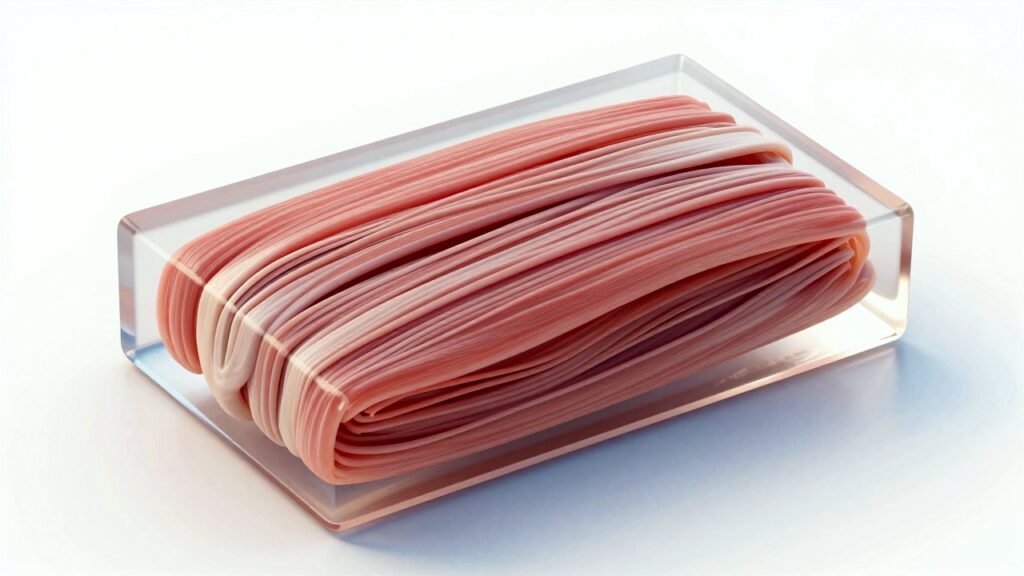
The gel skeletons are printed with light in about a minute each, using a method called xolography that hardens a whole shape inside a vat of liquid. Fine grooves in the gel anchor the muscle and line up its fibres, like combing hair in one direction, so less force is lost.
Jump, walk, swim, grab
The results are easy to see, literally. “With previous systems, you sometimes had to look under a microscope to see the flexing,” Balciunaite says. Now a single contraction lifts the actuator about 5 mm, roughly a third of its own length. A walking version moves at 6.2 mm per second, which ETH says is faster for its body size than any walking biohybrid robot reported so far. Other versions swim, crawl across a surface and grasp objects, confirms IEEE Spectrum.
The catch: living muscle needs feeding
These robots are not leaving the lab any time soon. The muscle has to sit in a nutrient solution to stay alive, so long-term use is still far off, ETH notes. Living tissue also varies, so no two actuators behave exactly alike, unlike factory-made parts. And anything bigger would need its own artificial blood supply to bring in oxygen and food and take away waste, which Katzschmann calls one of the biggest challenges.

What happens next
The team now wants to understand and control how muscle matures in the lab, and to work on that artificial vascular system. “We’re just beginning to build robots in a more natural way,” Katzschmann says. It’s a fun contrast with robots that copy nature with springs and motors, like the frog-like robot with snapping legs: here the robot uses nature’s own motor.
Read next
- Frog-like robot hops and swims with snapping spring legs
- Microduck robot: how a robot duck learns to walk in simulation
- ALBATROSS: the robot that falls like a seed, then sails away
The week's best tech stories, free
One email a week with the stories that matter, explained simply. No spam.
Sources
- One small leap for a muscle, one giant step for robotics – ETH Zurich (Deborah Kyburz), 22 October 2026
- Video Friday: Rubik’s Cube robot, biohybrid robot and more – IEEE Spectrum, October 2026
- Lab-grown mouse muscles enable tiny robots to jump, swim, walk and grasp – Tech Xplore, 22 October 2026
- Co-optimized volumetric muscle design for large dynamic deformations in versatile biohybrid robots – Nature Communications (Balciunaite, Michelis, Katzschmann et al.), 11 September 2026