
You can send a friend a photo of your morning coffee in a second. Soon you might send the smell too. Researchers at Ohio State University and China’s Zhejiang Laboratory have built “Scentronic”: an electronic nose that recognises a smell, sends it over the internet, and a small wearable that puffs out the matching scent somewhere else, as Reuters and Tech Xplore report. The study is published in Science Advances.
Why it matters: sight and sound travel online easily; smell, one of our most emotional senses, has always stayed behind. Adding it could make virtual and mixed reality feel more real, let online shoppers sniff before they buy, or let you share the aroma of a family meal from far away.
How you “send” a smell
Here’s the clever twist: no molecules travel down the wire. “In simple terms, it connects ‘smelling something here’ with ‘recreating the corresponding smell somewhere else,'” lead author Chunyu Yang, a doctoral student at Ohio State, told Reuters.
- Smell it. An electronic nose, or e-nose, about 15 cm across, uses an array of gas sensors that react to the chemicals in the air.
- Name it. A machine-learning model (software that has learned from examples) decides which smell it is, without anyone pressing a button.
- Send the name. Only that label goes over the internet.
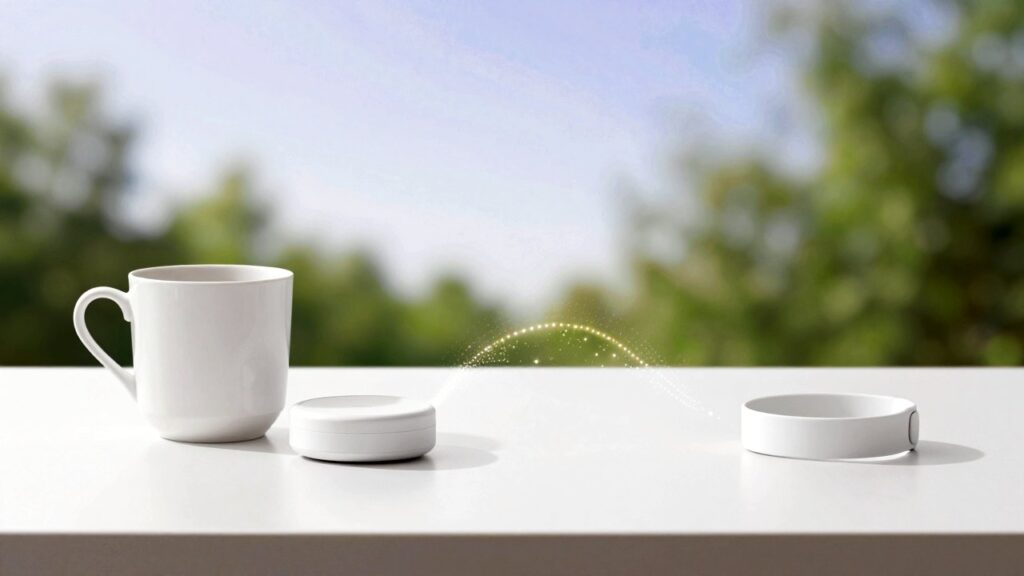
- Recreate it. A receiver worn as a wristband or necklace, or held in the hand, releases the matching scent from small reservoirs it already carries.
Think of it like a printer with five ink colours: the message says “print orange”, and the printer uses the orange it already has.
Five smells, and how well people recognised them
For now the system knows five everyday aromas with very different profiles: coffee, beer, red wine, cake and orange. In tests with 14 volunteers, people identified a single transmitted scent about 73 % of the time, and pairs of scents (say coffee with orange) about 71 % of the time, according to Tech Xplore. The wearable reacted to the sensor signal in 0.6 seconds, though classifying more complex food smells took from several to tens of seconds.
A cup for mixed reality
The team also built a “digital cup” that releases both scents and flavoured liquids. Wearing a mixed-reality headset (glasses that blend digital objects into the real room), a user picks a virtual drink, and the cup serves up the matching smell and taste in the real world. It’s a neat example of where XR could head next, after sight and sound coming from exactly the right place.
Honest limits
“At present, this is a research prototype,” Yang told Reuters. The e-nose recognises only those five scents; adding one means more training data and a new scented liquid. The system rebuilds a smell by category from preloaded channels, not its full chemistry, and the authors call their human tests simple, with limited controls that may introduce bias. Real-world use, scent accuracy, refills, cost and the safety of breathing the mist again and again all still need work.
What happens next
To leave the lab, Scentronic needs a much bigger and more varied library of smells and must handle messy real-life mixtures. Yang says a smartphone could one day talk to a small scent accessory, but squeezing everything into the phone itself would be hard. For now, it is a charming first step towards an internet you can smell.
Read next
- A screen that plays sound exactly where you see it
- Gaussian splatting: the 3D photo tech XR fans keep hearing about
- Self-powered glasses sensors read your pulse, blinks and bites
The week's best tech stories, free
One email a week with the stories that matter, explained simply. No spam.
Sources
- Sharing smells? New tech can transmit odours remotely – Reuters (Will Dunham) via CP24, 23 October 2026
- Something smells different as scientists send aromas over the internet – Tech Xplore (Paul Arnold), 22 October 2026
- Scentronic: An artificial intelligence-assisted olfactory interface for remote odor sharing and transmission – Science Advances (Yang et al.), October 2026