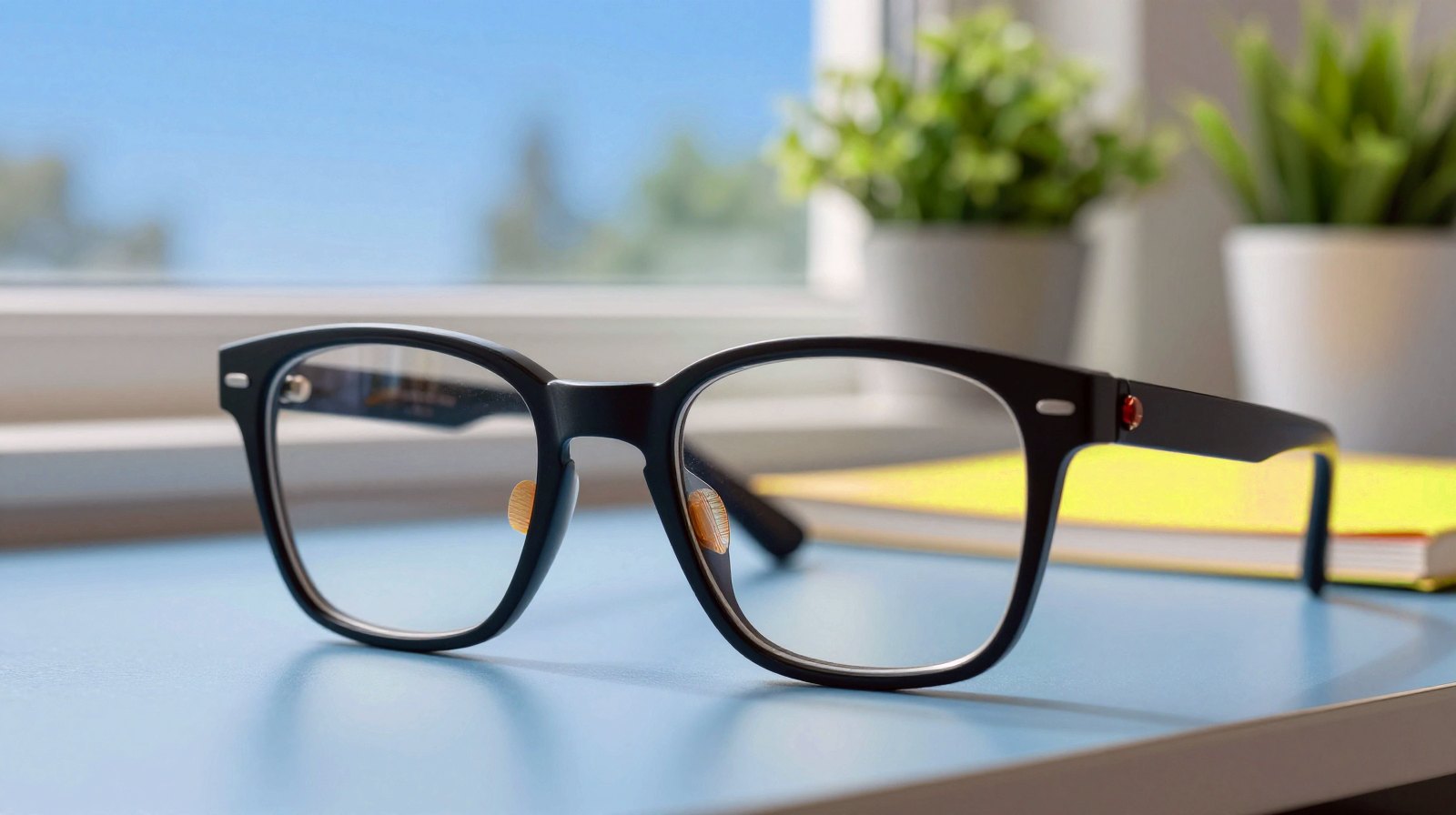
What if your everyday glasses could feel your pulse, notice when you clench your jaw and count your blinks, using sensors that make their own electricity from those very movements? Engineers at Northwestern University have built exactly that: a pair of ordinary-looking frames called GlassTENG, with three paper-thin sensors that turn the tiny motions of your face into electrical signals. As team leader Nivedita Arora put it to Tech Xplore, “a blink helps power the sensor that detects the blink.”
Why it matters: health wearables are only useful if you actually wear them, and the big reason people give up on them is charging. Glasses are something millions of people already put on every morning. Sensors that need almost no power could turn them into a quiet health companion that tracks heart rate, teeth grinding or eating habits without another gadget to plug in at night.
Static electricity, but useful
The trick is something you already know: rub a balloon on your jumper and it sticks to the wall. When two different materials touch and then pull apart, electric charge moves between them. This is called the triboelectric effect, and a sensor built on it is a triboelectric nanogenerator, or TENG.
Each GlassTENG sensor is a flexible stack of thin layers. When your face moves, or your artery pulses under the frame, the layers press together and separate, and each little squeeze produces a voltage. The sensor doesn’t need a battery to feel anything: the movement itself creates the signal.
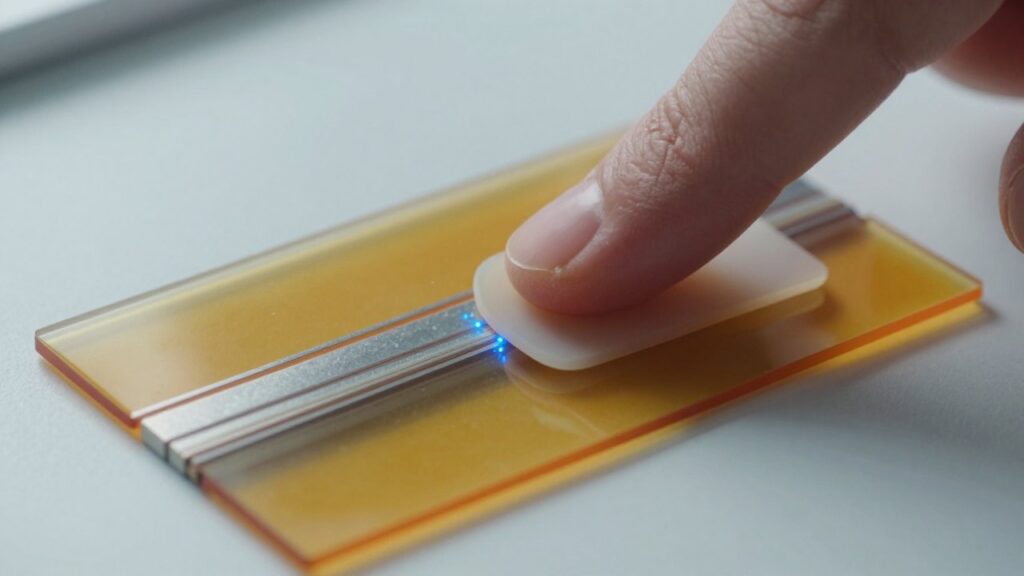
The three sensors sit where the face moves most:
- On the nose bridge: pulse, blinking and eyebrow movement.
- On the arm near the temple, over an artery just under the skin: pulse and jaw movement.
- Near the ear, over the chewing muscle: chewing and clenching.
What the tests showed
The team describes the work in a paper for the 2026 ACM International Symposium on Wearable Computers, also available as a preprint on arXiv. Here are the headline numbers:
- Tiny signals, tiny power. A pulse produces about 50 to 100 millivolts, a blink or eyebrow raise 200 to 500 millivolts, and a firm chew or clench up to 1.5 volts. The three sensors’ read-out electronics use about 4.1 microwatts together (1.36 microwatts each, according to the paper): just a few millionths of a watt.
- Good at telling faces apart. In a study with 20 volunteers doing six activities (blinking, raising eyebrows, clenching teeth, tapping teeth, eating and talking), the system recognised the right activity 93.8 % of the time overall, with 99 % for teeth tapping and 96 % for clenching.
- Heart rate, too. Compared with a chest-strap heart monitor, GlassTENG’s heart-rate estimates were off by an average of 1.82 beats per minute, measured over 30-second windows.
What it’s for
The researchers have a few targets in mind: spotting bruxism (unconscious jaw clenching and teeth grinding, which can wear teeth and cause headaches), keeping an eye on fatigue through blinking patterns, following eating behaviour, and tracking heart signals through the day. Co-author Nabil Alshurafa, also at Northwestern, told Tech Xplore that the future is about more than wearables that simply report what we did.
This is not medical advice, and GlassTENG is not a medical device: it’s a research prototype.
Should you wait for a pair?
Not just yet. A few honest caveats:
- Not entirely battery-free. The sensors make their own signals, but the prototype still streams its data to a phone or tablet over Bluetooth. Doing all the processing on the glasses without any battery is described as a long-term goal.
- Small study. Twenty people and six activities is a promising start, not proof that it works for everyone, all day, in real life.
- No product announced. There’s no price, brand or release date.
Still, the idea is lovely in its simplicity: the movements your face makes all day, from a blink to a bite of toast, become the power behind the sensors that watch over you. If this approach makes it into real frames, the smartest wearable you own might be the one perched on your nose.
Sources
- Blink-powered glasses harvest mechanical energy from facial movements to power sensors – Tech Xplore (Northwestern University), 13 October 2026
- GlassTENG: Self-Powered Triboelectric Nanogenerator based Sensing of Pulse, Jaw, and Upper Facial Activity from Everyday Glasses – R. N. Dave et al., arXiv, 7 July 2026
- GlassTENG (conference paper) – Proceedings of the 2026 ACM International Symposium on Wearable Computers