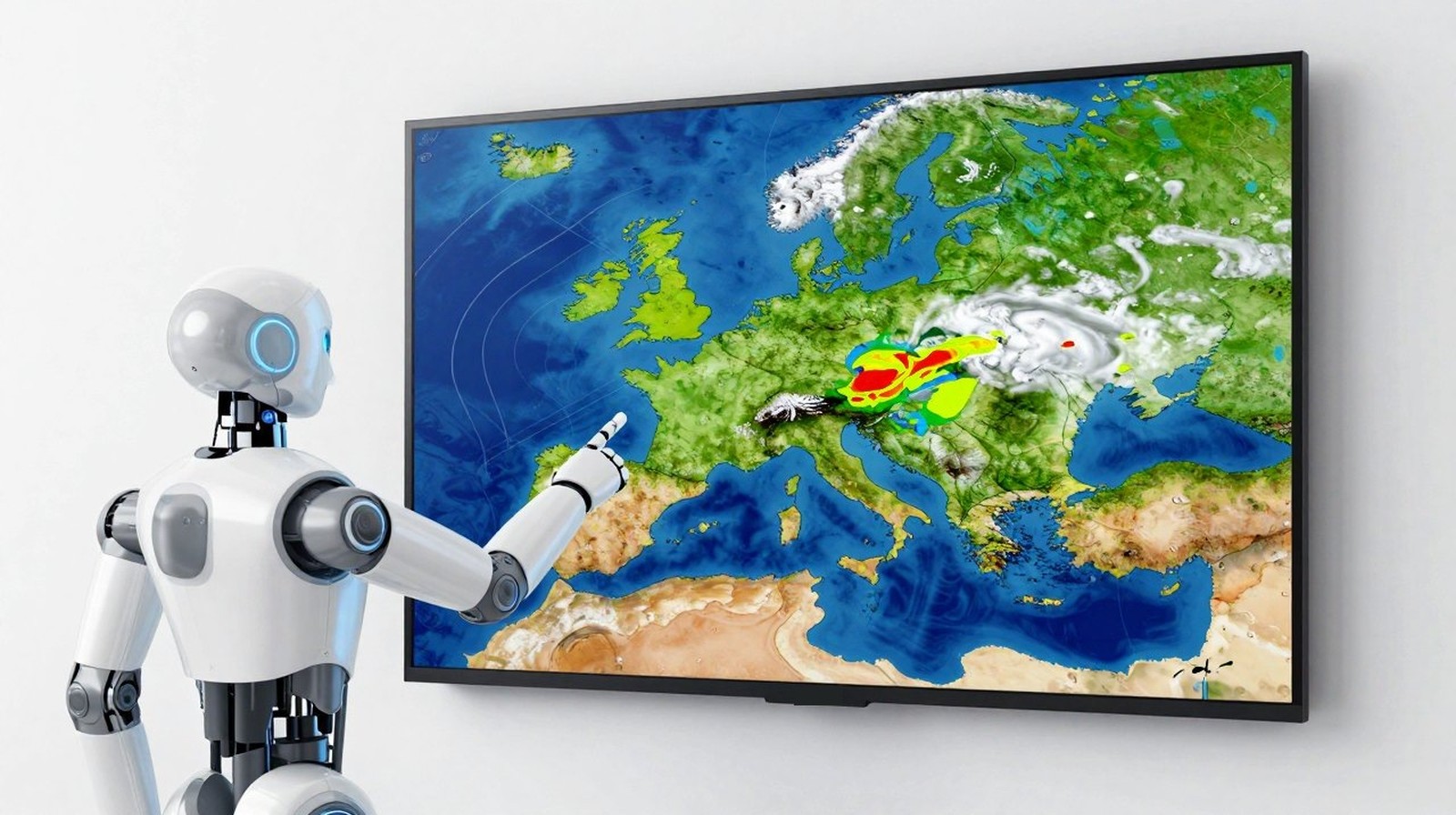
AI weather forecasts have gone from lab experiment to everyday tool in about three years. Today the European weather centre, the US weather service and China’s national forecasters all run artificial intelligence models every day, Google’s weather answers in Search and Maps come from one, and in October 2026 a study in Nature showed that a light AI add-on can make forecasts clearly better up to a month ahead.
Why it matters: a good forecast decides when farmers plant, when power companies brace for a cold snap and when a town evacuates before a flood. AI models are fast and cheap to run, so more countries can afford good forecasts and more scenarios can be tested before a storm. Here is how they work, which ones are really in use in November 2026, where you can see them yourself, and what they still get wrong.
How AI weather forecasts work
Classic forecasts are physics on a supercomputer. The model cuts the atmosphere into millions of boxes and solves the equations of air, heat and water step by step. This is called numerical weather prediction, and it is brilliant, but it takes hours on some of the biggest computers on Earth.
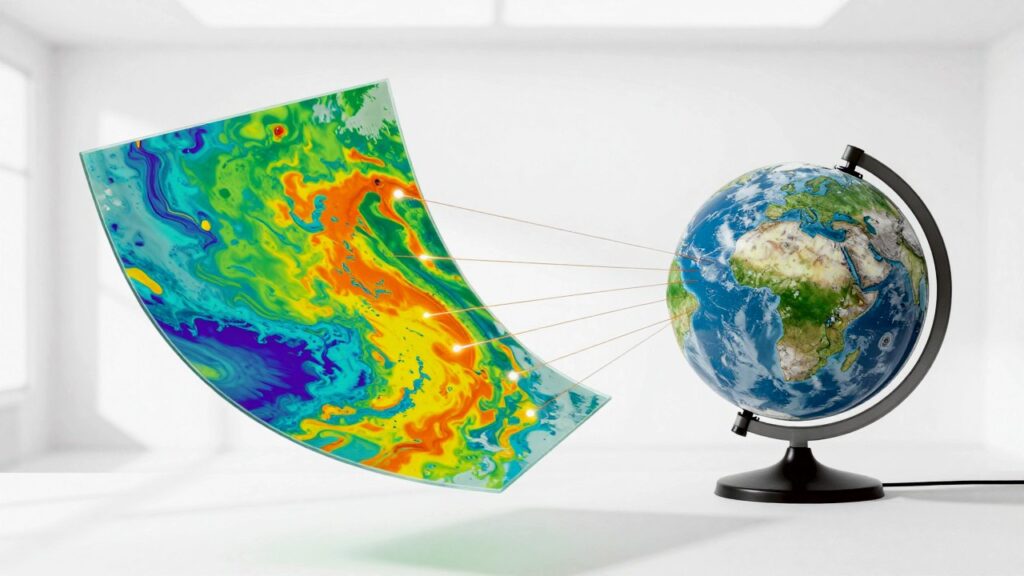
An AI model learns the same job by example. It studies about 40 years of past weather (a carefully rebuilt record called a reanalysis) and learns how the atmosphere usually changes from one moment to the next. Think of a chess player who has seen millions of games: they do not calculate every move, they recognise the pattern. Given today’s weather, it predicts six hours ahead, then repeats the step until it reaches 10 or 15 days.
The payoff is speed. The European Centre for Medium-Range Weather Forecasts (ECMWF) says its AI system uses roughly 1,000 times less energy than its physics model for a forecast. In the US, NOAA reports that one 16-day forecast from its AI model needs just 0.3 % of the computing power of the classic model and is ready in about 40 minutes.
One catch is easy to miss: most AI models still start from the “snapshot” of today’s atmosphere that physics-based systems build from satellites, balloons and weather stations. So AI and physics work as a team, and ECMWF itself calls the two complementary.
The main AI weather models in 2026
Several of these are open source: any weather service or university can download and run them.
| Model | Made by | What it is known for |
|---|---|---|
| GraphCast, GenCast, WeatherNext 2 and 3 | Google DeepMind and Google Research | GraphCast (2023) was an early star; GenCast gives many possible futures; WeatherNext 3 (September 2026) learns straight from live satellite data |
| AIFS (Single and Ensemble) | ECMWF, Europe | The first fully operational open AI forecast from a public weather centre |
| AIGFS, AIGEFS, HGEFS | NOAA, United States | AI versions of the US global model, built on GraphCast |
| Aurora | Microsoft | A “foundation model” for weather, air quality and ocean waves |
| Pangu-Weather | Huawei Cloud | Showed in 2023 that AI could be more than 10,000 times faster |
| Fengqing | China Meteorological Administration with Tsinghua University | China’s national AI forecast model |
| Earth-2 (Atlas, StormScope) | NVIDIA | Open models from 15-day forecasts down to 0-6 hour storm “nowcasts” |
Google DeepMind’s GenCast, published in Nature in December 2024, beat ECMWF’s top physics ensemble on 97.2 % of the 1,320 targets tested, DeepMind reported. Its newest model, WeatherNext 3, launched on 3 September 2026, gives hourly forecasts with a grid as fine as 5 km for temperature and humidity, and it now powers weather in Google Search, Gemini and Google Maps. Google says its rain forecasts improved by up to 60 % on one measure, though those figures are Google’s own.
Microsoft’s Aurora, described in Nature in May 2025, was trained on more than a million hours of data and also predicts air pollution and waves; a version of it produces forecasts for the MSN Weather app, as TechCrunch also reported. NVIDIA released its open Earth-2 family in January 2026, including StormScope for kilometre-scale storm forecasts up to six hours ahead (SiliconANGLE). These models run on graphics chips and Google’s TPUs, the AI processors we explained in our CPU, GPU, NPU and TPU guide.
NVIDIA Earth-2: an open toolbox to simulate the planet’s weather
NVIDIA, the company best known for the chips that train AI, has built its own weather “simulator”. In January 2026, at the American Meteorological Society’s annual meeting, it opened up Earth-2, which it calls the world’s first fully open, accelerated set of AI weather models and tools (NVIDIA, SiliconANGLE). Anyone, from a national weather service to a start-up, can download it, fine-tune it and run it on their own computers, for commercial or non-commercial use (SiliconANGLE).
Earth-2 covers every step of a forecast:
- The starting picture: HealDA builds the snapshot of today’s atmosphere (temperature, wind, humidity and pressure at thousands of points) in seconds on graphics chips, instead of hours on a supercomputer (NVIDIA).
- Up to 15 days ahead: the Atlas model forecasts more than 70 weather variables, including temperature, pressure, wind and humidity (NVIDIA, SiliconANGLE).
- The next six hours: StormScope zooms in to kilometre-sized detail to show where local storms and heavy rain will hit, in minutes. NVIDIA says it is the first AI to beat classic physics models at short-term rain forecasts (NVIDIA).
- Down to your town: CorrDiff turns coarse continental forecasts into sharp local ones, up to 500 times faster than traditional methods (NVIDIA).
It is already at work. The Israel Meteorological Service says Earth-2 cut its computing time by 90% at 2.5-kilometre detail, and after one rainstorm its CorrDiff-based model was the best of all its operational models for six-hour rain totals. The forecaster Brightband runs Earth-2’s 15-day model every day, The Weather Company is testing the storm nowcasts, and insurer AXA uses it to imagine thousands of possible hurricanes (NVIDIA). These figures come from NVIDIA and its partners, not independent tests.
Who really uses AI forecasts today
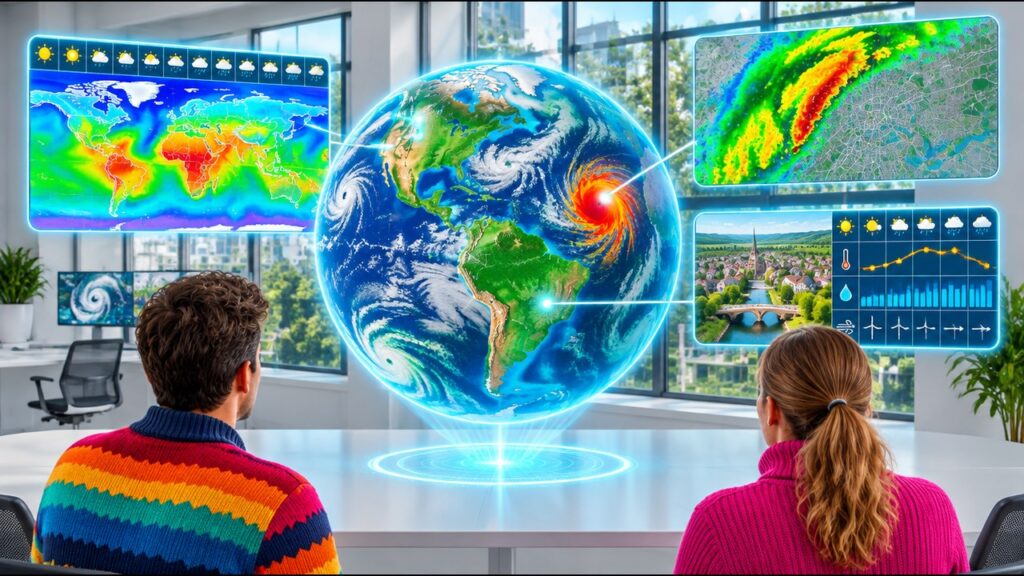
Europe. ECMWF, the centre most European weather services rely on, made its AIFS Single model operational on 25 February 2025 and the AIFS Ensemble (51 forecasts with small differences) on 1 July 2025. Version 2 arrived on 12 May 2026 with ECMWF’s first AI ocean-wave and snow-cover forecasts. The data is free and open.
Spain. The national weather agency AEMET is building its own AI model with Anemoi, ECMWF’s open training toolkit. At the Spanish Meteorological Association conference in February 2026, AEMET researchers showed early results for the Iberian Peninsula and the Canary Islands, including tests on the October 2024 DANA floods and Storm Filomena. They described real potential but also problems still to solve (AME 2026 abstract). For the DANA rain, AEMET’s own physics model still did best; the AI version beat ECMWF’s AIFS but smoothed the extremes (AME presentation). In other words: in development, not yet the official forecast.
United States. NOAA switched on three AI global models on 17 December 2025, including a “hybrid” ensemble that mixes 31 physics forecasts with 31 AI ones, a first for an operational centre (also covered by the World Meteorological Organization).
Asia. China’s Fengqing model, built by the China Meteorological Administration and Tsinghua University, is in national operational use, according to China Daily and a CMA briefing on the 2025 typhoon season.
Latin America. In September 2026 Mexico’s national weather service (SMN, part of Conagua) signed a four-year agreement with Google to test and validate AI forecasting tools for Mexican conditions, including flash-flood alerts (La Crónica, TeleSemana). Worldwide, the WMO agreed in October 2025 to build AI into the global forecasting system, with extra help for lower-income countries.
A month ahead: the gap AI is starting to close
Forecasts are great for tomorrow and good for next week, but two to six weeks ahead (forecasters call it “subseasonal”) has long been the weakest zone. That is exactly where the Nature study from October 2026 helps. Its method, Probabilistic Bias Correction, works like a spell-checker: it takes an existing model’s forecast and fixes it, learning from the model’s past mistakes, recent weather trends and each place’s usual climate (Science Media Centre Spain).
Applied to ECMWF’s model, it roughly doubled forecast skill two to six weeks out, won ECMWF’s 2025 AI forecasting competition, needs no supercomputer and is open source (MIT via Phys.org; Nature news). Independent experts were positive but careful: the biggest gains were in the tropics, with less of a boost over Europe. Do not expect “rain on Saturday the 14th” a month ahead; expect a more honest “a warmer, wetter week than usual is likely”.
Hurricanes and extreme weather
Storms are where AI has shone most. ECMWF reported track gains of up to 20 % for tropical cyclones with its AI model. In August 2026 Google DeepMind published WeatherNext Cyclones in Nature, together with forecasters from the US National Hurricane Center: its three-day forecasts are about as accurate as older systems at two days, roughly a full extra day to prepare (DeepMind, Singularity Hub). During the 2025 season it helped the hurricane centre foresee Hurricane Melissa’s rapid strengthening before it hit Jamaica.
The limits: what AI still gets wrong
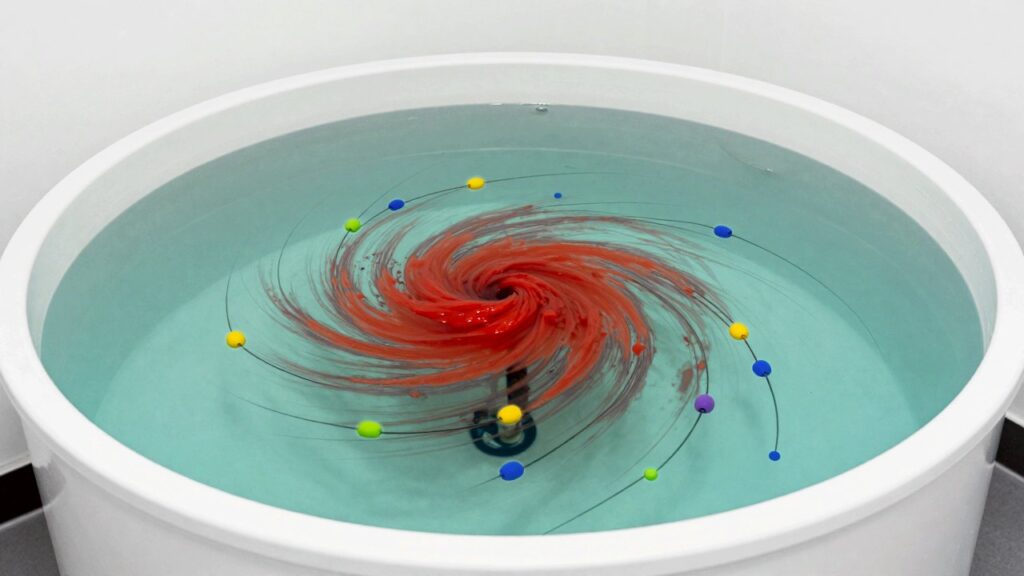
- Extremes get smoothed. AI models learn averages well, so the very highest rainfall or wind peaks can come out too gentle. The WMO notes big challenges remain for local high-impact weather, and AEMET found the same.
- Track yes, strength not always. NOAA says its first AI model improves hurricane tracks but is weaker on intensity.
- Coarser detail. ECMWF’s AI ensemble runs on a 31 km grid against 9 km for its physics ensemble, which stays essential for fine detail.
- Learned from the past. A warming climate brings weather the training data has rarely seen, so constant checking matters.
- Not the official word. Google itself says official warnings must come from your national weather service.
Weather AI websites: where you can see AI forecasts yourself
You do not need a supercomputer to peek at these models. All of these are free to look at (we checked they were online on 10 November 2026):
- ECMWF Charts (charts.ecmwf.int): official, free AIFS maps of pressure, wind, rain and temperature for the whole planet, next to the physics model. Best for weather fans who like maps.
- Google Weather Lab (deepmind.google.com/science/weatherlab): Google’s experimental site with global maps and storm tracks from WeatherNext, compared with ECMWF. Free, clearly labelled as research.
- Google Search, Gemini and Google Maps: type “weather” plus your town and the answer uses WeatherNext 3. The easiest option for everyday use.
- MSN Weather (msn.com/weather): free forecasts that Microsoft says use a version of Aurora.
- Tropical Tidbits (tropicaltidbits.com): a free, long-running model-map site that lists ECMWF’s AIFS and AIFS Ensemble beside classic models. Great for hurricane season.
For warnings, always use your national service: AEMET in Spain, the National Weather Service in the US, SMN in Mexico or Argentina.
Key takeaways
- AI weather forecasts learn from decades of past weather and run around 1,000 times more efficiently than physics models.
- ECMWF, NOAA and China’s weather agency use AI models every day; Spain’s AEMET is developing its own.
- A Nature study doubled forecast skill two to six weeks ahead with a light, open AI correction.
- Storm tracks are a big win; extreme peaks and storm strength are still weak spots.
- You can see AI forecasts free on ECMWF Charts, Google Weather Lab, Google Search and Tropical Tidbits.
What happens next
Expect more “hybrid” forecasts that blend AI and physics, more national services training their own models with open tools like Anemoi, and AI starting to build the starting snapshot of the atmosphere itself, as NVIDIA’s HealDA and Google’s satellite-fed WeatherNext 3 already try. The month-ahead correction is public, so weather services can test it now. AI is learning physics in other fields too.
AI courses on Udemy, from the basics to building your own apps, at your own pace.See courses with the discount →Best AI certifications →
Read next
- One AI learns to simulate sand, water, cloth and proteins
- What are the CPU, GPU, NPU and TPU? The definitive guide
- AI wrote 700 maths papers: what Lean proof checks really mean
The week's best tech stories, free
One email a week with the stories that matter, explained simply. No spam.
Sources
- Advancing subseasonal forecasting with machine learning – Guan, Mouatadid, Orenstein et al., Nature, 14 October 2026
- An AI tool improves weather forecasts up to a month ahead – Nature news, 21 October 2026
- AI-enhanced weather model doubles predictive power two to six weeks out – Phys.org / MIT News, 14 October 2026
- Expert reactions: AI method improves forecasts up to six weeks ahead – Science Media Centre Spain, 14 October 2026
- ECMWF’s AI forecasts become operational – ECMWF, 25 February 2025
- ECMWF’s ensemble AI forecasts become operational – ECMWF, 1 July 2025
- Significant update to ECMWF’s key forecasting systems IFS and AIFS goes live – ECMWF, 12 May 2026
- NOAA deploys new generation of AI-driven global weather models – NOAA, 17 December 2025
- NOAA deploys new generation of AI-driven global weather models – WMO, 17 December 2025
- Probabilistic weather forecasting with machine learning (GenCast) – Price et al., Nature, 4 December 2024
- GenCast predicts weather and the risks of extreme conditions – Google DeepMind, 4 December 2024
- Introducing WeatherNext 3 – Google, 3 September 2026
- Google’s WeatherNext 3 learns weather directly from live satellite data – The Decoder, 6 September 2026
- Operational tropical cyclone forecasting with AI – Alet et al., Nature, 6 August 2026
- WeatherNext AI model achieves breakthrough in forecasting cyclones – Google DeepMind, 6 August 2026
- DeepMind’s weather AI predicts hurricanes a day earlier – Singularity Hub, 17 August 2026
- A foundation model for the Earth system (Aurora) – Bodnar et al., Nature, 21 May 2025
- Microsoft’s Aurora AI foundation model goes beyond weather forecasting – Microsoft, 21 May 2025
- Microsoft says its Aurora AI can accurately predict air quality, typhoons and more – TechCrunch, 23 May 2025
- Accurate medium-range global weather forecasting with 3D neural networks (Pangu-Weather) – Bi et al., Nature, 5 July 2023
- Earth-2 launch: HealDA, Atlas and StormScope – NVIDIA Research, 26 January 2026
- Nvidia launches Earth-2 open AI weather forecast models and tools – SiliconANGLE, 26 January 2026
- China unveils a new AI meteorological model – China Daily, 19 December 2025
- FengQing and its performance in the 2025 typhoon season – China Meteorological Administration / ESCAP-WMO Typhoon Committee, 2025
- Anemoi: AEMET’s AI weather prediction model, first results and extreme events – Toledano et al., AEMET, XXXVII AME conference, February 2026
- Anemoi at AEMET (presentation) – AME conference, Málaga, February 2026
- Conagua-SMN and Google agree AI cooperation for forecasts – La Crónica de Hoy, 28 September 2026
- Google signs agreement with Mexico to strengthen early weather warnings – TeleSemana, 29 September 2026
- World Meteorological Congress endorses actions to promote AI for forecasts and warnings – WMO, October 2025
- NVIDIA Launches Earth-2 Family of Open Models – NVIDIA Blog, 26 January 2026
Disclosure: this article contains affiliate links
If you buy through them, the editorial company may earn a commission at no extra cost to you. Our picks are based on specifications, prices and published reviews, not on any payments.