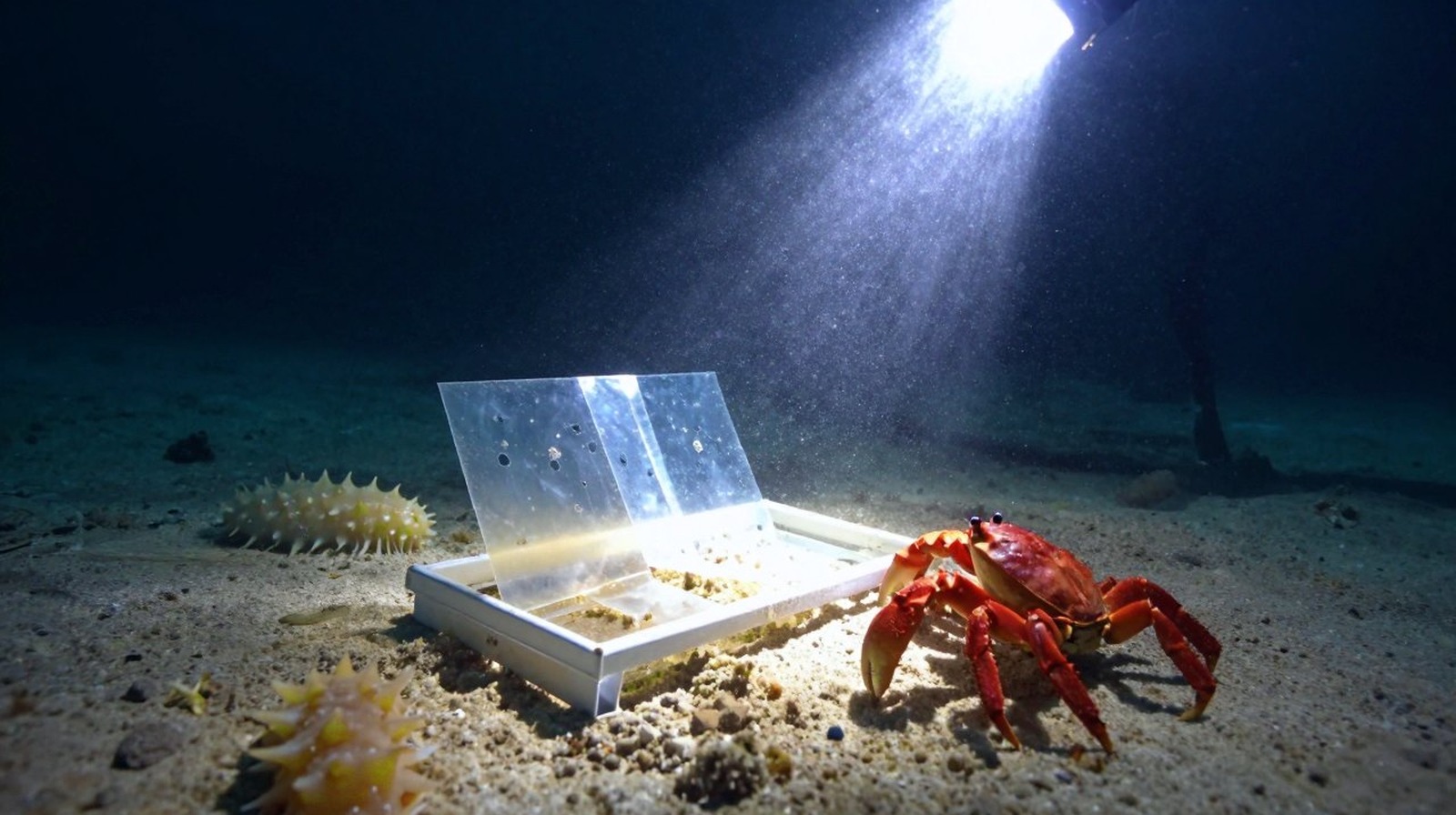
Here’s a plastic that carries its own clean-up crew. Researchers in Japan mixed tiny amounts of natural plastic-eating enzymes into compostable plastics, and the result broke down almost completely in the deep sea, they report in Nature. At 757 metres below the surface, the films were nearly gone within five months.
Why it matters: plastics sold as “compostable” usually do break down, but only in an industrial composting plant, warm and full of hungry microbes. Out at sea, and especially in the cold, dark deep sea, they can last a very long time. The new trick gives the plastic its own enzymes, so it doesn’t have to wait for the right microbes to find it.
Enzymes with an on switch
Enzymes are nature’s tiny scissors: proteins that cut big molecules into small pieces. The team from the University of Tokyo, the Japan Agency for Marine-Earth Science and Technology (JAMSTEC) and Gunma University used two natural ones, cutinase and lipase, which can snip the chemical links in polyester plastics. According to the universities’ announcement, reported by IBTimes Japan, the enzymes are mixed in while the plastic is being heated and shaped.
The clever part is what the researchers describe as a biodegradation “start switch”. While the plastic stays dry, the enzymes sit still and the item works as normal. Once it ends up in water, the enzymes wake up and start cutting. In the tests, the enzyme-filled plastics stayed about as strong and flexible as ordinary ones.
From a harbour to 5,500 metres down
The team tested four compostable polyesters with tongue-twister names (PBS, PBSA, PCL and PBAT) in very different places:
- A harbour at 2-6 metres deep. At JAMSTEC’s quay in Yokosuka, on Tokyo Bay, thin test films almost disappeared within a month. Even 0.1 % enzyme by weight was enough for fast breakdown in coastal seawater.
- The deep sea at 757 metres. Off Misaki, south of Tokyo, three of the plastics (PBS, PBSA and PCL) broke down almost completely within five months.
- The abyss at 5,503 metres. On the deepest seafloor, cold and under huge pressure, the breakdown was slower: the paper calls it “moderate”. Still, enzyme-filled films broke down faster than plain ones at every deep site.
The deep-sea samples were placed and collected with Japan’s crewed submersible Shinkai 6500 and left there for between 3 and 18 months.
Truly gone, not just smaller
A big worry with “degradable” plastics is that they simply crumble into microplastics. Here the researchers checked the chemistry: they found small breakdown molecules, and oxygen-consumption measurements (a sign that microbes were eating those pieces) supported mineralisation. That’s the scientific word for turning the plastic into carbon dioxide and water.
This builds on the same group’s earlier work. In 2024 they showed that microbes on the deep-sea floor, at 757 to 5,552 metres, can digest some biodegradable plastics, but that the breakdown slows with depth and that the popular bioplastic PLA didn’t break down at all, as Science Japan reported. Embedding enzymes is the answer to “what if the right microbes aren’t there?”
What it means for you, and what’s next
Don’t expect enzyme plastic bags at the supermarket next week. The paper is a proof of concept: it doesn’t cover cost, mass production or long-term effects, and it only works on these compostable polyesters, not on everyday plastics like PET bottles or polythene bags. It’s also no excuse to throw anything into the sea.
But it points to a useful future for things that are easily lost at sea, which is exactly where ordinary “compostable” plastics fail. Materials science keeps surprising us, from alloys that stay tough at -253 °C to threads that carry circuits, and plastics that clean up after themselves would be a very welcome addition.
Read next
- Cold-resistant alloys stay tough at -253°C, where metals snap
- Washable circuit fibres: threads that glow, compute and sense
- 3D printing grows metre-long single crystals of metal
The week's best tech stories, free
One email a week with the stories that matter, explained simply. No spam.
Sources
- Enzyme-embedded polyesters for accelerated biodegradation in the deep sea – Huang, Iida, Isobe, Kabe, Omura, … Nomaki, Kasuya, Iwata, Nature, 21 October 2026
- University of Tokyo team speeds biodegradable plastic breakdown up to 80-fold – IBTimes Japan, 23 October 2026
- The University of Tokyo demonstrates that biodegradable plastics can be degraded by microorganisms in the deep ocean – Science Japan (JST), April 2024