Disclosure: this article contains affiliate links to online courses. If you sign up through them, DIGITAL WOXTER TECHNEWS may earn a commission at no extra cost to you. We choose courses for their content, not for payments.
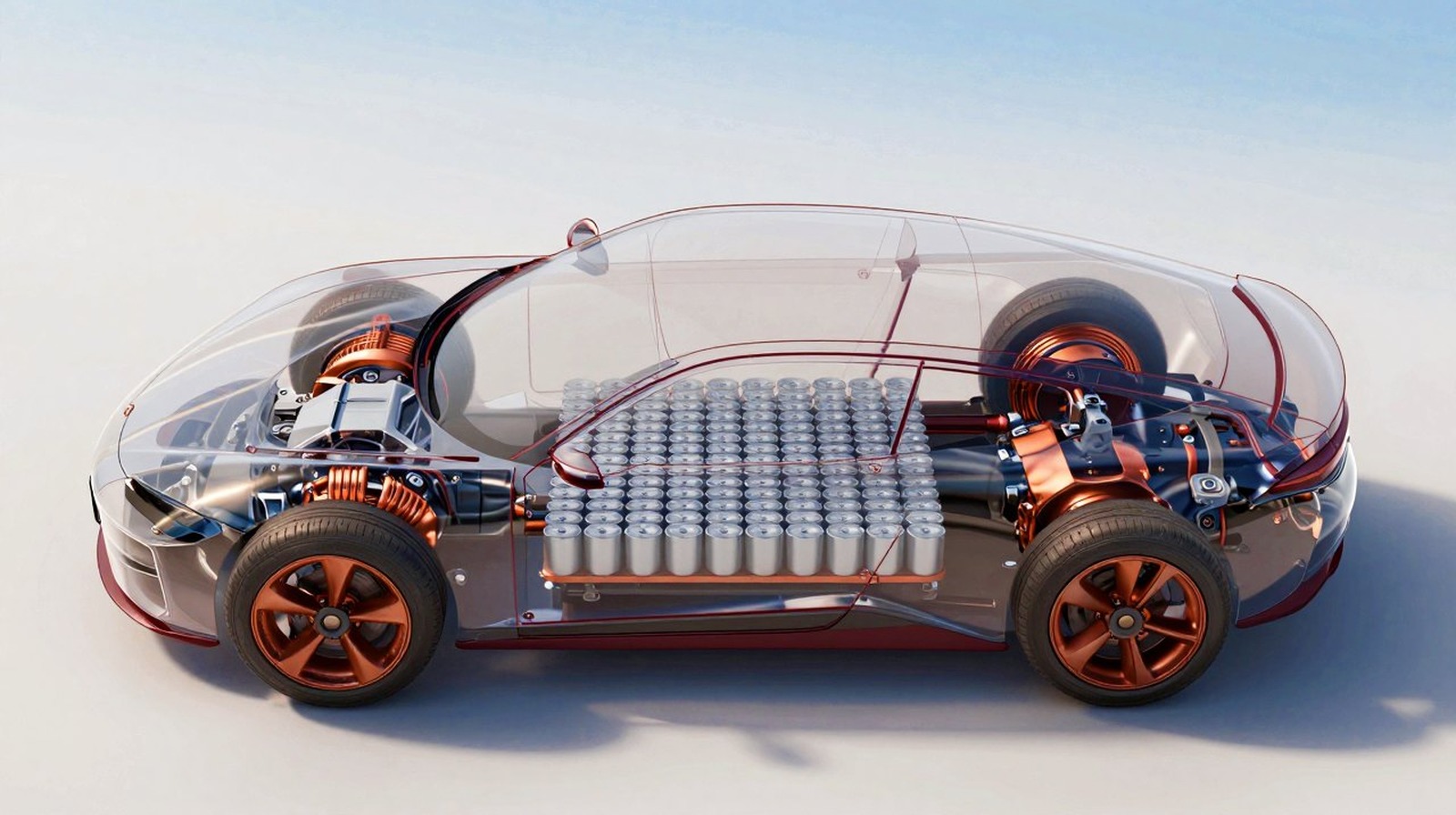
Mercedes-Benz is now building a new kind of electric motor in series: the axial-flux motor, which is shaped like a thin disc instead of the usual long cylinder. Since June 2026 these motors have been coming off seven production lines in Berlin-Marienfelde, the carmaker’s oldest working plant, founded in 1902. They are going into the new electric Mercedes-AMG cars: three per car, each one less than 9 cm wide, about the length of a bank card.
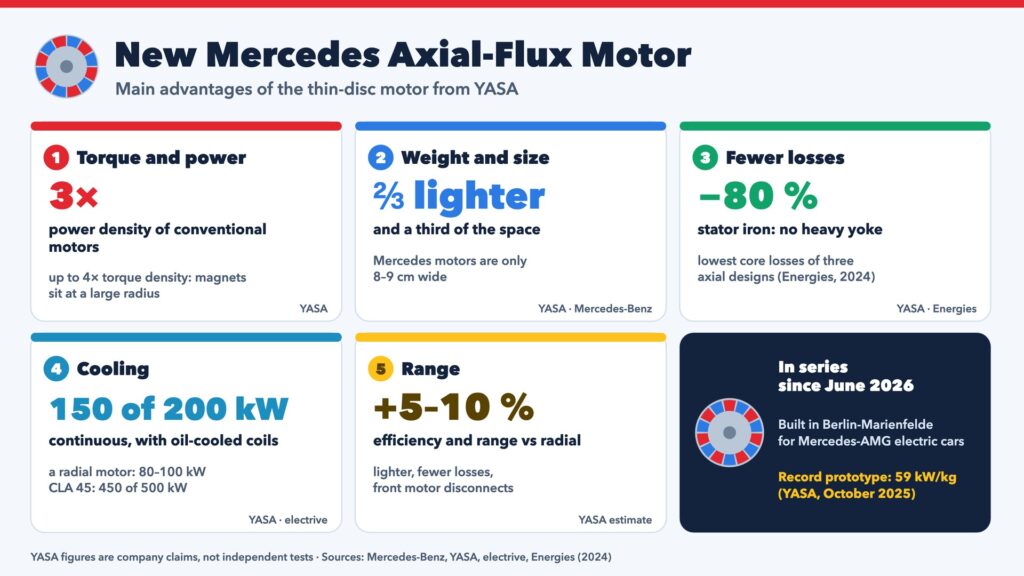
Why it matters: the technology comes from YASA, a British company from Oxford that has been a wholly owned Mercedes-Benz subsidiary since 2021. YASA says its motors deliver about three times the power density of conventional electric motors while being about two-thirds lighter and taking a third of the space. Those are company figures, not independent tests, but the physics behind them is simple and rather beautiful. Let’s take the motor apart, one diagram at a time.
First, what was announced
On 9 June 2026 Mercedes-Benz started large-scale production of the motor, and electrive reported the details: around 30,000 square metres of factory, three halls and seven lines. Building it takes 98 process steps, and 35 of them are being used for the first time anywhere in the world.
The first car to use it is the electric Mercedes-AMG GT 4-Door Coupé, unveiled in May. It has one axial-flux motor at the front and two at the rear. In the GT 63 they add up to 860 kW (about 1,169 hp) at peak and 530 kW continuously, enough for 0-100 km/h in 2.1 seconds. In July Mercedes-AMG brought the same layout to the smaller CLA 45: three axial-flux motors, 500 kW peak, 450 kW continuous and 1,759 newton-metres of torque.
Cylinder or disc: where the field points
Every electric motor works the same way at heart: permanent magnets on the spinning part (the rotor) are pulled along by electromagnets made of copper coils on the fixed part (the stator). What changes is the shape, and with it the direction of the magnetic field, which engineers call the flux.
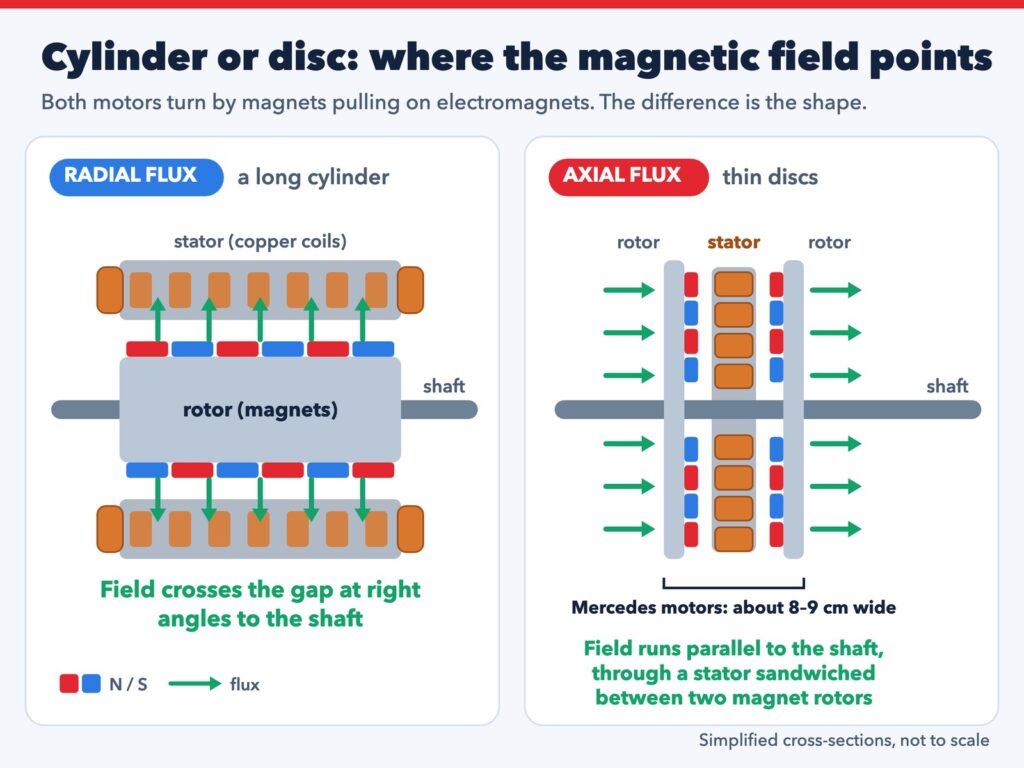
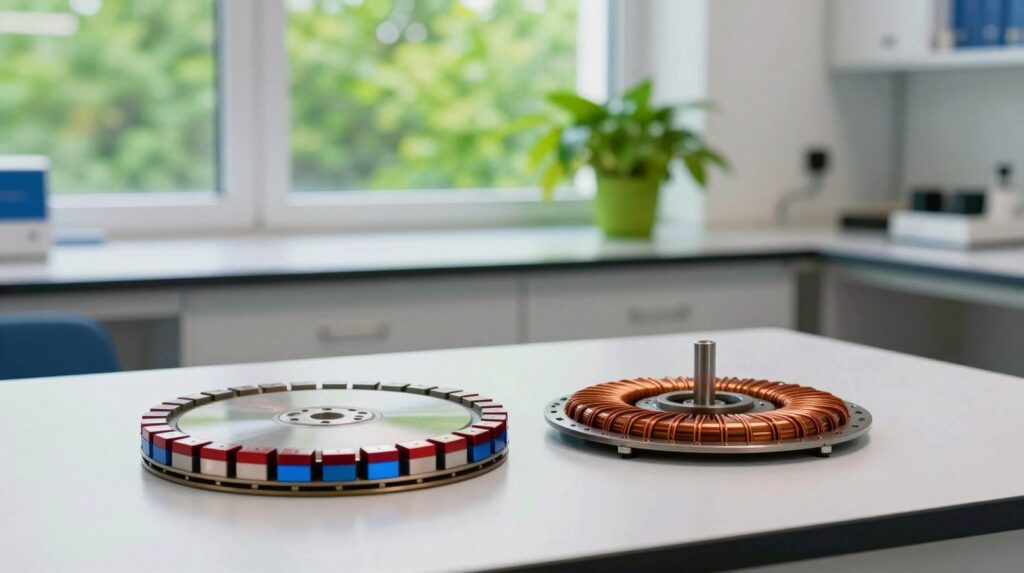
In almost every electric car today the motor is radial-flux: a long cylindrical rotor spins inside a ring-shaped stator, and the field jumps across the gap at right angles to the shaft, like the spokes of a wheel. In an axial-flux motor everything is flattened into discs. As Mercedes-Benz describes it, the stator sits like the filling of a sandwich between two rotor discs, and the field runs parallel to the shaft. The result is very slim: the front motor is just under 9 cm wide and each rear motor about 8 cm.
More torque: it’s all about the radius
Torque is the twisting force that gets a car moving, and it follows a rule you already know from a spanner: torque = force × radius. Push with the same force on a longer spanner and the stubborn bolt turns. YASA puts it exactly this way: the bigger radius of an axial machine immediately raises the torque.
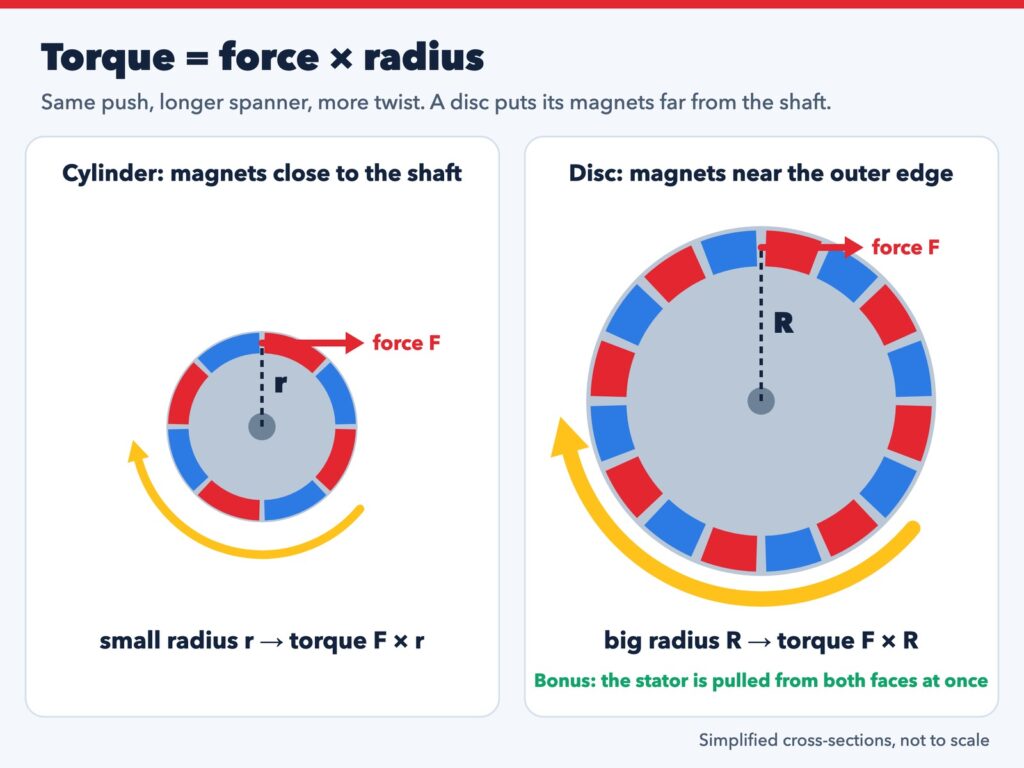
In a disc motor the magnets sit near the outer edge, far from the shaft, so every bit of magnetic pull acts on a long lever. And because the stator has a rotor on each side, it is pulled from both faces at once. YASA says its motors reach up to four times the torque density of other EV motors. A 2022 review in the journal Machines sums up the same family of motors as compact, with high power and torque density.
Less iron and copper: lighter, with fewer losses
YASA stands for “Yokeless And Segmented Armature”, and the name tells the story. A normal stator is a ring of iron teeth joined by a thick outer band of iron, the yoke, which carries the magnetic field around from one tooth to the next. YASA’s design leaves the yoke out: each coil is wound on its own separate iron segment, and the field crosses straight through it from a magnet on one rotor to a magnet on the other.
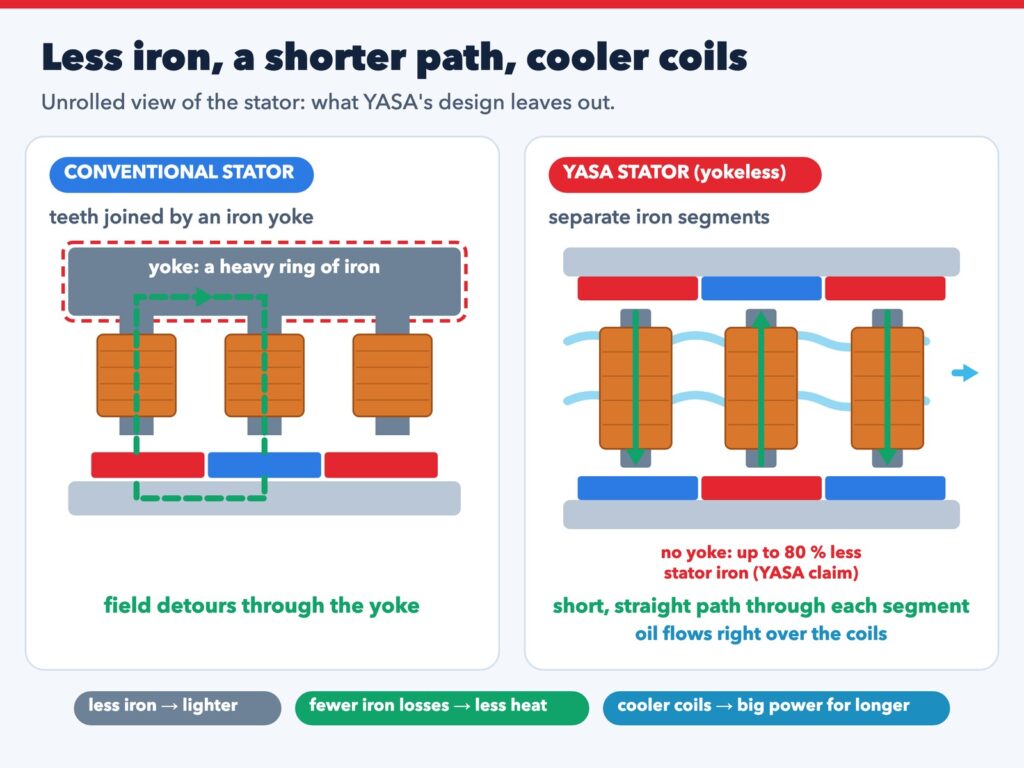
According to YASA, dropping the yoke cuts the stator’s iron by up to 80 %, and its motors use less copper, iron and magnet material overall. Less iron is not only less weight. Iron wastes a little energy every time the field flips direction, which happens hundreds or thousands of times a second, and that waste ends up as heat. An independent 2024 study in Energies compared three axial-flux layouts with 3D simulations and found that the yokeless, segmented one was best at keeping these “core losses” low.
The copper gets a makeover too. Mercedes winds the stator with rectangular wire instead of round wire, so more copper fits in the same space, a bit like stacking books on a shelf instead of logs.
A short path and cool coils
Without a yoke the magnetic field takes a short, straight route through each segment instead of a detour around the ring. The coils are also easy to reach: YASA combines short windings with direct oil cooling, and Mercedes-AMG cools its motors and gearboxes with oil. We have seen the same idea in computing, where bringing the coolant right to the hot spot lets chips work harder.
Heat is what limits how long any motor can keep giving its best. YASA’s own example: a 200 kW YASA motor can run at 150 kW continuously, where it says a comparable radial motor drops to 80-100 kW. The production cars show a similar pattern: the CLA 45 can deliver 450 of its 500 peak kilowatts continuously.
From the motor to more kilometres
Range depends on the whole car (battery, aerodynamics, tyres, weight), but the motor helps in three ways.
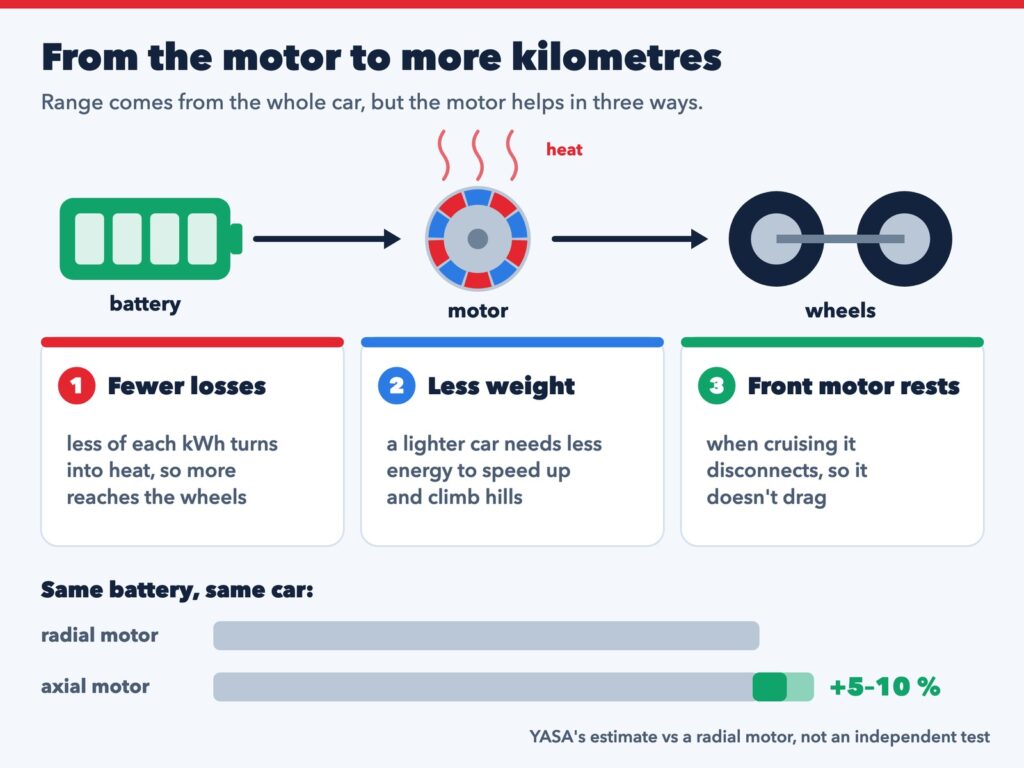
- Fewer losses. Every kilowatt-hour that doesn’t turn into heat inside the motor reaches the wheels instead.
- Less weight. A lighter car needs less energy to speed up and to climb hills.
- A front motor that rests. In the AMG GT, the front motor is a booster that can be decoupled under light load, so it doesn’t drag when you are cruising.
YASA estimates that the weight savings can give 5-10 % more efficiency and range than a radial machine. That is the company’s estimate, not an independent test. For reference, Mercedes-AMG quotes a WLTP range of 596-696 km for the GT 63 from a 106 kWh battery, and more than 670 km for the CLA 45 saloon from 94 kWh. Batteries are improving too, as our story on rechargeable zinc-air cells shows. And range also hides in simple places: soft tyres waste energy in any car, which is why our guide to car gadgets worth buying includes a cordless tyre inflator.
The catch, and what happens next
Disc motors are hard to build. During final assembly, Mercedes-Benz says, magnetic forces of up to 9 kN (roughly the weight of a small car) try to slam the rotor discs onto the stator, yet the gap must be held to less than 0.1 mm, so a control algorithm corrects the position in the last half-second. Developing these steps produced more than 30 patent applications.
For now the motor lives in expensive AMG cars, but the CLA 45 already shows it moving down the range. YASA is still pushing the limits: in October 2025 it showed a 12.7 kg prototype with a short-term peak of 750 kW, an unofficial record of 59 kW per kilogram, as Electrek also reported. That prototype is not in production. Watch for independent tests of the new AMG cars: they will show how much of the disc motor’s promise reaches the road.
Key takeaways
- Mercedes-Benz has built YASA’s axial-flux motor in series in Berlin since June 2026, for the electric AMG GT 4-Door Coupé and the CLA 45.
- The field runs parallel to the shaft through thin discs, so magnets sit at a large radius, and torque = force × radius.
- No iron yoke means less iron, lower core losses and a short magnetic path; oil cools the coils directly.
- Lighter, more efficient motors help range; YASA estimates 5-10 % versus a radial motor.
Learn it yourself
Want to go further? These online courses cover the skills behind this story:
- Electric Vehicles and Mobility Coursera: A free-to-audit beginner course from École des Ponts on how electric cars, charging and the wider shift to electric mobility work, for any background.
See the course on Coursera
Read next
- Zinc-air batteries that recharge: new catalyst runs 300 hours
- Boiling coolant inside chips: a safer way to tame AI heat
- Tesla renames Full Self-Driving to ‘Assisted Driving’ in Europe
The week's best tech stories, free
One email a week with the stories that matter, explained simply. No spam.
Sources
- Mercedes-Benz starts large-scale production of electric axial flux motor in Berlin-Marienfelde – Mercedes-Benz Media, 9 June 2026
- Mercedes-Benz begins axial flux motor production in Berlin – electrive, 10 June 2026
- Electric powerhouse: Mercedes-AMG unveils GT 4-Door Coupé – electrive, 20 May 2026 (updated 28 May 2026)
- Mercedes-AMG unveils electric CLA 45 with three axial-flux motors – electrive, 10 July 2026
- YASA industrialises axial flux motor production under Mercedes-Benz – Automotive Manufacturing Solutions, 22 July 2026
- Concept AMG GT XX: a new dimension of performance – YASA, 25 June 2025
- Axial flux technology – YASA (company claims), accessed 23 October 2026
- YASA smashes own unofficial power density world record (59 kW/kg) – YASA, 22 October 2025
- YASA just destroyed its own record for power density with its axial flux motor – Electrek, 22 October 2025
- A Review of Axial-Flux Permanent-Magnet Motors: Topological Structures, Design, Optimization and Control Techniques – Hao et al., Machines, 2022
- Axial Flux Permanent Magnet Motor Topologies Magnetic Performance Comparison – Wang, Zeng, Eastham and Pei, Energies, 2024