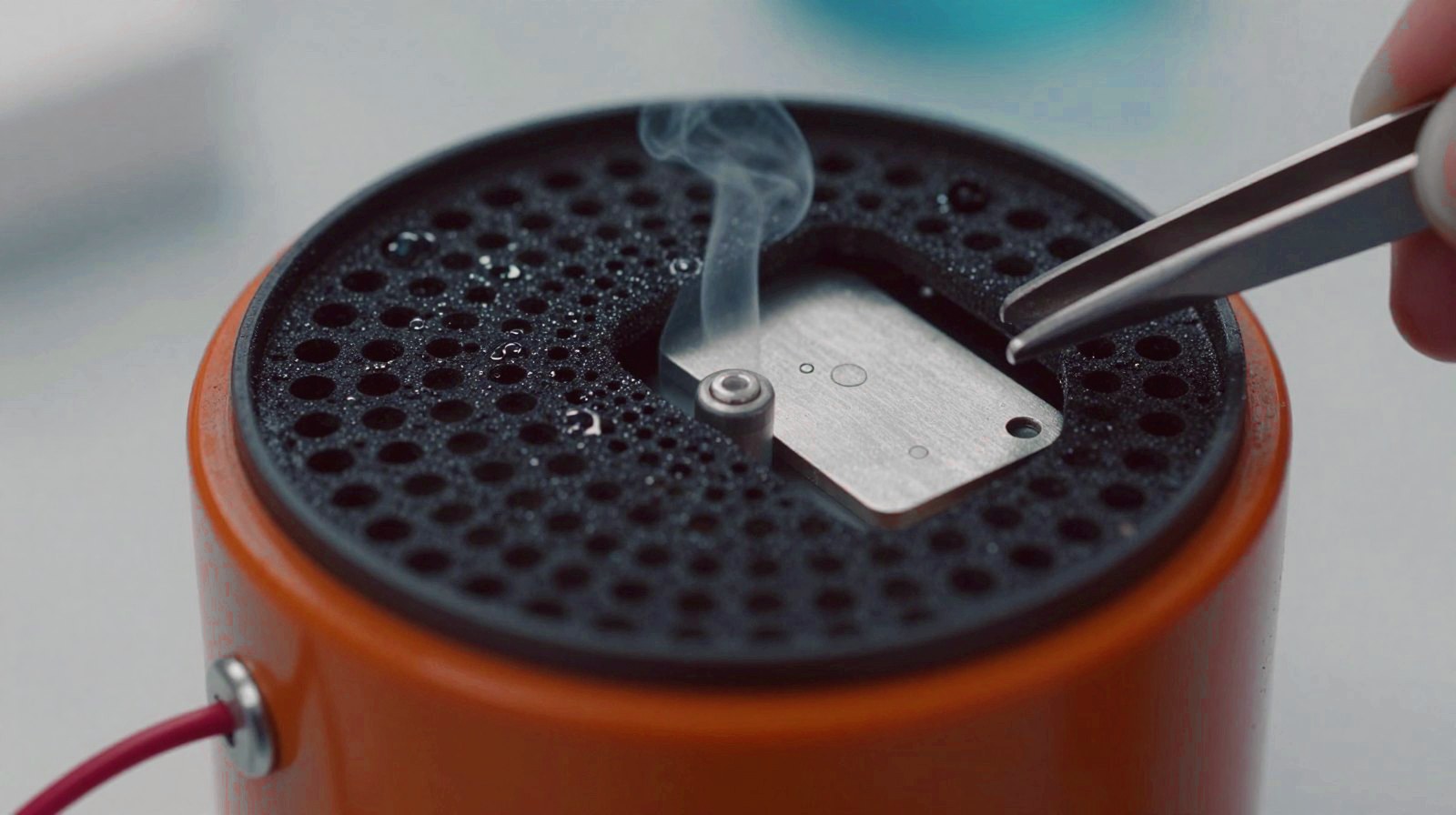
If anyone in your family wears a hearing aid, you have probably met a zinc-air battery: a tiny button cell with a sticker you peel off to “wake it up”. It works for a few days and then goes in the bin. Chemists at TU Darmstadt in Germany have now made a big step towards a zinc-air battery you can recharge. A new catalyst made from iron, nickel and carbon kept a test cell charging and discharging for more than 300 hours, the team reports in the journal Advanced Science.
Why it matters: on paper, zinc-air batteries can store up to five times more energy than the lithium-ion batteries in our phones and cars, according to the university. They run on zinc, a common metal, plus oxygen pulled from the air. The big catch has always been recharging them. Every step on that problem brings a cheaper, safer kind of battery a little closer.
A battery that breathes
A zinc-air battery literally breathes. When it gives you power, oxygen from the air reacts with zinc inside the cell. To recharge it, you have to run that reaction backwards and push the oxygen out again.
Both directions are hard work for the chemistry. Each one needs a catalyst (a helper material that speeds up a reaction without being used up), and most catalysts are good at only one of the two jobs. A battery that recharges needs one material that does both, again and again, without wearing out. Scientists call that “bifunctional”, which simply means “two jobs, one material”.

What the Darmstadt team built
The team led by chemist Jörg J. Schneider started from spinels, a large family of minerals. Their pick is nickel ferrite, a compound of nickel, iron and oxygen, like the natural mineral trevorite. They grew particles only a few nanometres across (a nanometre is a millionth of a millimetre) and anchored them firmly onto “carbon nanohorns”, tiny cone-shaped carbon structures. They also sprinkled nitrogen and phosphorus into the carbon surface, Tech Xplore reports.
The result is a material that does three things at once: it carries electricity, it stays chemically stable, and it activates oxygen. That matters at what the researchers call the “triple junction”, the tiny meeting point where the solid catalyst, the liquid electrolyte and oxygen from the air all touch. If that spot breaks down, the battery dies. In the team’s tests, a rechargeable cell built with the new catalyst kept going for more than 300 hours of charging and discharging, Interesting Engineering reports.
So, should you wait for one?
Not yet. This is a lab result, not a product, and the university itself calls it an “important step” rather than a finished battery. Rechargeable zinc-air cells still face other hurdles. Zinc can grow needle-like crystals called dendrites that short-circuit the cell, and the oxygen reactions are slow. A review in the Journal of Materials Chemistry A names exactly these problems as the main barriers to large-scale use.
The upside is what keeps researchers going. Zinc is abundant, easier to recycle and less toxic than lithium, and the water-based electrolyte cuts the fire risk that comes with lithium batteries, explains Bruno Marin of the EU-funded ZABAT project. That is why many teams see big, stationary batteries that store solar and wind power as a natural first home, long before a zinc-air cell ends up in your pocket.
What happens next
The big questions now are lifetime and scale: can the catalyst last far longer than a few hundred hours, in bigger cells, breathing ordinary air? If the answers keep coming back positive, the humble hearing-aid button could grow up into something much bigger. For now, keep buying the disposable ones, but know that the chemistry inside them is learning a new trick.
The week's best tech stories, free
One email a week with the stories that matter, explained simply. No spam.
Sources
- New momentum for the zinc-air battery – TU Darmstadt, 9 October 2026 (paper: S. K. Yadav, V. Trouillet, J. Lins, T. Gutmann, J. J. Schneider, Advanced Science, first published 27 September 2026, DOI 10.1002/advs.77749)
- Zinc-air batteries gain new momentum with long-lasting catalyst – Tech Xplore, 11 October 2026
- Scientists boost rechargeable zinc-air batteries to run for 300 hours – Interesting Engineering, 12 October 2026
- Challenges for large scale applications of rechargeable Zn-air batteries – N. Shang et al., Journal of Materials Chemistry A, 11 July 2022
- Bruno Marin, ZABAT Project: “Zinc-Air batteries hold immense potential” – Leitat, 8 March 2024