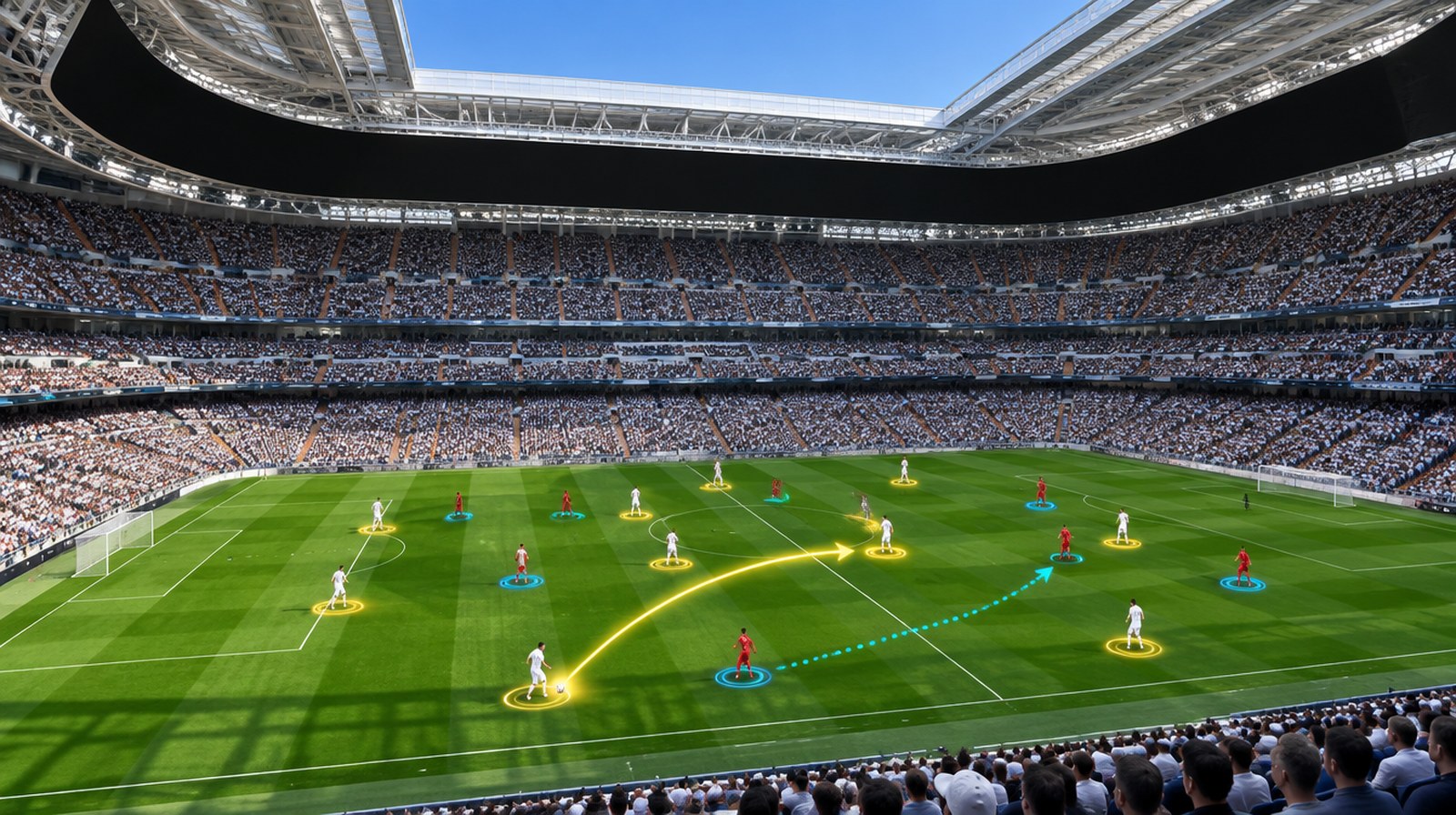
Sport is entering the age of XR, short for extended reality: every technology that extends what you see and hear beyond the real world in front of you. Augmented reality (AR), which adds graphics on top of the real game, is the best-known part of it. XR also covers virtual reality (VR), which puts you inside a completely digital scene, and mixed reality (MR), which blends the two.
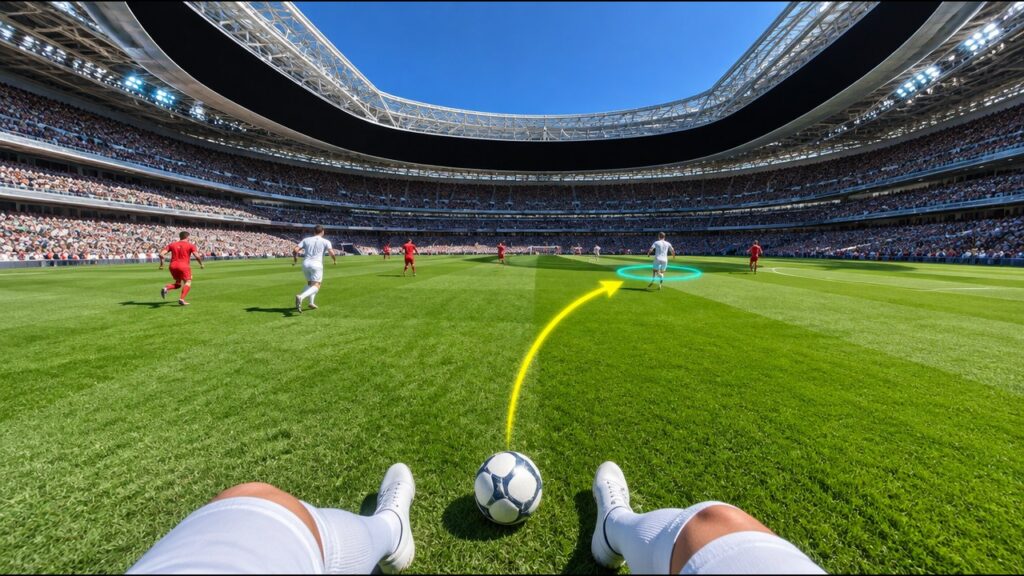
Augmented reality in sports has stopped being a fancy demo. In 2026 it is part of everyday viewing: virtual adverts that change from country to country, 3D offside replays on stadium screens, live heat maps over the pitch, and Real Madrid inviting fans to step “inside” the Bernabéu with a headset.
Why it matters: these tools change what you see at the game, on TV and on your phone, and they also help athletes train and referees decide. Here is a friendly tour of what works today, where it still struggles, and what to watch next.
What augmented reality in sports actually means
Augmented reality (AR) adds digital pictures on top of the real world. Think of the lines and floating stats over a live match: the grass is real, the graphics are painted on top. Virtual reality (VR) goes further and replaces what you see with a full 3D scene inside a headset. Mixed reality (MR) headsets can do both, blending digital objects into the room around you.
Put simply: AR adds to reality, VR replaces it, and MR mixes the two, and all three are XR. In this story you will meet all of them: AR graphics on TV and in the stadium, the VR-style immersive film of the Bernabéu, and mixed-reality headsets such as Apple Vision Pro that can switch between both.
To place graphics on a moving game, the system has to know where everything is. That is the job of tracking: cameras around the stadium follow the ball and every player many times a second, and software turns those positions into lines, arrows and 3D replays.
Bernabéu Infinito: Real Madrid and Apple bring the stadium home
The most talked-about project of the year comes from Madrid. Bernabéu Infinito (“Infinite Bernabéu”) is developed by Real Madrid in collaboration with Apple, and its first piece is an Apple Immersive film called Real Madrid: The Weight of Greatness. It was filmed at the Champions League match against Juventus at the Bernabéu on 22 October 2025, with more than 30 Blackmagic URSA Cine Immersive cameras, including a wire camera flying over the pitch (Six Colors, MacStories).
The film lasts about 20 minutes, is recorded in 180 degrees, in stereoscopic 3D (a slightly different picture for each eye, so the depth feels real) and 8K, with Spatial Audio (so the chants come from all around you; StadiumDB), and arrived free in the Apple TV app for Vision Pro owners on 22 May 2026 (UploadVR, Six Colors).

Since 15 July 2026 the experience is also part of the Bernabéu Tour, in the club museum. Members (Socios) and Madridistas Platinum can try it free by showing their digital membership card at the entrance arch (Real Madrid, StadiumDB). Before that, members queued at a stand opposite the stadium to try the headsets (esdiario).
A quick, honest note: Vision Pro is a mixed-reality headset, and this film is immersive video, closer to VR than to AR graphics over a live game. It still belongs here, because it shows where sports XR is heading. Florentino Pérez and Apple’s Eddy Cue describe the bigger goal as letting fans anywhere in the world feel they are inside the stadium, and in time, follow matches that way from home (esdiario, Appleosophy, MacDailyNews). There is no confirmed date or price for live matches yet, and no financial terms of the deal were published. The “infinite” in the name is the idea of a stadium with no seat limit.
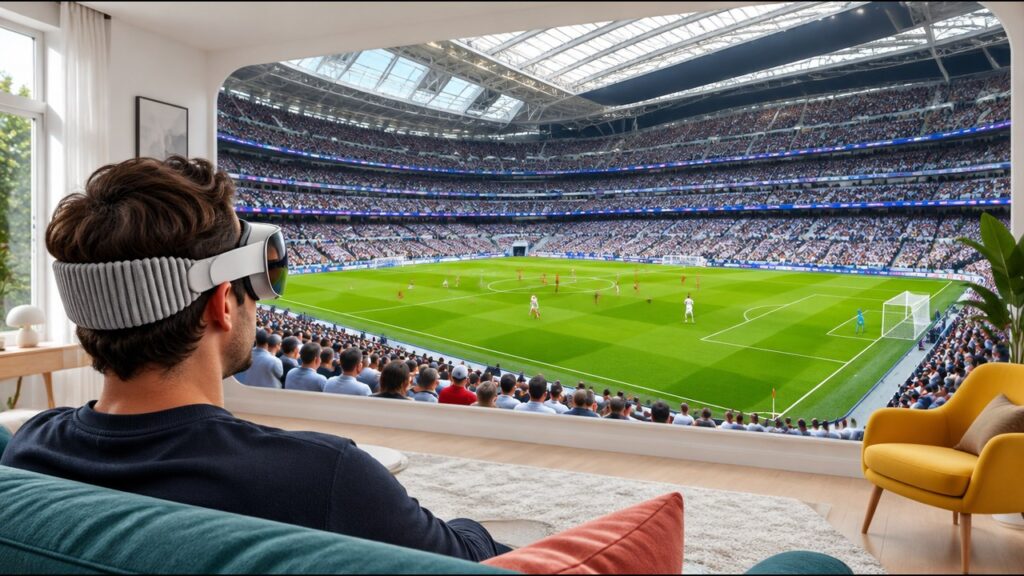
The stadium itself is a piece of sports tech. On 8 November 2026 the Bernabéu hosted its second NFL regular-season game, with the Cincinnati Bengals beating the Atlanta Falcons 34–17 in front of 78,660 fans (ESPN, Real Madrid). To make room for American football, the hybrid grass splits into six panels that sink into an underground vault about 30 metres deep, where they keep growing under controlled light, temperature and humidity (AJC). The first NFL game in Spain was played there in November 2025, when Miami beat Washington 16–13 in overtime (Sky Sports, ESPN).

Augmented reality fan activations in the stadium
A fan activation is any experience that invites people to join in, not just watch. AR is great at this because almost everyone already carries the device: a phone.
At Super Bowl LIX in New Orleans in February 2025, the NFL put Snapchat’s camera system inside the Caesars Superdome and placed AR “Lenses” on fans in the stands, such as virtual Chiefs and Eagles helmets (Snap, Social Media Today). In July 2025 Snap teamed up with live-events company RWS Global to bring similar in-stadium AR to more sporting events worldwide (Snap / RWS Global, AR Insider).
The benefits of using AR at an event are easy to see: fans become part of the show, and sponsors get a playful way to appear.
AR on TV: virtual ads, live stats and 3D replays
This is where most of us meet AR every week.
Virtual advertising swaps the adverts on the pitch-side boards in the TV picture, so a viewer in Asia sees a different brand from a viewer in the Americas. In June 2025 Germany’s league body, the DFL, approved uniqFEED’s AI-based system for the whole Bundesliga, alongside Supponor, which was approved earlier (SVG, Inside World Football).
In Spain, LaLiga opened the 2026/27 season with redesigned AR graphics that show live player and team stats, attack zones and heat maps (colour maps of where a player spends time), plus a referee camera in one match per round (LaLiga, MKT Esportivo). In Brazil, Globo’s Sportv added an AR tactics table to its Brasileirão coverage in 2025, drawing plays and strategies over the pitch (Máquina do Esporte, Propmark).
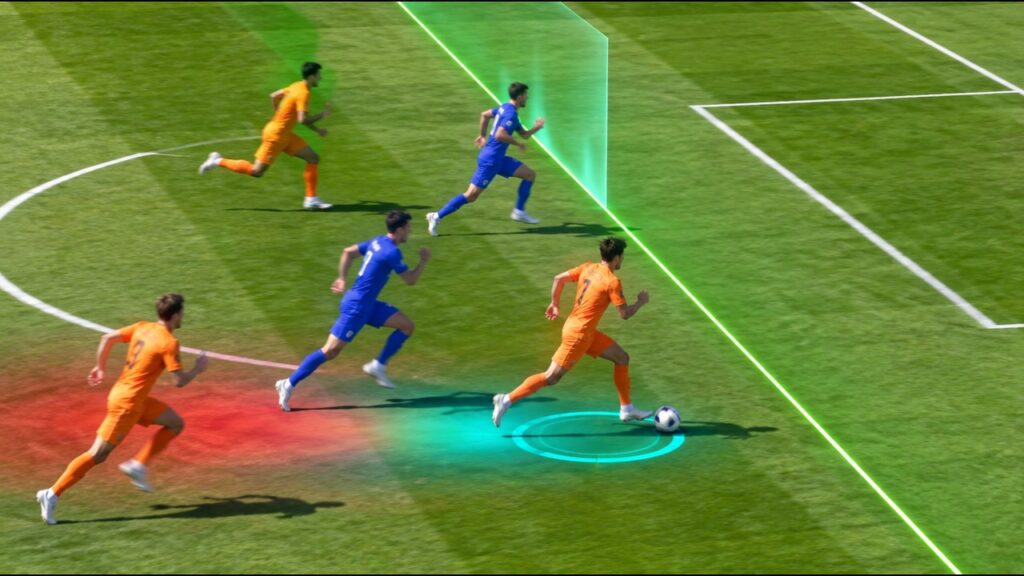
Augmented reality football replays are also helping fans understand referees. Since April 2025 the Premier League’s semi-automated offside system sends a 3D replay of the players, with a green or red line, to broadcasters and the giant stadium screens (Premier League, Sky Sports). At the 2026 World Cup, FIFA 3D-scanned every player, installed 16 tracking cameras in each stadium and used the data for 3D replays (FIFA, World Soccer Talk).
Multiview: one play, every angle
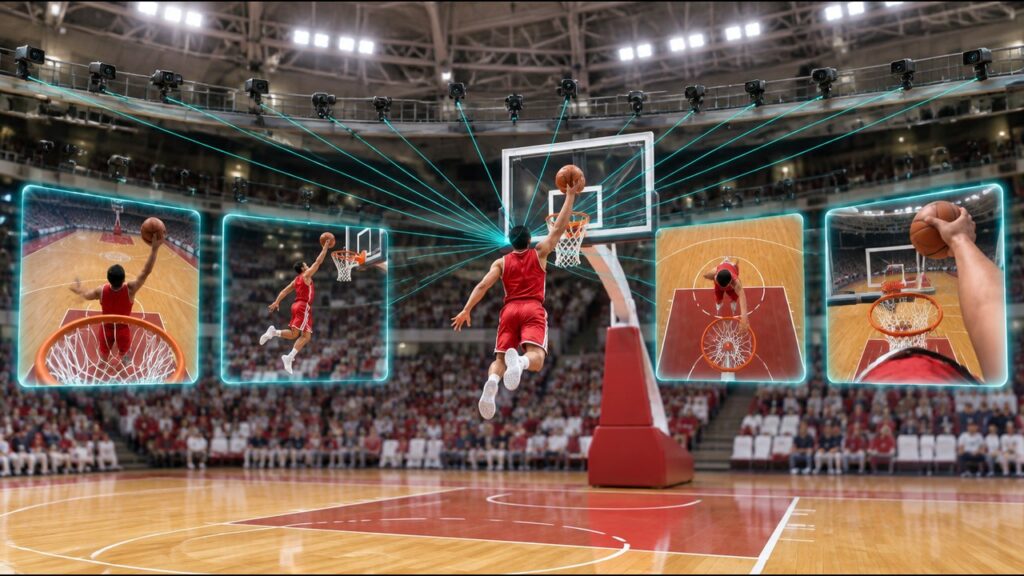
Watching the same play from any angle has a history in basketball. In November 2017 the NBA and Intel signed a multiyear deal to bring live virtual reality and Intel’s 360-degree volumetric video to NBA broadcasts (NBA). Volumetric means the cameras capture the action as a 3D scene, not as a flat picture. A ring of at least 38 5K cameras around the venue records every play, and software rebuilds it so a replay can be frozen and shown from any position, even through a player’s own eyes (NBA, CNBC).
In 2020 the Sacramento Kings made their arena, Golden 1 Center, the NBA’s first Intel research site, with multi-angle 3D replays planned for the big screen and the team app (SVG). Intel later put its sports unit up for sale in 2021 (Sportico), but the multiview idea lives on in today’s tracking cameras, 3D offside replays and immersive video.
AR for athletes, coaches and referees
The same tracking that makes pretty graphics also makes decisions. At Wimbledon 2025, electronic line calling, a descendant of Hawk-Eye, replaced human line judges on all 18 match courts for the first time in the tournament’s long history (Al Jazeera, NBC Sports). FIFA first tried referee body cameras at the 2025 Club World Cup and brought them to the 2026 World Cup (FIFA, World Soccer Talk).
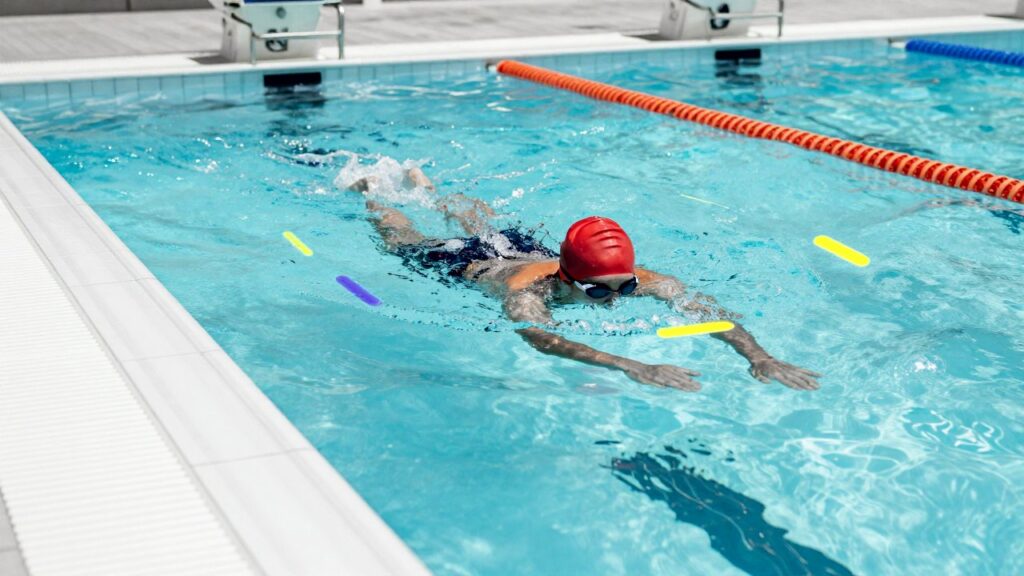
For athletes, AR often means a small display right in front of the eye. FORM’s Smart Swim 2 PRO goggles, launched in 2025, show pace, distance and heart rate inside the lens while you swim (SwimSwam, New Atlas). Sports glasses are getting smarter too: the Oakley Meta Vanguard, announced in September 2025, has no screen but can read out live stats from a Garmin watch or bike computer and film your ride (Meta, Wareable). We covered the health side of wearables in our piece on self-powered glasses sensors.
Smart glasses and headsets at games
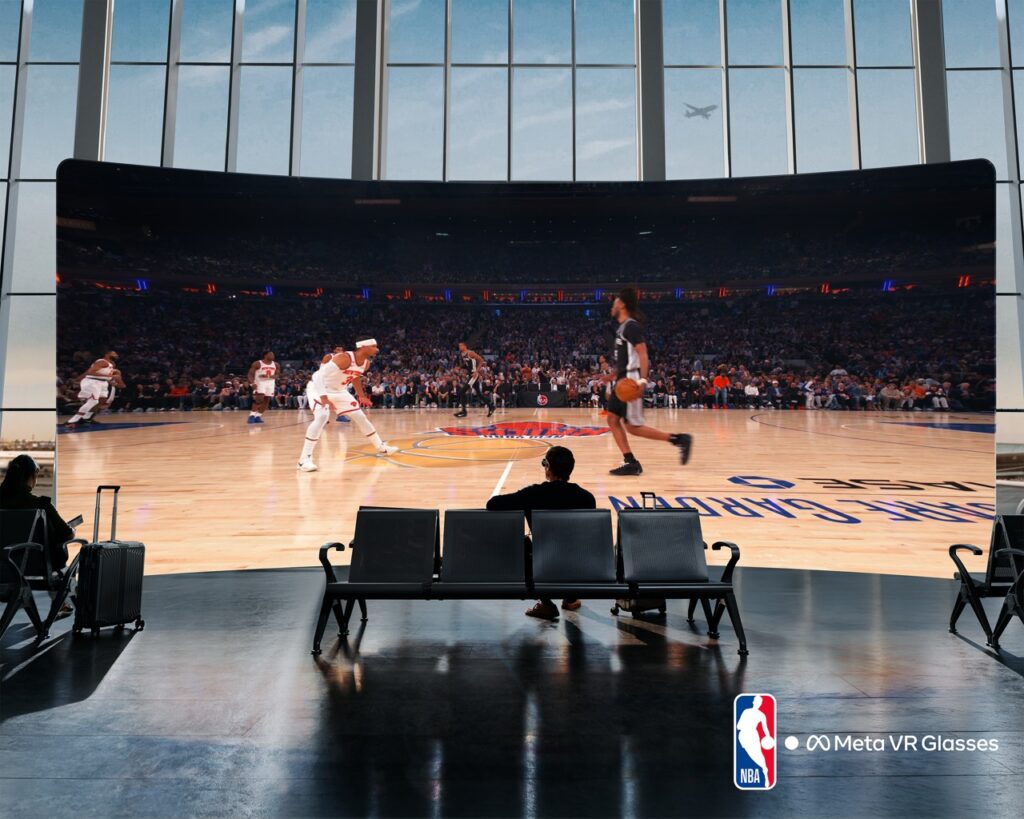
Headsets are moving from the stands to the sofa. In January 2026, Spectrum and Apple began streaming six Los Angeles Lakers games live in Apple Immersive, with up to seven camera spots such as courtside and under the basket. Vision Pro owners in Japan, Singapore and South Korea could watch through the NBA app too (Apple, MacRumors).
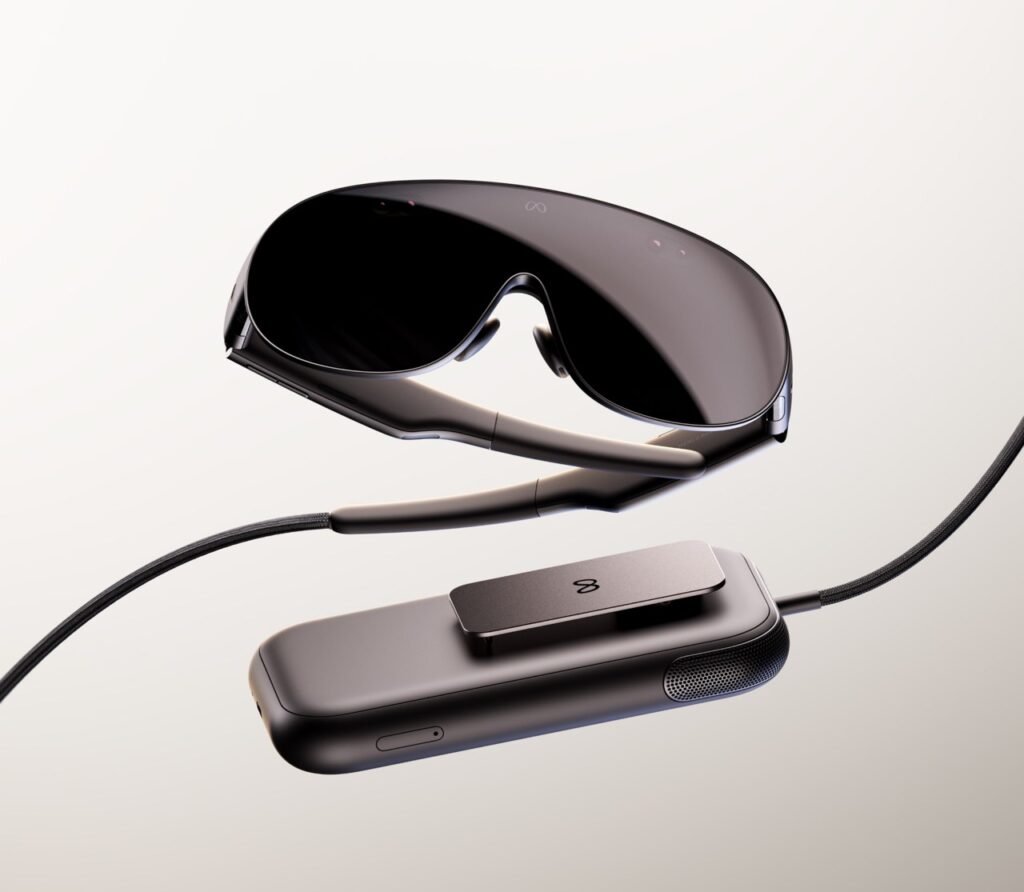
The newest glasses come from Meta. At its Connect event in September 2026 it unveiled Meta VR Glasses: about 100 grams, roughly a deck of cards and five times lighter than a Meta Quest 3, because the battery and computer sit in a puck that clips to your pocket (Meta, Tom’s Guide). They are VR glasses with a passthrough camera, so you can still see the room around you. For sports fans, Meta promises more than 100 immersive live US sports events a year with partners such as ESPN, MLB, NBC Sports, TNT Sports and UFC, and ESPN’s “Immersive Sports” streams in 8K with 180-degree views (Meta). They go on sale in spring 2027 in the Premium price range (Meta).
In Asia, operators have tested AR glasses inside ballparks for years: SoftBank tried them in a VIP box at the Fukuoka dome in 2024 (SoftBank), and Korea’s LG Uplus offered baseball content for its AR glasses back in 2020 (Asia Economy). Real glasses for everyone at the stadium are still rare, though: sunlight, battery life and narrow displays are hard problems.
The latest AR glasses at a glance
Real AR glasses you can wear all day are finally arriving. Here are six of the newest models with a display, from simple heads-up screens to true AR that pins graphics to the world around you. All six sit in the Premium price range (over $300), and so far only a few are sold in Spain (Meta, Road to VR, Snap, XREAL, 9to5Google, Even Realities, Android Authority, RayNeo, Tom’s Hardware, Rokid, heise).
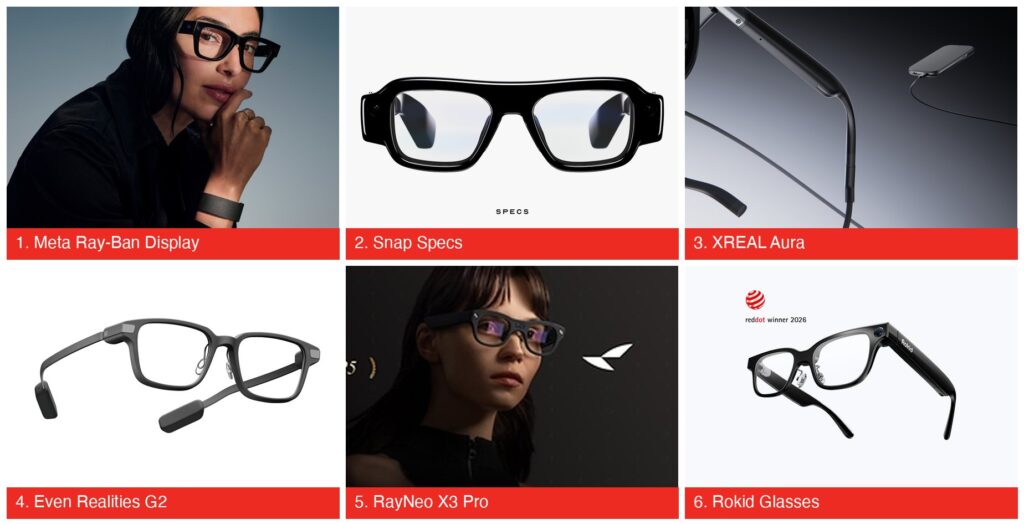
| Model | What you see | Weight | In Spain? | For sport today |
|---|---|---|---|---|
| Meta Ray-Ban Display (Meta) | A small screen in the right lens; controlled with a wristband | 69 g | No (France, Italy, Germany yes) | Turn-by-turn cycling directions |
| Snap Specs (Snap) | True AR: 3D graphics placed in the room, 51° view | 132–136 g | Not announced (France planned) | A golf green-reading demo |
| XREAL Aura (XREAL, Android XR) | Floating screens and apps anchored in the room, 70° view | 95 g + pocket puck | No date for Europe | A match on a giant virtual screen |
| Even Realities G2 (Even Realities) | Green heads-up text and graphics, no camera | About 36 g | Yes, official Spanish store | No official sports app yet |
| RayNeo X3 Pro (RayNeo, TCL) | True AR in full colour in both lenses, very bright | 76 g | Through some EU shops | None yet (maps and translation) |
| Rokid Glasses (Rokid) | Green heads-up display in both lenses | 49 g | No (Germany, France yes) | None yet; fades in strong sun |
Price range: all Premium (over $300). Specs are the makers’ figures; sports uses are what we could verify today.
The honest picture for sports fans: the glasses are getting lighter and brighter, but real sports apps are still few. Live scores, stats and replays in your lenses are the next step to watch.
Sports AR and immersive graphics
Esports shows were early fans of AR, because the game already lives inside a computer. Broadcasters use the same real-time game engines to put giant characters on stage or wrap players’ desks in graphics. For Rocket League’s championship, Psyonix, Epic Games, Capacity Studios and ESL built the “Hype Chamber”, an Unreal Engine set that runs on screens, LED walls and XR stages, and Epic released it free as a template for other sports (80 Level, TVBEurope). Curious about the 3D capture behind such scenes? Our Gaussian splatting explainer shows one of the newest tricks.
The limits: cost, connectivity, motion sickness and privacy
- Cost. Dozens of special cameras, tracking systems and headsets are expensive, so the best experiences still appear first at the richest clubs and leagues.
- Connectivity. Phone AR needs data, and a full stadium is one of the hardest places to get a fast connection. That is why many activations run through the big screen, not each phone.
- Motion sickness. Some people feel dizzy or queasy in headsets, especially when the camera moves and their body does not; research shows it depends a lot on the person and the content (Frontiers in Human Neuroscience, Iowa State University).
- Privacy. Camera glasses can film people without their knowledge or consent, and the rules on where that is fine are still unclear (Help Net Security, UploadVR).
Key takeaways
- Most sports AR today happens on TV and phones: virtual ads, live stats, heat maps and 3D replays.
- Real Madrid’s Bernabéu Infinito, with Apple, is the boldest stadium-at-home project, but live matches have no date or price yet.
- Tracking cameras power both the graphics and the referee tools, from offside replays to Wimbledon’s line calls.
- Glasses for athletes are useful now; glasses for every fan at the game are still on the way.
- Cost, crowded networks, motion sickness and privacy are the big limits to watch.
What happens next
Watch for LaLiga’s promised XR app after its immersive test at a Clásico, where more than 1,000 fans tried VR content (Infobae, Diario El Mundo), and for any news on live matches in Bernabéu Infinito. If you want to try sports AR today, the easiest way is free: look for a club’s AR lens or app on matchday, or watch the 3D replays on the next big game.
Read next
- Gaussian splatting: the 3D photo tech XR fans keep hearing about
- AI drone with one camera beats world champion pilots
- Scentronic: scientists send smells over the internet
The week's best tech stories, free
One email a week with the stories that matter, explained simply. No spam.
Sources
- Bernabéu Infinito, the new immersive experience of the Bernabéu Tour, free for Members and Madridistas Platinum – Real Madrid C.F., 14 July 2026
- Spain: A New Bernabéu experience – to infinity and beyond – StadiumDB, 17 July 2026
- Apple takes soccer immersive with Real Madrid – Six Colors, 21 May 2026
- Real Madrid immersive documentary releases this Friday on Apple Vision Pro – MacStories, May 2026
- Real Madrid Apple Immersive documentary – UploadVR, 22 May 2026
- Bernabéu Infinito: las gafas con las que Florentino Pérez quiere llevar el Real Madrid a millones de socios – esdiario, 5 June 2026
- Apple and Real Madrid working on the Infinite Bernabéu for Vision Pro – Appleosophy, 22 November 2025
- Real Madrid working with Apple to create 2026 immersive documentary – MacDailyNews, 20 November 2025
- Super Bowl LIX on Snapchat – Snap Newsroom, 4 February 2025
- Snapchat Super Bowl LIX activations – Social Media Today, February 2025
- Snapchat and RWS Global team up on in-stadium augmented reality experiences – Snap / RWS Global press release, 9 July 2025
- Snap elevates the in-stadium experience – AR Insider, 16 July 2025
- uniqFEED’s virtual ad tech secures league-wide approval for the German Bundesliga – Sports Video Group, 4 June 2025
- Bundesliga greenlights Supponor’s virtual ad technology for league-wide use – Inside World Football
- Las 10 novedades que refuerzan el liderazgo de LALIGA – LaLiga, 18 August 2026
- LaLiga terá bola conectada, câmera no árbitro e novas tecnologias na temporada 2026/27 – MKT Esportivo, 18 August 2026
- Globo estende pré-jogo e anuncia nova vinheta e pacote gráfico para o Brasileirão 2025 – Máquina do Esporte, 27 March 2025
- Globo aposta em câmeras de cinema para o Brasileirão 2025 – Propmark, 31 March 2025
- Semi-automated offside technology: What you need to know – Premier League, April 2025
- Semi-automated offside to be introduced in top flight on April 12 – Sky Sports, 2025
- Offside decisions, referee body cams: innovation at the FIFA World Cup 2026 – FIFA, 3 June 2026
- 2026 World Cup: FIFA unveils AI technology to enhance VAR decisions – World Soccer Talk, 2026
- Wimbledon to replace tennis line judges with electronic system from 2025 – Al Jazeera, 9 October 2024
- Wimbledon replaces line judges with technology in break with tradition – NBC Sports, 2025
- FORM launches world’s first augmented reality swim goggles protected with Corning Gorilla Glass – SwimSwam, 2025
- FORM smart goggles with AR display and Gorilla Glass – New Atlas, 2025
- Athletic Intelligence Is Here, Meet Oakley Meta Vanguard – Meta, September 2025
- Oakley Meta Vanguard smart glasses: specs and features – Wareable, September 2025
- Spectrum Front Row tips off January 9 on Apple Vision Pro – Apple Newsroom, January 2026
- Immersive Los Angeles Lakers games coming to Vision Pro on January 9 – MacRumors, 5 January 2026
- AR glasses trial at Fukuoka PayPay Dome – SoftBank News, 22 May 2024
- LGU+ operates AR, VR and special broadcast services for Korean Series – Asia Economy, 16 November 2020
- The Hype Chamber: Unreal Engine sample for broadcast and live events – 80 Level
- Epic Games releases sample project for live event broadcasts – TVBEurope
- Factors associated with virtual reality sickness in head-mounted displays: a systematic review and meta-analysis – Frontiers in Human Neuroscience, 2020
- Researchers explore how people adapt to cybersickness from virtual reality – Iowa State University
- Smart glasses are back, privacy issues included – Help Net Security, 5 February 2026
- Do Meta glasses make you a glasshole? – UploadVR
- LaLiga quiere redefinir cómo viven el fútbol los aficionados con un proyecto de realidad inmersiva – Infobae (agencies), 23 December 2025
- La Liga española apuesta por la realidad virtual para transformar el fútbol – Diario El Mundo, 28 December 2025
- NBA and Intel announce multiyear technology partnership – NBA, 8 Nov 2017
- Intel claims it has the power to put you directly on a concert stage or NFL field – CNBC, 25 Jun 2018
- Sacramento Kings To Debut Next-Gen Intel True View Tech – SVG, 13 Feb 2020
- Intel Exploring Sale of its Sports Technology Arm, True View Platform – Sportico, 2021
- Introducing Meta VR Glasses: A Cinema, Courtside Seat, and Workspace in Just 100 Grams – Meta, Sep 2026
- Meta Connect 2026 recap – Tom’s Guide, Sep 2026
- New features for Meta Ray-Ban Display – Meta, Sep 2026
- Meta Ray-Ban Display international launch – Road to VR, 2026
- Introducing Specs – Snap, Jun 2026
- XREAL Aura – XREAL
- XREAL Aura with Android XR – 9to5Google, 7 Oct 2026
- Even G2 – Even Realities
- Even G2 and R1 launch – Android Authority, Nov 2025
- RayNeo X3 Pro launches globally – RayNeo / PR Newswire, Dec 2025
- RayNeo X3 Pro review – Tom’s Hardware
- Rokid Glasses in France – Rokid / PR Newswire, 22 Jun 2026
- Rokid Glasses review – heise
- Bengals 34-17 Falcons (Nov 8, 2026) Game Recap – ESPN
- Crónica Falcons-Bengals – Real Madrid, 8 Nov 2026
- Could NFL bring home souvenir from Madrid — a retractable field? – AJC, 5 Nov 2026
- Miami Dolphins beat Washington Commanders 16-13 in overtime – Sky Sports, 16 Nov 2025
- Dolphins 16-13 Commanders Game Recap – ESPN, 16 Nov 2025