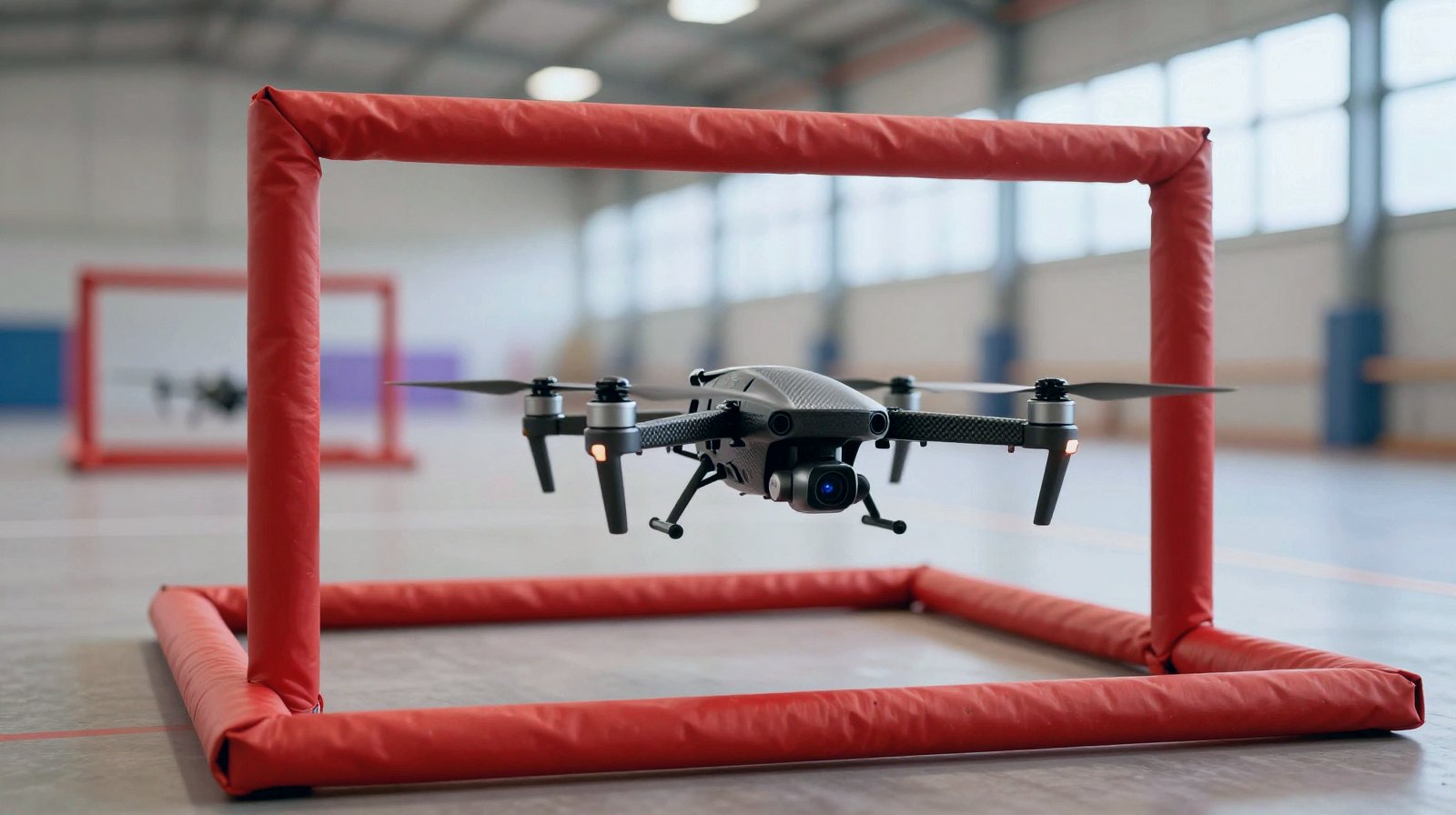
A racing drone with just one camera, no GPS and no help from the ground has beaten three former world champion human pilots at about 100 km/h. The team behind it, the MAVLab at Delft University of Technology (TU Delft) in the Netherlands, has now explained how it works in a peer-reviewed paper in Science Robotics, published on 14 October.
Why it matters: most fast robots need expensive sensors or a room full of tracking cameras to know where they are. This drone did it with the kind of hardware you find in a hobby racing drone, and its “pilot” is a tiny neural network that learned to fly by trial and error instead of being hand-programmed. Squeezing that much skill out of so little is exactly what cheaper, lighter and more capable robots will need.
What happened on the track
The race took place at the 2025 Abu Dhabi Autonomous Drone Racing Competition (A2RL), where AI teams first raced each other and the winner then faced human pilots in knockout heats. Crucially, the organisers designed the track and supplied the drone, so the Delft team could not tune the course or add extra sensors. The rules allowed only one forward-facing camera and the drone’s own motion sensors.
The Delft system, called MonoRace (“mono” for one camera), beat every other autonomous team and then three former Drone Champions League world champions, as reported at the time by DroneXL. According to the team’s preprint, its fastest run took 16.56 seconds for two laps of an 11-gate course, with a top speed of just over 28 metres per second. That is about 100 km/h, through gates only a few metres wide.
How one camera is enough
Seeing at that speed is harder than it sounds. “Flying at very high speed with only one camera is challenging because the images are blurry, deformed,” lead author Stavrow Bahnam said in the TU Delft release. The drone also has very little time to work out where it is.
MonoRace splits the job into two parts:
- Seeing: a neural network (a type of AI loosely inspired by the brain) spots the racing gates in each camera image. Because the team knows the real size and shape of the gates, the drone can work out its own position from how the gates look.
- Filling the gaps: between camera frames, an IMU (inertial measurement unit, the same kind of motion sensor that turns your phone’s screen when you rotate it) plus a physics model of the drone keep track of where it is going.
A pilot that learned by practising
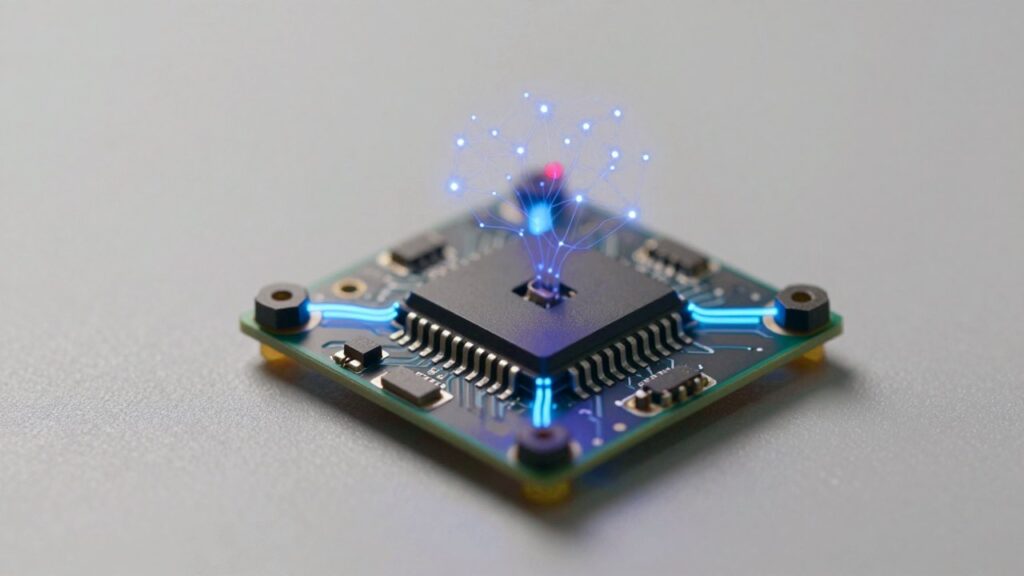
The most striking part is the controller. Normal drones use a stack of hand-tuned programs: one plans a path, another follows it, another keeps the drone level, and so on. MonoRace replaces all of that with one small neural network that sends commands straight to the four motors, 500 times a second.
That network was trained with reinforcement learning: a method where the AI tries things in a computer simulation millions of times and gets a “reward” for flying fast and passing through gates. Think of a video game player getting better after endless practice, except the player is software. To make sure the skill survived the jump to the real world, the team kept changing the simulated drone’s weight, motor strength and other details during training, so the network learned to cope with a drone that is never exactly as expected.
The network is tiny. The preprint describes just three layers of 64 artificial neurons, small enough to run on the drone’s flight controller, a chip far weaker than the one in your phone. “Our neural network learns to directly control the motors,” co-author Robin Ferede said, which lets it react extremely quickly.
How it compares
An AI drone has beaten human champions before: a system called Swift from the University of Zurich did it in 2023. But Swift raced in a controlled indoor setting and used a stereo camera (two cameras, like our two eyes), and its vision system was trained with help from motion-capture cameras. MonoRace did it with one camera, on a much bigger track it did not design, against an independent organiser’s clock. The authors say it is the first autonomous drone to win an independently organised human-versus-AI drone race.
The honest limits
It was not flawless. In the preprint, the team reports crashes when the motion sensor maxed out during a sharp diving turn, and when electronic interference corrupted camera images (in one case three out of every four frames). They fixed the first problem with software; the drone still finished a full track with half its frames corrupted. The system also relies on rectangular gates, and it cannot yet see or avoid other drones, which matters for multi-drone races and for real airspace.
Racing is also a special case: the track is known in advance. Flying through a forest, a warehouse or a disaster zone is a different, messier problem.
What happens next
“Autonomous racing is a way of pushing robotic AI to its limits,” said Guido de Croon, who leads the work. The team believes the same recipe (a small learned controller that talks directly to the motors, fed by cheap sensors) could help other machines move smoothly and efficiently, from robot vacuums to ship-to-shore cranes. Those are ideas, not demonstrations yet.
For the rest of us, the takeaway is simple: robots are increasingly learning their skills through AI practice instead of being programmed line by line, and they are doing it on surprisingly modest hardware. Watch for these learned controllers to appear in delivery drones, inspection robots and, eventually, things you own.
Read next
- Frog-like robot hops and swims with snapping spring legs
- Arduino Ventuno Q: the board that gives robots eyes and a brain
- Build your own AI gadget: Meta’s Muse kit for ESP32 and Pi
Sources
- MonoRace: Robust monocular AI for champion-level drone racing – S. Bahnam et al., Science Robotics, 14 October 2026
- The science behind the world’s fastest autonomous racing drone – TU Delft via EurekAlert!, 14 October 2026
- AI drone outpaces former world champions using one camera and no GPS – TechXplore, October 2026
- MonoRace: Winning Champion-Level Drone Racing with Robust Monocular AI (preprint) – arXiv, 21 January 2026
- TU Delft’s AI-Powered Drone Outpaces Human Champions in Historic A2RL Victory – DroneXL, 18 April 2025