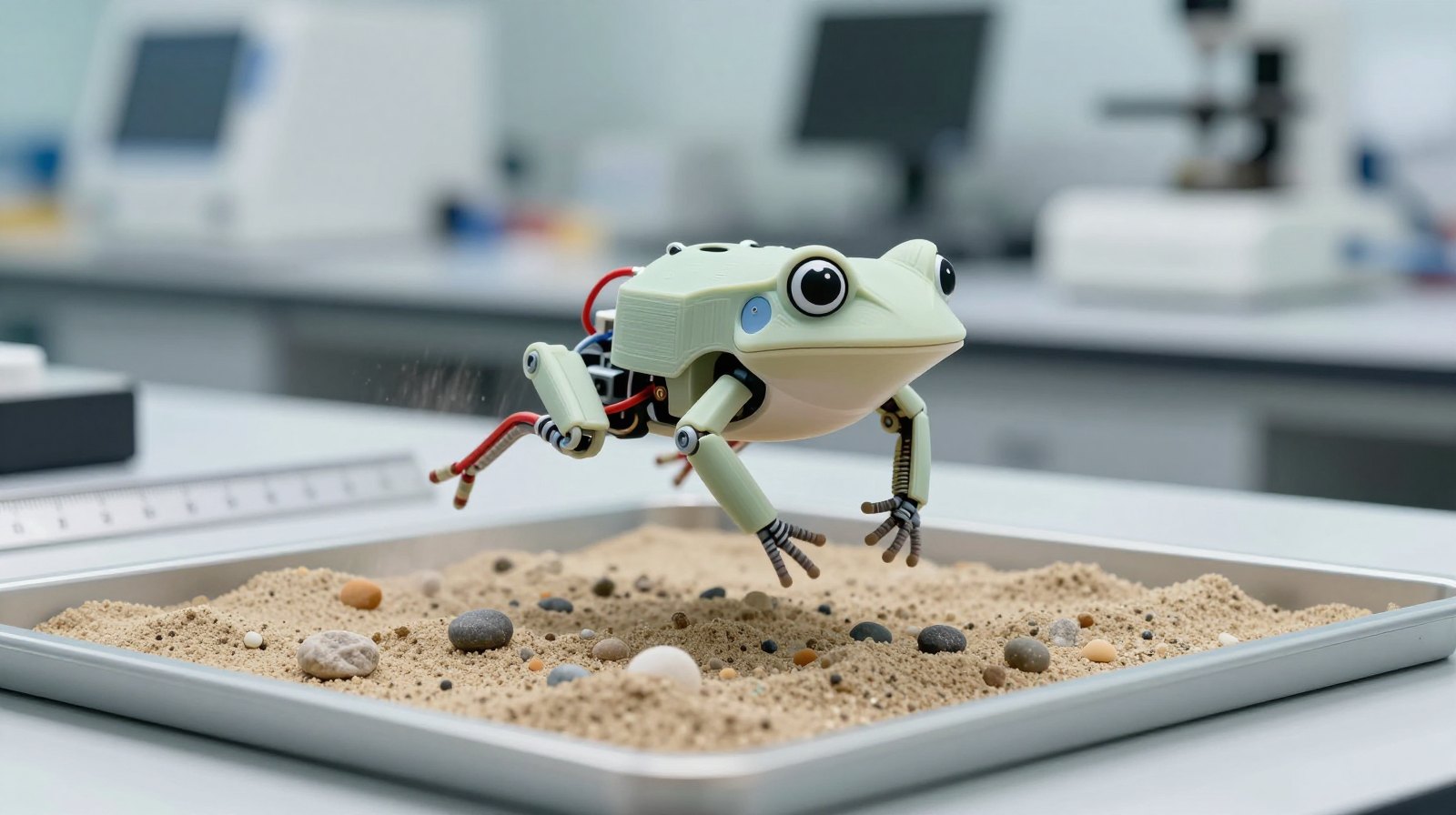
Engineers at UCLA and the University of Michigan have built a palm-sized, frog-like robot that hops across sand, grass and slippery leather, climbs steps, does backflips and even swims. Its secret is not a big, powerful motor. It is a pair of springy rods that bend, twist and then snap, releasing their stored energy in one quick kick.
Why it matters: small robots have a big problem. There is only so much motor and battery you can squeeze into something the size of your hand. This team found a way to let the shape of the robot’s legs do the heavy lifting, so a small, low-power motor is enough to send it bounding forward.
Meet the snapping frog
The prototype is 11 centimetres long and weighs 98.2 grams, less than a quarter of a pound, according to the UCLA announcement. Live Science puts it at about 3.4 ounces, roughly the weight of a deck of playing cards. Either way, it fits in your palm.
Like a frog, it does its pushing from the back. A wide front leg holds the battery, and two rear legs are each made from an elastic rod bent into a loop and driven by a small servo motor, as Tech Briefs describes it.
The research was published on 18 September in the journal Science Advances. It was co-led by Khalid Jawed, who runs the Structures-Computer Interaction Lab at UCLA, and Xiaonan (Sean) Huang, an assistant professor of robotics at Michigan, with co-first authors Dezhong Tong and Jiaqi Wang.
How a snap stores energy
You have probably felt this trick in your own hands. Think of a slap bracelet: you press on a flat metal strip, nothing happens, nothing happens… and then it suddenly whips around your wrist. Or a snap hair clip that resists your thumb and then clicks shut. In both cases, energy builds up quietly and comes out all at once.
The frog robot’s rods work the same way. Each one is shaped like a short piece of a coiled spring (a helix). The motor slowly bends and twists it, and energy builds up inside the rod. At a critical point the rod jumps into a new shape and releases that energy in a burst, pushing the robot forward. Then the motor unwinds the twist and starts loading the next snap.
The clever part is knowing which shapes will snap. The team found that some rods simply bend gradually, like a slowly sagging ruler, while others snap sharply. Using computer models and a robotic arm that bent real rods over and over, they mapped which shapes do which, and then picked the best one for a strong, repeatable kick. As Huang put it in the UCLA statement, the idea is “to let the mechanics of the robot do some of the work”.
What the little frog can do
The numbers from the paper are fun:
- Speed: up to 3.21 body lengths per second on wood, and 2.46 on average across six surfaces: wood, cloth, acrylic, leather, grass and sand.
- Versus stiff legs: the same robot with rigid legs averaged just 0.79 body lengths per second and nearly stalled on cloth and grass.
- Acrobatics: it could climb steps, launch into the air and do repeated backflips.
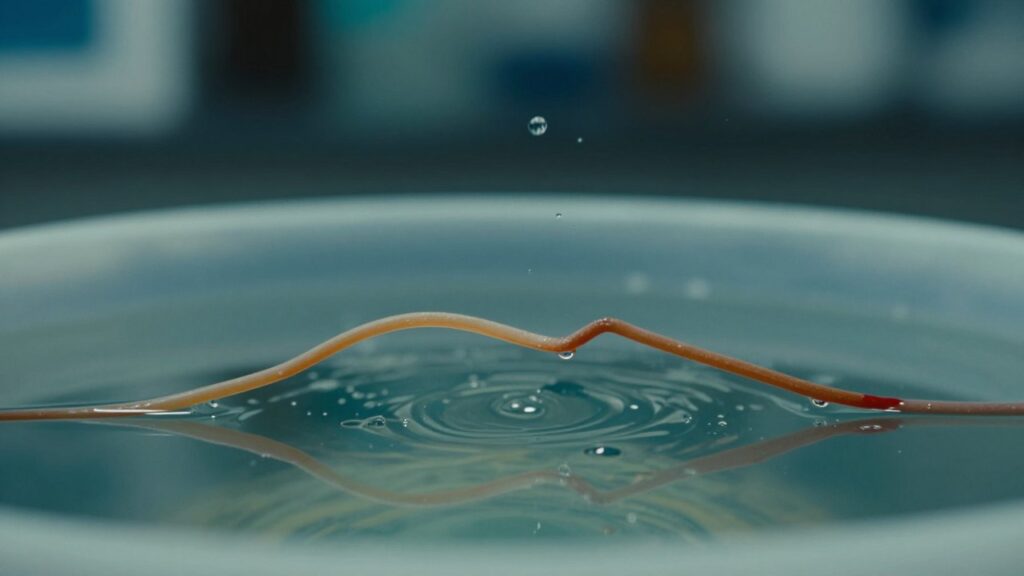
- Swimming: fitted with thin, flexible fins, it swam at about 0.5 body lengths per second and could steer around obstacles even with wind pushing it about.
Steering is simple: move the two rods at different rates and the robot turns. The researchers drove it by remote control through a sandbox full of rocks, and also added light sensors so it could steer itself towards a light on its own.
Why should you care?
Because this is a recipe, not just a toy. Jawed points out that it is the rod’s shape, not its size, that decides whether it snaps, so the same design rules should work at very different scales. He sees a path towards robots just a few millimetres wide that turn tiny motor movements into powerful bursts of motion.
According to Huang, robots like this could help wherever a machine must cross cluttered ground, get over obstacles, flip around quickly or move between land and water. Tech Briefs adds that the team imagines agile, energy-saving mini robots reaching places that are hard to get to today, from disaster zones to medical settings. Those are ideas for the future: what exists now is a lab prototype.
What happens next
The next steps are about shrinking and smartening. The design rules have to prove themselves in much smaller robots, and the simple light-following trick is only a first taste of robots that find their own way. No product or price has been announced. For now, the lesson is a delightful one: sometimes the smartest engine is a well-shaped spring.
Sources
- Geometry-controlled instability pathway selection in elastic helices enables fast, efficient robotic locomotion – Science Advances (Tong, Wang, Chen, Borum, Huang, Huang and Jawed), 18 September 2026
- Frog-like hopping robot propelled by twisting elastic rods – UCLA Newsroom, 25 September 2026
- Engineers Develop Low-Power Mini Robots Use Snap-Powered Motion – Tech Briefs, 30 September 2026
- Roboticists showcase tiny, frog-like robot that can hop across wet surfaces and swim – Live Science, 7 October 2026