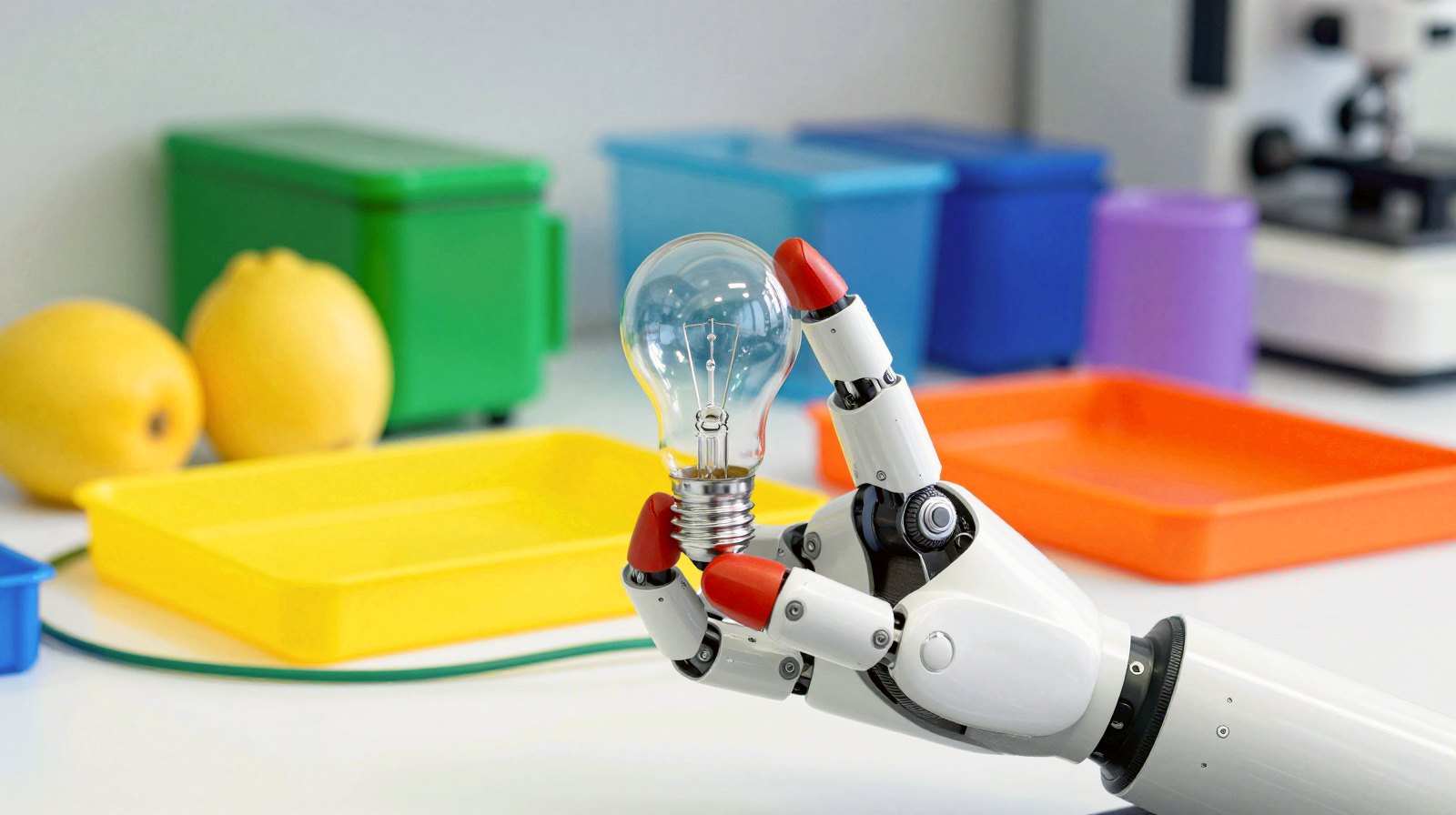
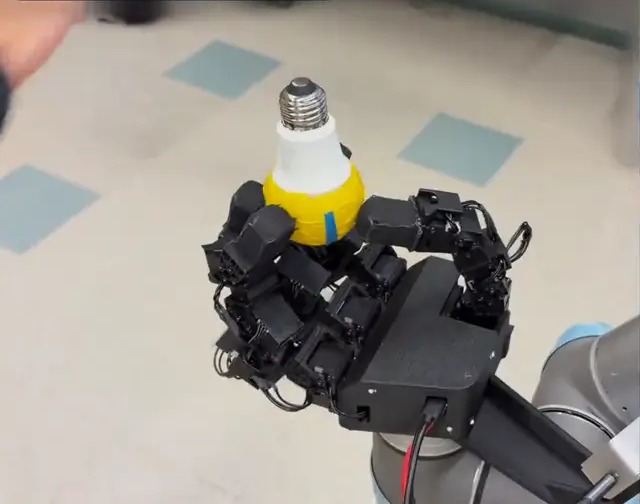
A robot hand has learned to shuffle a real lightbulb between its fingers with its palm facing the floor, and a new safety layer cut its drops from 16 to 4. That is the headline from a team at UC Berkeley and UC Davis, who shared the work as a preprint.
Why does a dropped bulb matter? Because hands are the hard part of robotics. A robot that can walk through your home is no use if it fumbles your wineglass. And the problem gets much harder when the palm turns sideways or down, because gravity is suddenly working against every finger.
What the hand actually did
The researchers used a LEAP hand, a robot hand with 16 joints. Its job was to move an object to a requested position and angle while keeping hold of it, a skill called in-hand manipulation. Picture rolling a pen around your fingers to get it ready for writing. Now picture a robot doing it.
The team tested four objects: a real lightbulb, plus 3D-printed models of a knife, a wineglass and a duck. Each object got its own controller. They then ran 13.3 hours of tests on the real hand, covering 4,800 requested moves and six wrist angles.
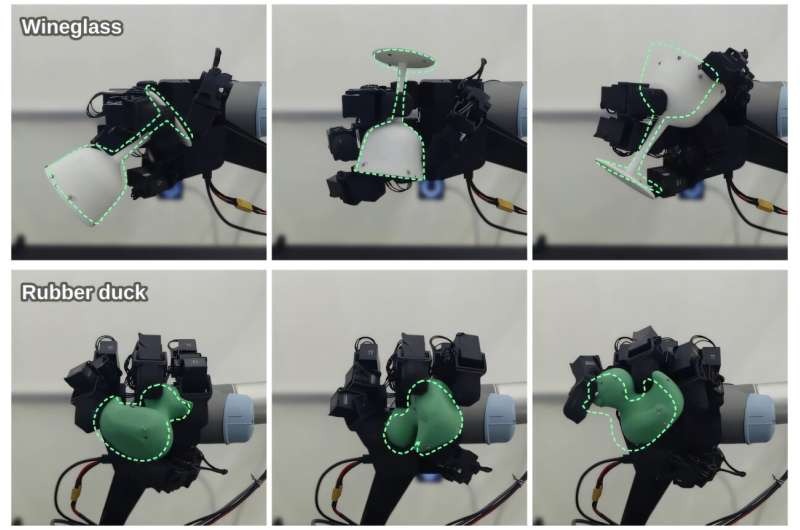
A move counted as a success if the object landed within 2 cm and about 23 degrees of the target within 10 seconds. Without the safety layer, the hand reached 95.2% of its targets.
Taught in a video game, with cheating at the start
The hand never watched a human do any of this. It learned entirely in simulation, through hundreds of thousands of practice grasps. According to Tech Xplore, the team began with unrealistically grippy fingertips, then slowly reduced the friction toward real-world levels. Think of training wheels that gradually lift off.
They also fed in measurements of how a real hand’s motors behave, so the simulated hand would match the physical one. If you enjoyed how a robot duck learns to walk in simulation, this is the same idea moved to a much fiddlier job.
The clever part: a separate safety net
The new idea is a second learned system that sits between the controller and the fingers. It has one job: spot a move that is likely to lose the object, and nudge it just enough to keep hold. It doesn’t even know where the object is supposed to go.
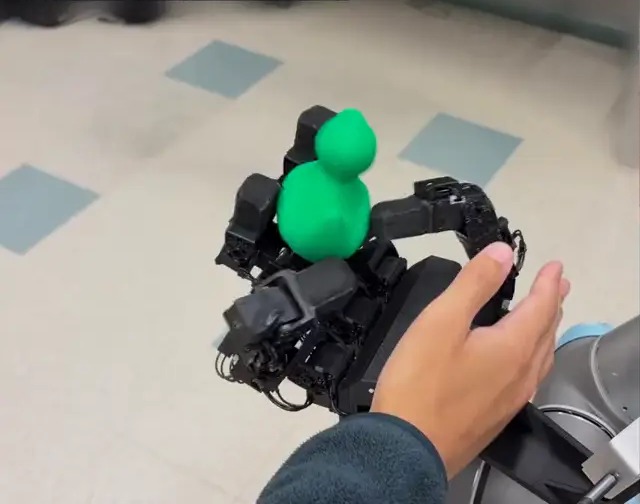
The authors sum it up neatly: “This separates learning the task from learning safety.” In other words, the main skill and the caution are trained on their own, then work together.
The price of being careful
Caution isn’t free. With the safety layer switched on, drops fell by 75%, from 16 to 4, but target success slipped from 95.2% to 91.5%. So the hand became a little less precise and a lot less clumsy. The team can turn that caution up or down.
For a robot holding a wineglass, that is a trade many of us would happily accept.
Why it’s still early
- It’s a preprint. The paper is on arXiv and has not yet been checked by independent reviewers.
- The best results used external cameras. Those numbers relied on motion-tracking cameras around the hand. The team also showed a version that uses a single wrist camera, which is closer to real life.
- One object, one controller. Teaching a single controller to handle many objects is still an open challenge.
- Real jobs are harder. The safety layer didn’t improve success in a small lightbulb-screwing demo.
What happens next
The team says it wants to share the full recipe as a platform for other researchers, and the code is listed as coming soon. Once it’s out, other labs will be able to test the results for themselves. It also pairs well with other recent work on robot skin that senses danger: one gives robots better reflexes, the other better judgement.
Read next
- Humanoid robot learns to walk and grab from separate lessons
- Robot skin that feels ‘pain’ pulls fingers away from needles
- Microduck robot: how a robot duck learns to walk in simulation
The week's best tech stories, free
One email a week with the stories that matter, explained simply. No spam.
Sources
- Robot hand learns nimble moves with fewer dropped objects, Tech Xplore, 3 November 2026
- Chuang et al., arXiv preprint 2610.37652, October 2026
- Dexterous In-Hand Object Pose Reaching with Learned Safety Filters, project page, UC Berkeley and UC Davis, 2026