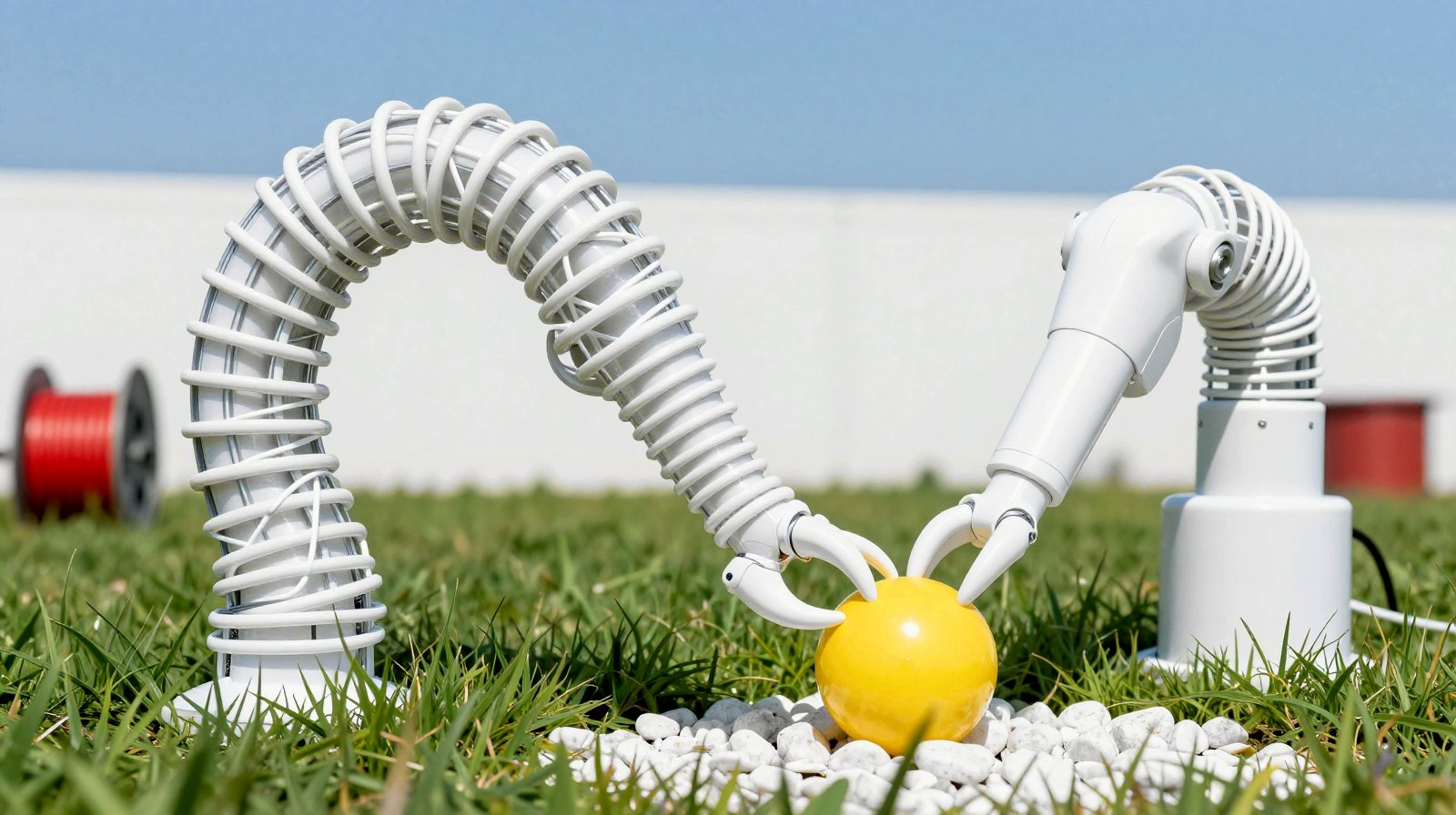
Engineers at Colorado State University have built bendy, tube-shaped robots that move a bit like an elephant’s trunk and can grab each other to build bigger machines. Each robot has a gripping claw at both ends, so it can work alone or link up with others into chains, loops and branches, the university reported on 11 November. The work is published in Nature Machine Intelligence.
Why it matters: most robots have one fixed body for their whole life. A robot arm stays an arm, a wheeled robot stays on wheels. These robots change shape for the job in front of them, so a small team could carry a box one minute and crawl across rocks like a snake the next.
A body made of sticks and strings
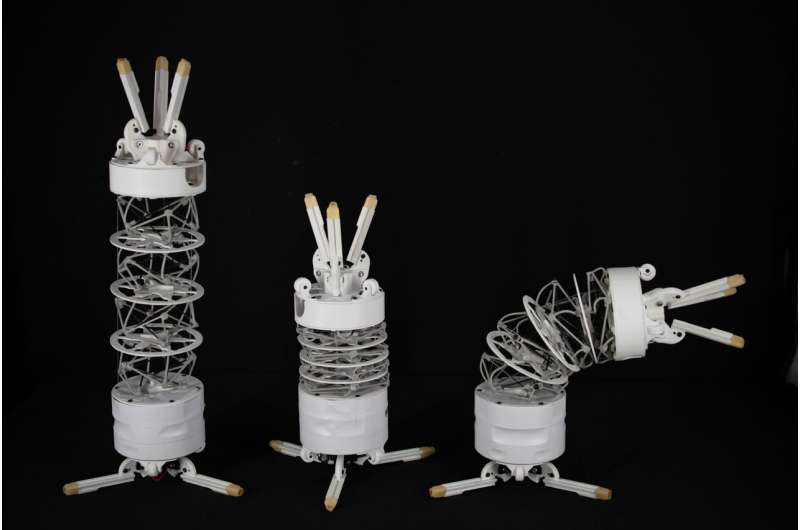
The trick is a building idea called tensegrity (short for “tensional integrity”). Instead of hinges and hard joints, stiff rods float inside a web of tight cables. Think of a camping tent: tight ropes and fabric, not glue or hinges, hold the poles in shape. Pull the cables a little more on one side and the whole structure bends.
That gives the robots a soft, springy body. They can bend, squash down, stretch out and curl without anything snapping, according to the team led by associate professor Jianguo Zhao. Small motors drive the movement. Finding motors small enough to fit, yet strong and reliable over long runs, was one of the hardest parts of the project, the university says.
Claws that hold hands
Each end carries a three-pronged claw. A claw can pick up an object, or it can grab the end of another robot. The researchers chose claws over magnets, a common way to join modular robots, because magnets can slip or fail as connection points, and the claws also forgive small misalignments when two robots meet.
Once connected, the robots can rearrange themselves into chains, loops and branches of different sizes. In their paper the team shows the robots manipulating and carrying objects together, moving in more than one way and doing “loco-manipulation”, the robot word for moving and handling things at the same time. A single robot can also grip an object, lift with its whole body or slither over rough ground.
Tested outside the lab
This is not only a lab demo on a clean table. Doctoral student and co-first author Mahmud Hasan Saikot took the robots out across natural, uneven landscapes to see how the soft bodies cope with real ground, Tomorrow’s World Today reports.
Today a person still steers them. But there is a first sign of teamwork: two robots have already found each other and connected on their own, without a human guiding the claws. The long-term goal is mostly autonomous teams of “tens or even hundreds” of units working with little supervision. That is a vision for the future, not something the team has tested yet.
Where shape-shifting robots could help
The researchers point to three kinds of jobs:
- Search and rescue: squeezing through rubble where a rigid robot would get stuck.
- Manufacturing support: one design that can become a gripper, a carrier or a crawler instead of three different machines.
- Space exploration: sending one box of identical robots to the Moon or Mars and assembling whatever shape a task needs on the spot.
Soft, bendy robots are having a great year. If you liked this one, you will enjoy the robot hand that walks on its fingers, another machine that changes what its body is for.
What happens next
The team’s next steps are making the robots work on their own, letting them operate safely alongside people, and making them faster. Keep an eye on the “find each other and connect” trick: if two robots can do it alone today, the real test is whether ten can do it tomorrow, in mud and wind, without anyone holding the remote.
Read next
- A robot hand that walks on its fingers, like Thing from the Addams Family
- Robot moth with artificial blood grows its own UV sensor
- Lab-grown muscle robots now jump, walk, swim and grab
The week's best tech stories, free
One email a week with the stories that matter, explained simply. No spam.
Sources
- Inspired by elephant trunks, shape-shifting robots bend, grab and team up, Colorado State University via Tech Xplore, 11 November 2026
- Tensegrity continuum robots enable task-adaptive morphologies for cooperative behaviors, Saikot, Spiegel, Kariyawasam, Stefka, Chrisler and Zhao, arXiv preprint accepted in Nature Machine Intelligence, 2026 (journal DOI 10.1038/s42256-026-01335-4)
- Elephant-inspired soft robots bend, grab, and team up, Tomorrow’s World Today, 11 November 2026