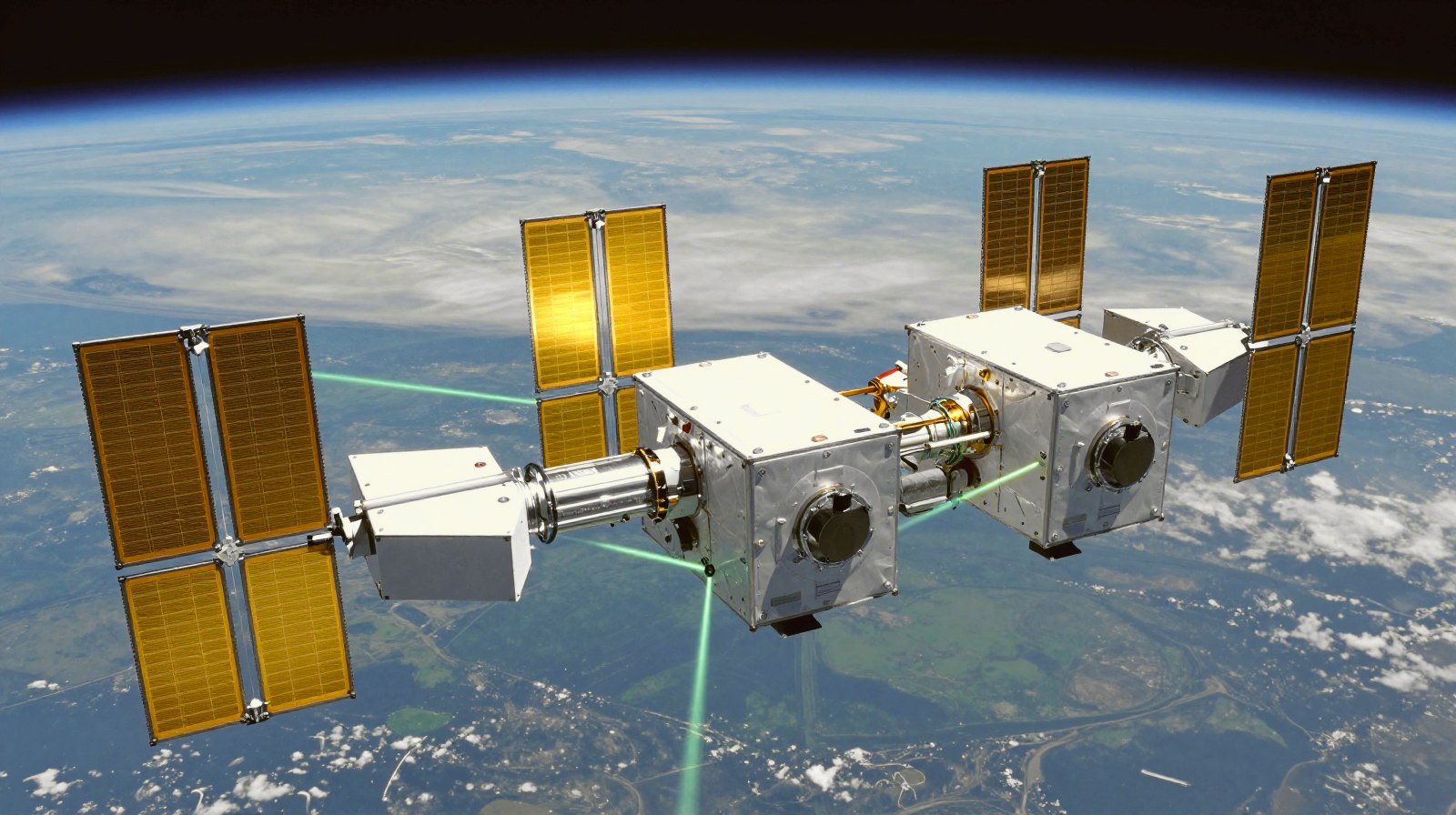
Data centres in space just moved from science fiction to paperwork. On 25 November 2026 the US Federal Communications Commission (FCC) gave SpaceX a conditional green light for “Starmind”: a constellation of up to one million satellites that would work as computers in orbit, crunching AI jobs powered by sunlight.
Why it matters: AI is hungry for electricity, land and cooling water, and data centres on the ground are fighting for all three. It is the first time the FCC has approved an entire constellation built for computing in space, Interesting Engineering and NeoTeo report. It is a permit, not a working machine, and the hardest engineering is still ahead.
What the FCC actually approved
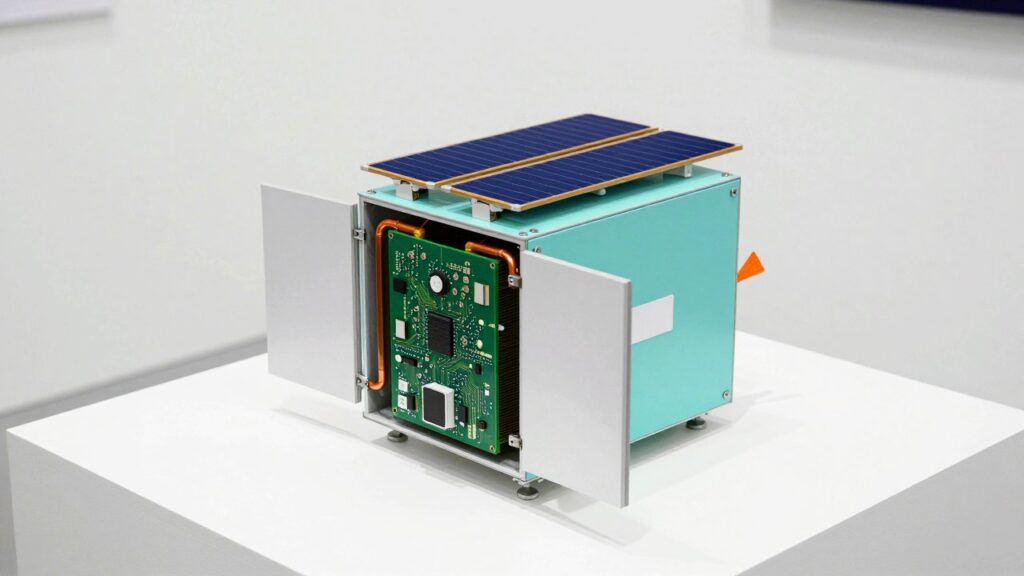
The order (number DA 26-1273) lets SpaceX launch and operate up to 1 million satellites, which FCC chair Brendan Carr described as “orbital compute modules”, according to Aviation Week and The Next Web. A million flying computers: that is the ceiling this permit sets.
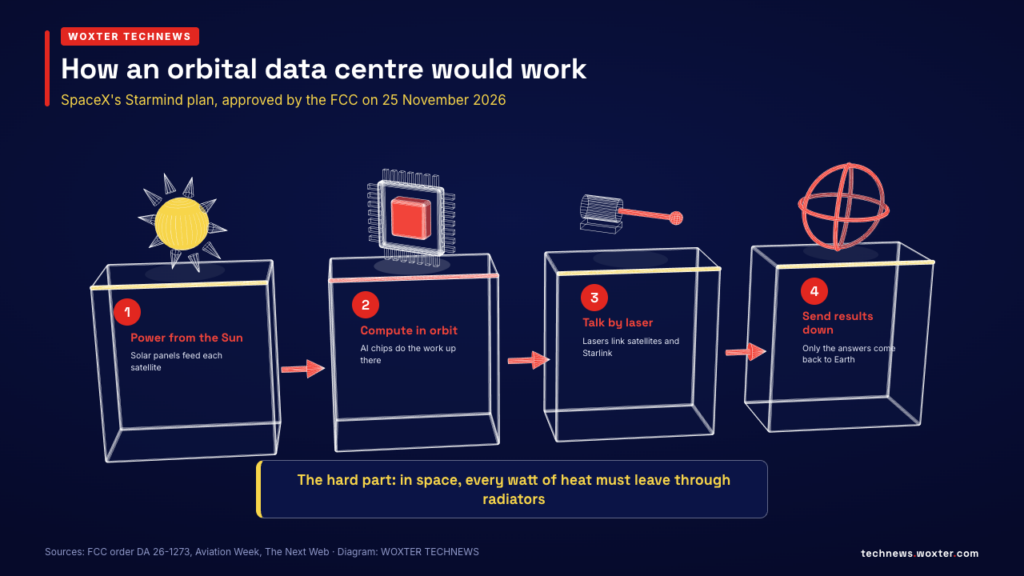
The satellites would mostly talk to each other, and to SpaceX’s Starlink network, with lasers. Radio links in the Ka band (18.8-19.3 GHz down to Earth, 28.6-29.1 GHz up to space) are only a backup for tracking and control, as Interesting Engineering and Aviation Week report. The idea is simple to say and hard to build: process the data up there, and send only the results back down.
The deadlines that come with it
The approval has a clock attached. According to Aviation Week and The Next Web, SpaceX must have:
- the first satellite working by 25 November 2033;
- 10 % of the constellation (100,000 satellites) by November 2035;
- half by November 2038;
- the full constellation by November 2040.
Miss a milestone and the permit shrinks or falls away. Operators often ask for more satellites than they plan to fly, to keep room to change designs, so “up to one million” is a ceiling, not a launch plan.
Space junk and the night sky
The FCC said SpaceX’s debris plans are fine for satellites flying below 600 km. For anything higher, SpaceX still has to file a final plan before launching, and its request to retire old satellites in other ways than burning them up in the atmosphere was put on hold, according to The Next Web and the FCC order summary reported by NeoTeo.
Not everyone is happy. Amazon, the satellite company Viasat and the American Astronomical Society asked the FCC to say no. Aviation Week reports the astronomers warned that radio signals “would imperil radio astronomy research” and that the satellites’ waste heat would brighten the infrared sky that telescopes study. Amazon called the plan a “lofty ambition rather than a real plan”, according to The Next Web. The FCC rejected the petitions and said some of the science concerns fall outside its authority.
Can a data centre really work in orbit?
Sunlight is the big attraction: SpaceX argues that orbital facilities could harness solar energy more efficiently than plants on the ground, with no clouds in the way, as Interesting Engineering reports. The catch is heat. Chips running AI get very hot, and in space there is no air to carry the heat away, so every watt has to be radiated off through large panels. The Next Web and Interesting Engineering both point to cooling, plus the cost of building and launching so many satellites, as the problems SpaceX still has to solve. Interesting Engineering adds that SpaceX’s giant Starship rocket would likely be key to making launches cheap enough.
SpaceX is not alone. Alphabet (Google’s parent) and Blue Origin are working on similar ideas, Aviation Week reports, and The Next Web says Blue Origin has applied for 51,600 satellites and the start-up Starcloud for 88,000. Elon Musk thanked the FCC on X: “This will be a great asset to America and the world.”
What happens next
Nothing launches tomorrow. The next real signs to watch are a first test satellite with serious computing power on board, a public design for its radiators, and the debris plan for higher orbits. Until then, Starmind is a permit with a 2033 deadline and a million-satellite ceiling: a bold bet that the cheapest place to power AI might be above the clouds.
Read next
- Robot builds first piece of a space antenna in orbit
- NASA’s Swift telescope falls to Earth after 22 years
- Nvidia explained: the heart of AI
The week's best tech stories, free
One email a week with the stories that matter, explained simply. No spam.
Sources
- FCC Greenlights SpaceX Plan For Orbital Data Centers – Aviation Week, 25 November 2026
- SpaceX wins FCC approval for Starmind orbital data centre network – The Next Web, 26 November 2026
- SpaceX gets FCC approval for one million space data center satellites – Interesting Engineering, 25 November 2026
- FCC authorizes SpaceX’s Starmind data center satellites – NeoTeo, 28 November 2026
- Order DA 26-1273 – Federal Communications Commission, 25 November 2026