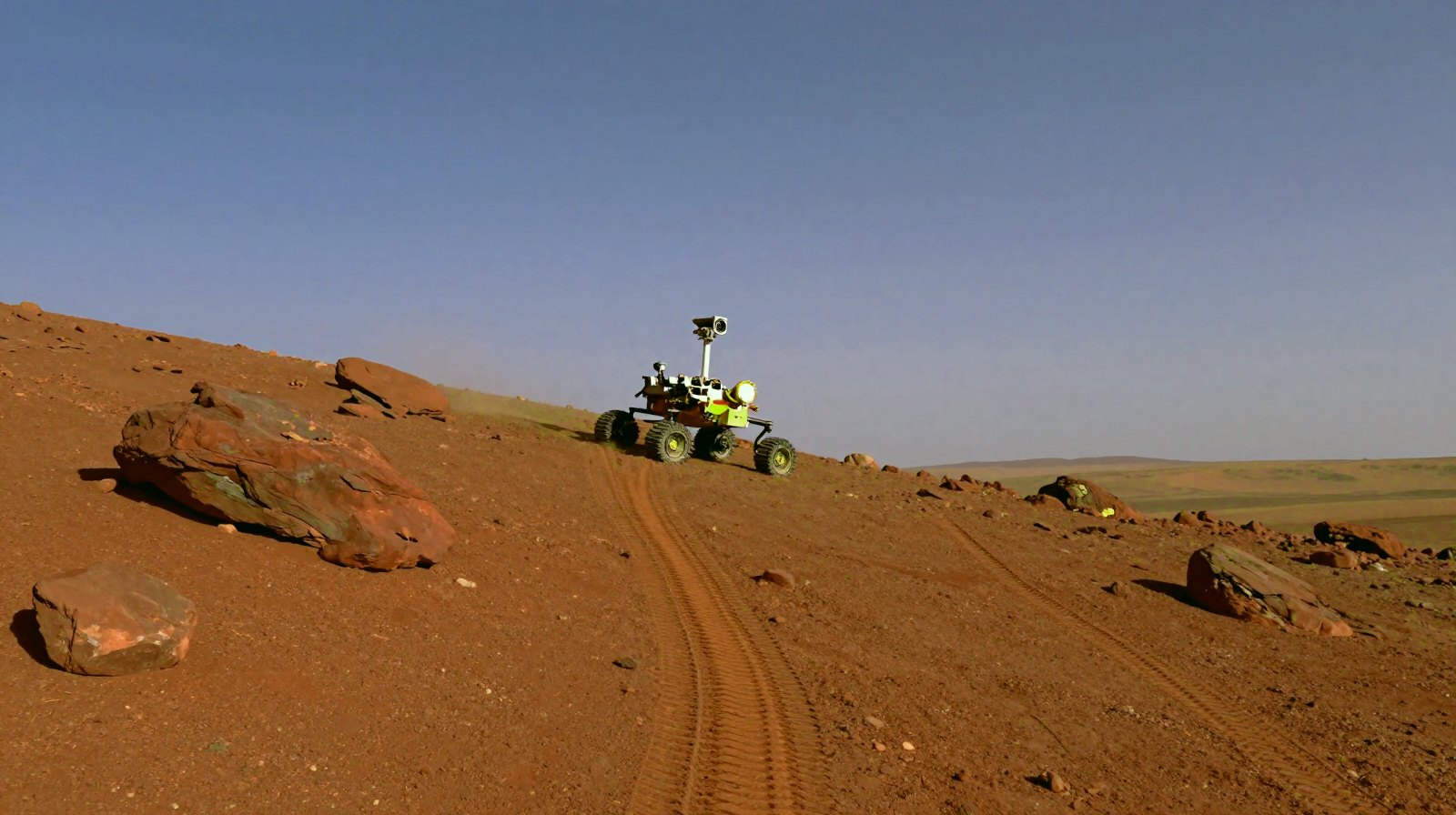
NASA’s Perseverance rover has just driven farther than any vehicle has ever driven on another world. On 11 October 2026, its 2,006th Martian day, the odometer reached 45.22 km (28.10 miles), passing the 45.16 km (28.06 miles) set by the Opportunity rover, according to NASA’s Jet Propulsion Laboratory.
Why it matters: Opportunity needed almost 15 years to drive that far. Perseverance did it in about five and a half. The secret is not a faster motor but a better brain: the rover now plans most of its own route, rock by rock, without waiting for instructions from Earth. That same self-driving skill is what future explorers on the Moon and Mars will depend on.
A marathon on Mars, one careful step at a time
45 km is roughly the length of a marathon. On Earth you could drive it in half an hour. On Mars it took years, and for good reasons. Radio messages take many minutes to cross between the planets, so nobody can steer the rover live like a remote-control car. The ground is full of boulders, sand traps and steep slopes, and there is no tow truck if a wheel gets stuck.
The rover also stops a lot on purpose. It is a science lab on wheels: it grinds into rocks, studies them up close and has collected 29 rock and regolith samples so far (regolith is the loose dust and grit on the surface). NASA’s driving team says that, two months before the record, Perseverance was only about 200 metres short of it, a distance a single drive could cover. The team chose short hops instead, to study ancient rock outcrops, and only rolled past the record when the science was done, as JPL’s Vandi Verma describes in the mission blog.
How a rover learns to drive itself
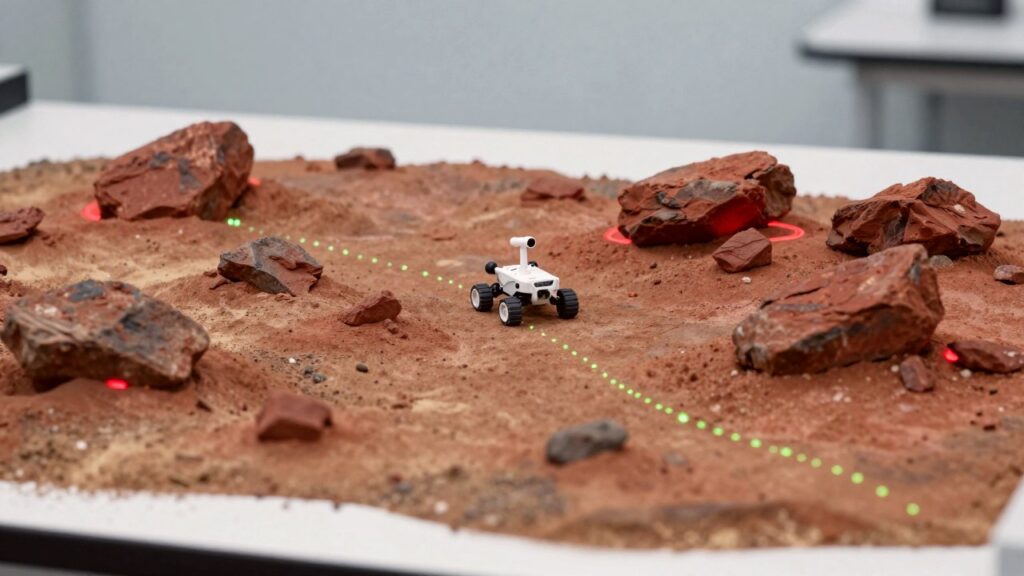
The key tool is AutoNav (autonomous navigation). The rover takes stereo pictures, builds a 3D map of the ground ahead, judges which patches are safe and picks a path while it keeps moving. According to NASA, more than 90 % of Perseverance’s total distance was driven with AutoNav checking the terrain. On the earlier rovers Spirit and Opportunity, the first version of the system handled about 5 % of the driving.
In an interview with IEEE Spectrum, JPL’s Mark Maimone, who has written self-driving software for four Mars rovers, explains what changed: Perseverance carries an extra processor with an FPGA (a chip that can be rewired for one job, here fast image processing), so it can think about the terrain while driving instead of stopping to look. AutoNav has reached speeds of up to 120 metres per hour. That sounds slow, but on Mars it is a sprint.
Software upgrades sent from Earth
The rover that holds the record is not quite the one that landed in 2021. The team keeps sending it new software. The mission blog lists some of the changes, each tested in thousands of simulations first:
- Steeper slopes: the tilt limit was raised to 24 degrees.
- Lower clearance: the rover may now pass over rocks with only 20 cm (about 8 inches) of space under its belly.
- Smarter braking and stronger steering: new braking software avoids rock hazards, and the steering motors can use almost twice as much current.
- Slip prediction: “dynamic slip tables” help the rover predict how much its wheels will slide on loose ground.
- Knowing where it is: a new feature compares the rover’s own photos with orbital images to work out its exact position on the map after a drive. It runs on a spare computer that once served the Ingenuity helicopter, and the team protects it against radiation glitches with clever software.
Maimone summed it up in the NASA release: “Perseverance is a better driver than the one that landed, and we’re not done.”
Records in context
The original mission plan called for no more than 20 km (12.4 miles) of driving, so Perseverance has already covered more than twice that. Its neighbour Curiosity, still working in Gale Crater, has driven more than 38 km (23.65 miles), according to EarthSky. Opportunity’s record held for years after its mission ended in a planet-wide dust storm.
If you enjoyed our story on Japan’s MMX mission to Mars’s moon Phobos, this is the other half of the picture: getting to Mars is hard, but moving around safely once you are there is just as big a challenge.
Back on Earth, the closest thing most of us have to a rover’s navigation cameras is a dash cam: our car gadgets guide explains how one records the road on a loop and saves a clip automatically after a bump.
What happens next
A first mission extension began in October and runs to about the end of 2028. Perseverance is exploring an area called Lac de Charmes, beyond the western rim of Jezero Crater, and will then head south along the rim towards “Rainbow Falls”, a block of ancient crust about 100 metres wide. The next driving puzzle, Maimone says, is teaching the rover to cope with sunlight glare in its navigation cameras. NASA’s project manager Steven Lee expects Perseverance “to keep adding to this record for many years to come”.
Read next
- Japan’s MMX launches to bring home soil from Mars’s moon Phobos
- AI drone with one camera beats world champion pilots
- Robot AI that imagines the scene before it moves
The week's best tech stories, free
One email a week with the stories that matter, explained simply. No spam.
Sources
- NASA’s Perseverance sets off-world record for total distance driven – NASA Jet Propulsion Laboratory, 12 October 2026
- Tracks along the longest drive on another world – Vandi Verma, NASA Science (Perseverance blog), 12 October 2026
- Perseverance sets Mars rover distance record – Evan Ackerman, IEEE Spectrum, 13 October 2026
- NASA’s Perseverance rover on Mars sets off-world driving record – Deborah Byrd, EarthSky, 13 October 2026