
A spacecraft built to go and look at dead satellites has been lost before its real work began, and the culprit was its own safety software. NASA and the company Starfish Space said on 3 November that their Otter spacecraft for the SSPICY mission cannot be recovered, because a fault-protection system kept its radio switched off by mistake, NASA reported.
Why it matters: low Earth orbit is filling up with broken satellites and old rocket parts. Spacecraft that can fly up close, inspect that junk and one day push it out of the way are a big part of keeping space usable. This loss shows how hard, and how unforgiving, that job still is.
What SSPICY was meant to do
SSPICY stands for Small Spacecraft Propulsion and Inspection Capability. The plan was for Otter to approach several inactive objects of U.S. origin in low Earth orbit, such as old satellites and rocket bodies, take a close look and gather data for future missions that will drag such objects down, according to Payload. NASA valued the mission at about $15 million.
It was also a test flight. NASA says it was Otter’s first launch and the first time Starfish’s navigation and propulsion technologies flew together on one spacecraft, along with a robotic arm that can bend and point.
What went wrong
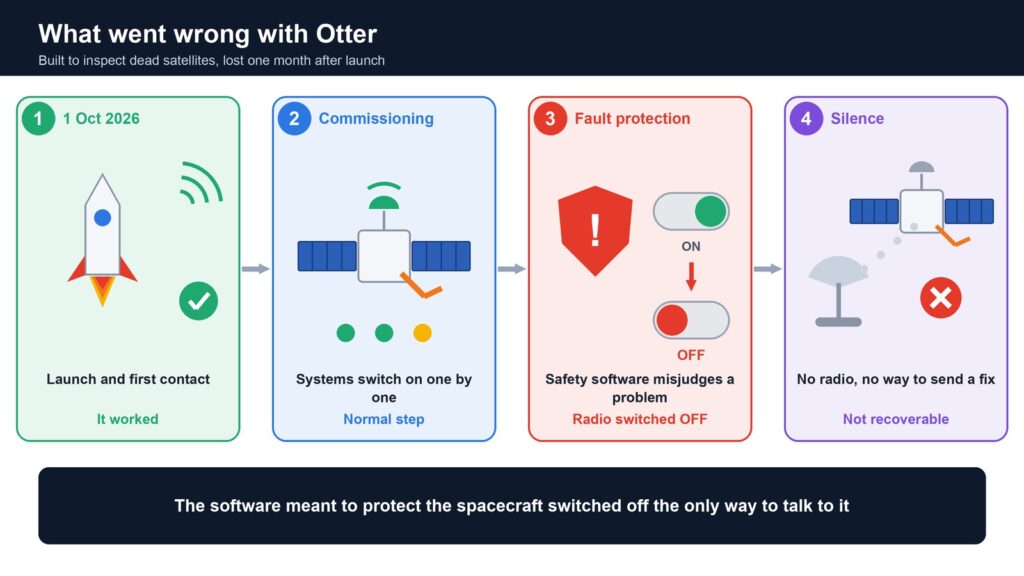
Otter launched on 1 October 2026 on SpaceX’s Transporter-18 rideshare, and Starfish made first contact soon after. Then, during commissioning (the first weeks when a spacecraft switches on its systems one by one and calibrates them), the link went quiet.
The team traced it to fault protection: the onboard software whose job is to spot problems and react, a bit like a circuit breaker at home. Instead of protecting the spacecraft, it wrongly kept the radio turned off. With no radio, there is no way to send a fix, so NASA and Starfish concluded the spacecraft is not recoverable. Payload reports the faulty fault protection was on the spacecraft bus (the main body that holds power, computers and radio) supplied by the company Astro Digital.
Not the first scare
Starfish has had a rough ride before. In 2023 its first small test craft, Otter Pup 1, was released into a fast spin by its ride to orbit, turning at 330 degrees per second, and the team still managed to recover it after six weeks, Payload notes. Its newer Otter Pup 2, launched in 2025, recently flew to within 33 metres of another satellite.
Spacecraft don’t always end the way their teams plan. For a much longer and happier story, read how NASA’s Swift telescope fell back to Earth after 22 years of work.
What happens next
“Technology demonstrations allow us to quickly test new systems, learn from their performance, and iterate,” said Greg Stover of NASA’s Advanced Research and Technology Division. NASA and Starfish are looking at completing SSPICY’s goals on other Starfish missions, and the company is fixing the bus software. Starfish also holds a $52.5 million contract with the U.S. Space Development Agency to remove satellites from orbit, Payload reports, so the next Otter launches will be watched closely.
Read next
- NASA’s Swift telescope falls to Earth after 22 years
- Voyager 1 will be one light-day from Earth on 18 November
- Rubin finds a possible sixth dwarf planet beyond Pluto
The week's best tech stories, free
One email a week with the stories that matter, explained simply. No spam.
Sources
- NASA-funded SSPICY mission experiences communications loss, NASA, 3 November 2026
- Starfish loses contact with Otter, cutting SSPICY short, Payload, November 2026