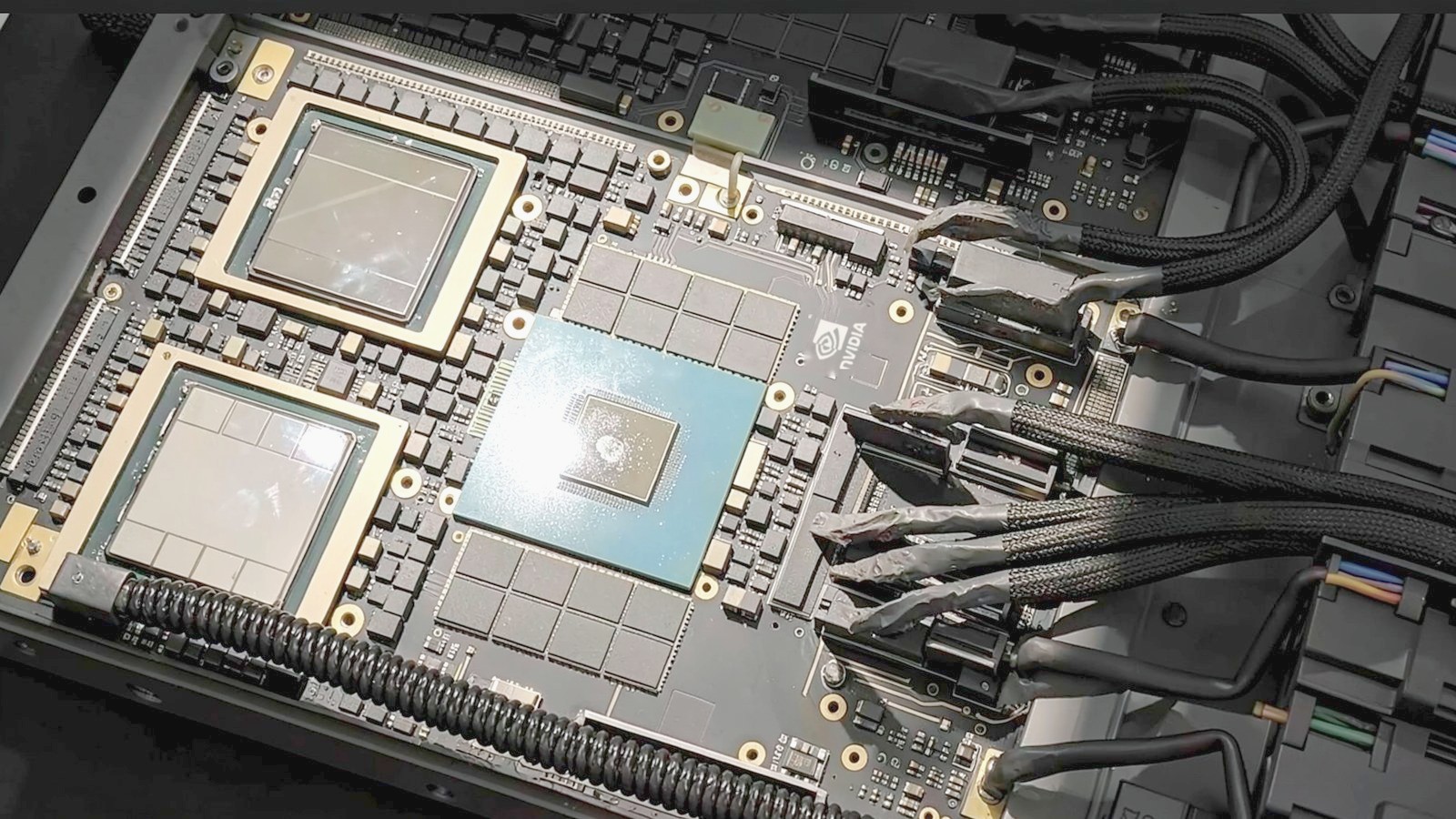
Nvidia started in 1993 with three engineers and an idea for better video game graphics. Today its chips train and run most of the world’s artificial intelligence, steer telescopes, filter particle collisions at CERN and teach robots to walk in virtual worlds. This is the technology behind the name, in plain words: what a GPU does, the whole Nvidia ecosystem around it, the science it powers, the factories it simulates and what comes next.
Why it matters: when you ask a chatbot a question, generate a picture or get a weather forecast, the heavy maths usually runs on Nvidia hardware somewhere. And this week the company changed leader for the first time in 33 years (we told that story in The NVIDIA TSUNAMI). The founder has gone; the technology below is what stays.
What a GPU actually does
A normal processor, the CPU, is like one brilliant chef who cooks one dish at a time. A GPU (graphics processing unit) is like a kitchen with thousands of cooks who each do one simple job at the same moment. That is perfect for drawing millions of pixels in a game, and it turned out to be perfect for AI too, because training an AI model is mostly the same simple multiplication repeated billions of times. (Our guide to the CPU, GPU, NPU and TPU explains the whole chip family.)
Today’s data-centre GPUs are giants. Blackwell, presented in March 2024, packs 208 billion transistors on two pieces of silicon joined by a 10 terabytes-per-second link, with 192 GB of very fast HBM3e memory (Nvidia; Tom’s Hardware). It also introduced FP4, a way of doing AI maths with only 4-bit numbers: less precise per step, but far faster and cheaper, which is fine for most AI work. The new Rubin GPU goes further: 336 billion transistors, 288 GB of HBM4 memory moving 22 terabytes per second, and NVLink 6 connections of 3.6 terabytes per second to its neighbours (Nvidia; SiliconANGLE).
The key idea is not one chip but many chips acting as one. A Vera Rubin NVL72 cabinet links 72 Rubin GPUs and 36 Vera CPUs (88 cores each) so tightly that software sees a single giant machine with 20.7 TB of HBM4 memory, according to Nvidia’s preliminary specifications.
The whole Nvidia ecosystem
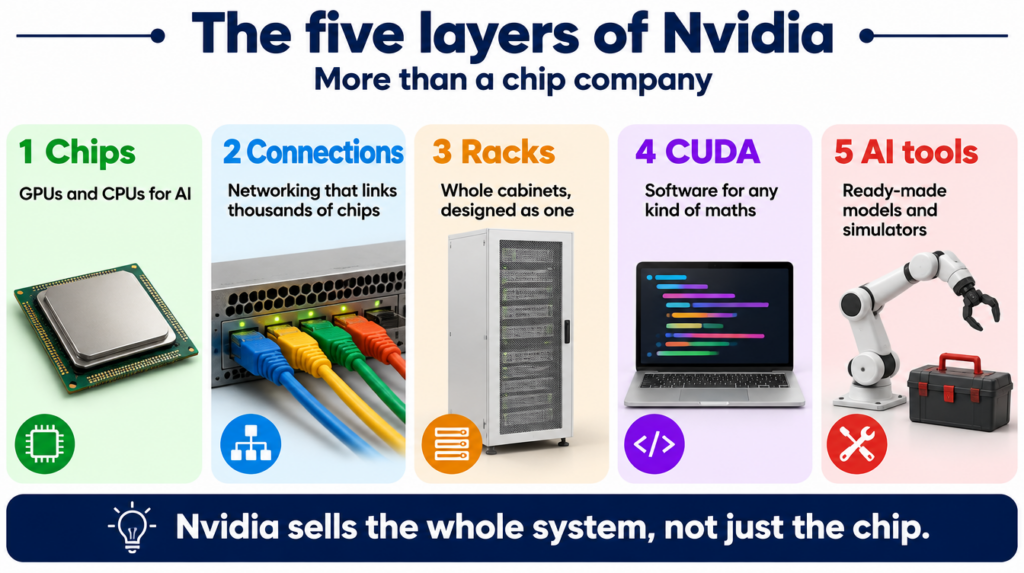
Nvidia stopped being “just a chip company” long ago. Its real product is a stack of layers that fit together, and very few rivals offer all of them:
- Chips: data-centre GPUs (Blackwell, Rubin), its own Arm CPUs (Grace, Vera), GeForce RTX for gamers and creators, and RTX PRO for workstations.
- Connections: NVLink between GPUs, plus InfiniBand and Spectrum-X Ethernet networks, BlueField and ConnectX network chips. Much of this came from Mellanox, which Nvidia agreed to buy in 2019 for about $6.9 billion (SEC filing; Data Center Frontier).
- Systems: whole cabinets (NVL72), DGX servers, and small desktop AI computers such as DGX Spark.
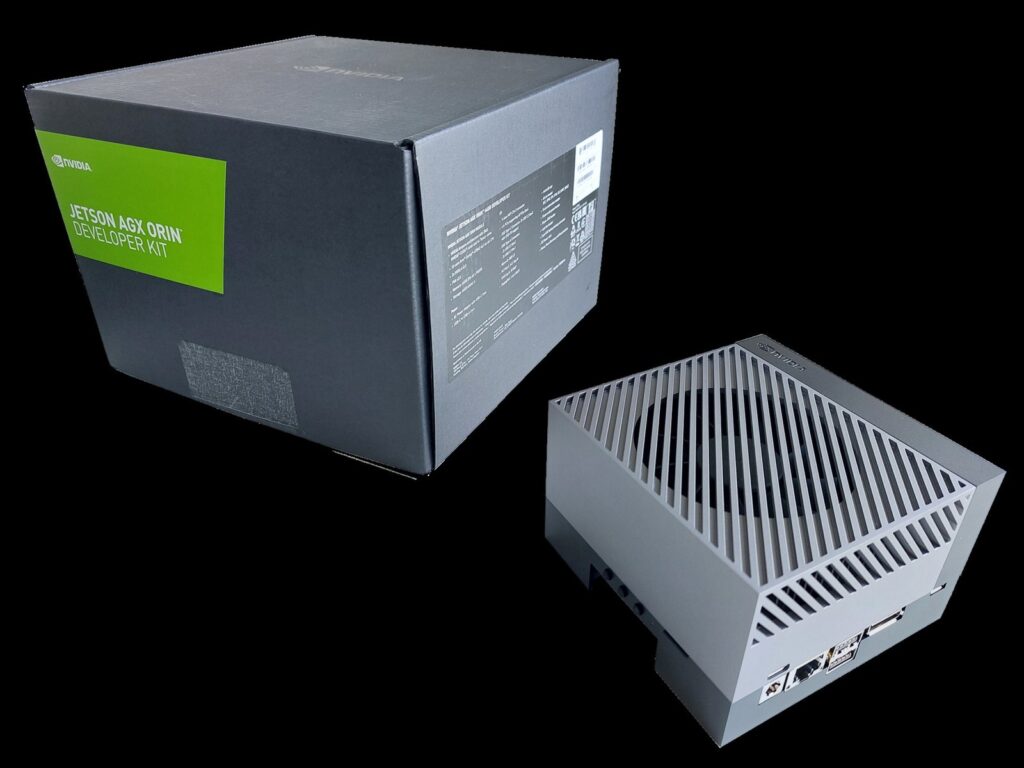
- Edge and robots: Jetson modules that put a GPU inside robots, drones and machines. The newest, Jetson AGX Thor, went on sale in August 2025 at $3,499 for the developer kit (TweakTown). DRIVE does the same for cars.
- CUDA: the software that lets programmers use a GPU for any maths. Shown in 2006 and released in 2007, it now has about 6 million developers, Nvidia says, plus libraries such as cuDNN for neural networks and cuBLAS for linear algebra.
- Platforms: Omniverse for 3D digital twins, Isaac for robots, Cosmos “world models”, NIM ready-to-run AI services, and DLSS, which uses AI to draw extra frames in games.
The money shows where the weight is. In the three months to 26 July 2026, Nvidia reported $96.2 billion in sales, and $89.0 billion of that came from data centres.
From a diner table to CUDA
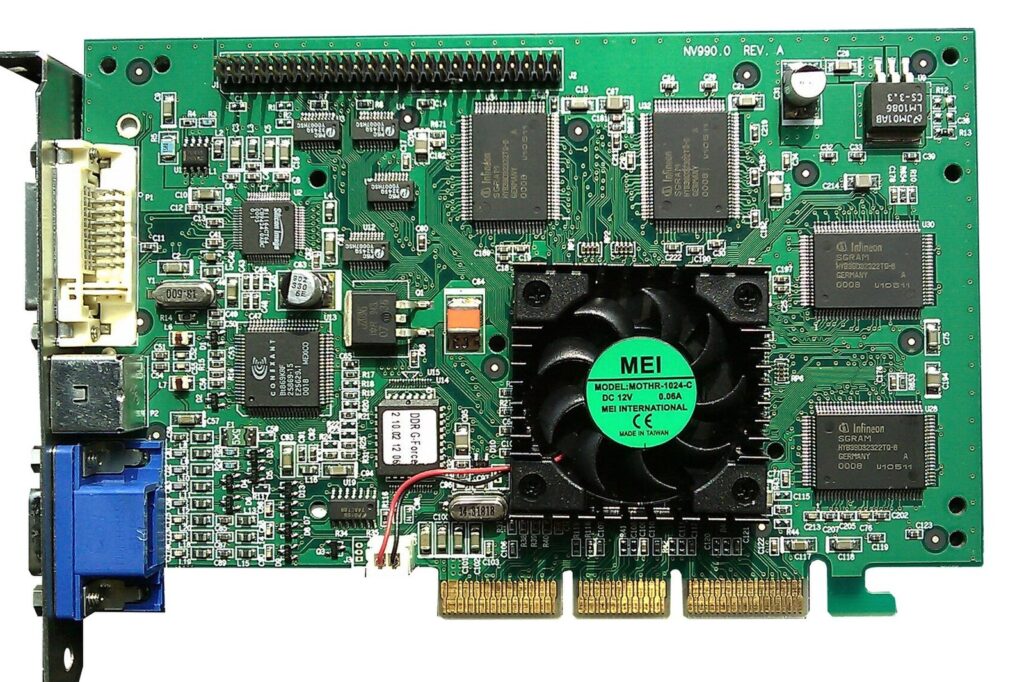
Jensen Huang, Chris Malachowsky and Curtis Priem founded Nvidia on 5 April 1993, after planning it over meals at a Denny’s restaurant in San Jose (Nvidia timeline). The RIVA 128 chip of 1997 was the first hit: by January 1998 Nvidia had shipped its millionth. In 1999 came the GeForce 256, sold as the world’s first GPU.
The bet that changed everything was CUDA. At first it looked like an expensive hobby. Then, in 2012, a University of Toronto team trained an image-recognition network called AlexNet on two Nvidia GTX 580 gaming cards over five to six days and beat every rival by a wide margin (the original paper). Researchers switched to GPUs, their code was written in CUDA, and that habit is still Nvidia’s strongest advantage.
GPUs for science: from telescopes to CERN
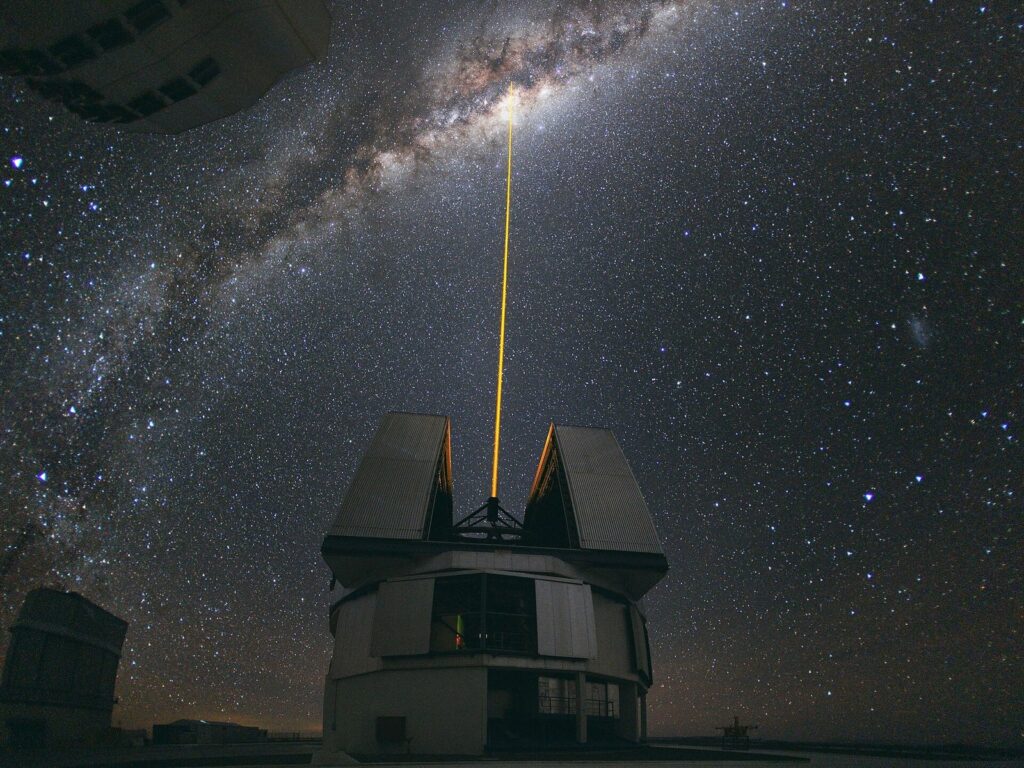
Sharper telescopes with adaptive optics. Earth’s air shimmers, the reason stars twinkle, and that blurs every big telescope. Adaptive optics fixes it: a sensor measures the distortion, often using an artificial star made by a laser shining into the sky, and a flexible mirror bends to cancel it, hundreds or thousands of times a second. The hard part is the maths in the middle, done in a fraction of a millisecond. That is now a GPU job. At the Keck Observatory in Hawaii, a new real-time controller built on Nvidia GPUs must close the loop from camera to mirror in at most 500 microseconds, with a goal of 250 (Keck team, SPIE 2022; ANU). It is based on COSMIC, a GPU platform from the Paris Observatory and the Australian National University, which ran on the sky with about 110 microseconds of delay. The same platform is planned for MAVIS, a new instrument for ESO’s Very Large Telescope in Chile, aiming for 160 microseconds (ESO workshop; SPIE 2024).
Particle physics. At CERN, the LHCb experiment’s first filter, called Allen, runs entirely on GPUs: about 500 of them sift 30 million particle collisions per second down to the 1 or 2 million worth keeping (Computing and Software for Big Science; CERN). The ALICE experiment also reconstructs its data on GPUs.
Climate and weather. In November 2025 a European team including Nvidia won the Gordon Bell Prize for climate modelling by running a complete Earth-system model at 1.25 km resolution on about 8,000 Grace Hopper chips of the Swiss Alps supercomputer (idw; DKRZ). Nvidia’s Earth-2 platform uses AI to turn coarse 25 km forecasts into 2 km detail; Nvidia says it is 1,000 times faster than traditional methods (Nvidia; The Register). We covered the trend in AI forecasts up to a month ahead.
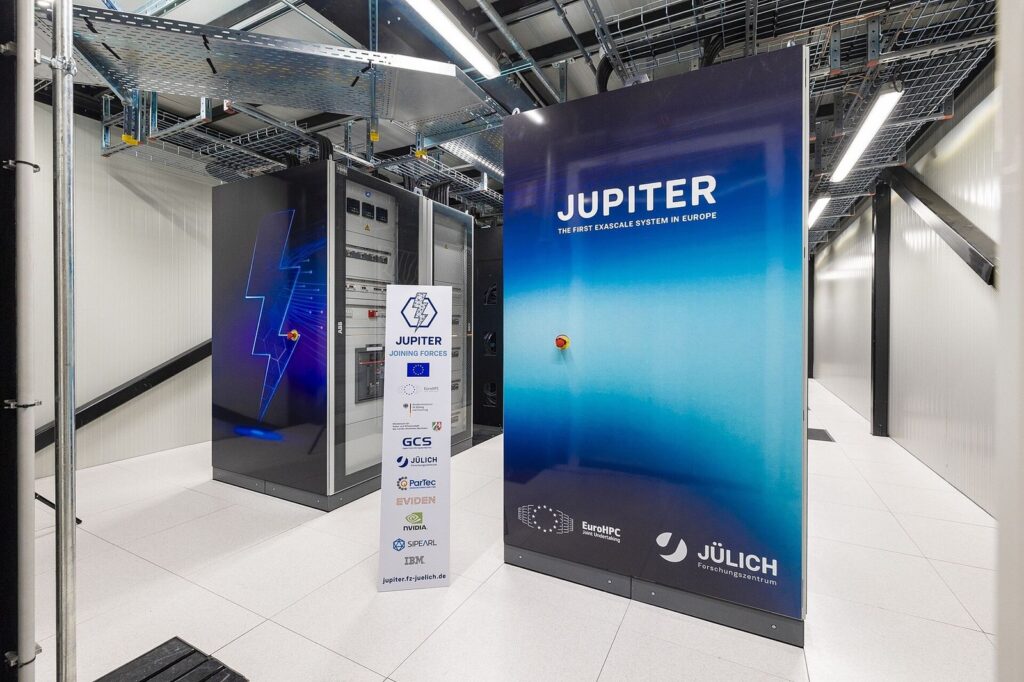
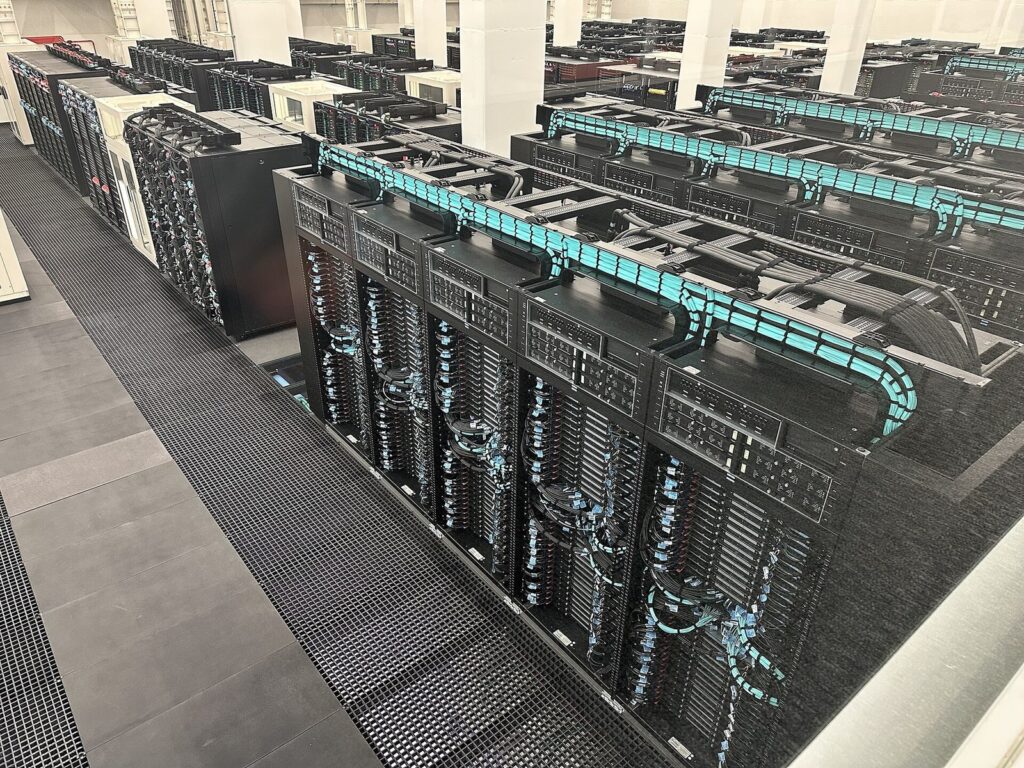
Supercomputers. Europe’s first exascale machine, JUPITER in Jülich, Germany, uses about 24,000 Nvidia GH200 Grace Hopper superchips and reached exactly one exaflop, a billion billion calculations per second, in the TOP500 ranking (EuroHPC; TOP500). In Barcelona, MareNostrum 5’s accelerated part runs more than 4,400 Nvidia H100 GPUs (TOP500; BSC). Not every top machine is Nvidia: El Capitan in the US uses AMD, and today’s number one, China’s LineShine, uses no GPUs at all.
Medicine and quantum. BioNeMo, Nvidia’s open platform for AI drug discovery, is used by more than 200 biotech and pharma groups, Nvidia says, and CUDA-Q lets researchers simulate quantum computers on GPUs before real ones are big enough (Nvidia; The Quantum Insider).
The RTX family: one architecture, from games to AI PCs
The GeForce RTX 50 series, launched from January 2025 on the same Blackwell architecture, is the side of Nvidia most people can buy. Each card has CUDA cores for graphics, RT cores for realistic light and Tensor cores for AI, which power DLSS 4: for every frame the card draws, AI can generate up to three more (Nvidia). The same Tensor cores run AI models at home, without the cloud.
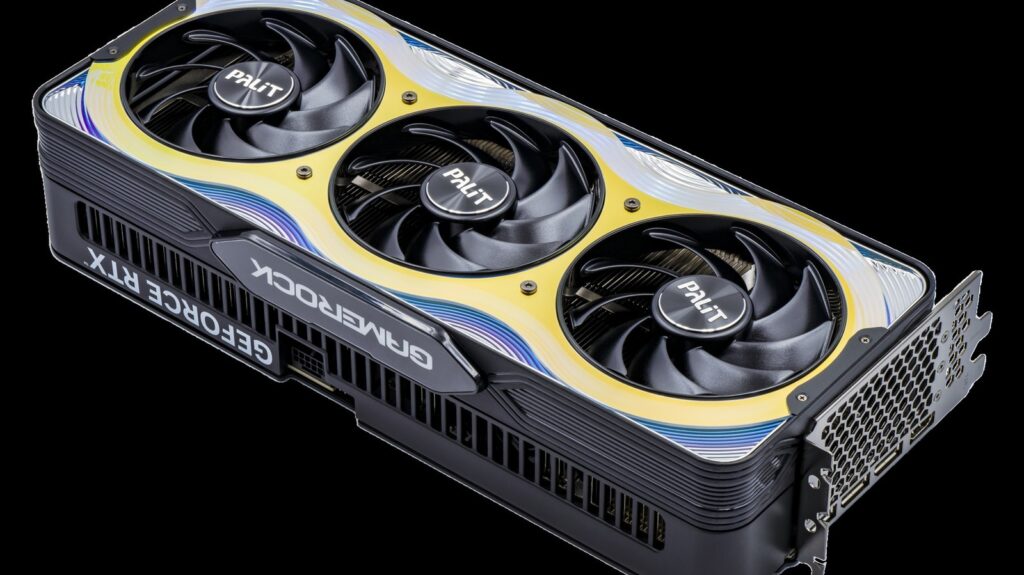
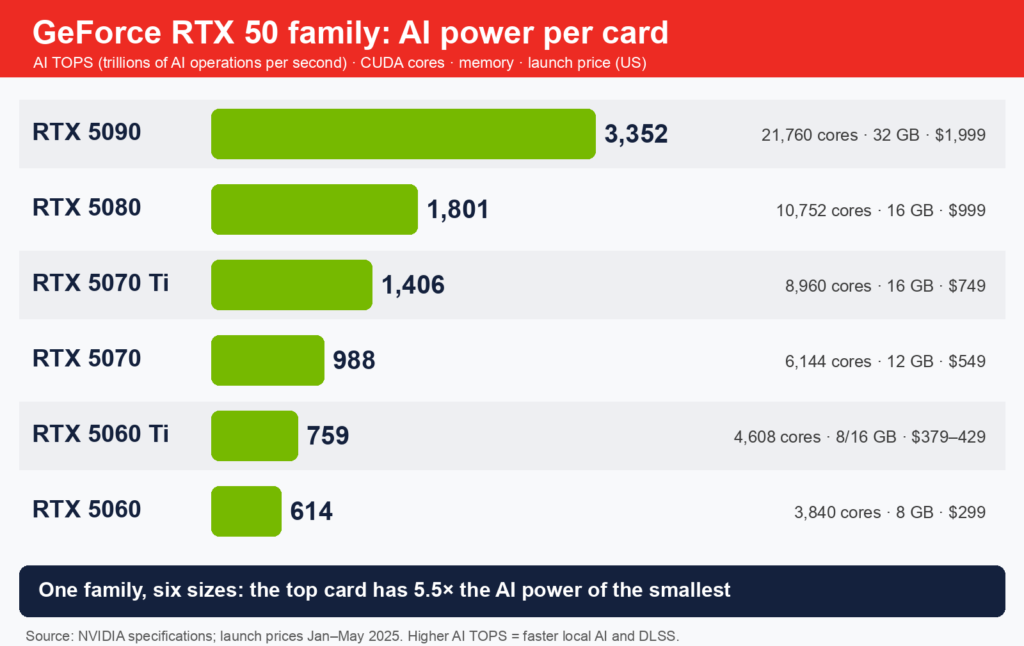
The numbers come from Nvidia’s specifications, with launch prices confirmed by GamersNexus and Tom’s Hardware. “AI TOPS” means trillions of AI operations per second (we explain the unit in What are AI TOPS?). For professionals, the RTX PRO 6000 Blackwell has 24,064 CUDA cores and 96 GB of memory (StorageReview).
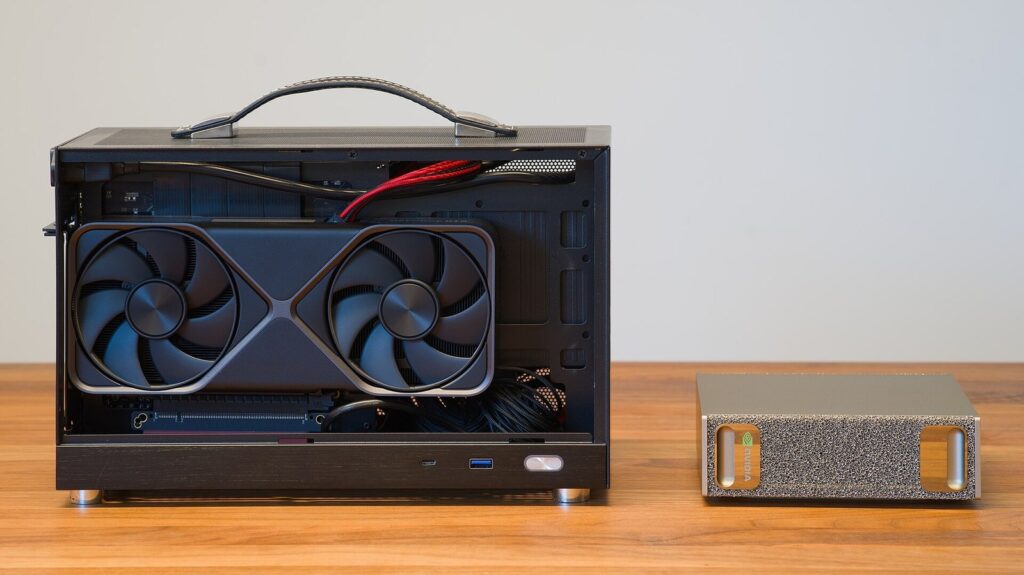
The latest computers. DGX Spark, a gold box the size of a book, went on sale on 15 October 2025 at $3,999 with Nvidia’s GB10 chip, 128 GB of shared memory and up to one petaflop of FP4 AI power (Engadget; The Register); its price has gone up since (ServeTheHome). Its big brother, DGX Station, offers 748 GB of memory. And since 16 October 2026 the same idea fits in a laptop: RTX Spark laptops from ASUS, Dell, HP, Lenovo, Microsoft and MSI.
AI agents at home: from the Mac mini to NemoClaw
This year’s surprise hit in personal AI was OpenClaw, an open-source agent that can work on your computer for you: answering messages, organising files, running tasks. Many people set it up on an Apple Mac mini, which caused a buying wave in early 2026 (Business Insider; Decrypt). Nvidia’s answer came at its GTC conference on 16 March 2026: NemoClaw, a package that installs OpenClaw with Nvidia’s own Nemotron models and a protective sandbox, to run on RTX PCs and DGX computers (Nvidia; SiliconANGLE). “OpenClaw is the operating system for personal AI,” Huang said. The point for Nvidia is simple: an agent that runs at home needs a GPU at home.
Robots learn in virtual worlds
Teaching a robot by trial and error in the real world is slow and breaks things. So robots now practise in simulation first: thousands of virtual copies, each on slightly different ground, falling over safely millions of times until they learn. This is called reinforcement learning, and the hard part is the jump from the tidy virtual world to the messy real one, the “sim-to-real gap”. Nvidia’s free Isaac Sim and Isaac Lab tools do the practice; Cosmos, launched in January 2025, adds “world models” trained on 20 million hours of video that can generate realistic practice scenes (TechCrunch).
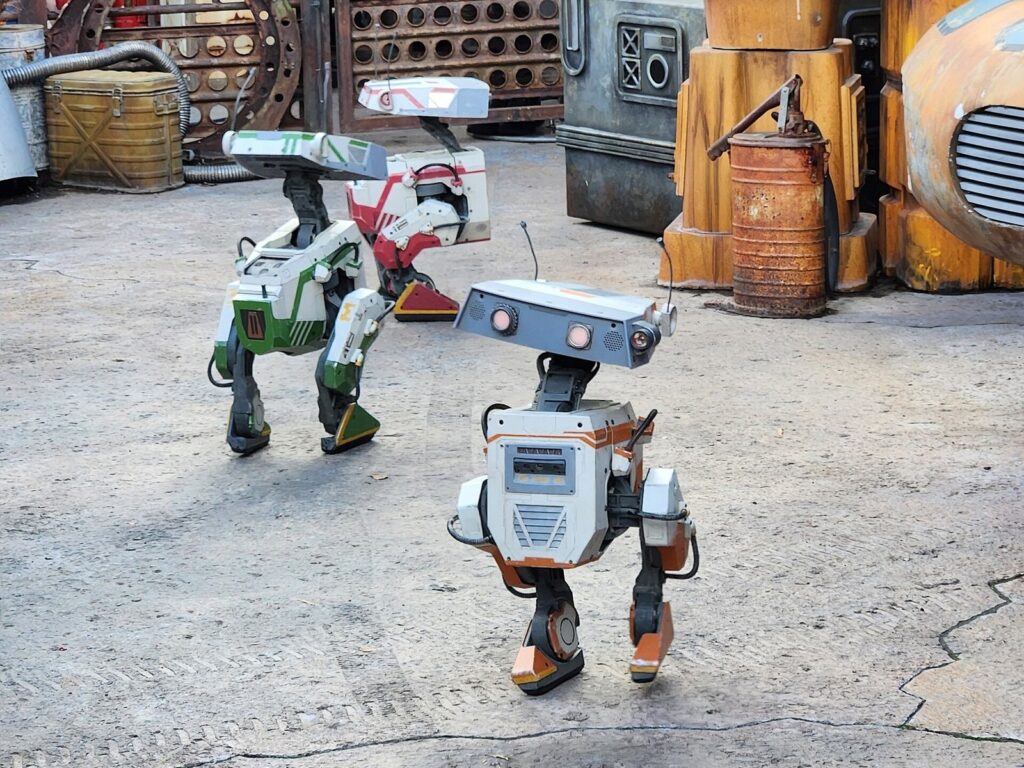
In March 2025 a small Star Wars-style droid called Blue walked on stage with Jensen Huang, and Nvidia, Google DeepMind and Disney Research announced Newton, an open physics engine for training robots (TechCrunch; TechRadar). Disney’s BDX droids, now walking in its parks, learn their moves this way.
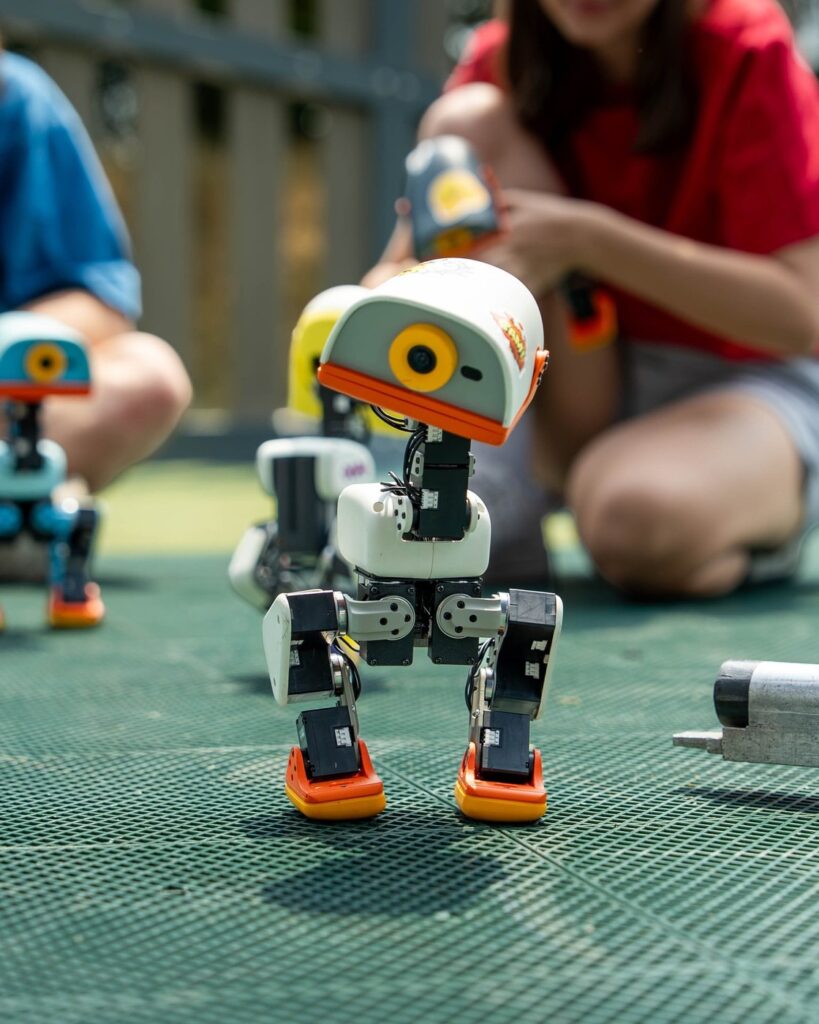
The cutest example is the duck. At Nvidia’s GTC Berlin keynote on 21 October 2026, four 25-centimetre Microduck robots from Pollen Robotics and Hugging Face sat, napped and somersaulted on command. Each learned to walk in simulation: Nvidia’s tutorial runs 4,096 virtual ducks at once on a single graphics card, up to 1.25 million simulation steps per second, with deliberately messy physics so the real duck copes with a real floor (Hugging Face and Nvidia; The Register). We explained it step by step in how a robot duck learns to walk, and the same idea in a humanoid that learns to walk and grab.
Digital factories: build it virtually first
The same simulation tools now plan whole factories. BMW planned its new plant in Debrecen, Hungary, entirely in Nvidia Omniverse: a “digital twin” of the factory ran virtual production for more than two years before the real one opened, built from more than 7 million square metres of 3D-scanned BMW buildings (BMW Group; BMW Blog). BMW now uses its Virtual Factory across more than 30 sites and says it is projected to cut planning costs by up to 30 per cent (Assembly Magazine). Foxconn and TSMC plan factories the same way (Nvidia).
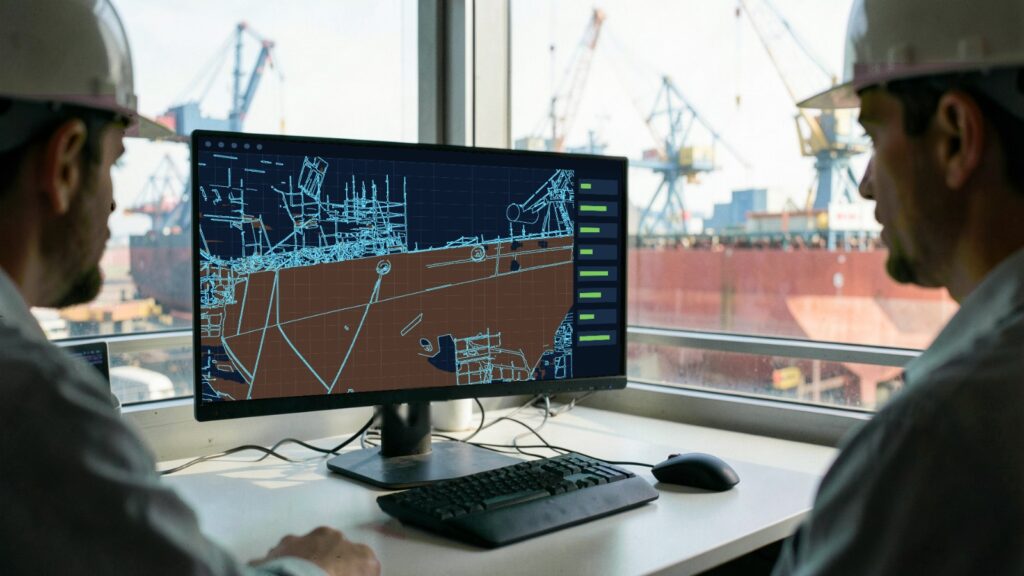
Shipbuilding is going the same direction. Spain’s Navantia is building a digital shipyard, “Shipyard 4.0”, and designs its F-110 frigates around a digital twin, though with other partners: Accenture and Siemens’ Xcelerator software, with a joint research centre in Ferrol aiming for “Shipyard 5.0” (Accenture; Digital Engineering; University of A Coruña). The idea is the same everywhere: test every robot, crane and production line in the virtual world, then build once. Even physics itself is being learned this way, as in one AI that simulates sand, water and cloth.

The roadmap: one new generation every year
Nvidia used to release a new chip family every two years. Now it does it every year, and it publishes the plan in advance so customers can prepare buildings and power supplies.
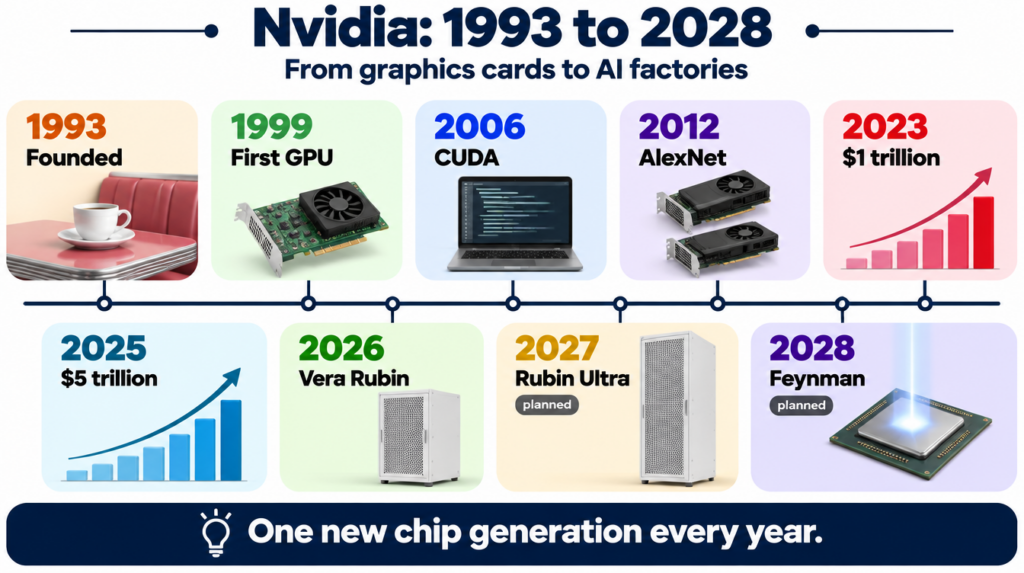
2025: Blackwell Ultra. 288 GB of memory per GPU and about 1.5 times the AI power of Blackwell (Tom’s Hardware).
2026: Vera Rubin. Named after the astronomer who found the evidence for dark matter. Not one chip but a family designed together: the Rubin GPU, the 88-core Vera CPU, NVLink 6 switches, ConnectX-9 and BlueField-4 network chips and Spectrum-6 switches with light-based optics built in. Nvidia said in August that Vera Rubin was in full production and already running at several cloud companies (Nvidia; ASUS).
2027: Rubin Ultra. Four GPU dies in one package and 1 TB of HBM4E memory, in a new “Kyber” cabinet where the computers slide in vertically like books on a shelf. A single cabinet could draw up to 600 kilowatts, so getting the heat out is as hard as the chips (see boiling coolant inside chips).
2028: Feynman. Named after the physicist Richard Feynman, with chips stacked on top of each other, a new CPU called Rosa, after Rosalind Franklin, and more connections that use light instead of copper (The Next Platform; HPCwire), an idea we explained in moving data with light, not wires.
Key takeaways
- A GPU is thousands of small calculators working at once, which is exactly what AI, graphics and science need.
- Nvidia sells a complete ecosystem: chips, networking, cabinets, CUDA and ready-made platforms for robots, factories and science.
- GPUs now steer telescope mirrors in microseconds, filter CERN collisions and run Europe’s first exascale supercomputer.
- Robots and factories are increasingly built twice: first in a virtual world, then in the real one.
- The plan is one new generation a year: Vera Rubin (2026), Rubin Ultra (2027), Feynman (2028).
What happens next
Three things are worth watching. First, the results today, 17 November, the first under the interim chief executive. Second, whether the yearly rhythm of new chips holds as Vera Rubin ramps up. Third, power: every step on the roadmap needs more electricity per cabinet, so the limit on AI may soon be the plug rather than the chip.
Read next
- The NVIDIA TSUNAMI
- Microduck robot: how a robot duck learns to walk in simulation
- How the universe lit up after the Big Bang: Lumina simulation
The week's best tech stories, free
One email a week with the stories that matter, explained simply. No spam.
Sources
- NVIDIA Announces Financial Results for Second Quarter Fiscal 2027, NVIDIA Newsroom, 26 August 2026
- NVIDIA Blackwell Platform Arrives to Power a New Era of Computing, NVIDIA Newsroom, 18 March 2024
- Blackwell B200 GPU revealed, Tom’s Hardware, March 2024
- Inside the NVIDIA Rubin Platform, NVIDIA Technical Blog, January 2026
- Nvidia debuts Rubin chip, SiliconANGLE, 5 January 2026
- NVIDIA Vera Rubin NVL72, NVIDIA product page, 2026
- Mellanox acquisition filing, U.S. Securities and Exchange Commission, 2020
- Nvidia to acquire Mellanox in $6.9 billion deal, Data Center Frontier, March 2019
- Jetson AGX Thor dev kit, TweakTown, August 2025
- Corporate timeline, NVIDIA
- ImageNet Classification with Deep Convolutional Neural Networks, Krizhevsky, Sutskever and Hinton, NeurIPS 2012
- Enabling the next generation of Keck AO with the RTC upgrade, Chin et al., SPIE 2022
- Keck AO real-time controller, Australian National University
- COSMIC and MAVIS real-time computers, ESO RTC4AO workshop, 2023
- MAVIS RTC: a COSMIC-based real-time computer, SPIE 2024
- Allen: a high-level trigger on GPUs for LHCb, Computing and Software for Big Science, 2020
- Allen documentation, CERN
- Gordon Bell Prize for Climate Modelling 2025, idw, November 2025
- ICON simulations nominated, DKRZ, 2025
- NVIDIA Announces Earth Climate Digital Twin, NVIDIA Newsroom, 18 March 2024
- Nvidia’s AI climate model takes aim at severe weather, The Register, 19 August 2024
- JUPITER: launching Europe’s exascale era, EuroHPC, 5 September 2025
- TOP500 list, November 2026, TOP500
- MareNostrum 5 ACC, TOP500
- MareNostrum 5 overview, Barcelona Supercomputing Center
- NVIDIA expands CUDA-Q, NVIDIA Newsroom, 14 September 2026
- Nvidia expands open-source CUDA-Q platform, The Quantum Insider, 14 September 2026
- DLSS 4 Multi Frame Generation, NVIDIA, January 2025
- GeForce graphics cards compared, NVIDIA
- RTX 5090, 5080, 5070 Ti and 5070 specs, GamersNexus, January 2025
- RTX 5060 Ti and RTX 5060 announced, Tom’s Hardware, April 2025
- RTX PRO 6000 workstation GPU review, StorageReview
- Nvidia starts selling its $3,999 DGX Spark, Engadget, October 2025
- Nvidia GB10 Spark, The Register, 13 October 2025
- NVIDIA DGX Spark 64GB launched and 128GB price increases, ServeTheHome, 3 October 2026
- The Mac mini’s moment, thanks to OpenClaw, Business Insider via AOL, 2026
- OpenClaw and the Mac mini shortage, Decrypt, 2026
- NVIDIA Announces NemoClaw, NVIDIA Newsroom, 16 March 2026
- Nvidia launches NemoClaw agent toolkit, SiliconANGLE, 16 March 2026
- Nvidia releases its own brand of world models, TechCrunch, 6 January 2025
- Nvidia partners with Google DeepMind and Disney, TechCrunch, March 2025
- Nvidia, Google and Disney’s Star Wars robot, TechRadar, March 2025
- Microduck: sim-to-real with Isaac Lab, Hugging Face and NVIDIA, 21 October 2026
- Jensen Huang sends in the robot ducks, The Register, 21 October 2026
- Virtual production under way in future plant Debrecen, BMW Group, 21 March 2023
- BMW is virtually planning its Neue Klasse factory with Nvidia, BMW Blog, 22 March 2023
- BMW scales Virtual Factory, Assembly Magazine, 11 June 2025
- Omniverse digital twins for Taiwan’s manufacturers, NVIDIA Blog
- Accenture assists Navantia, Accenture, December 2019
- Navantia partners with Siemens to digitalize shipbuilding, Digital Engineering
- Digital twin research line, CEMI, University of A Coruña and Navantia
- Blackwell Ultra B300, Tom’s Hardware, March 2025
- ASUS ramps up Vera Rubin NVL72 shipments, ASUS via PR Newswire, November 2026
- Rubin Ultra with 600,000-watt Kyber racks, Tom’s Hardware, March 2025
- Driving down the AI system roadmap with Nvidia, The Next Platform, 19 March 2026
- Huang shares Nvidia roadmap, HPCwire, 17 March 2026