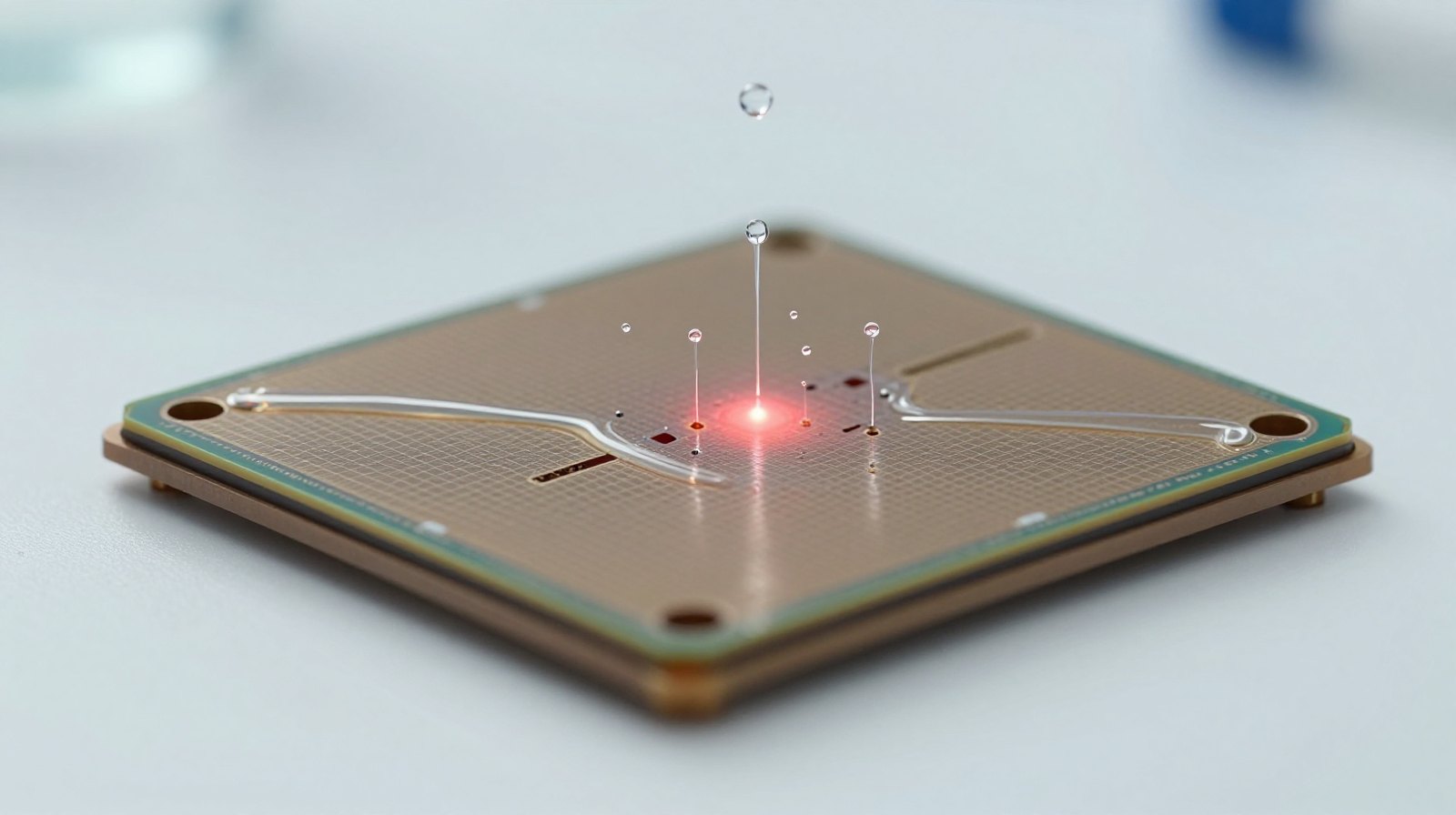
Computer chips are getting so hot that engineers now want to pour coolant inside them. The catch: water and electronics are a risky mix. Engineers at Peking University have shown a safer way. They etched tiny channels into a test chip and filled them with an electrically insulating liquid that boils as it carries heat away. Their design handled up to 1,570 watts per square centimetre, well above the roughly 1,000 W/cm² that earlier designs with this kind of liquid usually reached, the team reports in Nature Electronics.
Why it matters: heat is one of the biggest limits on how fast and how small chips can get, especially the giant processors that train and run AI. A coolant that cannot cause a short circuit, flowing right next to the hottest spots, could make that kind of cooling easier to trust inside real computers.
How hot is 1,570 W/cm²?
“Heat flux” means how much heat passes through a given area. Picture squeezing all the power of an electric kettle through a square the size of your fingernail. That is the scale we are talking about. For comparison, bright midday sunshine delivers about 0.1 W/cm², so this little test area was coping with something like fifteen thousand times more.
Chips are not hot everywhere at once. They have “hot spots” where the busiest circuits sit, and that is where heat flux climbs. Today most processors are cooled from the outside: a metal plate or a fan-cooled heatsink sits on top, and heat has to travel up through several layers to reach it. Every layer slows the escape.

Why not just use water?
“Embedded cooling” skips those layers. Hair-thin channels are etched straight into the silicon, so the coolant flows millimetres or less from where the heat is made. With water, this approach can remove up to 3,000 W/cm², the paper notes. Big companies are interested too: Microsoft said in 2025 that lab tests of its own in-chip channels removed heat up to three times better than cold plates, depending on the workload, a result also reported by insideHPC.
But water conducts electricity once impurities dissolve in it, and a leak next to live circuits can mean a short. A dielectric liquid (one that does not conduct electricity) is much safer. The Peking University team used one called HFE-7100. Its weakness is that it carries heat less well than water, which is why dielectric designs have struggled to pass 1,000 W/cm², even when the liquid was pre-cooled and pressurised.
The trick: let it boil, then get the bubbles out fast
The team’s answer is “two-phase” cooling. The liquid absorbs heat until it boils, and turning liquid into vapour soaks up a lot of energy, the same reason sweat cools your skin. The danger is that vapour bubbles can block the channels. When the hot spot dries out, cooling suddenly fails. The point where that happens is called the critical heat flux.
So the engineers built what they call a “horizontal-up” manifold (the plumbing that feeds and drains the channels). Fresh liquid comes in sideways through horizontal inlets, and vapour escapes straight up through vertical outlets. Think of a busy station with separate doors for people getting on and people getting off: nobody blocks anybody. According to the authors, this layout is “central to the enhanced heat transfer”, and it pushed the critical heat flux to 1,570 W/cm².
The test chips used a thin platinum film as a heater over a 3 × 3 mm area, Tech Xplore reports. Because everything was made with standard MEMS techniques (the micro-machining used to build tiny sensors), the team says the design can be integrated with normal chip-making processes.
What happens next
This is a lab demonstration on test chips, not a cooler you can buy. The researchers still need to try it on real commercial processors, check that it stays reliable over long periods and test a wider range of chips, Tech Xplore notes. Water-based designs still remove more heat in absolute terms, so the real question is whether “safe enough and good enough” wins in data centres. If it does, the hottest chips of the next decade might be cooled by tiny boiling rivers running right through them.
Sources
- Horizontal-up microfluidics for embedded chip cooling with a dielectric fluid – W. Xiao, Z. Wu, Z. Jiang, Y. Wang, W. Wang, B. Song (Peking University), Nature Electronics, published online 7 October 2026
- Vapor-clearing channels could keep powerful chips cool with less risk of short circuits – Tech Xplore, 12 October 2026
- AI chips are getting hotter. A microfluidics breakthrough goes straight to the silicon to cool up to three times better – Microsoft, September 2025
- Microsoft: In-Chip ‘Microfluidics’ Improves Silicon Cooling 3X – insideHPC, September 2025