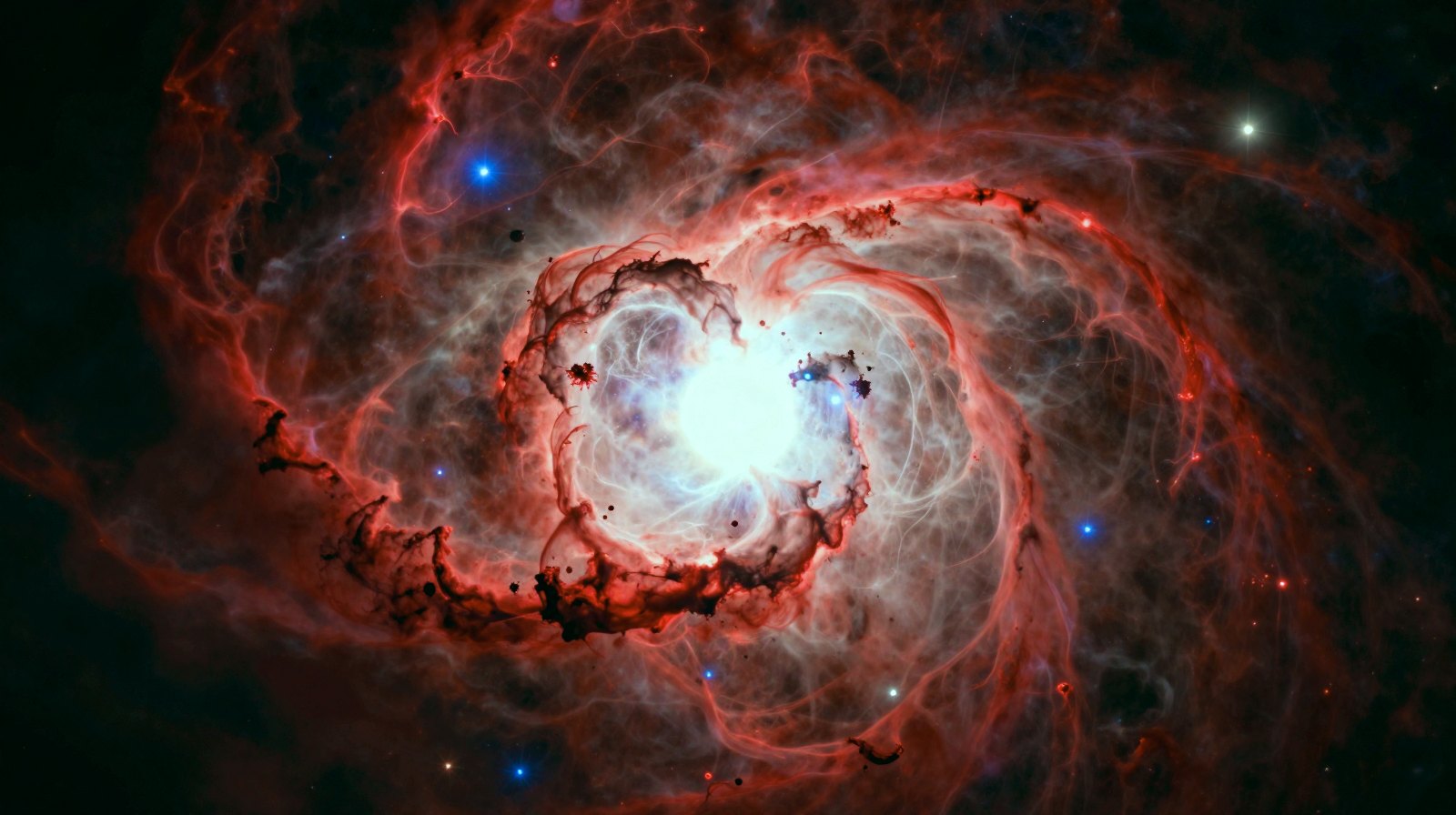
The James Webb Space Telescope has caught what looks like a star exploding in the young universe, and it spotted the blast only a few days after it went off. The flash, named AT 2026abck, sits in a galaxy so far away that its light set out when the universe was only a little over a billion years old. A team led by astronomers at the University of Illinois Urbana-Champaign describes it in a new study posted on arXiv, reported by Phys.org.
Why it matters: exploding stars, or supernovae, are how the universe makes and spreads many of the elements in planets and in us. Catching one in its first days shows what the star and its surroundings were like just before it died. Doing that for the early universe, where stars formed in very different conditions, is extremely rare. Most distant supernovae are found weeks or months after the fact.
Spot the difference, cosmic edition
The find comes from NEXUS, a large Webb observing programme that keeps returning to the same patch of sky about every two months. That rhythm turns the telescope into a giant game of spot-the-difference. On 28 May 2026, the spot in question was empty. On the next visit, around 71 days later, there was a new point of light that kept getting brighter: more than 1.4 magnitudes in about 12 days, as measured in the explosion’s own frame, which means it brightened more than three and a half times.
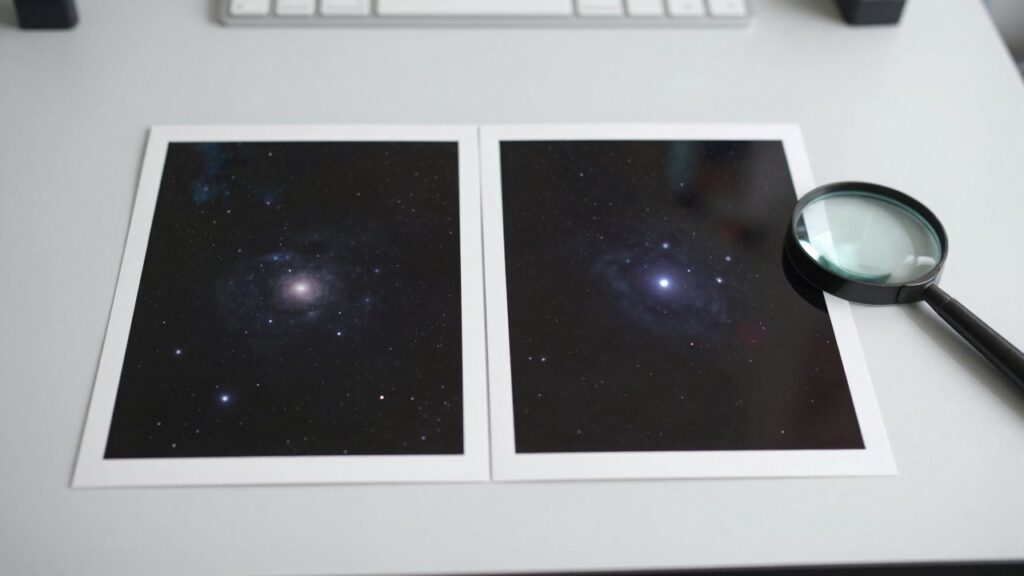
It is unimaginably faint from here. Its magnitude of about 27.4 makes it a few hundred million times dimmer than the faintest stars you can see with the naked eye on a dark night. Only a telescope with Webb’s huge mirror and infrared eyes can pick it out at all.
How far, and how young?
Astronomers measure distance in the early universe with redshift (z): as the universe expands, light travelling through it gets stretched towards redder colours, and the bigger the stretch, the farther and older the source. The galaxy hosting AT 2026abck has a redshift of 5.02. Its light has been on its way for roughly 12.5 billion years.
By modelling its light, the team estimates the blast was caught about 4 to 10 days after the explosion, counted in the galaxy’s own time. At that moment it was remarkably hot and big:
- About 17,000 °C at its glowing surface, roughly three times hotter than the surface of our Sun.
- About 46 times the Earth-Sun distance across in radius. Put it where our Sun is and its edge would reach well beyond the orbit of Neptune.
- Brighter and hotter than any of the 34 nearby comparison supernovae of the same kind at a similar age, according to the study.
A first without a cosmic magnifying glass
Webb has already flagged more than 200 possible supernovae out to around redshift 6, Phys.org notes, but very few seen within days of exploding. The only other supernova at this distance confirmed with a spectrum, called Eos, was boosted up to about 30 times by gravitational lensing, where a massive galaxy cluster in front bends and magnifies the light behind it. AT 2026abck had no such help. The authors call it the first robustly detected flash of this kind at redshift 5 or beyond in an ordinary, unmagnified patch of sky. That’s good news: it suggests regular Webb surveys can catch more of them.
Its position also helps rule out impostors. It sits between two parts of its host galaxy, thousands of light-years from the centre, which argues against a flare from the galaxy’s central black hole.
Why “possible”?
Here’s the honest caveat. The team has no spectrum of the explosion itself, the rainbow-like fingerprint that would confirm exactly what it is. The analysis rests on its brightness through several colour filters, while the distance comes from the host galaxy’s spectrum. The team’s favourite explanation is a Type II supernova (a massive star whose core collapsed) slamming into a dense shell of gas the star shed shortly before dying. They can’t fully rule out other options, though, such as an extra-powerful “superluminous” supernova caught while still rising. The study is a preprint, so it hasn’t been through peer review yet.
What happens next
Time will tell, quite literally. A Type II supernova should fade quickly in ultraviolet light, while a superluminous one would keep brightening. Deeper observations with Webb’s spectrograph could settle it for good. Either way, a star that died 12.5 billion years ago has just shown up for its close-up, only days into its final act.
Sources
- NEXUS: Discovery of a Luminous Young Transient at z=5 – M.-Y. Zhuang, Y. Shen et al. (University of Illinois Urbana-Champaign), arXiv preprint, 29 September 2026
- Webb spots possible early-universe supernova just days after it happened – Phys.org, 13 October 2026