On 18 November, a little probe launched in 1977 will become the first human-made object ever to sit one full light-day from Earth. At that point Voyager 1 will be about 25.89 billion kilometres away, so a radio message travelling at the speed of light will need 24 hours to reach it, and the answer another 24 hours to come back, NASA’s Jet Propulsion Laboratory says.
Why it matters: nothing we have ever built has gone this far, and Voyager 1 is still talking to us. The milestone comes just after a busy few weeks: engineers squeezed out more power to keep its last instruments running, and the probe gave its team a scare by going silent for two days in October.
How far is a light-day?
Light is the fastest thing in the universe. A light-day is simply the distance it covers in 24 hours: about 25.9 billion kilometres, or roughly 173 times the distance between the Earth and the Sun, according to EarthSky, which bases its timing on NASA’s figures.
Voyager 1 has been flying for 49 years, 2 months and 11 days to get there, at about 61,155 km/h (38,000 mph). Even at that speed, crossing one light-day took half a century. That is the honest scale of space.
Suzanne Dodd, Voyager project manager at JPL, summed up the waiting game: “If you want to say ‘hello’ to Voyager, you send your message and then you go home.” The reply turns up about two days later.
Nothing on board changes on 18 November, and the probe will not notice anything around it. The milestone is a ruler, not an event: a way to feel how big the space between the stars really is.
Spain is on the line too
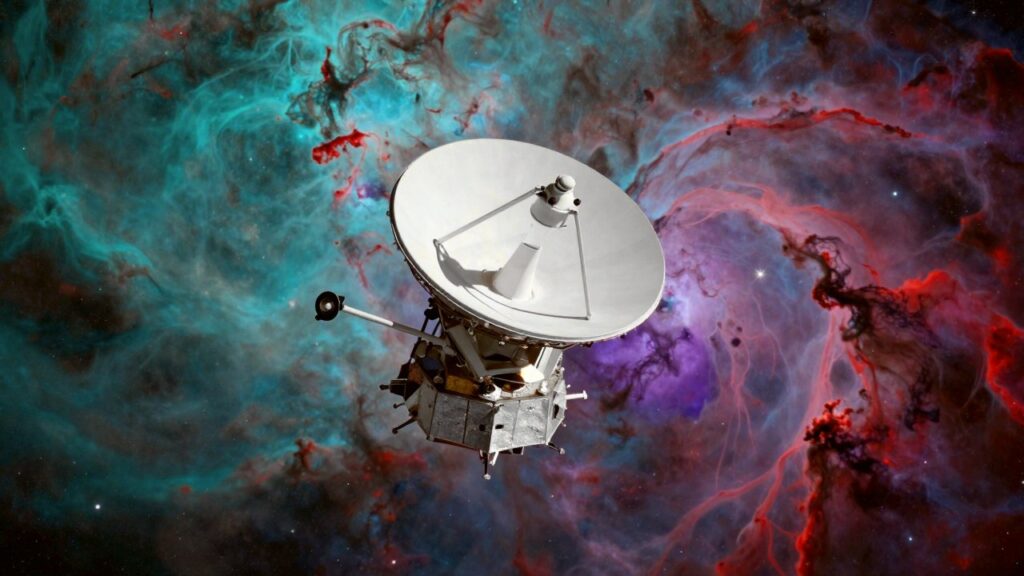
Voyager 1’s voice is now so faint that NASA’s Deep Space Network has to team up several giant dishes to hear it. The network has three stations around the world, and one of them is near Robledo de Chavela, about 60 km west of Madrid, run for NASA by Spain’s National Institute of Aerospace Technology (INTA). In April 2024, all six of its antennas listened to Voyager 1 together for the first time, because the probe’s signal is fainter than that of any other spacecraft the network tracks, NASA reported.
Turning things off to stay alive
Voyager runs on radioisotope thermoelectric generators: boxes that turn the heat of decaying plutonium into electricity. They lose about 4 watts of power every year, NASA explains, so the team keeps making hard choices about what stays on.
The probe launched with 10 science instruments, and most are now switched off. The Low-Energy Charged Particle instrument, which measured particles and cosmic rays in interstellar space, was turned off in April 2026, EarthSky reports.
In early September, engineers finished a manoeuvre they nicknamed the “Big Bang”: they switched off three devices that help keep the spacecraft warm and switched on three lower-power alternatives, all at the same moment so the heat stayed balanced. They had done the same on Voyager 2 about six weeks earlier. Without this swap, Voyager 1 would have had to lose another instrument as early as summer 2027, according to NASA and Interesting Engineering.
Two days of silence
Then came a scare. On 18 and 19 October, the Deep Space Network tried to pick up Voyager 1 twice, 24 hours apart, and heard nothing. On 20 October, after about 48 hours, the signal came back, and contact has held since.
The team found that one group of thrusters (the small jets that keep the probe and its antenna pointed at Earth) had gone offline, and the backups had switched on by themselves. That is what the probe’s fault protection is programmed to do: when something looks wrong, it puts the spacecraft into a safe setup and pauses normal work. “This is the first time we’ve seen the spacecraft do something like this,” said mission manager Kareem Badaruddin. Engineers are still working out why it happened.
Think about the patience involved: every command you send to check on a 49-year-old machine now takes almost a whole day to arrive.
What happens next
Voyager 1 will cross the light-day line on 18 November and keep going, never to come back. Its twin, Voyager 2, about 3.2 billion km closer, should reach the same mark in November 2035, EarthSky says, if it is still alive by then.
Both probes also carry a message for anyone out there: a gold-plated record with greetings in 55 languages, 27 pieces of music and 116 images of life on Earth, NASA notes. On 18 November, that record will be one light-day from home. Not bad for a machine designed in the 1970s.
Closer to home, robotic explorers are also stretching their limits: read how Perseverance set the record for the longest drive on another world.
Read next
- Rubin finds a possible sixth dwarf planet beyond Pluto
- Perseverance sets record for the longest drive on another world
- Japan’s MMX launches to bring home soil from Mars’s moon Phobos
The week's best tech stories, free
One email a week with the stories that matter, explained simply. No spam.
Sources
- NASA’s Voyager 1 Conserves Power, Resolves Brief Communications Pause – NASA Jet Propulsion Laboratory, 29 October 2026
- Farthest human-made object in space loses contact, goes nearly one light-day away from Earth – Interesting Engineering (Kaif Shaikh), 31 October 2026
- November’s Night Sky Notes: Light-Day Away – NASA Science (Kat Troche), 30 October 2026
- Voyager 1 to reach 1 light-day from Earth on November 18 – EarthSky (Kelly Kizer Whitt), 26 June 2026
- Six Deep Space Network antennas in Madrid arrayed for the first time – NASA Jet Propulsion Laboratory, 29 April 2024