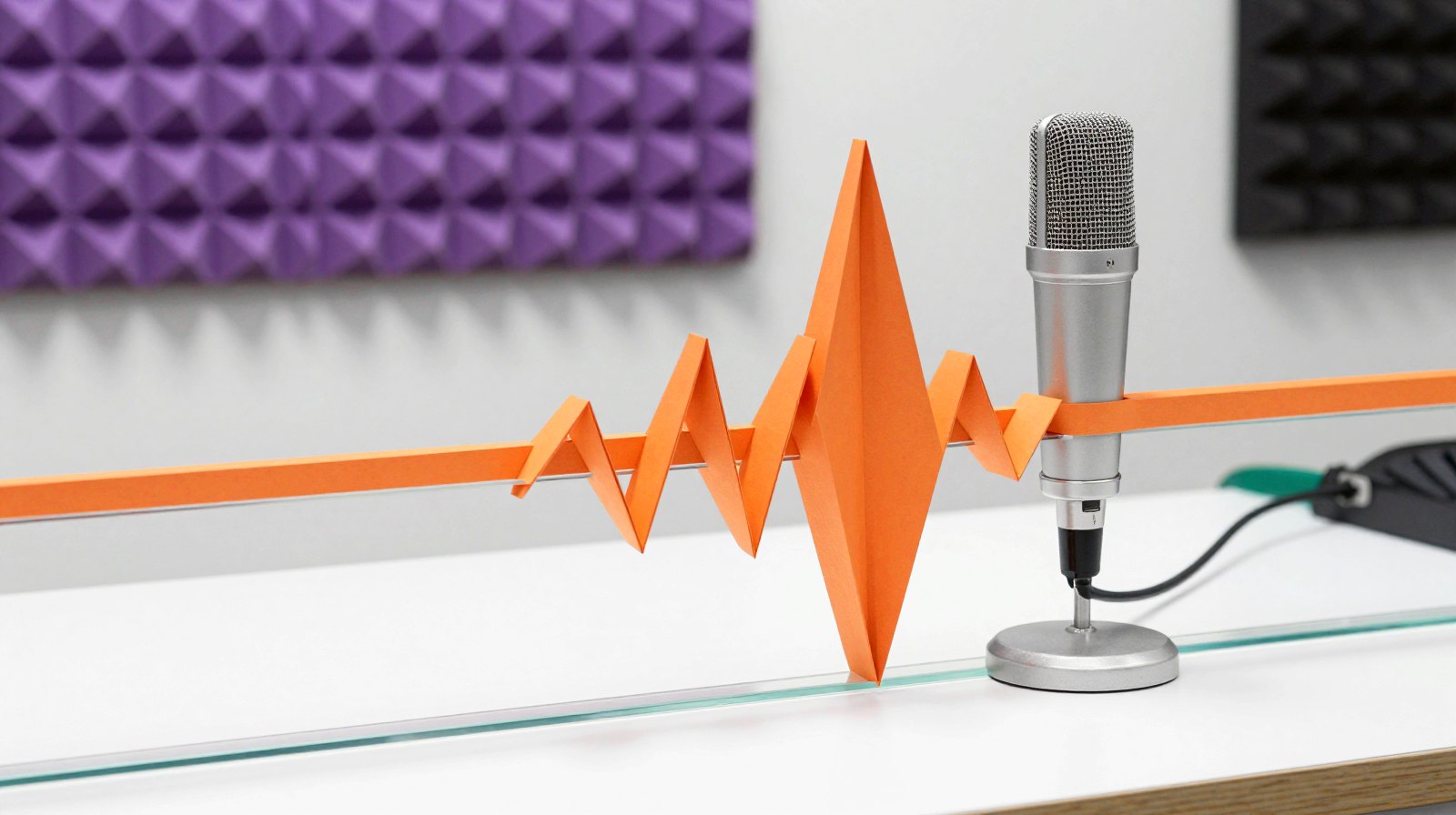
Engineers at Imperial College London have built a recording system that never clips a loud sound. Instead of chopping off the peaks that are too big, it folds them back into range before they are turned into numbers, and then uses mathematics to unfold the original sound. The system is called USF-Audio, Imperial reported on 11 November.
Why it matters: every digital microphone, from a phone to a hospital stethoscope, has a ceiling. Go over it and the sound distorts. Turn the level down to stay safe and the quiet details sink into hiss. That trade-off has been part of digital sound for almost 90 years. This work shows, in real hardware, that there is a way around it.
A ceiling as old as digital sound
The story starts in 1937, when the British engineer Alec Reeves, a former Imperial student, invented pulse-code modulation: measure a sound wave many times a second and write each measurement down as a number. Claude Shannon later supplied the mathematics behind it. Your music files, phone calls and voice notes still work this way.
The device that does the measuring is a converter, and it has a fixed range, like a ruler of a fixed length. A wave taller than the ruler gets flattened at the top. That is clipping, the harsh crackle you hear when someone shouts into a cheap microphone. Once the peak is cut off, it is gone: every too-loud value is recorded as the same maximum number, and repair software can only guess at what was there.
The classic fix is to add more bits (the digits used for each measurement), which means more precise and more demanding hardware. A CD uses 16 bits per sample.
Fold it, don’t chop it
The Imperial team asks a different question. In the words of associate professor Ayush Bhandari, “what if we changed what the bits represent, rather than simply adding more of them?”
Their method, called Unlimited Sensing, folds the signal. Think of the hands of a clock: when the hour hand passes 12 it does not stop, it wraps around and starts again at 1. In USF-Audio an analogue circuit does the same to the sound wave. When the wave reaches the top of the range, it wraps around to the bottom and carries on.
The folded wave looks scrambled and sounds scrambled. But nothing has been thrown away. Because real sounds change smoothly from one instant to the next, the pattern of folds follows a mathematical structure, and an algorithm can work out how many times the wave wrapped and rebuild the original.
What the tests showed
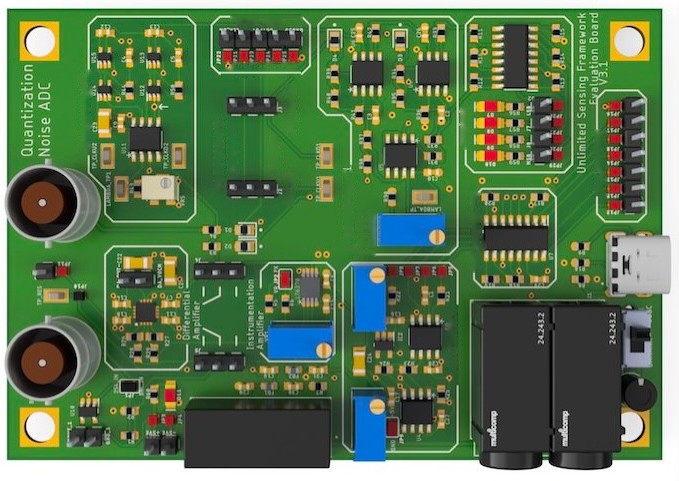
The team built the whole chain, from microphone to finished audio: a custom folding converter made with off-the-shelf components, plus the recovery software. They deliberately gave it very little to work with: only six bits per sample.
- More range: the six-bit prototype handled at least 18 decibels more dynamic range than a conventional six-bit converter. That is roughly eight times the range of signal heights, with no extra bits.
- Real sounds: the recordings included speech, music, heart sounds and animal calls. The project page counts 14 real-world recordings made through the prototype.
- Real ears: in a listening study with 52 people, the rebuilt audio was rated higher than conventional six-bit recordings and than clipped ones. On a scale of 1 to 5, clipped audio averaged 1.62, conventional capture 3.22 and USF-Audio 3.81, according to the project page.
The researchers are careful about what this means. In a separate high-precision comparison, listeners rated USF-Audio and a conventional reference essentially the same. The benefit shows up where ordinary recording runs out of range, not as a promise that every recording will sound better.
Where it could be useful
The biggest win may not be in the music studio. It is in small, low-power devices that must hear very quiet and very loud things with simple hardware. Imperial mentions digital stethoscopes, wearable health monitors and environmental sensors left to listen on their own for long periods. Doing more with fewer bits could also mean sensing hardware that uses less energy.
Sound keeps surprising us this year. We have covered a smartwatch that tracks your whole body with ultrasound and a screen that plays sound exactly where you see it.
What happens next
This is a laboratory prototype, and Imperial says more engineering is needed before the benefits show up in practical devices. The paper, by lead author Ruiming Guo with Yuliang Zhu and Ayush Bhandari, is published in IEEE Transactions on Audio, Speech and Language Processing. Imperial presents the audio work as a foundation for broader sensing research, wherever a sensor has to cope with the very faint and the very strong at once. Almost 90 years after Reeves, there is still room for a new idea in how we turn the world into numbers.
Read next
- A screen that plays sound exactly where you see it
- Thermal noise wireless: sending data with static, not radio
- Sonar in your smartwatch can now track your whole body
The week's best tech stories, free
One email a week with the stories that matter, explained simply. No spam.
Sources
- Imperial engineers challenge 90-year limitation in digital audio sensing, Imperial College London, 11 November 2026
- Re-thinking Digital Audio via Unlimited Sensing: Theory, Algorithms, and Hardware Validation, Guo, Zhu and Bhandari, IEEE Transactions on Audio, Speech and Language Processing, 2026
- USF Audio: digital audio, reimagined, Computational Sensing and Imaging Lab, Imperial College London, project page, consulted 13 November 2026
- Engineers challenge 90-year limitation in digital audio sensing, Tech Xplore, 11 November 2026