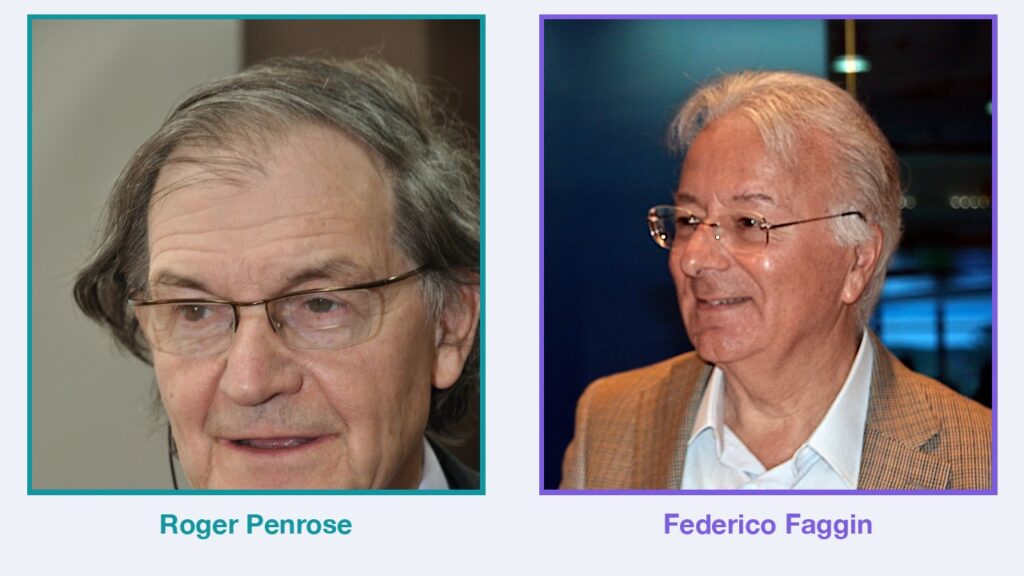
You are reading these words, and somewhere inside you there is a feeling of reading them. Science can watch the neurons that fire while you read, but it still cannot say how that activity becomes an experience. Two famous thinkers believe the answer hides in quantum physics: Nobel laureate Roger Penrose and Federico Faggin, the engineer who designed the first commercial microprocessor. They agree on almost nothing else. Here are their ideas, one picture at a time, and what the evidence says so far.
Why it matters: if the mind depends on quantum physics, then today’s computers, and the AI chatbots that run on them, could never feel anything, however clever they sound. If it doesn’t, consciousness is “just” a very complicated kind of brain activity, and that has big consequences too.
The question nobody has solved
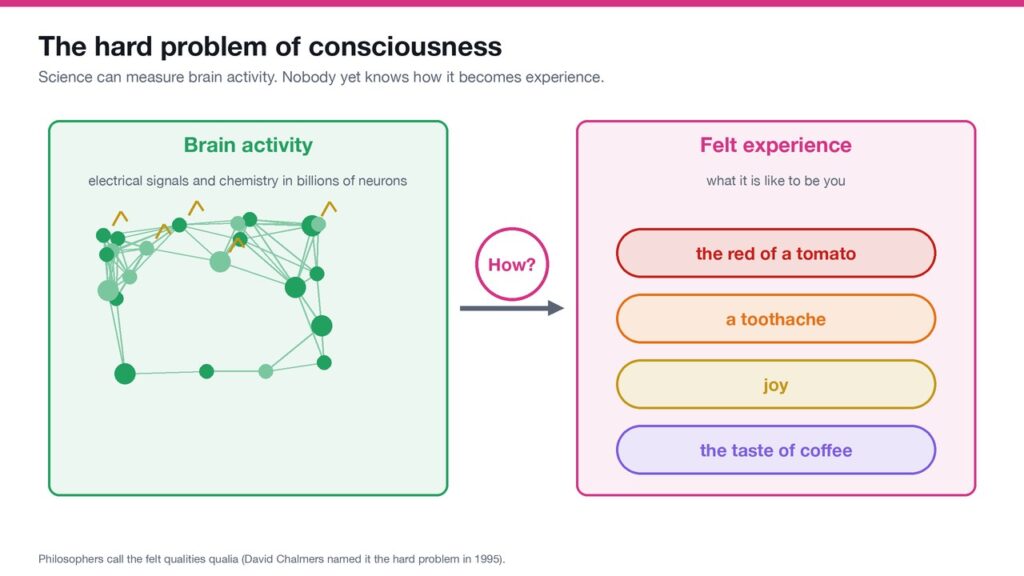
When you taste coffee or feel a toothache, there is something it is like to be you. Philosophers call these felt qualities qualia. Explaining how electrical signals and chemistry in the brain turn into them is what the philosopher David Chalmers named, in 1995, the hard problem of consciousness. Brain scans show which areas light up, but not why there is an inner experience at all.
Three quantum ideas you need
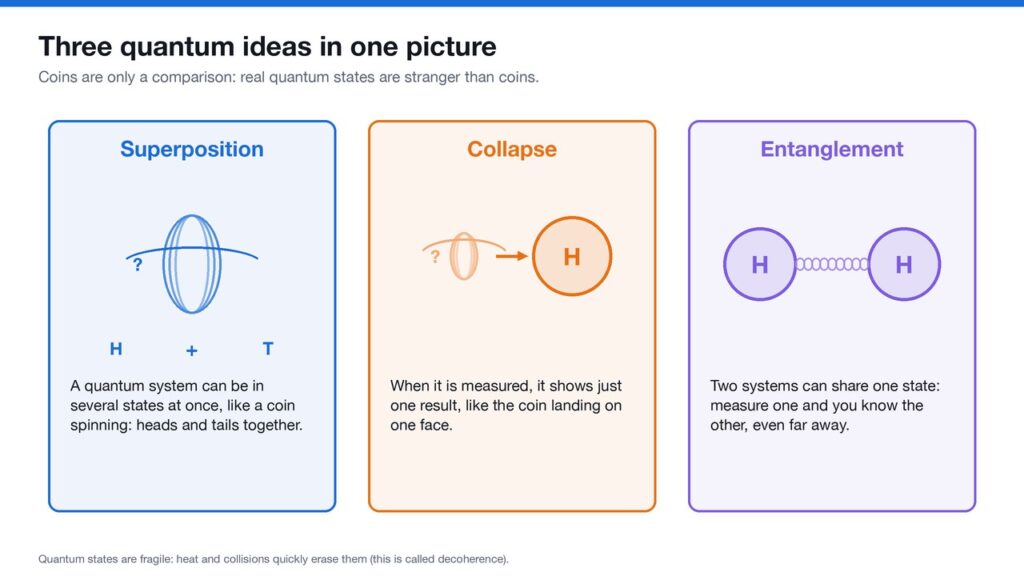
Quantum physics describes the world of atoms and particles, and it works very differently from everyday life. A quantum system can be in several states at once (superposition); when it is measured it shows only one result (often called collapse); and two systems can share a single state, so that measuring one tells you about the other (entanglement). These states are very fragile: heat and collisions with other particles quickly erase them, a process called decoherence. Keep that last word in mind, because it is the biggest problem for both theories.
Penrose: understanding is not computing
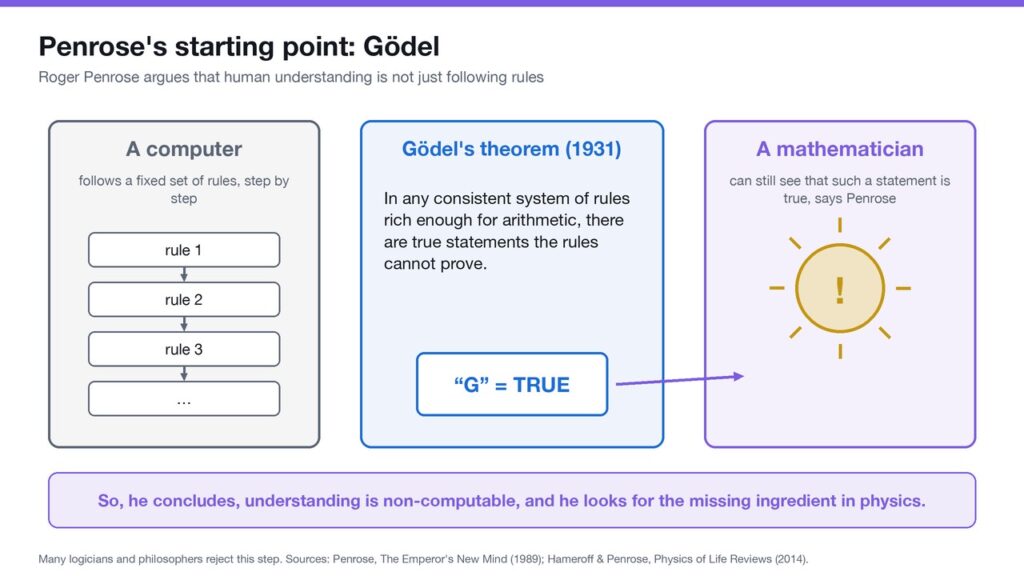
Roger Penrose shared the 2020 Nobel Prize in Physics for his work on black holes. In his books The Emperor’s New Mind (1989) and Shadows of the Mind (1994) he started from a famous result in logic: Kurt Gödel showed in 1931 that any consistent set of rules rich enough to do arithmetic contains true statements that those rules cannot prove. A human mathematician, Penrose argues, can still see that such statements are true. So human understanding cannot be just a computer program following rules: something “non-computable” must be going on in the brain. Many logicians and philosophers reject that step, but it led Penrose to look for the missing ingredient in physics.
Orch OR: quantum moments in tiny tubes
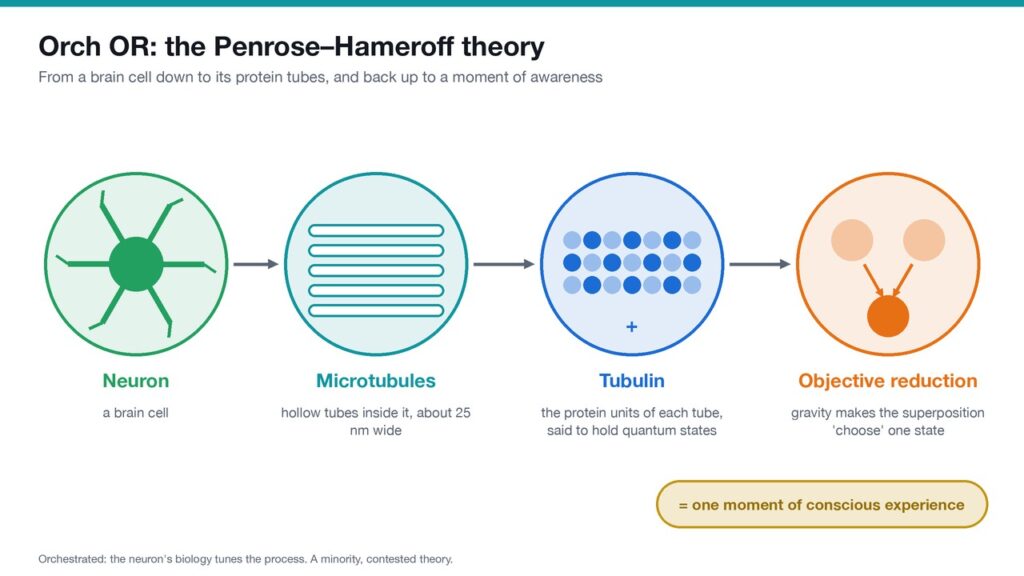
With the anaesthesiologist Stuart Hameroff, Penrose proposed in the 1990s a theory called Orchestrated Objective Reduction, or Orch OR, which they reviewed in Physics of Life Reviews in 2014. Inside every neuron there are microtubules, hollow tubes about 25 nanometres wide built from a protein called tubulin. The theory says tubulin can hold quantum superpositions. Penrose’s own idea about physics is that a superposition cannot last forever: when enough mass is spread over different states, gravity makes it “choose” one. That objective reduction, tuned (“orchestrated”) by the biology of the cell, would be a single moment of conscious experience.
A clue from anaesthesia
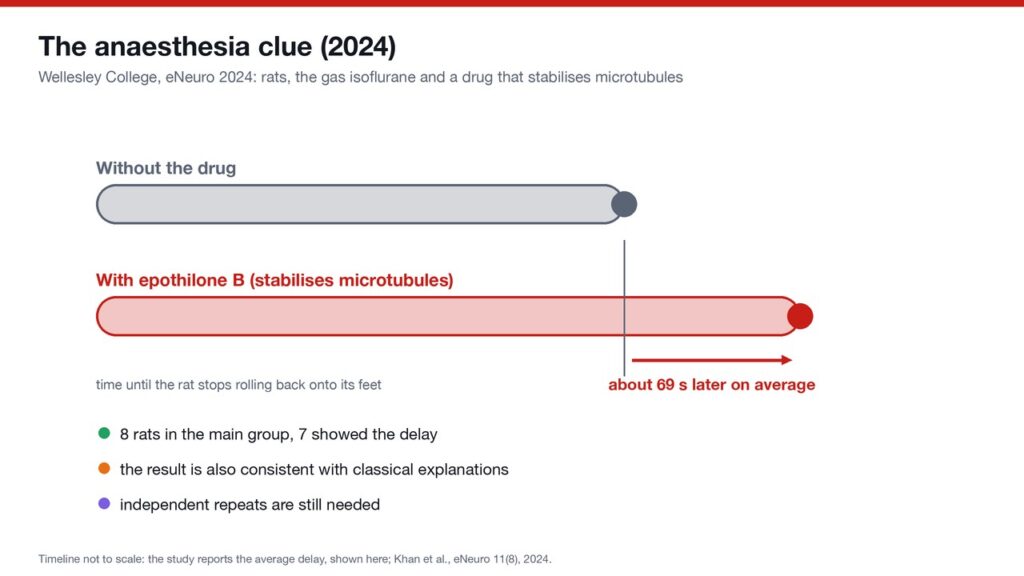
If microtubules matter for consciousness, the gases that switch it off during surgery might act on them. In 2024 a team at Wellesley College, in the US, gave rats a drug that stabilises microtubules, called epothilone B, and then the anaesthetic gas isoflurane. As they reported in eNeuro, the rats took on average about 69 seconds longer to lose consciousness, and seven of the eight rats in the main group showed the delay. The authors say this supports a role for microtubules; they also note it is a small study and that the result is consistent with classical explanations too. In 2025, the team’s leader Michael Wiest argued in Neuroscience of Consciousness that a quantum basis for consciousness is now experimentally supported, a claim other scientists dispute.
Faggin: consciousness comes first
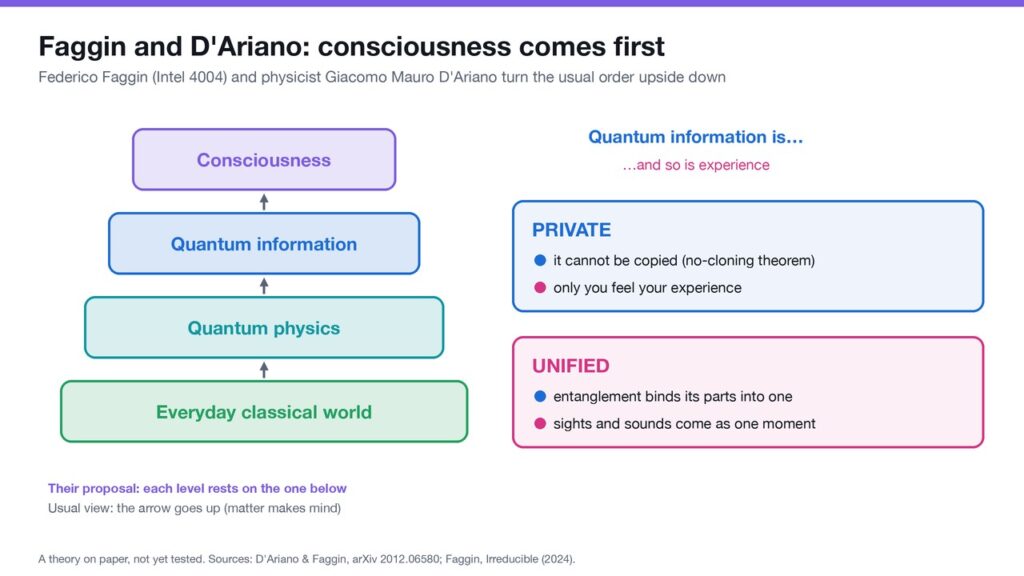
Federico Faggin led the design of the Intel 4004, the first commercial microprocessor, according to the Computer History Museum. Today he argues the opposite of what most scientists assume. With the physicist Giacomo Mauro D’Ariano he set out a theory in the paper “Hard Problem and Free Will: an information-theoretical approach”. Their starting point is that information is felt from the inside by the system that holds it, and that the information of consciousness must be quantum. Quantum information is private, because it cannot be copied (the no-cloning theorem of 1982), and its parts can be bound into one by entanglement, just as our experience is private and comes as one unified moment. In their picture, everyday classical physics rests on quantum physics, quantum physics on quantum information, and quantum information on consciousness. Faggin develops this for general readers in his 2024 book Irreducible, which concludes that no computer can ever be conscious.

Enlightenment, God or the universe?
Some people take these ideas one step further and link them to spiritual traditions. Buddhist traditions call the goal of meditation enlightenment, or awakening, and some see in it a mind that steps into the quantum level of reality, where all consciousness is united in one. Faggin uses a similar word: in a 2022 interview with Beshara Magazine he described everything as made of “an undivided energy that has the desire and the capacity to experience and know itself”, which he calls “One”, and he traces his views to a night at Lake Tahoe in 1990 when, in his words, “I experienced myself as love”. Depending on their beliefs, people call that unity God, the universe or universal consciousness. This is philosophy and faith, not tested science: no experiment has shown that meditation or enlightenment involves quantum states.
Why you can’t fully share what you feel
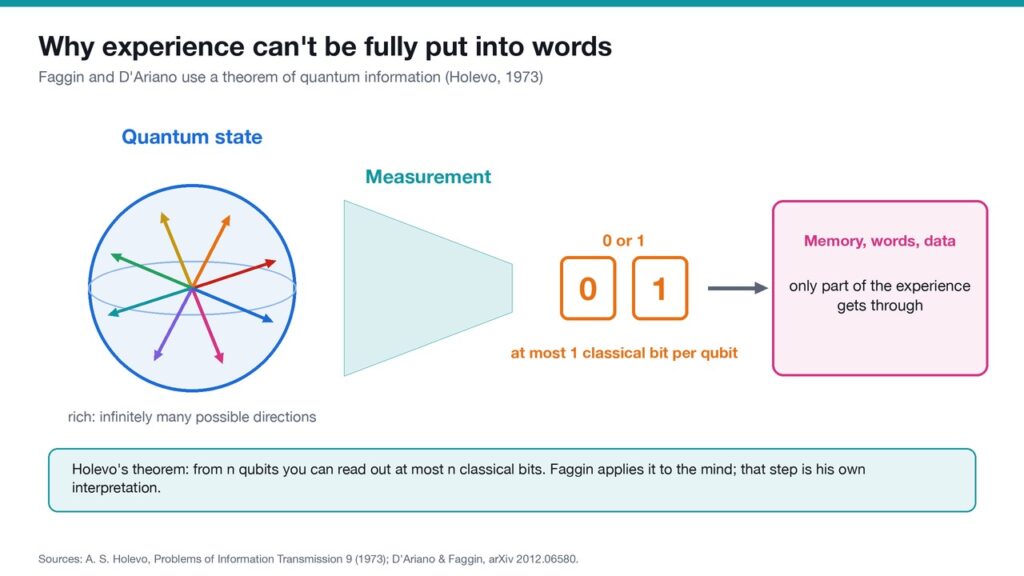
Faggin and D’Ariano add a striking argument from quantum information theory. A theorem by the physicist Alexander Holevo (1973) says that when you measure a set of qubits, the quantum version of bits, you can read out at most one classical bit per qubit, even though a quantum state holds far more possibilities than that. In their paper they apply it to the mind: turning a quantum experience into classical memory, words or data “must be necessarily incomplete”. That, they argue, is why we can describe the taste of coffee but never hand the taste itself to someone else. The physics of the theorem is solid; applying it to the mind is their own interpretation.

The objections
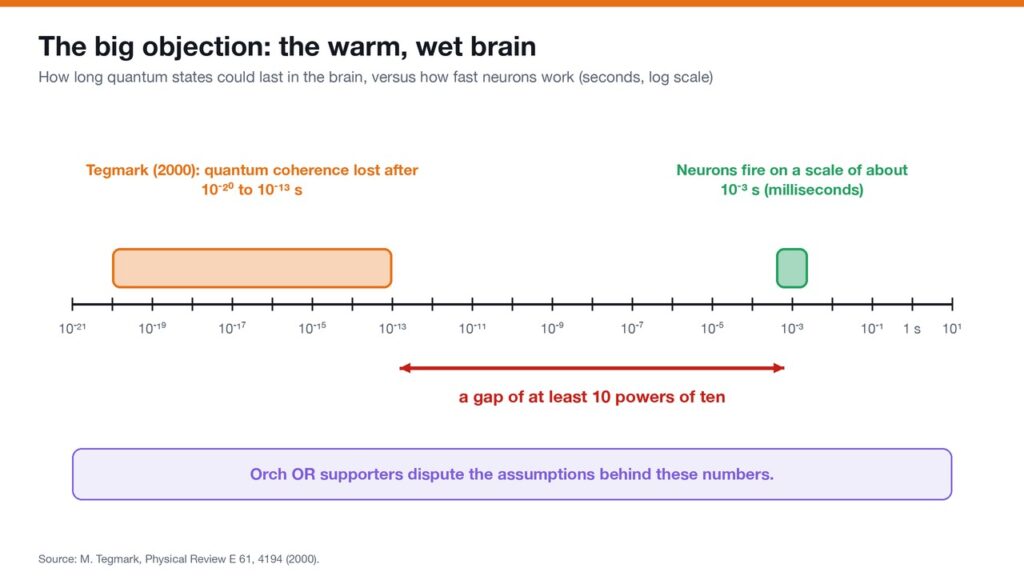
Both theories are minority views, and they face serious problems. The best known is the warm, wet brain. In 2000 the physicist Max Tegmark calculated in Physical Review E that quantum coherence in the brain would vanish in about 10-20 to 10-13 seconds, while neurons work on a scale of thousandths of a second. Orch OR’s supporters dispute the assumptions behind those numbers. The gravity part of Penrose’s idea was tested deep under the Gran Sasso mountain in Italy: the experiment, published in Nature Physics in 2020, ruled out the simplest version of the model, though not every form of gravity-related collapse. Faggin and D’Ariano’s theory, for its part, has not yet been tested by any experiment, and critics such as the reviewer of Philosophy Now argue that ordinary neuroscience explains more with fewer assumptions.
Science still can’t connect mind and brain
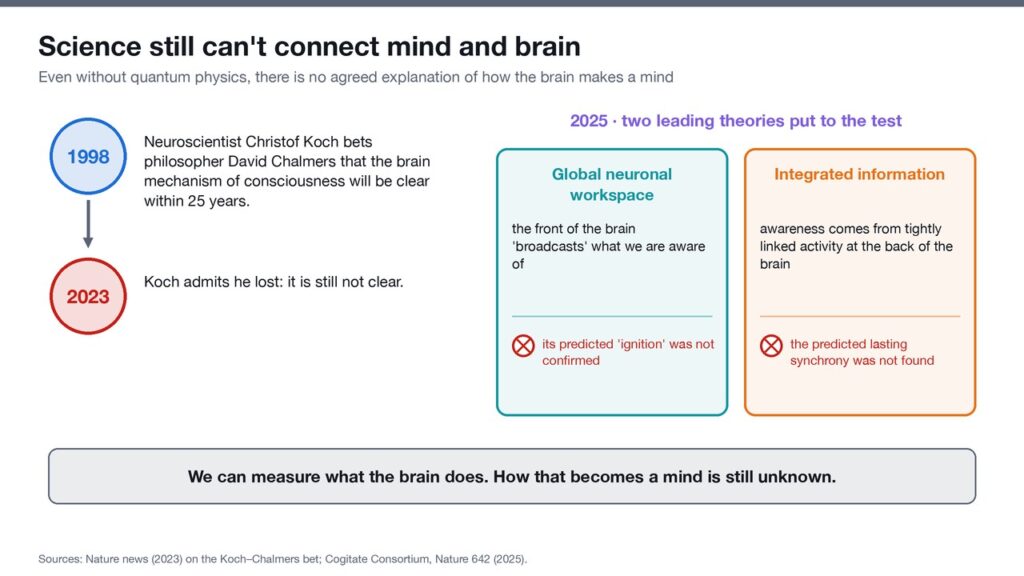
These quantum theories exist partly because mainstream science has no agreed answer either. Researchers can map which brain areas are active when we see, hear or feel something, but there is still no accepted explanation of how that activity becomes a mind. In 1998 the neuroscientist Christof Koch bet the philosopher David Chalmers that the brain mechanism behind consciousness would be clear within 25 years; in June 2023 Koch admitted he had lost, as Nature and Scientific American reported. In 2025 a group of laboratories published in Nature a head-to-head test of the two leading non-quantum theories, global neuronal workspace and integrated information theory: the results matched some predictions of each, but challenged key ideas of both. In short, nobody yet knows how to fit the mind and the brain together, and that open space is exactly where Penrose and Faggin place their bets. Faggin says he has an explanation, which he sets out in his book Irreducible: for him the mind does not come out of the brain at all, because consciousness is the most basic part of reality and the physical world, our brain included, is built on top of it.
So, do we have a quantic mind?
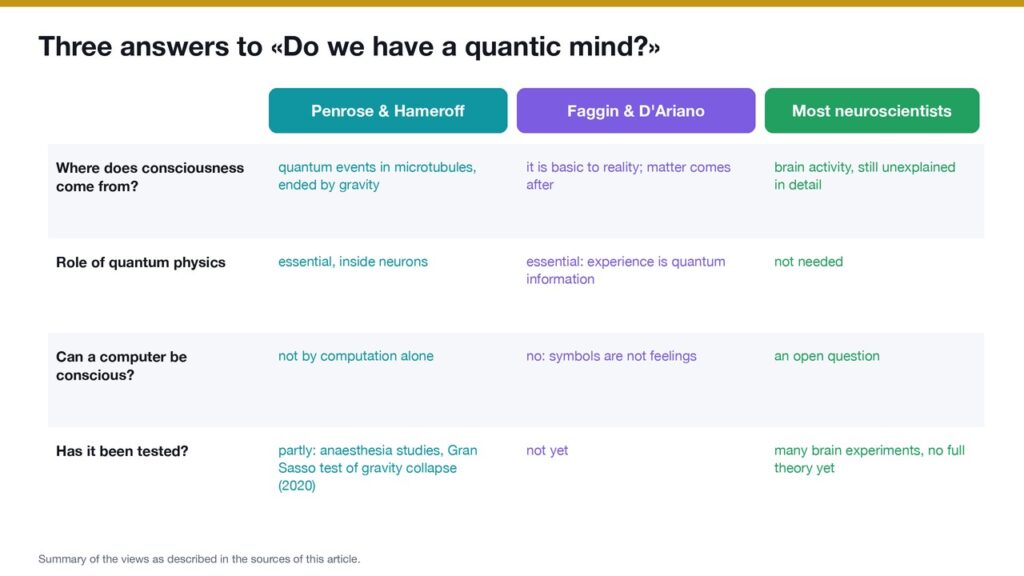
The honest answer is that nobody knows yet. Penrose and Hameroff place the quantum part inside our neurons and make predictions that experiments can check. Faggin places consciousness at the very base of reality, which is bold but much harder to test. Most neuroscientists think quantum physics is not needed and that consciousness comes from brain activity we do not yet fully understand. What has changed is that the question has left pure philosophy: anaesthesia studies, underground physics labs and quantum information theory now all have something to say about it.
Still, just the fact that two brilliant scientists take these ideas seriously points in a completely new direction. If they are right, it could give us a new understanding of the meaning of our own existence: we humans would not be isolated minds locked inside a brain, but an integral part of a universal consciousness.
Key takeaways
- The hard problem, how brain activity becomes experience, is still open: even the leading non-quantum theories failed key tests in 2025.
- Penrose and Hameroff propose quantum events in microtubules, ended by gravity; a 2024 anaesthesia study gave them a new clue, but not proof.
- Faggin and D’Ariano propose that consciousness is quantum information felt from the inside, private and impossible to share in full.
- Decoherence, the Gran Sasso test and the lack of experiments for Faggin’s theory keep both ideas far from settled.
Read next
- Penrose’s quantum consciousness: what anaesthesia reveals
- Federico Faggin: the microprocessor pioneer on consciousness
The week's best tech stories, free
One email a week with the stories that matter, explained simply. No spam.
Sources
- Facing Up to the Problem of Consciousness – David J. Chalmers, Journal of Consciousness Studies 2(3), 1995
- The Nobel Prize in Physics 2020 – NobelPrize.org
- Consciousness in the universe: A review of the ‘Orch OR’ theory – Stuart Hameroff and Roger Penrose, Physics of Life Reviews 11, 2014
- Microtubule-Stabilizer Epothilone B Delays Anesthetic-Induced Unconsciousness in Rats – S. Khan et al., eNeuro 11(8), 2024
- A quantum microtubule substrate of consciousness is experimentally supported – M. C. Wiest, Neuroscience of Consciousness, 2025
- Federico Faggin – Computer History Museum
- Hard Problem and Free Will: an information-theoretical approach – Giacomo Mauro D’Ariano and Federico Faggin, arXiv, 2020
- A single quantum cannot be cloned – W. K. Wootters and W. H. Zurek, Nature 299, 1982
- Importance of quantum decoherence in brain processes – Max Tegmark, Physical Review E 61, 2000
- Underground test of gravity-related wave function collapse – S. Donadi et al., Nature Physics, 2020
- Irreducible by Federico Faggin (review) – Frank S. Robinson, Philosophy Now 170
- Decades-long bet on consciousness ends — and it’s philosopher 1, neuroscientist 0 – Nature, June 2023
- A 25-Year-Old Bet about Consciousness Has Finally Been Settled – Scientific American, 2023
- Adversarial testing of global neuronal workspace and integrated information theories of consciousness – Cogitate Consortium, Nature 642, 2025
- Consciousness as the Ground of Being (interview with Federico Faggin) – Richard Gault and Jane Clark, Beshara Magazine 20, 2022