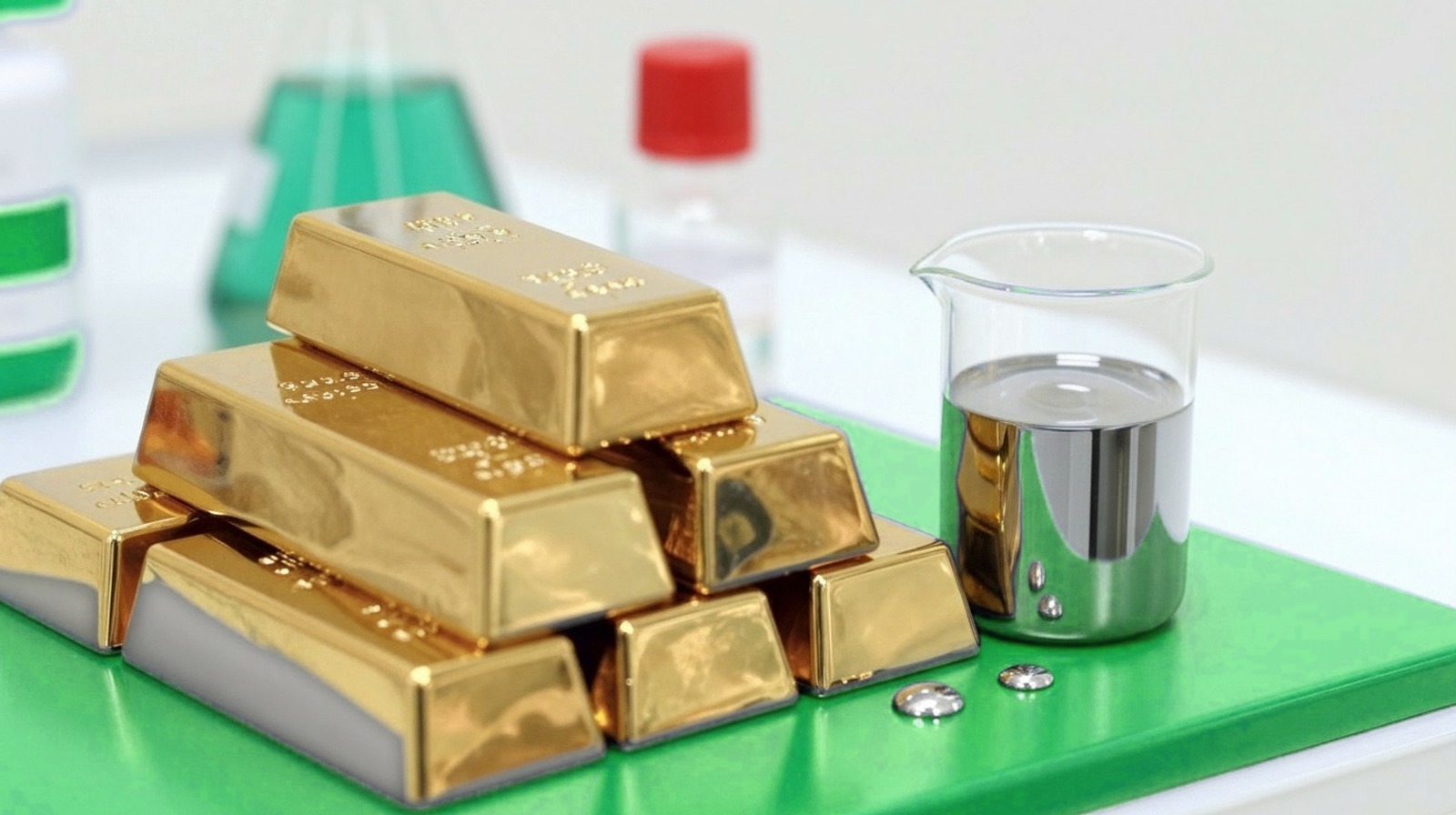
The oldest dream in chemistry just got a fusion upgrade. Marathon Fusion, a start-up in San Francisco, says it has used neutrons from fusion reactions to turn mercury into real, stable gold, and on 21 October it posted measurements to back the claim, Euronews and Business Today report.
Why it matters: fusion power plants will be hugely expensive to build, and electricity alone may not pay for them. If the same machine could also make a few tonnes of gold a year, the money looks very different. The physics is sound. Whether it works at scale is the big open question.
So, did science really find a new treasure? Not yet. What exists today is a clever plan, worked out on computers, to make gold as a side product of future fusion power plants, plus a first lab claim that nobody outside the company has checked. Here is what is real and what is still a plan.
How do you turn mercury into gold?
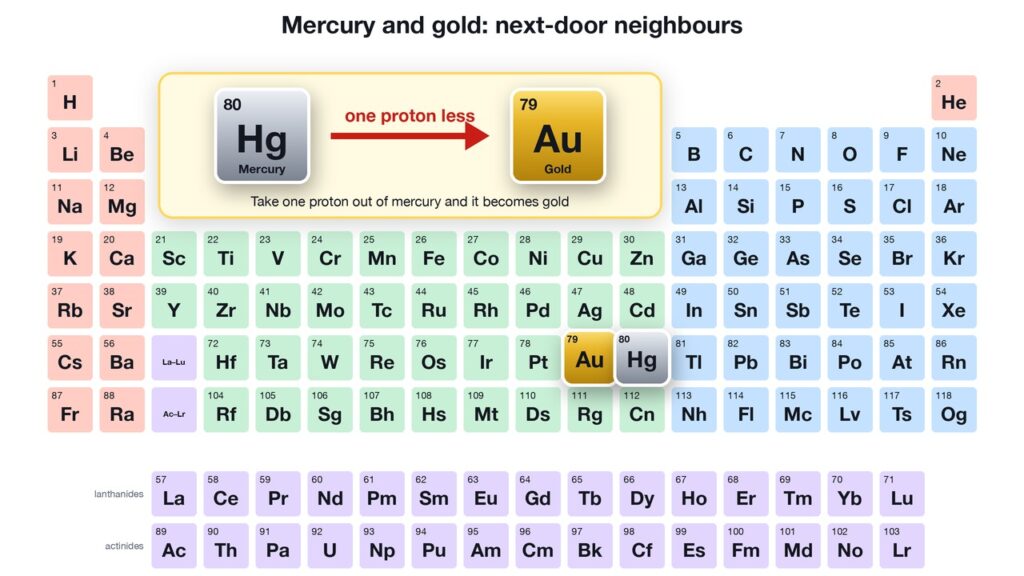
On the periodic table, mercury and gold are next-door neighbours: mercury has 80 protons, gold has 79. Change one proton and you change the element. That is what alchemists tried for centuries with fire and potions, and what nuclear physics can actually do.
Here is the recipe from Marathon’s 2025 paper, step by step:
- Take mercury-198, a natural, stable form of mercury (about 10 % of ordinary mercury).
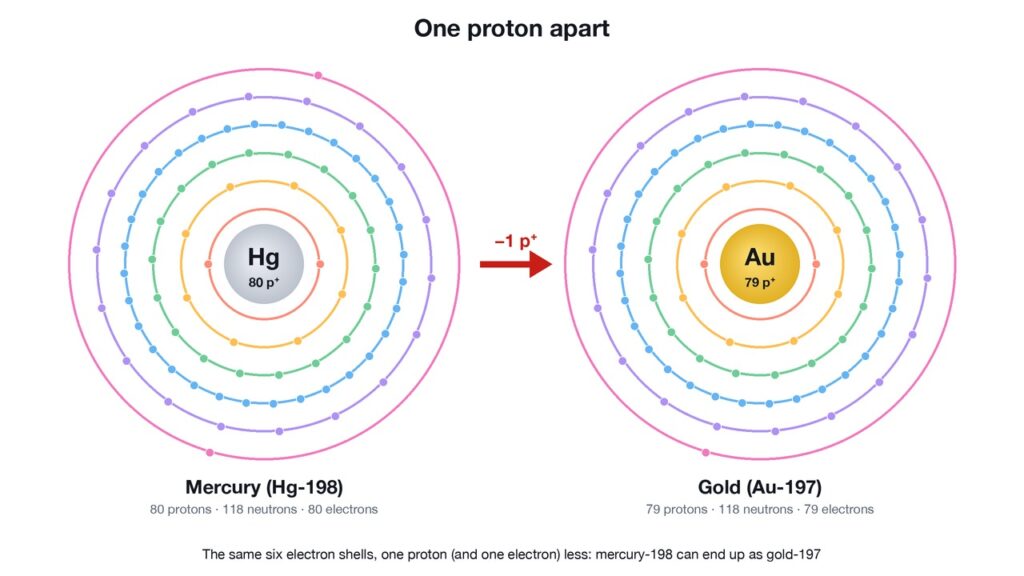
- Hit it with a very fast neutron (a neutral particle from the heart of an atom). The neutron knocks one neutron out, leaving mercury-197.
- Mercury-197 is unstable. With a half-life of about 64 hours, it grabs one of its own electrons, which turns a proton into a neutron. Now it has 79 protons: it is gold-197, the only stable kind of gold.
The trick is speed. The knock-out only happens with neutrons above about 9 million electronvolts of energy, the paper says. Neutrons from today’s fission reactors are far too slow, but a fusion reaction between deuterium and tritium (two heavy forms of hydrogen) shoots out neutrons at 14 million electronvolts. Fusion is the right hammer for this nail.
The plan: a gold layer inside a fusion plant
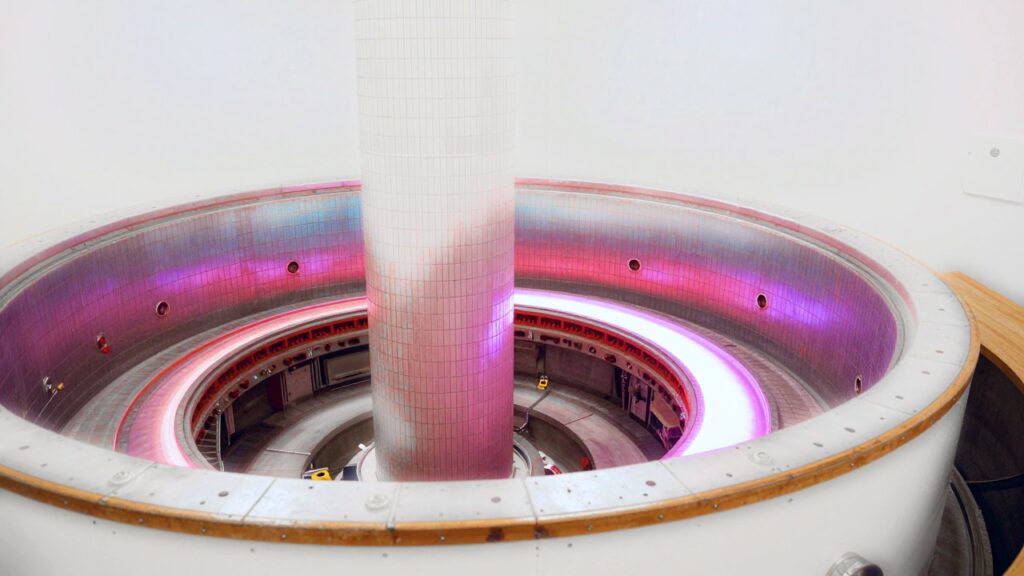
Every fusion power plant of this type needs a blanket: a thick layer around the hot plasma that catches the neutrons, turns their energy into heat and breeds new tritium fuel. Marathon’s idea is to add a thin layer of mercury, rich in mercury-198, on the inside of that blanket.
The neat part: when a neutron knocks a neutron out of mercury-198, you end up with two neutrons instead of one. Blankets need exactly that kind of neutron multiplication to breed enough fuel, so in the team’s computer simulations the plant keeps making its own tritium and its electricity output does not drop.
The headline number from the paper: about 2 tonnes of gold per year for every gigawatt of fusion heat. Their example plant, with 1,500 megawatts of heat, makes about 2.9 tonnes a year. Turned into electricity, that is roughly 5 tonnes per gigawatt of electric power, which is the figure Kitco and Interesting Engineering quoted in 2025. Both numbers describe the same simulation.
One catch on the shopping list: the simulated plant uses mercury enriched to 90 % mercury-198, and about 600 tonnes of it. Sorting mercury atoms by weight on that scale is a big industrial job in itself.
The waiting game: gold that must cool down
Fresh fusion gold is not quite ready for a ring. A tiny share comes out as radioactive gold isotopes, mostly made from a rarer form of mercury. The paper’s own numbers:
- about 7 years until it counts as the lowest class of low-level radioactive waste in the US;
- about 14 years until it no longer has to be labelled radioactive under US rules;
- about 18 years until an ounce of it is less radioactive than a banana (bananas contain a little natural radioactive potassium).
Kitco reported the same 7 to 17-year storage range, and Euronews quotes the company saying up to 18 years. Marathon argues this is not a big problem, because most gold sits in vaults anyway, and that cleaner mercury can shorten the wait.
What is new this month
Until October, all of this lived in computer simulations. On 21 October Marathon announced on X that it had made gold from mercury with fusion neutrons “last month”, at ten times the rate of CERN’s 2025 record, and it posted gamma-ray measurements (the energy fingerprint of radioactive atoms) showing signs of mercury-197 and gold-197.
For scale, that CERN record is a famous one. In the Large Hadron Collider, near-miss collisions of lead nuclei made about 86 billion gold nuclei between 2015 and 2018, just 29 picograms (trillionths of a gram), and each one broke apart a split second later, CERN reported in May 2025 (ScienceAlert has the friendly version). Ten times a tiny amount is still a tiny amount.
And the important small print: Marathon has not said how much gold it made, how pure it is or which CERN number it beat, and nobody outside the company has checked the data yet, both Euronews and Gadget Review point out. The 2025 paper is still a preprint that has not been through peer review. Marathon’s own experimental reactor is small: 1 kilowatt of fusion power, according to its website, about a millionth of a power plant.
Why fusion fans care: the money
Electricity is cheap to sell. In the paper’s example, a 3-billion-dollar fusion plant selling only electricity at 50 dollars per megawatt-hour roughly breaks even over its life. Add gold worth an assumed 300 million dollars a year and the authors calculate the plant becomes worth over 3 billion dollars more. That is why they say gold could double a fusion plant’s revenue.
Will it crash the price of gold? Not any time soon. The world mines about 3,300 tonnes of gold a year, according to the US Geological Survey. Euronews worked out that even 100 such plants would add about 500 tonnes a year, around 14 % of mine output. And no fusion plant sells electricity yet. Physicist Adrian Bevan wrote in The Conversation that “On paper, it is possible to make gold from mercury in a fusion reactor”, but its assumptions stay untested until real fusion plants exist.
What happens next
So, a new treasure? For now it is a promising recipe, not a find. Three things to watch: the peer-reviewed version of the paper, real numbers from the September experiment (how many atoms of gold, from how much mercury), and an independent lab repeating it. If those arrive, fusion will have found a shiny side hustle. Either way, a fusion start-up measuring fresh gold atoms in its own lab is a wonderful headline for 2026: the alchemists would have loved it.
Read next
- First nuclear clocks: thorium atoms now keep time by themselves
- Radiation detection from a helicopter in just six seconds
- Nobel Prize in Physics 2026: a telescope made of Antarctic ice
The week's best tech stories, free
One email a week with the stories that matter, explained simply. No spam.
Sources
- Scalable Chrysopoeia via (n, 2n) Reactions Driven by Deuterium-Tritium Fusion Neutrons (preprint) – Rutkowski, Harter, Parisi (Marathon Fusion), arXiv, 17 July 2025, revised 3 August 2025
- Could lab-made gold crash prices like diamonds? US start-up says it turned mercury into gold – Euronews, 23 October 2026
- Mercury to gold: Marathon Fusion claims 10x CERN record, but can ‘modern alchemy’ work? – Business Today, 22 October 2026
- Marathon Fusion Claims Mercury-to-Gold Transmutation Without Disclosing Key Data – Gadget Review, 23 October 2026
- Cracking the alchemist’s code: fusion energy company looks to turn mercury into gold – Kitco News, 30 July 2025
- Nuclear fusion reactors can turn mercury into gold, US firm claims – Interesting Engineering, 24 July 2025
- A company says it could turn mercury into gold using nuclear fusion. Can we take this claim seriously? – Adrian Bevan, The Conversation, 25 July 2025
- ALICE detects the conversion of lead into gold at the LHC – CERN, 8 May 2025
- Scientists witness lead literally turn into gold in the Large Hadron Collider – ScienceAlert, 9 May 2025
- Mineral Commodity Summaries 2025: Gold – US Geological Survey, January 2025
- Marathon Fusion – company website, accessed 30 October 2026