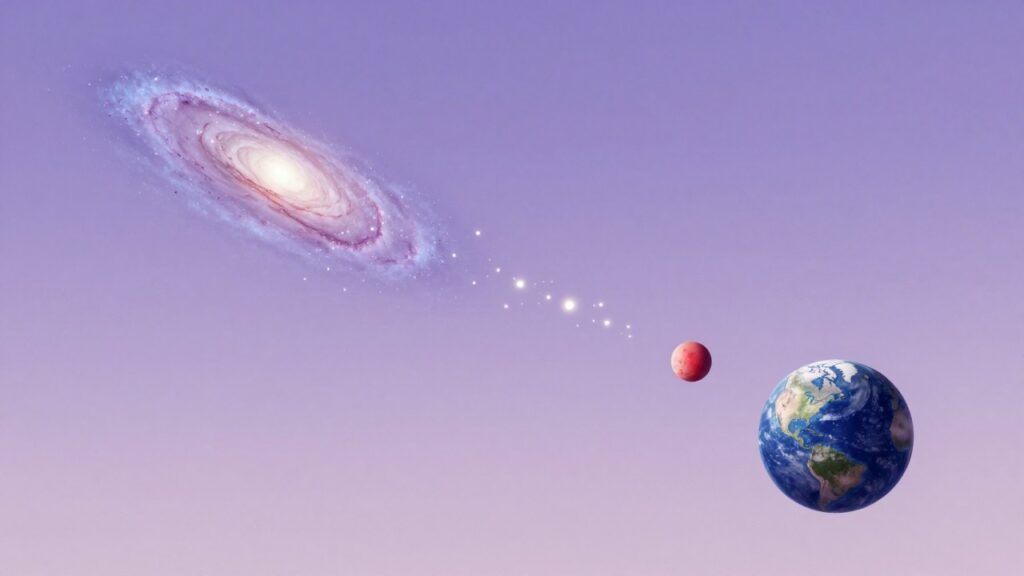
Imagine catching a particle that has crossed half the universe, slipped through stars and planets as if they were not there, and finally left a tiny flash of light deep inside the ice of Antarctica. That is exactly what Francis Halzen set out to do, and this week it won him the 2026 Nobel Prize in Physics.
The prize honours his “decisive contributions to the IceCube Neutrino Observatory and the discovery of high-energy neutrinos of astrophysical origin”, as Scientific American reports. Halzen, born in Belgium in 1944 and a professor at the University of Wisconsin-Madison since 1972, takes the prize alone. That makes him the first sole winner of the physics Nobel since 1992.
Meet the neutrino, the shyest particle in the universe
Neutrinos are tiny particles that almost never bump into anything. Scientific American calls them the least understood of the 17 known fundamental particles. They fly straight through planets, people and everything else, which makes them wonderful messengers: nothing bends or blocks them on their way from distant cosmic events. The catch is that something so shy is incredibly hard to catch.
The trick is size. If you watch an enormous amount of matter, every now and then one neutrino will hit an atom and give itself away.
A telescope made of ice
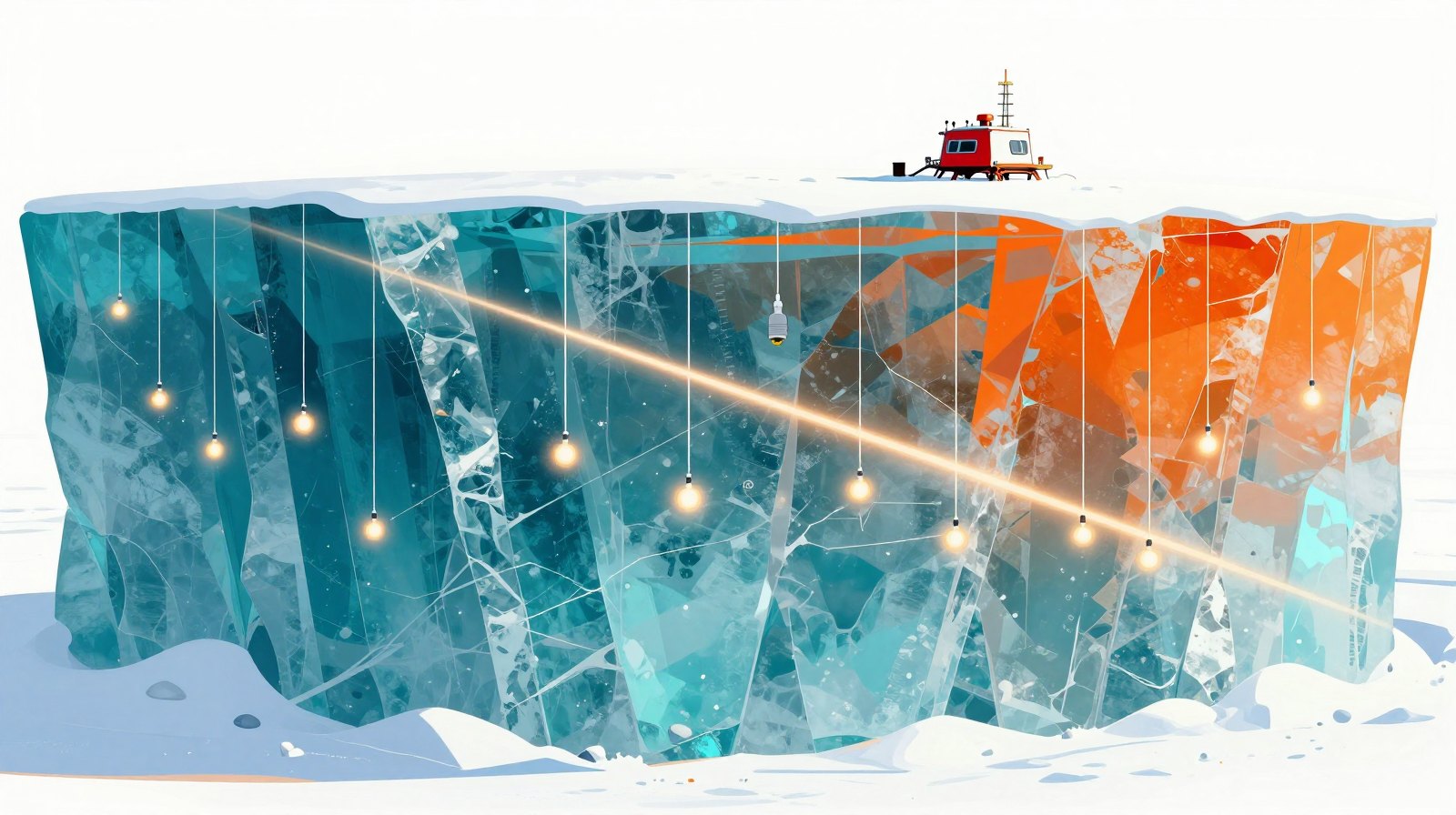
Halzen’s “audacious idea”, in the words of the American Institute of Physics, was to turn a giant block of natural Antarctic ice into a telescope. Here is how IceCube works, according to the AIP and Scientific American:
- Where: at the South Pole, near the Amundsen-Scott station.
- How big: about a cubic kilometre of crystal-clear ice, which makes it the largest neutrino telescope in the world.
- How it was built: engineers melted deep holes with jets of hot water and lowered long strings of sensors into them, around one and a half to two kilometres down.
- The eyes: 5,160 light sensors waiting in the dark.
- The moment of truth: when a neutrino strikes an atom in the ice, it makes a faint flash of blue light. The sensors record it, and scientists work out the neutrino’s energy and the direction it came from.
Halzen proposed the idea in 1988. Construction finished in December 2010, at a total cost of $279 million, and full operations began in 2011. By 2013, IceCube had already spotted 28 high-energy neutrinos from beyond our solar system, opening a brand-new window on the universe.
Why it matters
Light is not the only way to look at the sky. Neutrinos carry news from places light cannot easily escape, such as the surroundings of black holes and exploding stars, as the AIP notes. A neutrino telescope lets astronomers “hear” those events in a completely different way. As the AIP’s chief executive put it, when scientists find a new way to observe nature, they often find questions they did not even know how to ask.
Halzen himself was quick to share the credit: “I hope this reflects on the really courageous people who joined me in the beginning of this project,” he told Scientific American.
What happens next
- 10 December: Halzen receives the prize in Stockholm.
- A bigger IceCube: an upgrade was approved in 2019, and plans for an even larger “IceCube-Gen2” were submitted in 2020, according to the AIP.
- A shadow over the celebration: Scientific American notes that a proposed US budget for 2027 would cut IceCube’s funding in half.
Sources
- 2026 Nobel Prize in Physics awarded to Francis Halzen, pioneer of high-energy neutrinos – Scientific American, 6 October 2026
- AIP Congratulates 2026 Nobel Prize Winner in Physics – American Institute of Physics, 6 October 2026