
A robot rolling around a campus looks up at a rooftop and decides there’s a squirrel on it. It’s actually a chimney. That kind of mistake sounds funny, but in a robot’s memory it can stick for good. MIT engineers have built a system, called UQ-DAAAM, that lets a robot notice when it isn’t sure what it saw, take another look and fix its own memory, MIT News reported on 5 November.
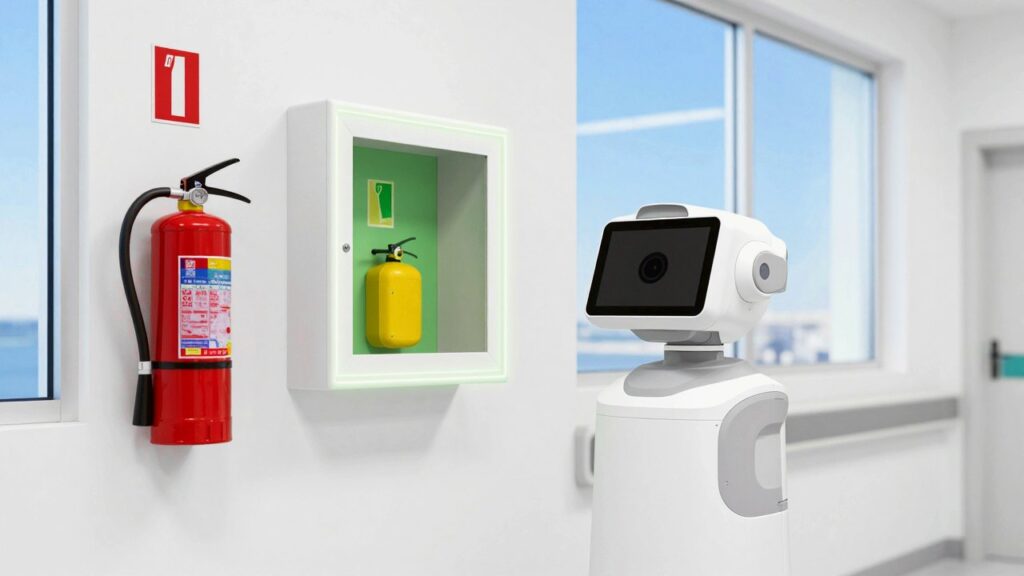
Why it matters: robots that help in hospitals, warehouses or homes need to remember where things are. If a robot files a defibrillator as a fire extinguisher, it might not find it in an emergency, the researchers warn. A robot that knows what it doesn’t know is safer to trust.
How robots remember things
Modern robots often describe what they see with a vision-language model, the same kind of AI that can caption a photo in words. The MIT team’s earlier system, DAAAM, uses one to label every object in a 3D map of the robot’s surroundings, so the robot can later answer questions such as “where did you last see a fire extinguisher?”
The weak spot: these models sometimes guess, especially when an object is far away, half hidden, blurry or badly lit. And once a wrong label is in the map, “this wrong memory would persist as the robot proceeds in its environment,” says co-lead author Harry Zhang.
How UQ-DAAAM spots its own mistakes
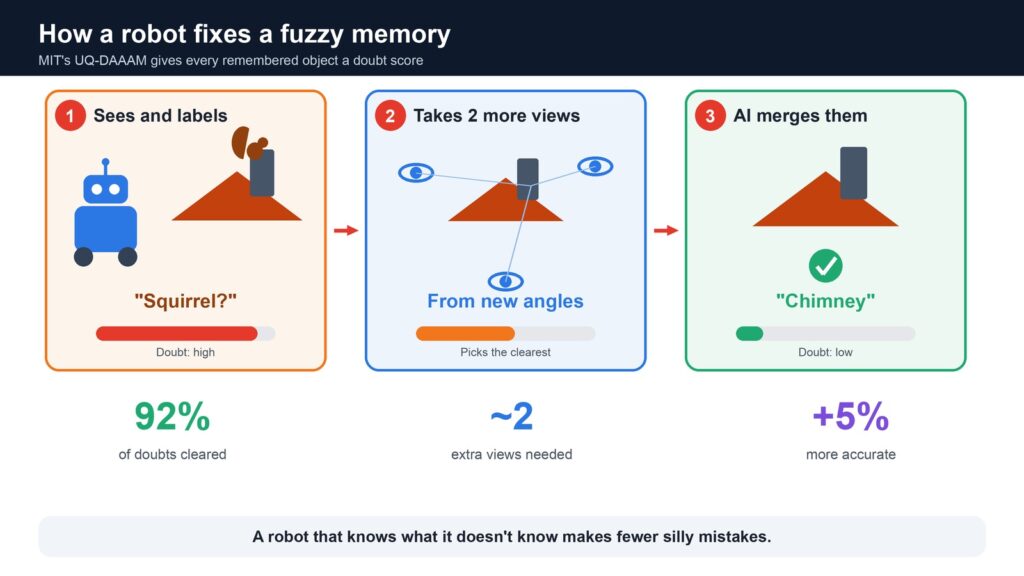
The new system gives every object in the map an uncertainty score, built from two clues:
- How confident the AI sounds: how sure the model is about the words it chose for an object.
- Whether the views agree: if the same object gets very different descriptions from different angles, something is off.
“We fuse both sources of uncertainty into a single number,” says senior author Luca Carlone, who leads MIT’s SPARK Lab. When the number is too high, the robot picks a few extra views that should clear things up, and a large language model merges all the descriptions into one, giving more weight to the newer and clearer ones. The team proved that its way of choosing views avoids running the vision model over and over, which keeps the computing cost down.
In the chimney example, the robot first said it couldn’t describe the dark object on the roof, then called it a squirrel. After more views, it settled on “a dark gray, cylindrical chimney with a slightly tapered top and a smooth surface.”
The results
- It cleared up the doubt for about 92 percent of uncertain objects.
- It needed only about two extra descriptions per object to do it.
- Its object descriptions were 5 percent more accurate than the previous best method.
- It answered questions about objects, where they are and when they were last seen more accurately than the comparison systems.
“Allowing a robot to know what it doesn’t know is going to be essential for this technology to be deployed safely,” Carlone says. The work, by Zhang, Nicolas Gorlo and Carlone, was presented at the NeurIPS AI conference, and the paper is on arXiv. It was partly funded by the US Army Research Laboratory and the Office of Naval Research.
What happens next
The team wants to try UQ-DAAAM on other robots, such as mobile robot arms, and to send robots back on purpose to the parts of a map they are least sure about. It’s a small step, but the same idea we saw in AI agents that ask for help only when unsure: AI that measures its own doubt makes fewer silly mistakes.
AI courses on Udemy, from the basics to building your own apps, at your own pace.See courses with the discount →
Read next
- AI agents that ask for help only when unsure work 3x better
- Robot hand learns to stop dropping things, palm down
- Humanoid robot learns to walk and grab from separate lessons
The week's best tech stories, free
One email a week with the stories that matter, explained simply. No spam.
Sources
- Clearing up a robot’s fuzzy memory, MIT News, 5 November 2026
- Robots can erase and rewrite their bad memories with MIT’s new system, Interesting Engineering, 6 November 2026
- UQ-DAAAM: MIT’s system to correct robot memory, Scientific Frontline, November 2026
Disclosure: this article contains affiliate links
If you buy through them, WOXTER AMERICA LLC may earn a commission at no extra cost to you. Our picks are based on specifications, prices and published reviews, not on any payments.