In 1935, thirty-four years before people walked on the Moon, an engineer from Granada designed a suit to climb into the stratosphere. Not inside a sealed cabin, but in an open basket hanging from a balloon, about 25 kilometres up. His name was Emilio Herrera Linares, and his suit never got off the ground.
His story is SPANISH GENIUSES · Chapter 2, our new documentary. Here’s the quick guide.
The film recreates historical scenes from period photographs, plans and documents; real photographs are marked on screen. The narration is in Spanish; the English version is coming soon. Missed Chapter 1, Torres Quevedo? It’s on the site too.
A boy who watched the stars
Herrera was born in Granada on 13 February 1879. His father was an army officer who loved science and balloons. In his memoirs, Emilio remembered climbing the tower of the family home at dawn to watch the stars fade over the Sierra Nevada.
At 17 he joined the Academy of Engineers in Guadalajara, and in 1903, already an officer, he moved to the Ballooning School, where he qualified as an aeronaut, according to his biography at the Royal Academy of History.
An eclipse seen from a balloon
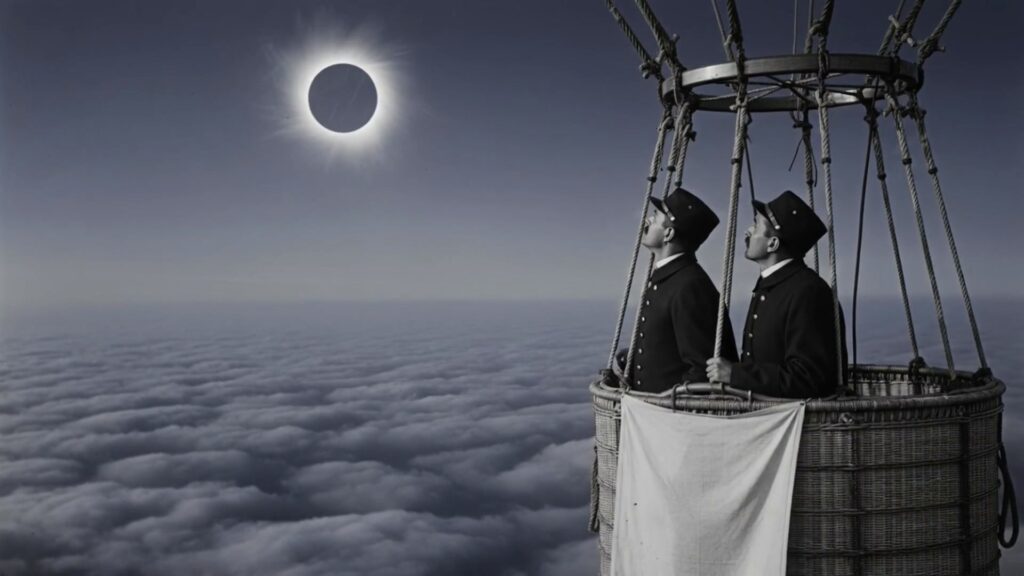
On 30 August 1905 a total solar eclipse crossed Burgos. Three balloons went up to watch it, and Herrera flew in one of them, the Marte. At about 4,000 metres night fell in the middle of the day: below, a sea of clouds; above, the Sun’s corona. Herrera noticed the “shadow bands” dancing on his hands and on the basket, and suggested they came from the atmosphere itself, as elDiario.es tells. It was the start of his scientific work.
Over the Strait, by plane
In 1911 he earned his military pilot’s licence in the very first class. In February 1914 he flew from Tetouan to Seville with José Ortiz Echagüe in a small monoplane: they passed over the Rock of Gibraltar and landed at Tablada. From 2,000 metres, Herrera later said, the battleships looked like “toy boats”. Spain’s Air and Space Force remembers it as the first flight across the Strait.
A laboratory for the wind
After the First World War he went from pilot to scientist. He designed and ran the Aerodynamic Laboratory at Cuatro Vientos in Madrid, working from 1921 with a wind tunnel among the most advanced in Europe. Propellers, planes, airships and Juan de la Cierva’s autogyro were all tested there. In 1928 he crossed the Atlantic aboard the Graf Zeppelin on its first trip from Germany to the United States.
The suit: a small spaceship made to measure
Up at 25 kilometres, the air has about 40 times less pressure than on the ground and the temperature drops below minus 50 °C. Other pioneers went up shut inside sealed metal cabins. Herrera wanted an open basket so he could move and run experiments, so the cabin had to be the suit itself.
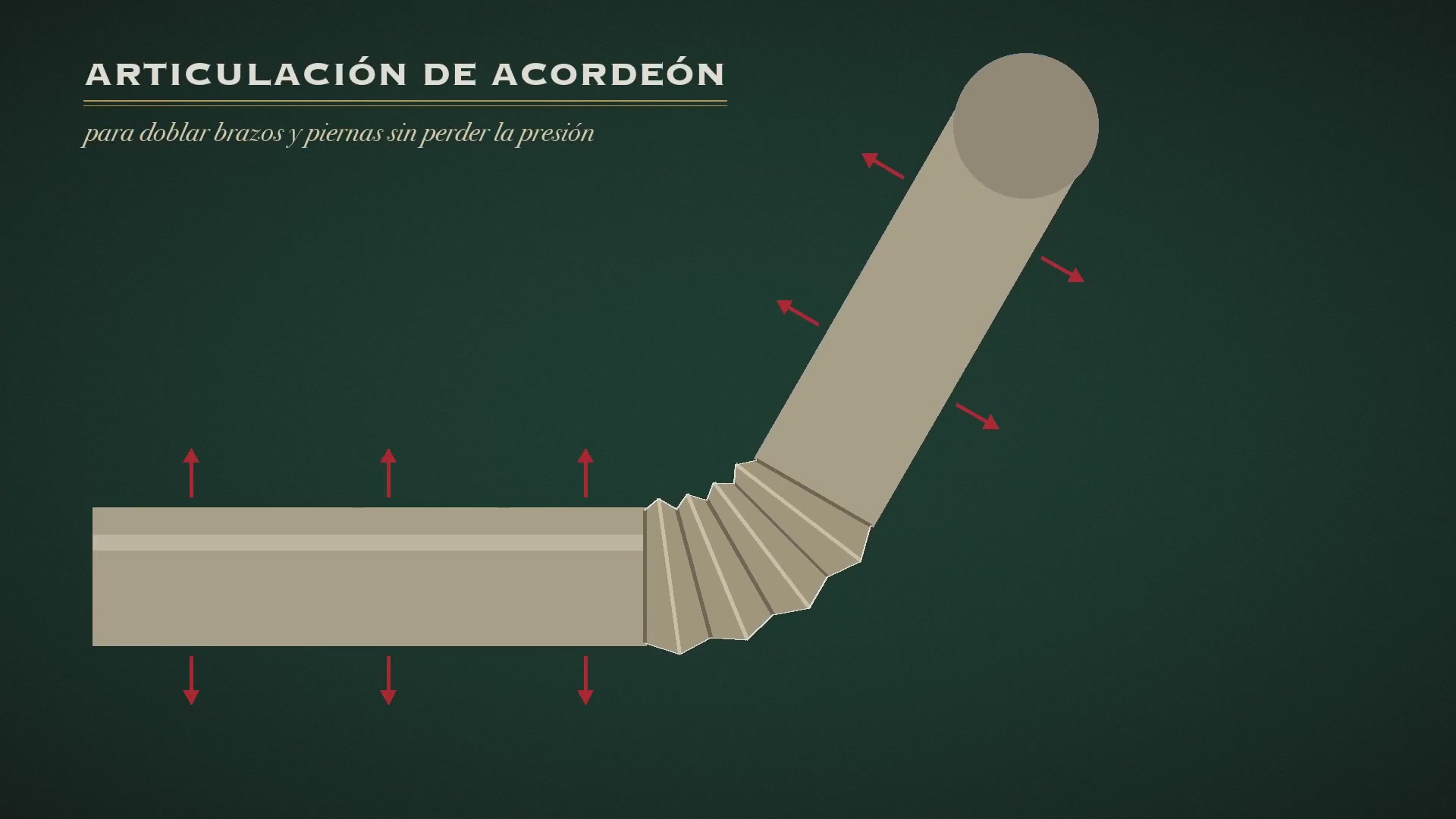
He designed it in 1935 in layers: wool inside, airtight rubber in the middle and canvas reinforced with steel cables outside, with accordion joints to bend arms and legs without losing pressure. It carried oxygen, a microphone to talk by radio, a three-glass visor against knocks, ultraviolet and infrared light, and a silver cape to reflect the sun. It was tested in a vacuum chamber at Cuatro Vientos.
It wasn’t the first pressure suit: American aviator Wiley Post had already flown in one in 1934. But Spain’s Official State Gazette calls Herrera’s suit a “forerunner of space suits”.
The flight that never took off
By the summer of 1936 everything was ready, including the rubberised silk balloon. Then the Spanish Civil War broke out. Herrera stayed loyal to the Republic he had sworn to serve, and his youngest son, a fighter pilot, died at the front. The balloon’s silk ended up as raincoats for soldiers, and the suit, left behind at Cuatro Vientos, disappeared.
In 1939 he went into exile in Paris. He thought it would be short; it was for good. He kept working: he calculated how to put a satellite in orbit and paths to Venus, and he even led the Spanish Republic’s government in exile. He died in Geneva in 1967, two years before Apollo 11 reached the Moon in pressure suits.
What’s left
Only the silver cape survives, kept by family friends in Granada, according to elDiario.es. Today there are replicas of the suit in Spanish museums. His remains returned to Granada in 1993, and in July 2026 the Spanish government posthumously restored his rank of general.
Watch the film
Herrera never reached the stratosphere, but today’s astronaut suits do what he imagined: pressure, oxygen, movement and a visor against the sun. Press play on Chapter 2, and next time you see an astronaut, think of an engineer from Granada in a silver cape.
Read next
The week's best tech stories, free
One email a week with the stories that matter, explained simply. No spam.
Sources
- Royal Decree 569/2026 restoring the rank of general to Emilio Herrera Linares – Boletín Oficial del Estado, 14 July 2026 (in Spanish)
- Emilio Herrera Linares – E. Atienza, Diccionario Biográfico, Real Academia de la Historia, accessed October 2026 (in Spanish)
- Emilio Herrera Linares, artífice de la ingeniería aeronáutica española – E. Gudín de la Lama, Llull 46, 2023 (in Spanish)
- Del aire al «más allá» (memoirs) – E. Herrera Linares, Editorial Universidad de Granada, 2018 (in Spanish)
- Centenary of Tablada Air Base – Ejército del Aire y del Espacio (in Spanish)
- The great “Spanish eclipse” of 1905 – A. Martínez Ron, elDiario.es, 23 January 2026 (in Spanish)
- Emilio Herrera’s “lost” cape – A. Martínez Ron, elDiario.es, 16 May 2024 (in Spanish)
- Conserving Wiley Post’s Helmet – National Air and Space Museum, 2015
- Earth Atmosphere Model – NASA Glenn Research Center
- What Is a Spacesuit? – NASA