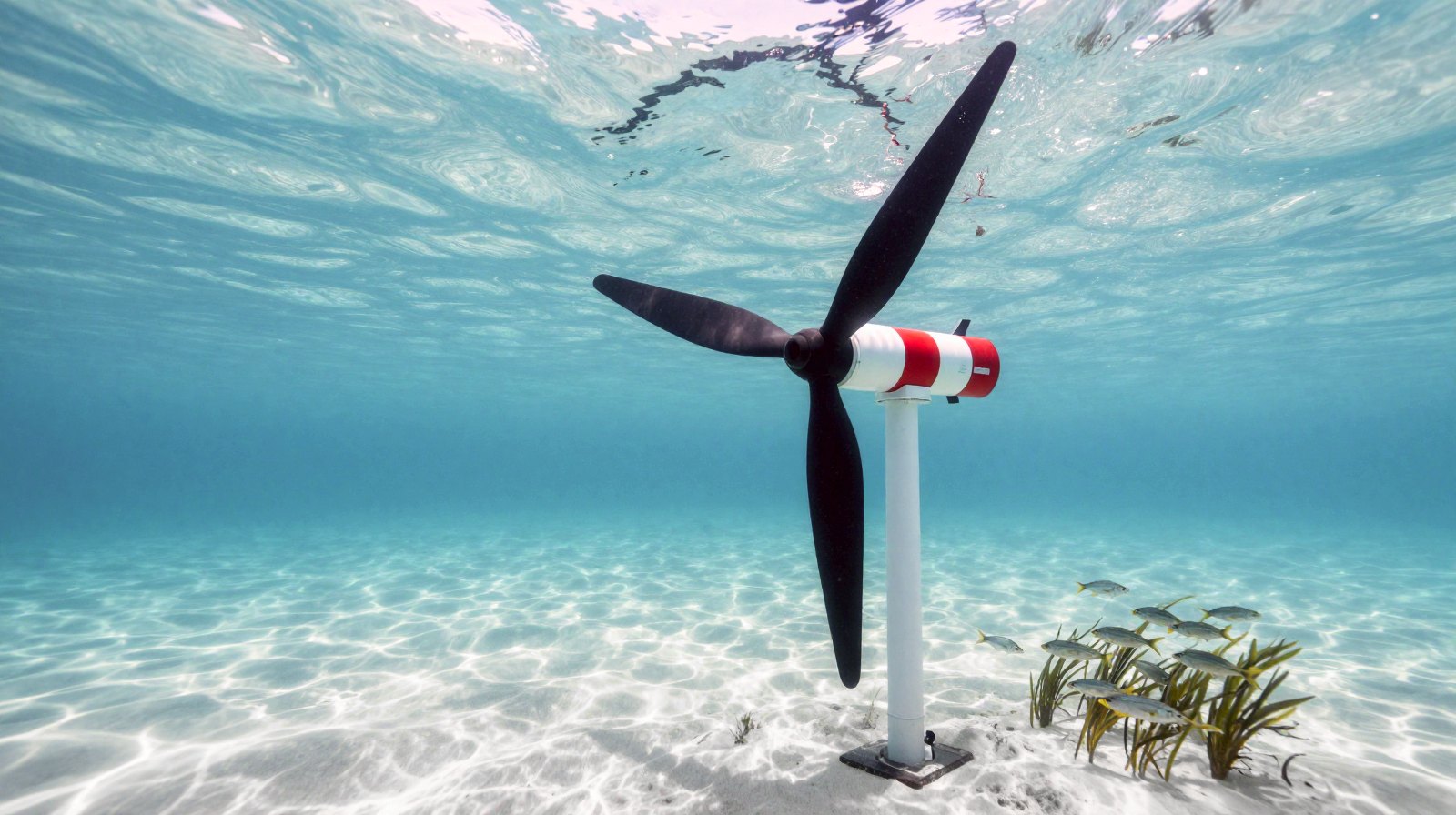
Tidal turbines are like wind turbines placed underwater, spun by the sea as the tide flows in and out. Their blades take a brutal beating from fast, swirling currents. Engineers at the University of Edinburgh and the tyre maker Michelin have now built blades from flexible rubber that simply bend out of the way when the water pushes too hard, the university announced on 11 November. The study is published in Nature.
Why it matters: the tides are as predictable as a clock, which makes them a very attractive source of clean power. But turbines working on the seabed are expensive to build and even more expensive to repair. Anything that removes moving parts, and the breakdowns that come with them, brings cheaper tidal electricity closer.
The problem: blades that must dodge the current
Today’s tidal turbines protect themselves with pitch control: motors, sensors and bearings twist each blade away from the flow when the current gets too strong, a bit like turning your hand sideways when you hold it out of a car window. It works, but it is one more complex machine that has to survive years in salt water.
Turbulent water is also never steady. Every gust of current makes the force on the blades jump up and down, and those constant load fluctuations are what wear turbines out over time.
The rubber trick
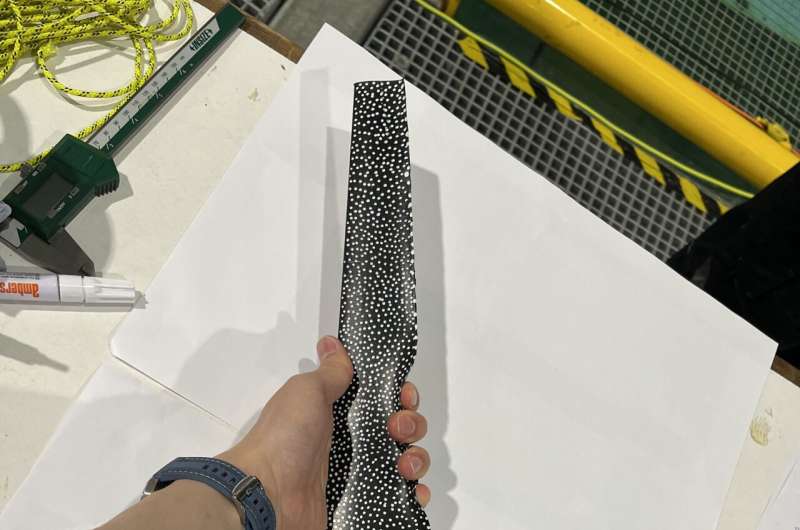
The new blades have a stiff steel spar running through them from root to tip, like a backbone, wrapped in flexible rubber. When the current gets stronger, the back edge of the blade bends and flattens its curved shape, so the blade sheds the extra force by itself. No hinges, no bearings, no motors. The idea came from nature: fish and trees bend in strong flows instead of fighting them.
There is a bonus. Rubber has almost the same density as water, so the blades can be made neutrally buoyant (they neither sink nor float), which cuts the up-and-down loads even further, The Edinburgh Reporter notes.
Tested in a giant round pool
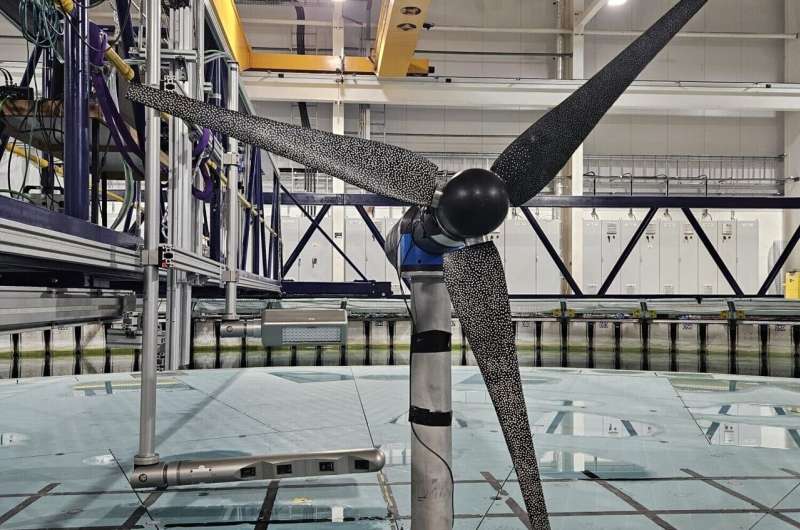
The team tested a 1.26-metre model turbine at FloWave, the university’s 25-metre circular tank that recreates the turbulence of real tidal currents. They then combined the tank measurements with computer simulations of a full tidal cycle and of a full-size 20-metre turbine.
- Same energy: the rubber blades produced as much power as a conventional turbine with active pitch control in the same conditions.
- Calmer loads: the damaging load fluctuations dropped by up to 29 %.
- Long life: early calculations suggest full-size rubber blades could last longer than the 20 years expected of today’s turbines.
“Our blades do that job on their own,” said Professor Ignazio Maria Viola of the University of Edinburgh, who co-led the study with Bertrand Daval, Michelin’s vice-president of research and development for composite solutions. Michelin’s part is its long experience with rubber that takes heavy, repeated loads every day: think of a tyre rolling over the road, turn after turn.
How big could tidal power get?
The UK aims for 1 gigawatt of tidal stream power by 2035, enough for about a million homes, and projections quoted in the announcement see more than 300 gigawatts of tidal power worldwide by 2050. Strong tidal sites exist on many coasts around the world, so a cheaper, simpler turbine would matter far beyond Scotland.
Turbine blades are a hot topic in clean energy. We recently covered how old wind turbine blades can be turned into graphene in seconds, a fix for the other end of a blade’s life.
What happens next
This is still research: the blades need more development and testing at sea before anyone can buy them. Michelin has filed a patent on the technology, and the University of Edinburgh holds related patents. The next milestone to watch is a full-size rubber blade spinning in a real tidal channel.
Read next
- Old wind turbine blades turned into graphene in seconds
- Why the power grid hiccups every minute: batteries on a clock
- White aerogel keeps roofs cool in full sun without electricity
The week's best tech stories, free
One email a week with the stories that matter, explained simply. No spam.
Sources
- Shape-shifting rubber blades could make tidal power cheaper, University of Edinburgh via Tech Xplore, 11 November 2026
- Flexible rubber blades for tidal turbines, Viola et al., Nature, 11 November 2026
- Edinburgh researchers could “unlock” tidal power with rubber blades, The Edinburgh Reporter, November 2026