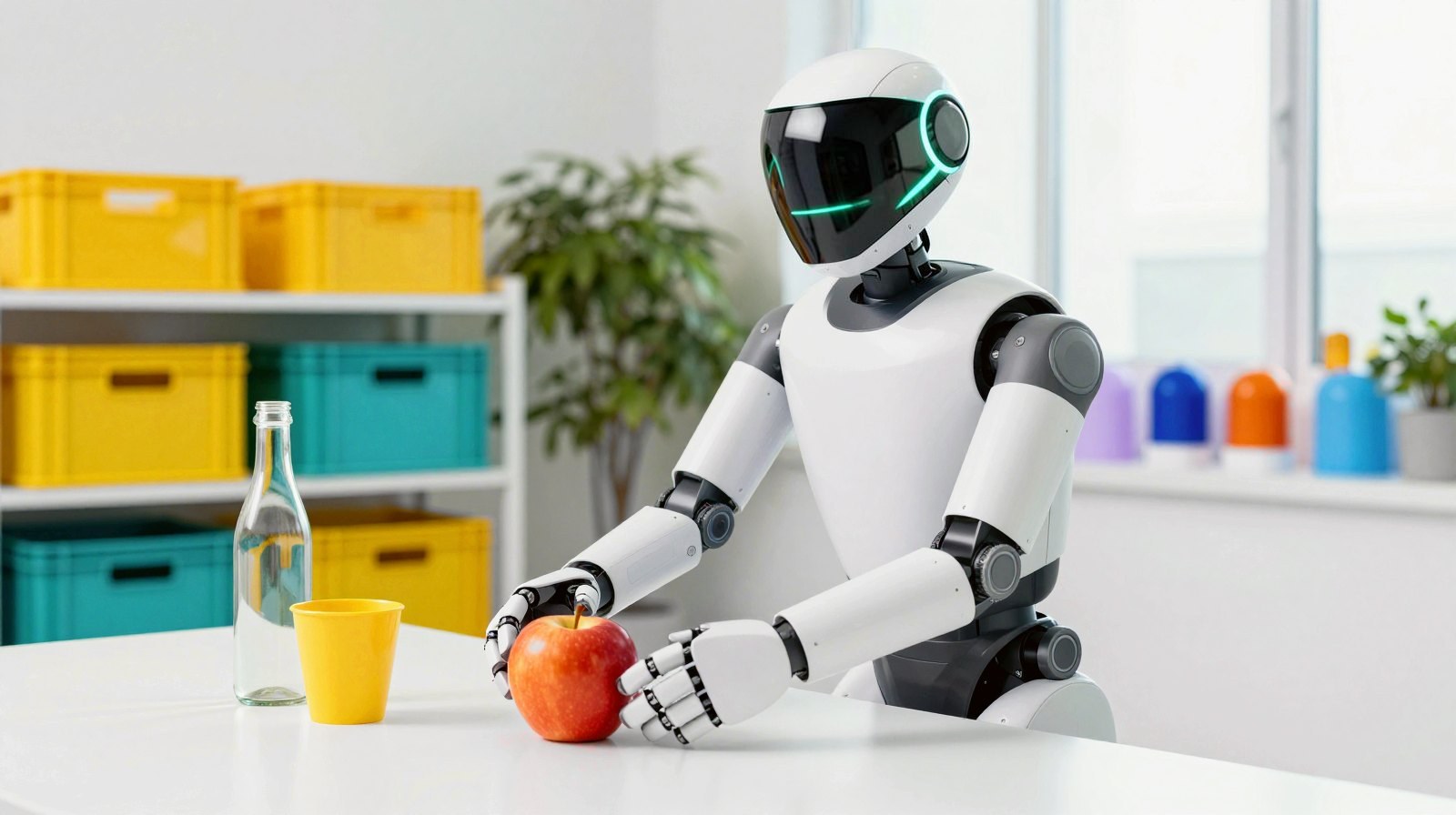
A humanoid robot has learned to walk over to a table, pick something up, carry it somewhere else and put it down, without ever being shown that whole routine from start to finish. Engineers at Seoul National University taught it with separate lessons, some only about walking and some only about grabbing, and an AI system worked out by itself when to switch from one to the other, according to the university’s announcement.
Why it matters: the boring part of teaching robots is the data. Recording one long, perfect demonstration of “walk, grab, walk, place” is slow and expensive, and one fumble near the end ruins the whole clip. If robots can stitch short, simple lessons together on their own, training a helper for a warehouse or a factory gets much cheaper.
Walking and grabbing are two different jobs
For a human, crossing a room with a cup feels like one smooth action. For a humanoid robot it is two very different problems. Walking is about legs, balance and big, rhythmic movements. Grabbing is about fingers, wrists and small, careful ones. Different joints do the work, and they move in completely different ways.
That makes training awkward. You can easily collect lots of walking clips, and lots of grabbing clips, but those clips never tell the robot the most important thing: when to stop walking and start reaching.
A team of specialists with a coach
The new system is called RISE (short for “Responsibility-Induced Specialized Experts”). It is a vision-language-action model, an AI that looks through the robot’s cameras, reads an instruction in plain words and turns both into movements. Professor Songhwai Oh’s team gave it one shared “eyes and understanding” part and several separate “action experts”, plus a small coordinator on top, which they call a meta-controller, Tech Xplore reports.
Here is the clever trick. During training, each expert is scored on how well it predicts the next movement. The better it does on a piece of data, the more “responsibility” it gets for learning from it. Nobody tells the experts what to be, yet they naturally split up: some become walking specialists, others grabbing specialists. Think of a kitchen where the chefs who are best at desserts end up making all the desserts.
The coordinator then decides how much to listen to each expert, moment by moment. When its attention swings from the walking experts to the grabbing experts, that swing is the signal that one stage is done and the next one can start.
The results, in simulation and in real life
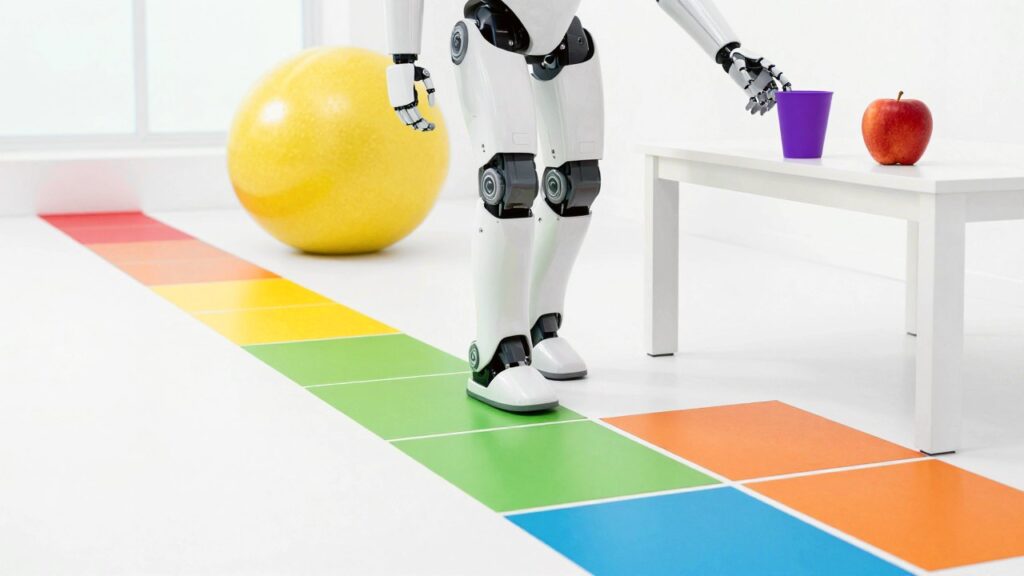
The team tested RISE on tasks of two to four steps with apples, bottles and cups, such as “walk, then pick up” or “walk, pick up, walk, put down”. In simulation it succeeded 87.3% of the time on average. A comparison system with a single expert, built on NVIDIA’s GR00T humanoid model, managed 73.6%.
Then they moved to a real Unitree G1 humanoid with two robotic hands, 43 joints and fingers to control in total. On real tasks of up to five steps, RISE succeeded half the time (50.0%), against 30.0% for the comparison system, a gap of 20 percentage points. According to the team, its lead held up as the tasks got longer, which is exactly where stitching lessons together is hardest.
Honest limits
Fifty percent is a big step up, but it also means the robot still fails one task in two in the real world. The published summaries don’t give the number of trials per task, so the exact figures should be read as early results. The work has been accepted at IROS 2026, one of the big international robotics conferences.
RISE also does things one after the other: walk, then stop, then grab. It can’t yet carry a tray while turning a corner or open a door mid-stride. And the team says the robot needs to adapt better to new places, and be safer, before it could help in hospitals, care homes or houses.
What happens next
The researchers see logistics and manufacturing as the first places this could be useful: fetch a part, carry it, put it down, repeat. Their next goal is whole-body behaviour, such as handling an object while walking at the same time, Professor Oh said.
It fits a clear trend in robot AI: instead of hand-coding every movement, teams are teaching robots to combine skills, like the robot AI that imagines the scene before it moves. As those skills get smarter, keeping them secure matters too: we explained how one hidden word can hijack an AI robot.
Read next
- Robot AI that imagines the scene before it moves
- Microduck robot: how a robot duck learns to walk in simulation
- One hidden word can hijack an AI robot, and how to stop it
The week's best tech stories, free
One email a week with the stories that matter, explained simply. No spam.
Sources
- Humanoid AI connects walking and object handling without demonstrations of complete task sequences – Seoul National University College of Engineering via Tech Xplore, 2 November 2026
- Seoul National University develops RISE AI, 87.3% success rate for humanoid robot (Korean) – Special Times, 30 October 2026
- Learning Humanoid Loco-Manipulation with Responsibility-Induced Specialized Experts for Vision-Language-Action Models – Hogun Kee, Wooseok Oh, Songhwai Oh et al., Seoul National University Robot Learning Lab, IROS 2026 (paper PDF)