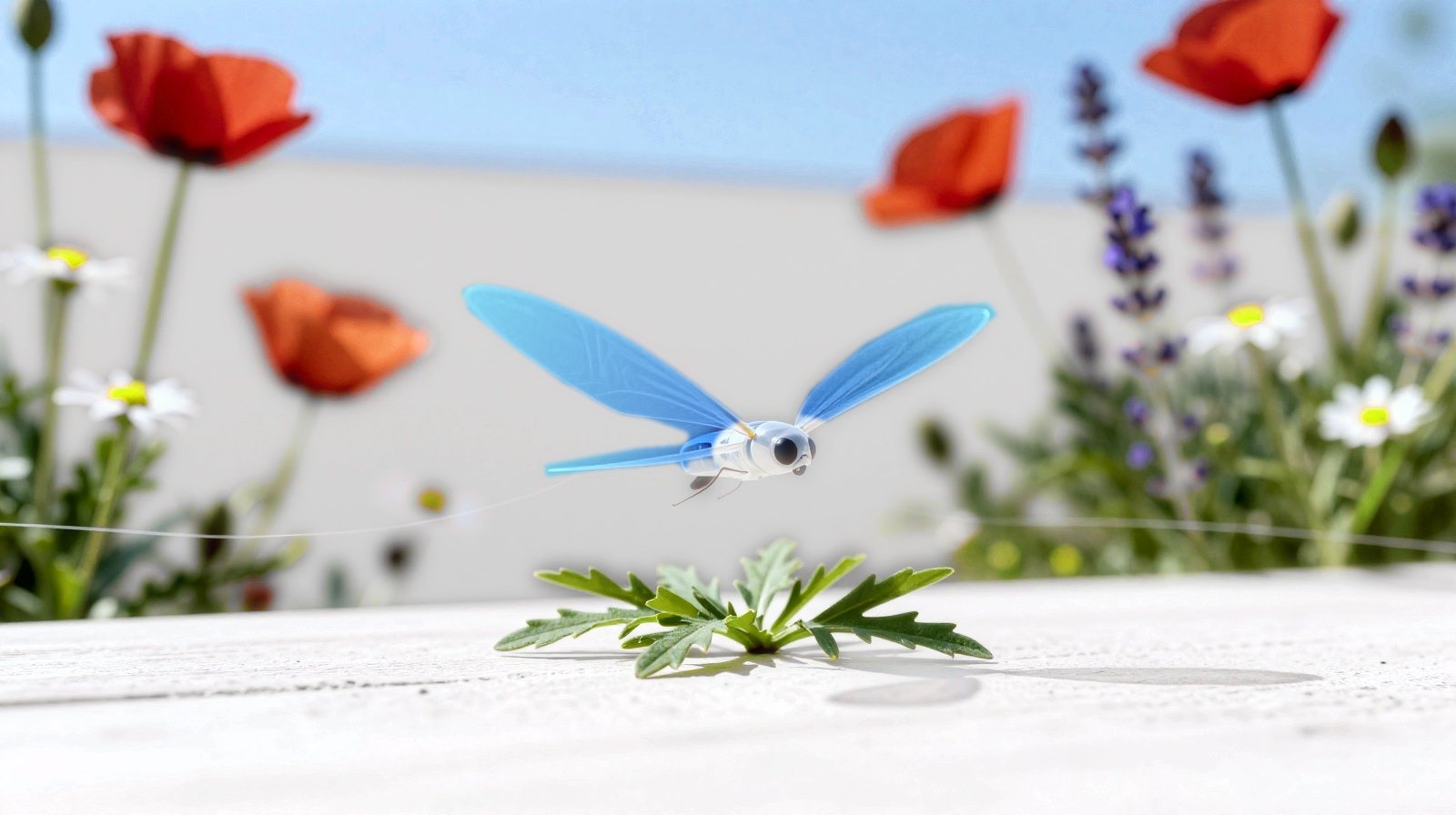
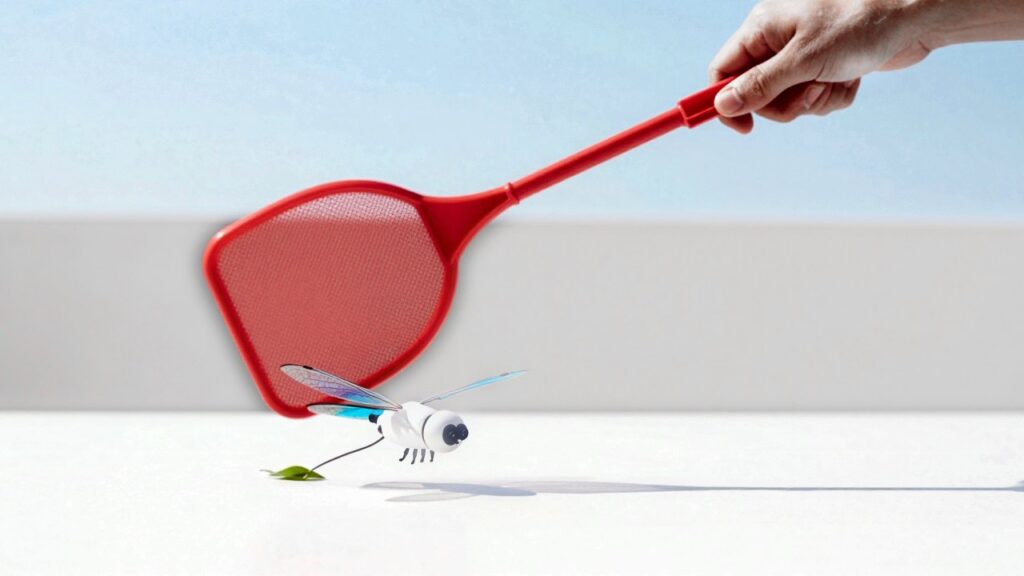
Swat it, squash it, and it flies again. Engineers at UCLA and UC Davis have built a flying robot that weighs just 185 milligrams (less than a fifth of a gram), is made entirely of plastic-like polymers, and takes off again after being hit with a flyswatter, according to their paper in Science Robotics.
Why it matters: tiny flying robots could one day check crops, sniff the air for pollution or search collapsed buildings. But most of them are as fragile as a soap bubble, and one bump against a wall ends the mission. Real insects crash all the time and simply carry on. This robot is a real step towards copying that toughness.
No motor, no gears: an electric “muscle”
Many tiny flyers use a transmission: stiff little hinges and levers that turn a small vibration into a wing flap. Rigid parts like these are what tends to break in a crash. The UCLA team, led by Qibing Pei with Wenzhong Yan as co-senior author, threw them out.
Instead, the robot’s “muscle” is a thin film of a special polymer (a relaxor ferroelectric, if you like big words) that stretches when electricity is applied, Tech Xplore explains. That film flaps the wings directly, with nothing in between. Fewer parts, fewer things to snap.
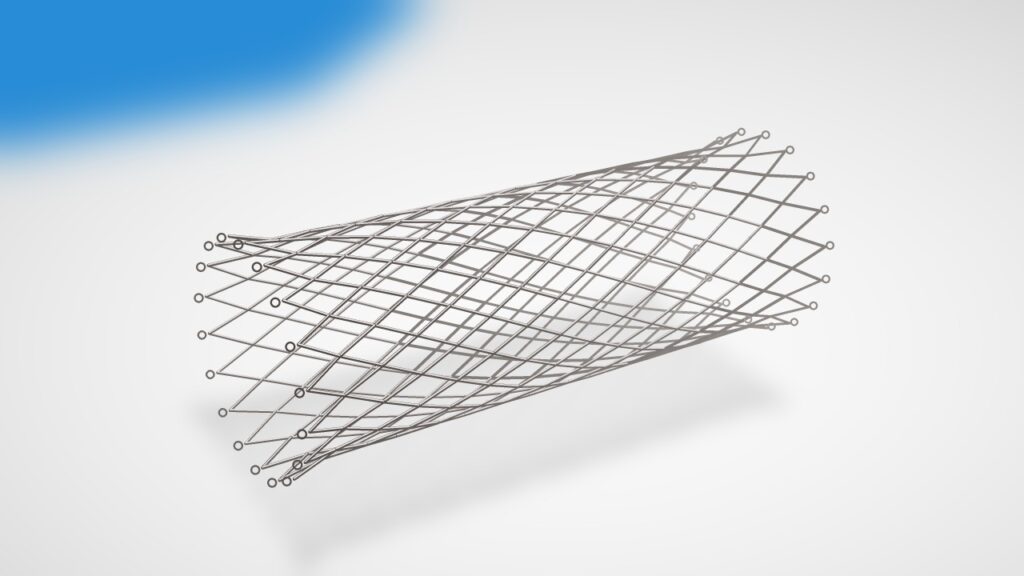
Engineers have other tricks for tiny artificial muscles. A famous one is nitinol, a “shape-memory alloy” of nickel and titanium discovered at the US Naval Ordnance Laboratory around 1960 (the name mixes Ni, Ti and NOL, the lab’s initials). Bend it while it is cool and it stays bent; warm it up and its atoms shuffle back into their original arrangement, so the metal returns to the shape it “remembers”, Invention & Technology explains. Thin nitinol wires even work like muscles: an electric current heats them and they get shorter, typically by 2 to 5 % of their length, then relax again as they cool (Flexinol wire data, Tech Briefs). You may be wearing some: it is used in braces wires for teeth. Doctors also use it to repair the aorta, the body’s main artery: in a stent graft, nitinol rings sewn onto a fabric tube are squeezed thin, slid in through a blood vessel and spring open inside to reinforce a weak, bulging section called an aneurysm (Endovascular Today, ENGAGE study protocol). And once it even flapped the wings of a toy. The UCLA robot takes a different route, though: its polymer muscle moves directly with electricity, not with heat.
Wings shaped like little cones
The wings are flexible cones rather than flat sheets. Their lopsided shape bends a little with every beat, and that bending helps push air down to create lift. Because they are soft, they also give way when they hit something, and the wing material resists creasing, so they spring back into shape.
The researcher Wenzhong Yan calls this “mechanical intelligence”: smart behaviour built into the material and shape itself, with no computer deciding anything.
The numbers
- 185 mg in total.
- Lift up to 3 times its own weight, enough to take off without help, the paper reports.
- Climbs at about 40 cm per second on average.
- Back in the air after a flyswatter hit, and still working after being flattened under loads of about 11,000 times its own weight, according to Tech Xplore.
Insect-sized flying robots are not new: Harvard’s RoboBee showed controlled flight in Science back in 2013. What is new here is a design that survives the rough life of a real insect.
Should you expect one buzzing around soon?
Not yet. Today’s prototype still flies on a leash: thin wires bring its power from outside, and it carries no battery, no brain and no sensors. Steering, turning and landing still need work too. The team’s next goals are better flight control, the ability to carry a small load, and a fully self-contained robot with its own power, electronics and sensors.
Power is the hard part at every size. Even in your pocket, part of a battery’s energy is lost as heat on the way to your phone, as our guide to power banks and chargers explains; squeezing useful energy into a robot lighter than a fifth of a gram is a far tougher puzzle.
What happens next
If the team can add onboard power and control, the researchers see uses in environmental monitoring, pollinating crops and search and rescue in tight or dangerous spaces. A robot that shrugs off bumps is a robot you can actually send into a messy world. For more tiny flyers and walkers, see how an AI drone with one camera beat world champion pilots.

Read next
- AI drone with one camera beats world champion pilots
- Lab-grown muscle robots now jump, walk, swim and grab
- Microduck robot: how a robot duck learns to walk in simulation
- Zinc-air batteries that recharge: new catalyst runs 300 hours
The week's best tech stories, free
One email a week with the stories that matter, explained simply. No spam.
Sources
- Takeoff of an all-polymer micro aerial flying robot – Yuan Zhu et al. (UCLA, UC Davis), Science Robotics, vol. 11, issue 118, 30 September 2026
- Insect-inspired flying robot bounces back after collisions – Tech Xplore, 28 October 2026
- Controlled Flight of a Biologically Inspired, Insect-Scale Robot – Ma et al., Science, 2013
- The Metal With A Memory – Invention & Technology (Isaac Mayo), Fall 1993
- Flexinol wire properties – Images Scientific Instruments, accessed 28 October 2026
- Robot Arms with Artificial Muscles Are Lightweight and Flexible – Tech Briefs (Saarland University), 1 January 2022
- Consistent, durable outcomes at 3-year follow-up across Endurant trials – Endovascular Today, December 2013
- Endurant Stent Graft System Post Approval Study (ENGAGE PAS), protocol – ClinicalTrials.gov NCT01379222