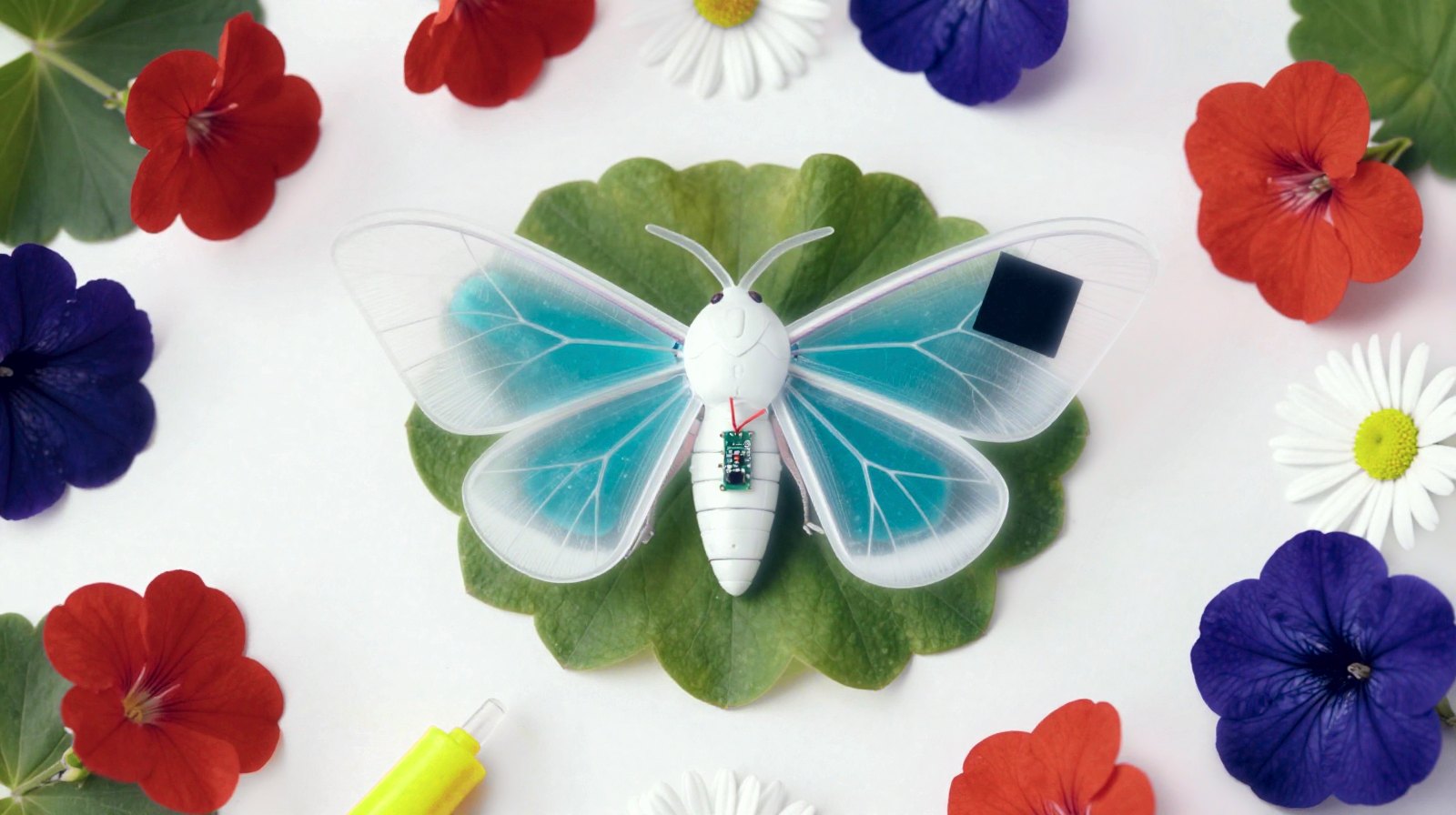
A robot moth in Estonia has grown a brand-new sense on the job. Researchers at the University of Tartu and the Italian Institute of Technology pumped a kind of artificial “blood” through its see-through plastic wings, shone ultraviolet light on one spot, and a working UV sensor formed right there, inside the robot, according to their study in Advanced Science.
Why it matters: almost every robot today is stuck with the sensors it left the factory with. If it meets something new, it cannot add an eye or a nose. This moth shows a first, simple way for a robot to build part of its own hardware where it is needed, the way living bodies grow and repair tissue.
Why a moth?
Insects like moths have an open circulatory system: instead of a closed network of tight blood vessels, their body fluid (called hemolymph) washes loosely through the body. That makes the plumbing much simpler to copy, because the liquid does not need precise flow control, the Estonian Research Council explains.
The team took the wings of the blue underwing moth (Catocala fraxini) as a blueprint, using specimens from the university’s own collection. Then they 3D printed the robot’s body in transparent PETG, a tough plastic that many home 3D printers use.
Veins you can see through
The robot’s “blood vessels” work at two sizes. Channels about a millimetre wide run across each wing, and each wing covers 86 square centimetres, a little more than half a postcard. On top of that, the tiny gaps between the printed plastic lines act as microchannels, so the liquid soaks about 10 micrometres (far thinner than a human hair) into the plastic itself.
A single pump fills the whole body with about 3 millilitres of liquid, less than a teaspoon. That liquid carries the building blocks: a chemical called pyrrole, a light-activated starter and a cellulose-based additive, Interesting Engineering reports.
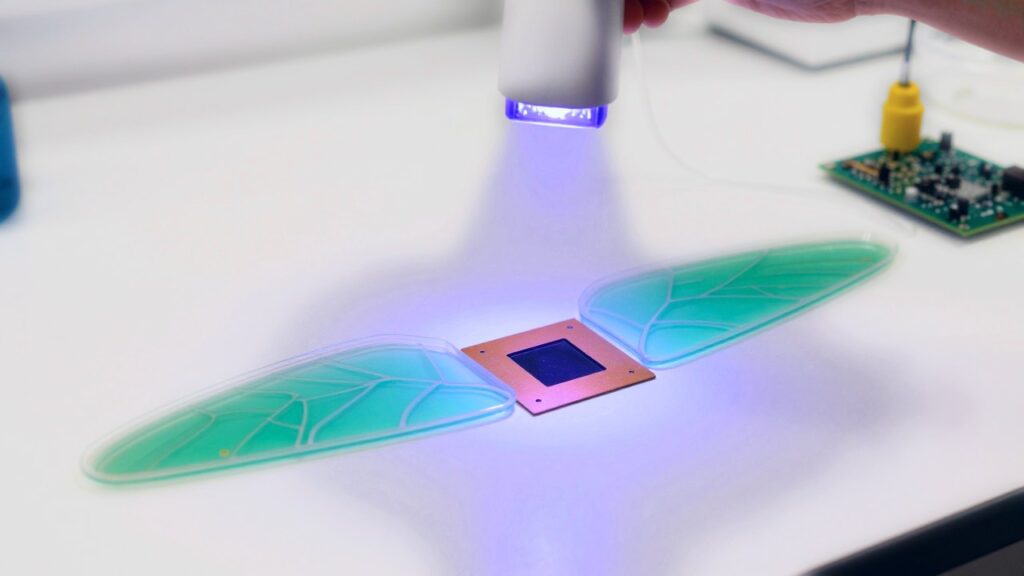
Grow a sensor in one minute
Here is the clever part. When the researchers shine UV light on a chosen spot for about a minute, the pyrrole there turns into polypyrrole, a plastic that conducts electricity. The lit area turns black: that black patch is the new sensor. A stencil decides its shape, with a precision of about 0.3 mm.
From then on, whenever UV light hits the patch, its electrical resistance drops for a moment. A small onboard computer notices the change and reacts: the moth flaps its wings, using a shape-memory wire (a nitinol “muscle” that shortens when it warms up, which we explained in our story on the flying robot that survives a flyswatter), or switches on an LED. Before the sensor grew, the robot did not react to UV light at all.
A sensor that gets better with practice
Two surprises came out of the tests. First, the sensor became more sensitive every time it was exposed, because leftover pyrrole kept turning into polypyrrole. The authors call this a kind of “material memory”. Second, the sensors still worked after more than four months in storage.
Lead author Kadri-Ann Pankratov, a PhD student at Tartu, puts the goal simply: “I’m working on giving robots a circulatory system.”
What it can’t do yet
This is a proof of concept, and the team is clear about its limits. There is only one chemical recipe, and it cannot be undone. The researchers decided when to fill the veins, and a stencil, not the environment, decided where the sensor formed. The same UV light that built the sensor is also the only thing it can sense.
And the robot did not choose anything by itself. “Right now, the robot’s central intelligence knew which component was coming,” Pankratov told Interesting Engineering. How to remove that pre-planning is still an open question.
What happens next
The team expects the idea to work with other materials. Polypyrrole could be tuned to protect against corrosion, shield electronics, or connect with living tissue, and the veins could carry other chemicals, perhaps reversible ones. Pankratov hopes that in about ten years, artificial blood and circulatory systems will be a standard option for robots, including ones that work out in nature.
Robots are slowly borrowing more from biology, from skin that feels “pain” to real lab-grown muscle. A robot that grows the sense it needs, where it needs it, would be a big step on that road.
Read next
- Flying robot of 185 mg survives a flyswatter and flies again
- Robot skin that feels ‘pain’ pulls fingers away from needles
- Lab-grown muscle robots now jump, walk, swim and grab
The week's best tech stories, free
One email a week with the stories that matter, explained simply. No spam.
Sources
- Receptogenesis in a Vascularized Robotic Embodiment – Kadri-Ann Pankratov, Indrek Must et al. (University of Tartu, Italian Institute of Technology), Advanced Science, 2026, DOI 10.1002/advs.76999
- Robot moth grows a UV sensor by using an artificial circulatory system – Estonian Research Council via Tech Xplore, 30 October 2026
- Scientists create moth-inspired robot that grows new senses using artificial blood, UV light – Interesting Engineering (Rupendra Brahambhatt), 31 October 2026
- Receptogenesis in a Vascularized Robotic Embodiment (preprint) – arXiv 2603.09473, March-June 2026