Disclosure: this article contains affiliate links to online courses. If you sign up through them, DIGITAL WOXTER TECHNEWS may earn a commission at no extra cost to you. We choose courses for their content, not for payments.
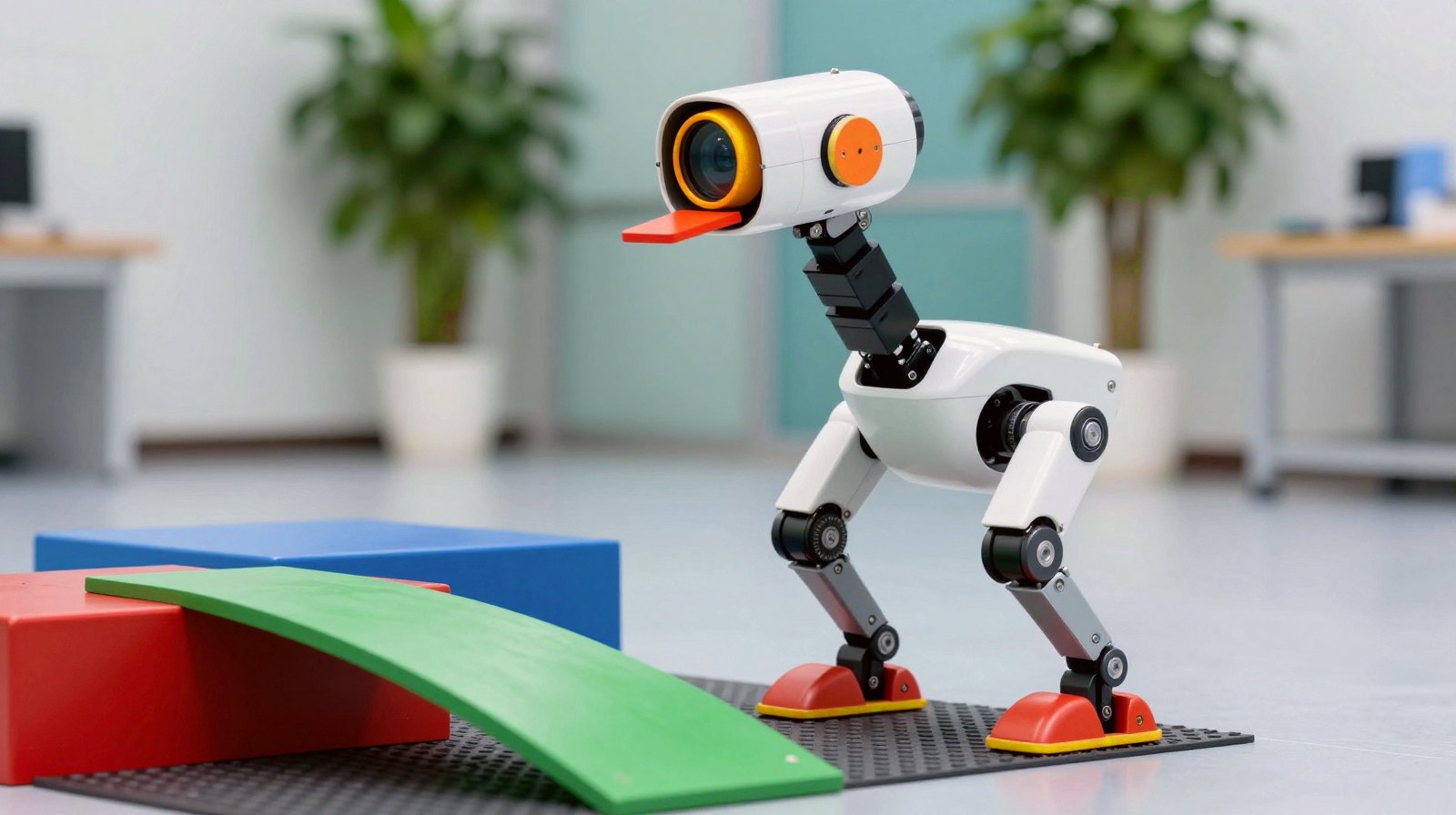
A little robot duck, just 25 centimetres tall, stole the show at NVIDIA’s GTC Berlin keynote on 21 October. Four Microducks sat down, took a “nap” and rolled into somersaults when NVIDIA’s chief executive Jensen Huang asked them to, and the clip went viral within hours, TechCrunch reports. Behind the cute act sits a serious idea: the duck learned to walk in a virtual world first, and NVIDIA used it to show off the free tools that make that possible.
Why it matters: teaching a robot to walk by programming every movement by hand is slow and fragile. Training in simulation lets thousands of virtual copies practise at the same time, fall over safely and pass what they learn to the real machine. Until recently that was the work of big research labs. Microduck puts the same recipe into a small open-source robot that anyone can retrain.
Meet Microduck
Microduck is made by Pollen Robotics, a French robotics team that Hugging Face (the huge online library of open AI models) bought in 2025. It is their second small robot, after the desk companion Reachy Mini. According to TechCrunch and Pollen’s own code page, it stands 25 cm tall, weighs about 800 grams and moves on 15 small motors. It sees with a camera and a small lidar sensor (which measures distance with invisible light) and keeps its balance with two motion sensors, a bit like the balance organ in your inner ear.
Out of the box it can waddle, crouch, get back up after a fall and pick things up with its beak. With an accessory it even roller-skates. Pre-orders opened on 27 August, with deliveries planned before Christmas. Hugging Face’s chief executive Clément Delangue said pre-orders passed 20,000 the day after the Berlin video, a company figure reported by TechCrunch.
If the waddle reminds you of the walking droids in Disney’s Star Wars parks, you are not the only one: TechRadar made the same comparison. There is a real link, too. When a Disney BDX droid walked on stage at GTC in March 2025, NVIDIA, Google DeepMind and Disney Research announced Newton, an open-source physics engine for training robots. That same engine now runs the duck’s virtual playground in NVIDIA’s new tutorial.
How a duck learns to walk without leaving the computer
The method is called reinforcement learning: learning by trial and error, with points for good moves. Think of teaching a dog with treats, except the “dog” is a small neural network and the treats are a score. Stay upright and move in the right direction: points. Fall over or wobble: fewer points. After millions of tries, the network has worked out a walking style on its own.
Doing that with a real robot would take years and a lot of broken plastic. So the practice happens in simulation. In NVIDIA’s step-by-step tutorial, published on Hugging Face on 21 October, the free Isaac Lab 3.0 framework runs 4,096 virtual ducks at once on a single graphics card, reaching up to 1.25 million simulation steps per second with rough ground switched on. Newton does the physics: gravity, friction and every foot touching the floor.
The finished “brain”, called a policy, is surprisingly small. It reads 61 numbers (joint angles, tilt, the direction you want it to go) and answers with 14 joint positions, 50 times a second, on the duck’s own little Rockchip processor, Tech Times explains.
The secret: a deliberately messy virtual world
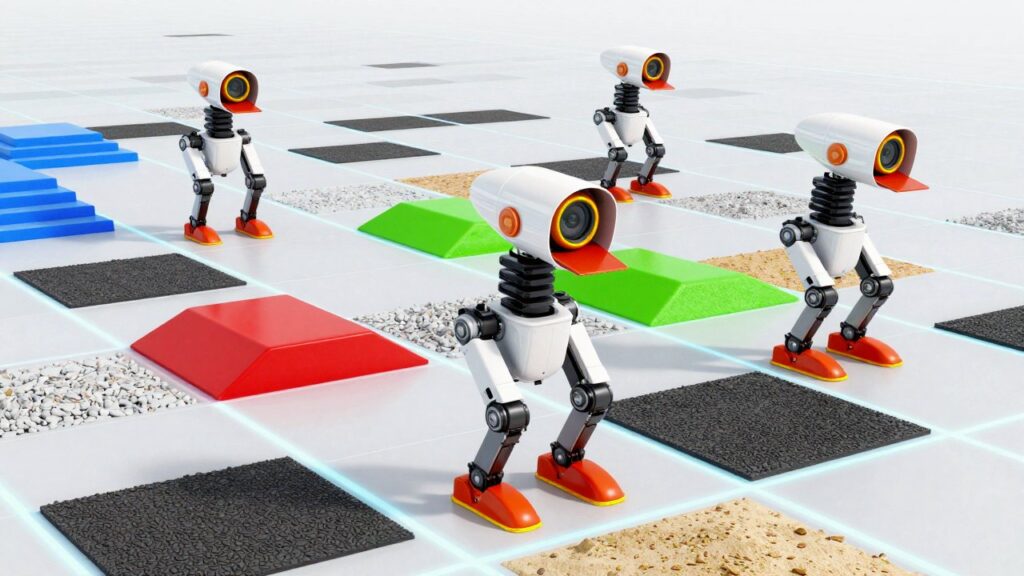
Here is the catch every robot maker knows. A simulation is too perfect. Floors are perfectly flat, motors react instantly, batteries never run low. A robot trained only in that tidy world stumbles in your living room. Engineers call it the sim-to-real gap.
The fix is to make the virtual world messy on purpose, a trick called domain randomisation. Each of the 4,096 ducks gets slightly different weight, floor grip, battery voltage and reaction delay, and is shoved now and then. The tutorial even adds “backlash”, the tiny play in cheap gears, like a loose bike chain. Special actuator models copy how the duck’s hobby-grade motors really respond. A duck that copes with all those versions of reality copes with the real one.
It works. According to the tutorial and Tech Times, the trained policy walks forward, turns and recovers from falls on carpet, with no extra tuning on the physical robot.
Why NVIDIA put a duck on stage
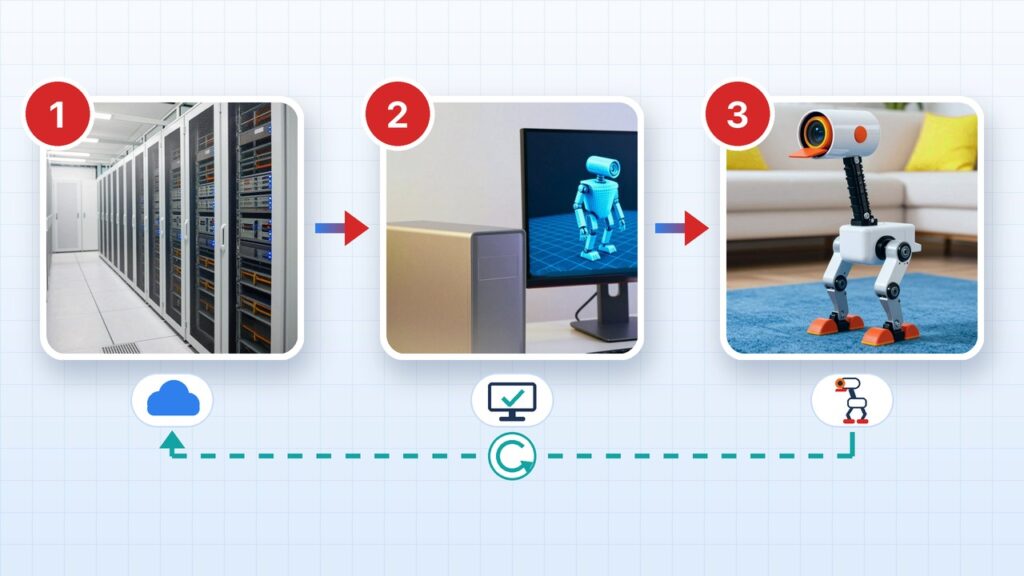
On stage in Berlin’s Tempodrom, the ducks showed a three-step chain, The Register reports: the AI was trained in the cloud, checked on an NVIDIA RTX Spark computer (the desktop AI machines we covered in our RTX Spark article), then loaded into the robots. Huang called physical AI, meaning AI that moves things in the real world, “the next great industry”.
Two days later NVIDIA went one step further. In a developer blog post, AI agents (assistants that carry out multi-step jobs on their own) design an obstacle course from a simple prompt, build the 3D pieces with free tools such as FreeCAD and Blender, then train the duck to climb ramps and platforms using its depth camera. The course is assembled in Isaac Sim, and the blog points to a free Hugging Face collection of more than 2,000 ready-made 3D objects for simulation.
There is a business side, too. NVIDIA agreed in September to buy Hugging Face for about $12.9 billion, a deal still waiting for approval, Phoronix reported. So the duck is also a family showcase. And to be fair: Pollen’s own training recipe uses a different free tool, mjlab, built on Google DeepMind’s MuJoCo Warp physics. NVIDIA’s Isaac Lab is an extra route, not the only one, and both share that MuJoCo Warp core.
How to try it yourself
You do not need a duck to start. The Microduck training setup is open source inside Isaac Lab on GitHub; you need a Linux computer with a supported NVIDIA graphics card. On Hugging Face, the Microduck Arena lets people submit a trained policy and compare it with others on shared challenges. If you do own a duck, the tutorial shows how to copy the new brain onto the robot and test it safely on its stand first.
Thinking of it as a Christmas present? Remember that Microduck is a programmable robot more than a plush toy: it is at its best with someone who enjoys tinkering, training and sharing new tricks.
What happens next
The first ducks should reach homes before Christmas, and Pollen says owners will be able to teach them new tricks and share them with everyone. Watch the Arena leaderboard: if thousands of owners start training in simulation, the most creative robot moves of 2027 may come from a living room rather than a lab.
Learn it yourself
Want to go further? These online courses cover the skills behind this story:
- Fundamentals of Reinforcement Learning (University of Alberta) Coursera: The trial-and-error learning behind walking robots, explained step by step: rewards, value functions and how an agent balances exploring with using what it knows. Intermediate level.
See the course on Coursera
Read next
- Nvidia RTX Spark: laptops that run big AI models offline
- Robot AI that imagines the scene before it moves
- AI drone with one camera beats world champion pilots
The week's best tech stories, free
One email a week with the stories that matter, explained simply. No spam.
Sources
- Train in Simulation, Deploy on a Real Robot: Microduck with Isaac Lab 3.0 – NVIDIA with Pollen Robotics, Hugging Face blog, 21 October 2026
- Using AI Agents to Teach Robots Like Microduck to Walk in Simulation – NVIDIA Technical Blog, 23 October 2026
- Jensen Huang sends in the robot ducks to sell Nvidia’s AI-everywhere vision – The Register, 21 October 2026
- Hottest toy for Christmas? Nvidia CEO plays with adorable Microduck robots, 20,000 sell – TechCrunch, 23 October 2026
- Sim-to-real gap narrowed for Microduck: Isaac Lab 3.0 and pure-simulation training – Tech Times, 22 October 2026
- Hugging Face launches Microduck, an open-source duck robot – TechCrunch, 27 August 2026
- Microduck software repository – Pollen Robotics, GitHub, 2026
- Microduck compared with Disney’s BDX droid: lidar, NFC and roller skates – TechRadar, 2026
- Announcing Newton, an Open-Source Physics Engine for Robotics Simulation – NVIDIA Technical Blog, 18 March 2025
- Nvidia, Google, Disney Partner to Develop Robot AI Infrastructure – AI Business, March 2025
- NVIDIA Acquiring Hugging Face For $12.93 Billion – Phoronix, 3 September 2026
- Nvidia acquires Hugging Face in US$12.9 billion mega deal – CRN Australia, September 2026