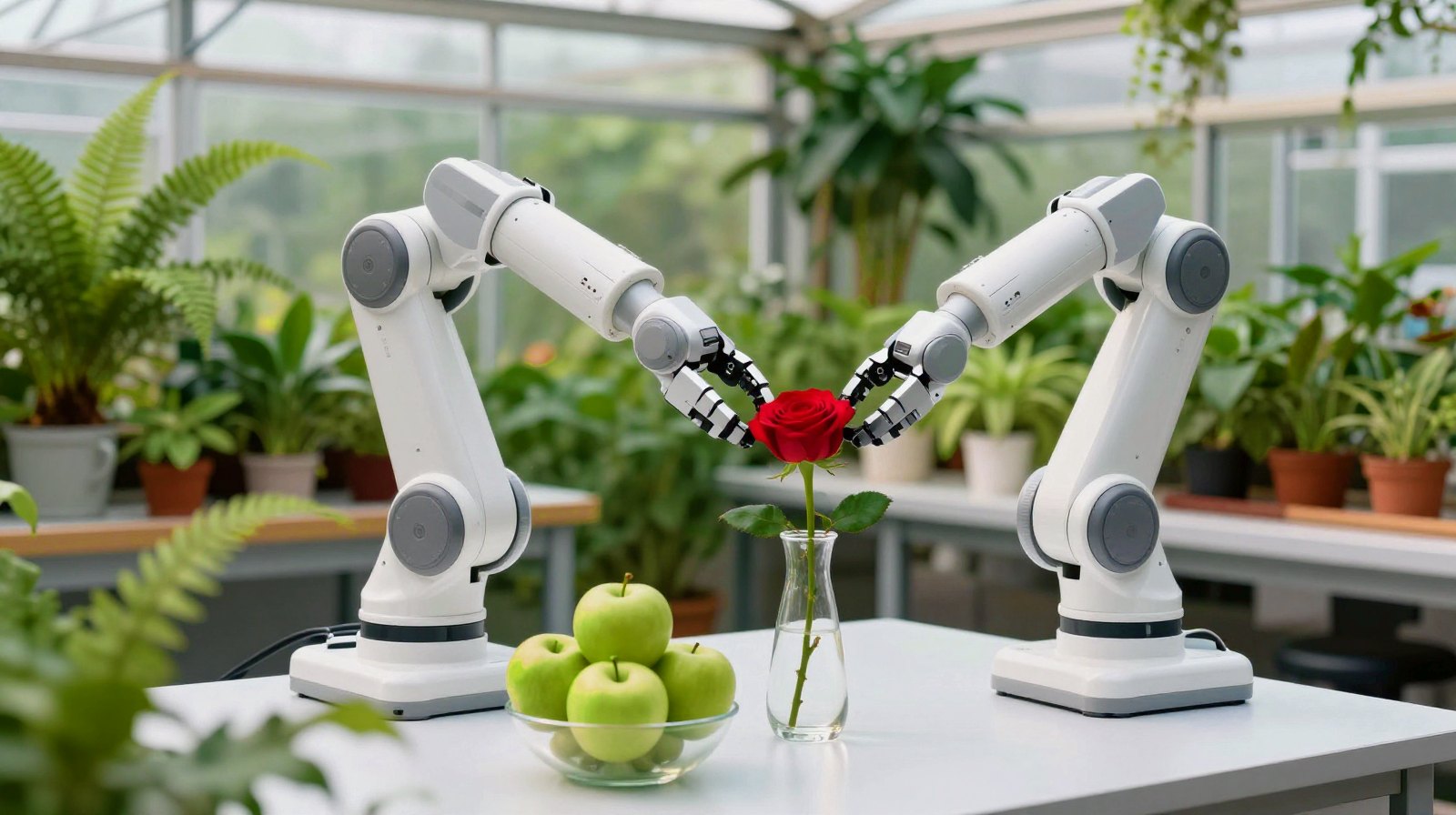
Before you reach for a cup, your brain quietly pictures what will happen: your hand closing around it, the cup lifting. A team at Seoul National University has given a robot a similar habit. Their AI model, Dynin-Robotics, imagines what the scene should look like after a move, then uses that picture to choose its next action, as reported by Tech Xplore and described in the team’s research paper.
Why it matters: most robots today are good at repeating exactly what they were shown and bad at anything slightly different. A robot that can “look ahead” can check its own plan before it acts, which is a step toward machines that cope with messy homes, warehouses and hospitals instead of tidy factory cells.
One brain for words, pictures and movement
Dynin-Robotics belongs to a new family of AI called vision-language-action models. Think of a chatbot that, instead of only answering in words, can also see through a camera and answer with arm movements. You type “move the apple to the plate”, it looks at the table, and it produces the motions.
What makes this one different is that it handles language, images, video and robot actions inside a single model, rather than bolting separate systems together, according to Tech Xplore and the paper. It is built on a type of AI called a diffusion model (the same idea behind many image generators, which start from noise and refine it step by step), here used to fill in words, pictures and movements alike.
Picture the result, then pick the move
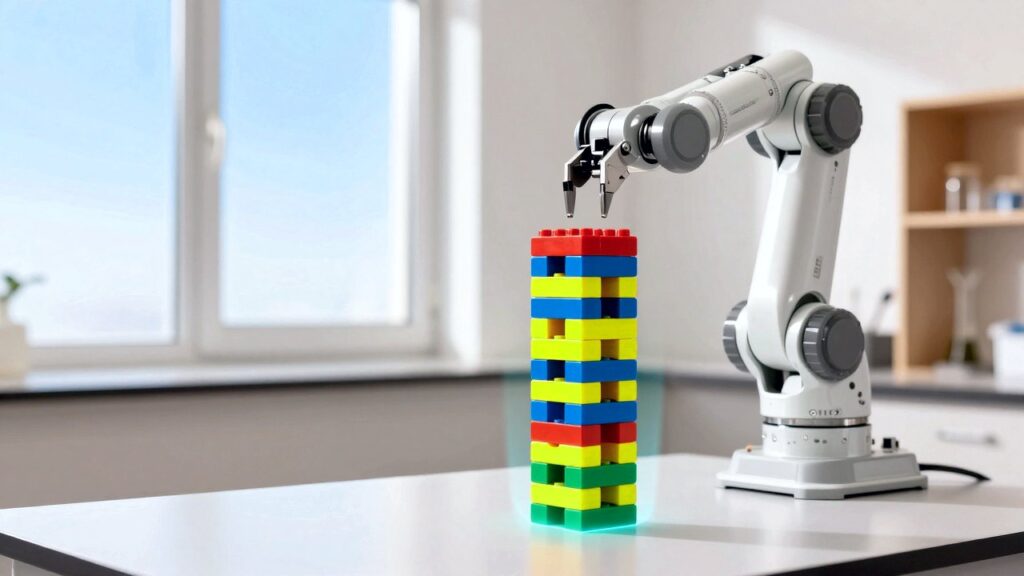
The trick is that the model learns several jobs at once. Besides predicting the next movement, it predicts what the camera will see after that movement, what the scene should look like once the task is done, and even how to describe in words what a robot did in a video. At work, it can generate several candidate actions, imagine the outcome of each, and keep the one whose imagined result best matches the goal, the researchers explain in their paper.
That extra “imagination” seems to help with fuzzy instructions. In simulated fruit-picking and flower-arranging tasks, the model handled indirect requests, such as picking “the flower that symbolises love”, better than a version trained only on movements, reports Tech Xplore.
The numbers
- Training: about 1.33 million recorded robot trajectories from 48 public datasets, according to the paper.
- Real robot tests: on a robot arm in four everyday-style setups (moving fruit, sorting blocks by colour, stacking blocks freely and stacking them in a set colour order), it succeeded 78.4 % of the time on average (paper, Tech Xplore).
- Against well-known rivals in the same four setups, the team reports 73.0 % for NVIDIA’s GR00T N1.6, 73.6 % for NVIDIA Cosmos Policy and 76.9 % for Physical Intelligence’s π0.5.
- Speed: by predicting several steps of a movement in parallel and reusing work it has already done, it chooses actions up to about 29 times faster than its own unoptimised version.
A fair reading: these are the researchers’ own results, in a limited set of tasks, and a few percentage points is a modest lead. The university says the work will be presented at NeurIPS, one of the biggest AI conferences, in December; for now the paper is a preprint that other experts have not yet publicly reviewed.
What it can’t do yet
The team is upfront that the tests used simulations and fixed real-world setups, and that it needs to try many more objects, tasks and places before anyone puts it to work in industry, says Tech Xplore. The robot also doesn’t yet use touch or force sensing, which matters a lot when you handle something fragile.
What happens next
The researchers plan to add touch and force sensing, explore surgical and endoscopic robots with Seoul National University’s medical school, and build what they describe as a robot that gets smarter the more it is used, learning from both its successes and its failures. Early targets are practical ones: sorting parcels in logistics and handling parts in factories. If “imagine first, then act” holds up outside the lab, it could become a standard ingredient in the next generation of home and work robots.
Read next
- AI drone with one camera beats world champion pilots
- Arduino Ventuno Q: the board that gives robots eyes and a brain
- Frog-like robot hops and swims with snapping spring legs
Sources
- Robot AI predicts future scenes to guide its next moves – Tech Xplore (Seoul National University College of Engineering), 19 October 2026
- Dynin-Robotics: Omnimodal Unified Diffusion Vision-Language-Action Model – H. Lee, J. Kim, J. Oh, J. Kim, G. Choi, H. Kim, J. Do, arXiv, September 2026