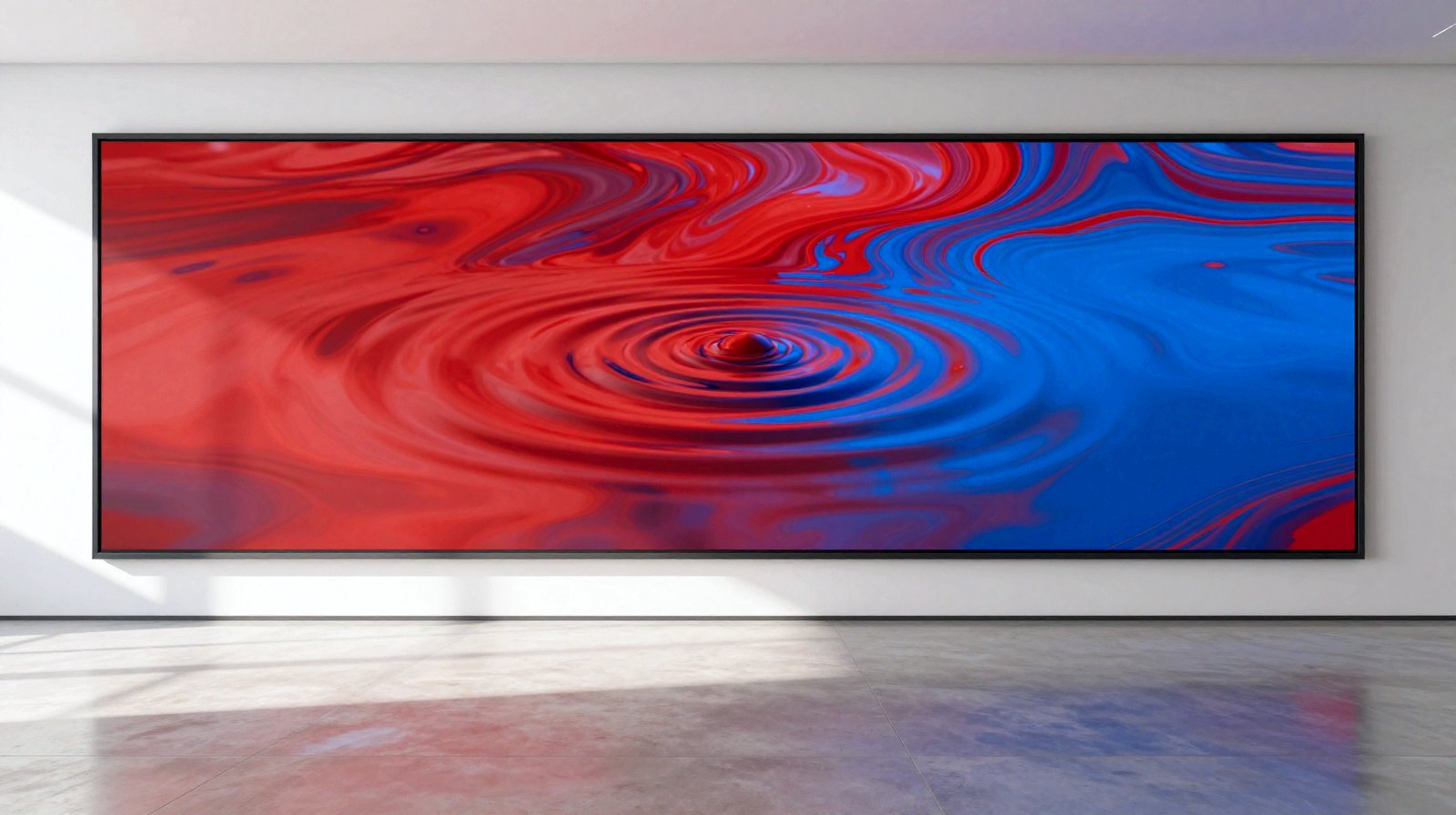
Picture a giant video wall where a singer’s voice comes from her mouth, and a passing car’s roar actually travels across the screen with the car. No speakers anywhere. Researchers at the Korea Institute of Machinery and Materials (KIMM) have built a 100-inch prototype that does just that, by making precise patches of the screen itself vibrate like a speaker, as reported by Tech Xplore and Electronics For You.
Why it matters: on almost every screen today, the picture is in one place and the sound comes from somewhere else, from speakers under the TV, beside a cinema screen or hidden in a car dashboard. Your brain fills the gap, but it’s never quite right. Sound that comes from exactly where the action is makes big screens feel more natural, and it could help in places where you need to know at a glance which part of a screen is “talking”.
A screen that is also the speaker
Any flat panel can make sound if you shake it at the right speed: that is how some TVs already play audio through the glass. The hard part is shaking only one spot and keeping the rest of the panel still. Vibrations love to spread, like ripples on a pond.
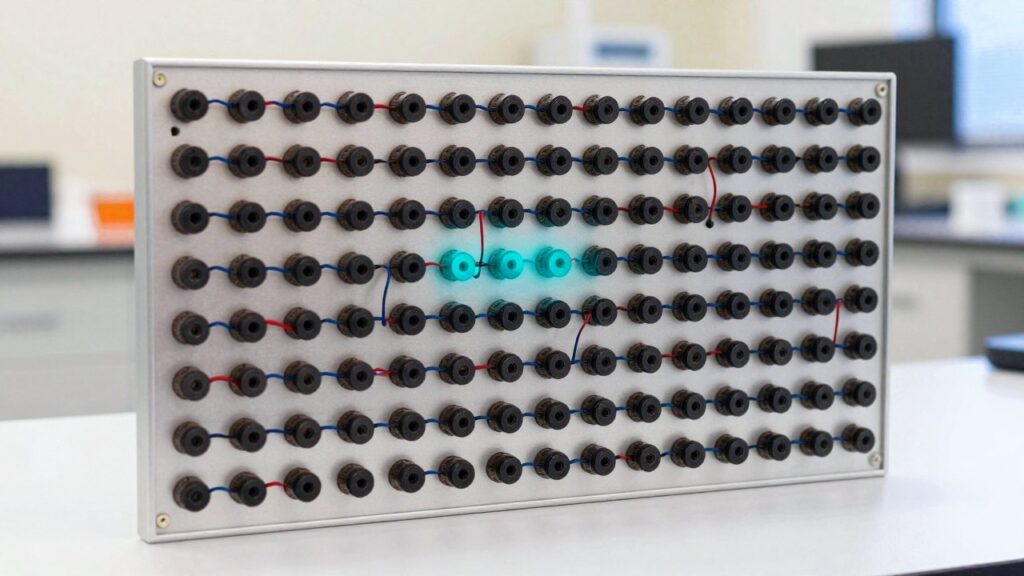
KIMM’s team, led by senior researcher Dr Dongjoon Kim, mounted 80 small actuators called voice coil motors (the same moving-coil part that drives an ordinary loudspeaker) on the back of the panel. First they measured how the panel responds when each one pushes. Then they “worked backwards”: for any spot on the screen, software calculates exactly how hard each actuator must push so their vibrations add up in that spot and cancel out elsewhere, according to Tech Xplore and Electronics For You.
Where AI comes in
To make sound follow the picture, the system has to know where each sound belongs. That is where AI comes in: it finds the position and size of each sound source in the video, pulls one chosen sound out of a mix (a voice from background music, say) and plays it from the matching area of the screen in real time. When the person or object moves, the sound moves with it, both reports explain.
Two extra tricks keep it smooth. A “selective excitation” step leaves out actuators that transmit vibration poorly, which keeps the maths stable, and a smoothing step stitches successive sound signals together so there are no clicks or gaps as a voice moves, says Tech Xplore.
How well does it work?
- Aim: it picked the intended sound zone with 99.9 % accuracy.
- Focus: the active zone vibrated up to 35 decibels more strongly than the quiet zones. Every 10 dB is roughly a tenfold difference in sound energy, so that is a very sharp spotlight.
- Proof: an acoustic camera, which “photographs” where sound comes from, confirmed the sound came from the right place and followed the moving image.
- Size: the prototype is about 100 inches (2.5 metres), made from a transparent LED display film on an aluminium panel.
Those figures come from the team’s tests, published in the Journal of Mechanical Science and Technology and reported by Tech Xplore and Electronics For You.
Should you wait for this TV?
Not yet. This is a large research prototype, not a product, and the team is aiming first at big screens: media art, concerts and exhibitions, digital signs, giant LED walls and in-car displays. The design is modular, so several units can be joined into a larger screen, and driving several of them together can produce deep bass, a bit like a large woofer, according to Tech Xplore. Electronics For You adds that KIMM holds a Korean patent on the modular system, and the team plans to extend it to modular LED tile displays, the tiles that big outdoor and stage screens are built from.
What happens next
The next test is moving from one carefully built panel to the kind of LED tile walls already used in stadiums, shops and stages. If it scales, the first place you are likely to hear sound coming straight out of a picture is not your living room but a museum, a concert or a car dashboard, where knowing exactly which part of a screen is speaking really helps.
Read next
- What is a Googlebook? Google’s new Android laptops explained
- Gaussian splatting: the 3D photo tech XR fans keep hearing about
- Self-powered glasses sensors read your pulse, blinks and bites
Sources
- Sound comes from where you see it: Display technology reproduces sound at on-screen locations – Tech Xplore (National Research Council of Science and Technology), 19 October 2026
- Display Technology Makes Sound Follow On-Screen Action – Electronics For You, 15 October 2026
- Vibration field control for an audio-visual integrated modular display – D. Kim et al., Journal of Mechanical Science and Technology, 2026