Disclosure: this article contains affiliate links to online courses. If you sign up through them, DIGITAL WOXTER TECHNEWS may earn a commission at no extra cost to you. We choose courses for their content, not for payments.
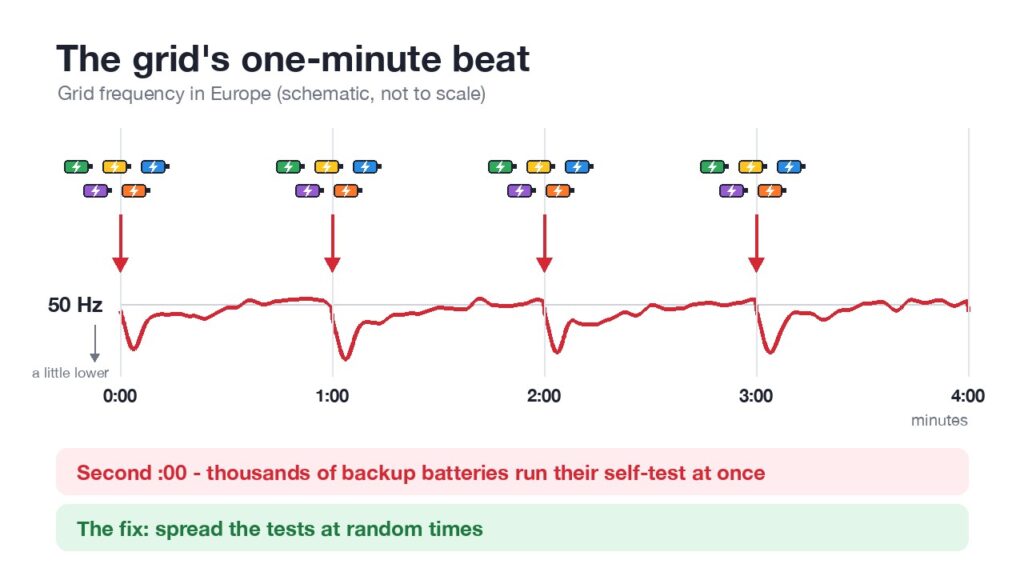
Every minute, on the minute, Europe’s power grid gives a tiny hiccup. For years nobody knew why. Now German researchers have found the culprit: thousands of backup batteries whose software checks itself at the very same second, all over the world, according to a study published in Nature Energy on 30 October.
Why it matters: the wobble is small and not a danger to the grid today. But it wears out hydropower turbines a little, and it shows something new: as homes, factories and data centres fill up with smart, clock-driven devices, tiny software choices can add up to effects you can measure across a whole continent.
The grid has a heartbeat
Electricity in Europe alternates 50 times per second: that is the grid’s frequency, 50 hertz (60 in North America). It works like a heartbeat that tells everyone how healthy the system is. When more power is being used than produced, the frequency dips a little; when there is extra power, it rises. Grid operators watch it every second and nudge power plants up or down to keep it steady.
Normally those small ups and downs look random, because millions of people switch things on and off at random moments. That is why a pattern that repeats exactly every 60 seconds stood out. TenneT, Germany’s largest transmission grid operator, had seen the frequency dip briefly at the start of every minute for several years, Forschungszentrum Jülich explains.
The culprit: batteries that check themselves on the minute
The team, led by physicist Dirk Witthaut at Forschungszentrum Jülich with the University of Cologne and the Karlsruhe Institute of Technology, put measuring points at 80 locations on the Jülich campus. The same one-minute pattern showed up wherever large battery systems were installed.
The suspects are uninterruptible power supplies (UPS) and battery storage systems: big batteries that keep hospitals, offices and data centres running if the power cuts out. Their control software runs a quick self-test every minute, timed by a synchronised clock. Each test causes a short spike in demand. One battery does not matter, but when thousands all do it at second zero, the grid feels it, the paper shows. “The observed effect can only be produced if many devices are consuming electricity at the same time,” Witthaut said.
Florian Dörfler, who commented on the study in the same journal, describes it as “an extra beat every minute”: self-tests in battery backups that accidentally act in unison.
Five continents, and Mallorca too
The minute beat is not just a German quirk. The researchers found it in grid frequency data on five continents, the Nature Energy paper reports. An earlier version of the study, posted on arXiv in 2025, lists grids from Continental Europe, Great Britain and the Nordic countries to Australia, Iceland, South Korea, Malaysia and the eastern and western United States.
That preprint also has a Spanish detail: on the Balearic island of Mallorca there was no one-minute pattern in late 2019, but it had appeared by 2025, after battery storage systems were installed on the islands.
The beat is also getting stronger in places. In Ireland, where data centres with large battery backups use about a fifth of the country’s electricity, the size of the one-minute signal quadrupled between 2016 and 2021, according to Jülich.
Is it dangerous?
Not today. The dips are measurable but not critical for grid security, the researchers say. The real cost is wear and tear: hydroelectric turbines briefly slow down and speed up again with every beat, and the paper names the effect as one reason for stricter frequency-control requirements.
The worry is the future. Battery storage, data centres and the Internet of Things (everyday devices connected to the internet) are all growing fast, and they may amplify these oscillations, the authors warn. Heat pumps, air conditioners, washing machines and dishwashers with digital controls could show similar patterns, Witthaut suspects.
The fix is almost funny
Why every minute, exactly at second zero? Probably just because nobody told manufacturers otherwise: there are no binding rules for when these checks must run, so the start of the minute was the obvious choice, Witthaut suspects. The solution is equally simple. “You would simply have to distribute the checks randomly, rather than always starting them at the same time,” he said. The preprint notes that at least one manufacturer already shifts its test time with an offset that changes every day.
What it means for you
Nothing to do at home: your fridge is not the problem. But the story is a nice reminder that the grid is now as much software as copper. A few lines of code in millions of devices can be felt from Ireland to Australia, and smart, randomised timing will matter more as batteries spread.
Small backup batteries follow the same idea at home: the power station in our camping gadgets guide can charge from the wall while it powers your devices, which is how its backup (UPS) function works.
Learn it yourself
Want to go further? These online courses cover the skills behind this story:
- Circuits Brilliant: Hands-on interactive lessons on how electricity, current and circuits work: a friendly start for anyone curious about the grid.
See the course on Brilliant
Read next
- Zinc-air batteries that recharge: new catalyst runs 300 hours
- Boiling coolant inside chips: a safer way to tame AI heat
- NTT moves data with light, not wires, inside AI data centres
The week's best tech stories, free
One email a week with the stories that matter, explained simply. No spam.
Sources
- One-minute frequency disturbances from unintended synchronization in cyber–physical power systems – Carsten Hartmann, Dirk Witthaut et al., Nature Energy, 30 October 2026
- An extra beat every minute – Florian Dörfler, Nature Energy (News & Views), 30 October 2026
- Mystery of 60-second fluctuations in power grids solved – Forschungszentrum Jülich via Tech Xplore, 30 October 2026
- Cyber-Physical Systems on the Megawatt Scale: The impact of battery control on grid frequency stability – Hartmann et al., arXiv preprint, 10 October 2025