What a week for explorers. A Japanese probe set off to bring home soil from a moon of Mars, NASA’s rover broke the distance record for driving on another world, and astronomers found a star that really does glow green. Back on Earth, a 3D printer that makes a whole object in about a minute went open source, and a plastic learned to dissolve in the deep sea. Here are the seven stories worth knowing, a minute each.
1. Japan’s MMX sets off for Mars’s moon Phobos
JAXA’s Martian Moons eXploration probe lifted off on an H3 rocket from Tanegashima on 20 October at 04:41 Japan time and separated from the rocket about 71 minutes later, as planned, according to JAXA and AFP via Phys.org. Nobody has ever landed on Phobos. MMX should reach Mars in August 2027, scoop at least 10 grams of soil (about two teaspoons) and send it home in a capsule that lands in Australia in 2031. Our full story: Japan’s MMX launches to bring home soil from Mars’s moon Phobos.
2. Perseverance drives farther than any vehicle on another world
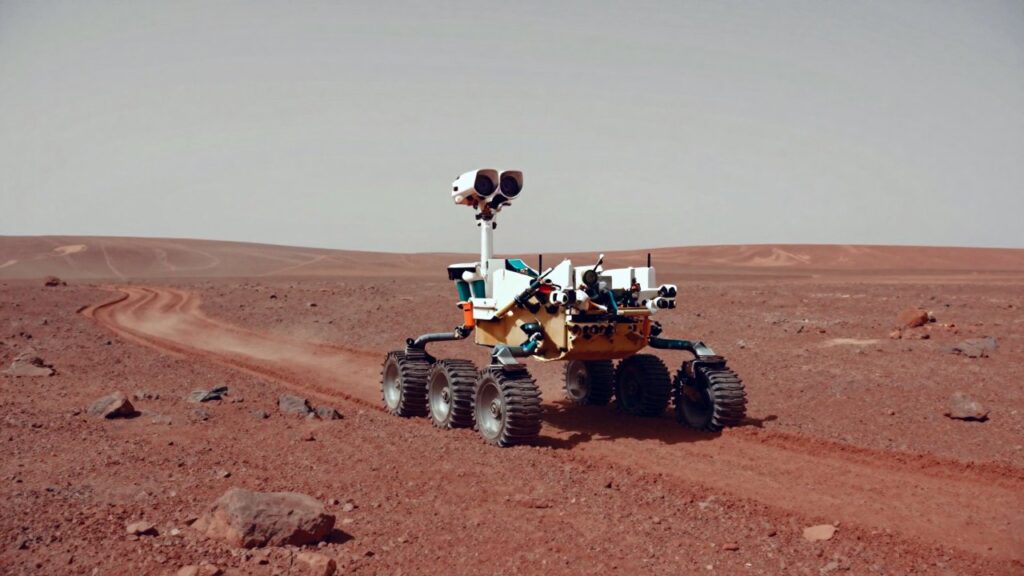
On 11 October the rover’s odometer reached 45.22 km, passing the 45.16 km set by Opportunity, says NASA JPL. Opportunity needed almost 15 years to get that far; Perseverance did it in about five and a half, largely because it now plans most of its own route. IEEE Spectrum explains how that self-driving works. Read more: Perseverance sets record for the longest drive on another world.
3. Five silicon qubits share one wire without losing accuracy
A RIKEN-led team ran five silicon qubits (quantum bits made from the spin of single electrons) at the same time through one shared control line, and all five stayed at about 99.9 % accuracy, they report in Nature Physics. Why it counts: a useful quantum computer needs huge numbers of qubits, and there is no room for one cable each. The Quantum Insider also notes that silicon qubits fit today’s chip factories. Our explainer: Silicon qubits: five run on one wire at 99.9% accuracy.
4. OpenCAL: build-it-yourself printing in about 90 seconds
UC Berkeley released the plans, code and resin recipe for OpenCAL, a volumetric 3D printer: instead of stacking layers, it shines moving light patterns into a spinning vial of resin, and the whole object hardens at once. Parts cost about $1,600, report VoxelMatters and 3D Printing Industry. Our story: OpenCAL: an open-source 3D printer that prints in 90 seconds.
5. AI makes three-to-six-week weather forecasts sharper
A study in Nature describes a light, open-source AI step that corrects existing forecast models instead of replacing them. It learns from each model’s past mistakes and recent trends, and MIT’s write-up on Phys.org says it doubles predictive power two to six weeks out. That window matters to farmers, power grids and flood planners. More here: AI weather forecasts get sharper up to a month ahead.
6. A compostable plastic that breaks down in the deep sea
Japanese researchers mixed tiny amounts of plastic-cutting enzymes into compostable plastics. Placed 757 metres below the surface, the films were nearly gone within five months, they report in Nature, as IBTimes Japan also covers. The enzymes stay quiet while the plastic is dry and wake up in water. Our story: Biodegradable plastic that breaks down even in the deep sea.
7. The first truly green star
Astronomers at the University of Warwick found a dead star, the white dwarf WD J1330+6435, that would look pale green to a human eye. Sodium from the remains of its old planets soaks up the yellow, orange and red part of its light, report ScienceDaily and Popular Science. Read it all: First green star found: a dead star that glows chartreuse.
What to watch
- MMX is now cruising to Mars: arrival is planned for August 2027, and the Phobos samples are due back in 2031.
- OpenCAL: with every file public, expect the first school and hobby builds to show up in the maker community.
- Silicon qubits: the next test is doing the same trick with many more qubits on one line.
Read next
- AI agents beat Minecraft: four bots slay the dragon in 27 hours
- New series Spanish Geniuses: Torres Quevedo, the forgotten genius
- Microduck robot: how a robot duck learns to walk in simulation
The week's best tech stories, free
One email a week with the stories that matter, explained simply. No spam.
Sources
- Launch result of the Martian Moons eXploration (MMX) spacecraft – JAXA, 20 October 2026
- Japan to launch world-first mission to moon of Mars – AFP via Phys.org, 19 October 2026
- NASA’s Perseverance sets off-world record for total distance driven – NASA JPL, 12 October 2026
- Perseverance sets Mars rover distance record – IEEE Spectrum, 13 October 2026
- Simultaneous high-fidelity single-qubit gates in a spin qubit array – Nature Physics, 15 October 2026
- RIKEN team improves parallel control of silicon spin qubits – The Quantum Insider, 19 October 2026
- UC Berkeley releases OpenCAL, an open-source volumetric 3D printer – VoxelMatters, 19 October 2026
- Build-It-Yourself OpenCAL Volumetric 3D Printer Forms Whole Parts in 90 Seconds – 3D Printing Industry, 21 October 2026
- Advancing subseasonal forecasting with machine learning – Nature, 14 October 2026
- AI-enhanced weather model doubles predictive power two to six weeks out – Phys.org / MIT News, 14 October 2026
- Enzyme-embedded polyesters for accelerated biodegradation in the deep sea – Nature, 21 October 2026
- University of Tokyo team speeds biodegradable plastic breakdown – IBTimes Japan, 23 October 2026
- Astronomers discover a ghostly green star unlike any known before – ScienceDaily (University of Warwick), 19 October 2026
- Astronomers discover first green star and the reddest star ever recorded – Popular Science, 15 October 2026