Disclosure: this article contains affiliate links to online courses. If you sign up through them, DIGITAL WOXTER TECHNEWS may earn a commission at no extra cost to you. We choose courses for their content, not for payments.
Most 3D printers build things the patient way: one thin layer at a time, for hours. A new open-source machine from UC Berkeley skips the layers completely. It shines moving pictures of light into a spinning bottle of liquid resin, and a whole object appears inside it at once, typically in one to two minutes. It is called OpenCAL, and this week its makers released everything you need to build one yourself, as reported by VoxelMatters and 3DPrint.com.
Why it matters: this kind of printing, called volumetric printing (the whole volume cures together, instead of layer by layer), has lived almost only in a few research labs. Now the drawings, the code and even the resin recipe are public, and the parts cost about $1,600. That puts a very new way of making things within reach of school makerspaces, small labs and determined hobbyists.
How you print with light and a spinning vial
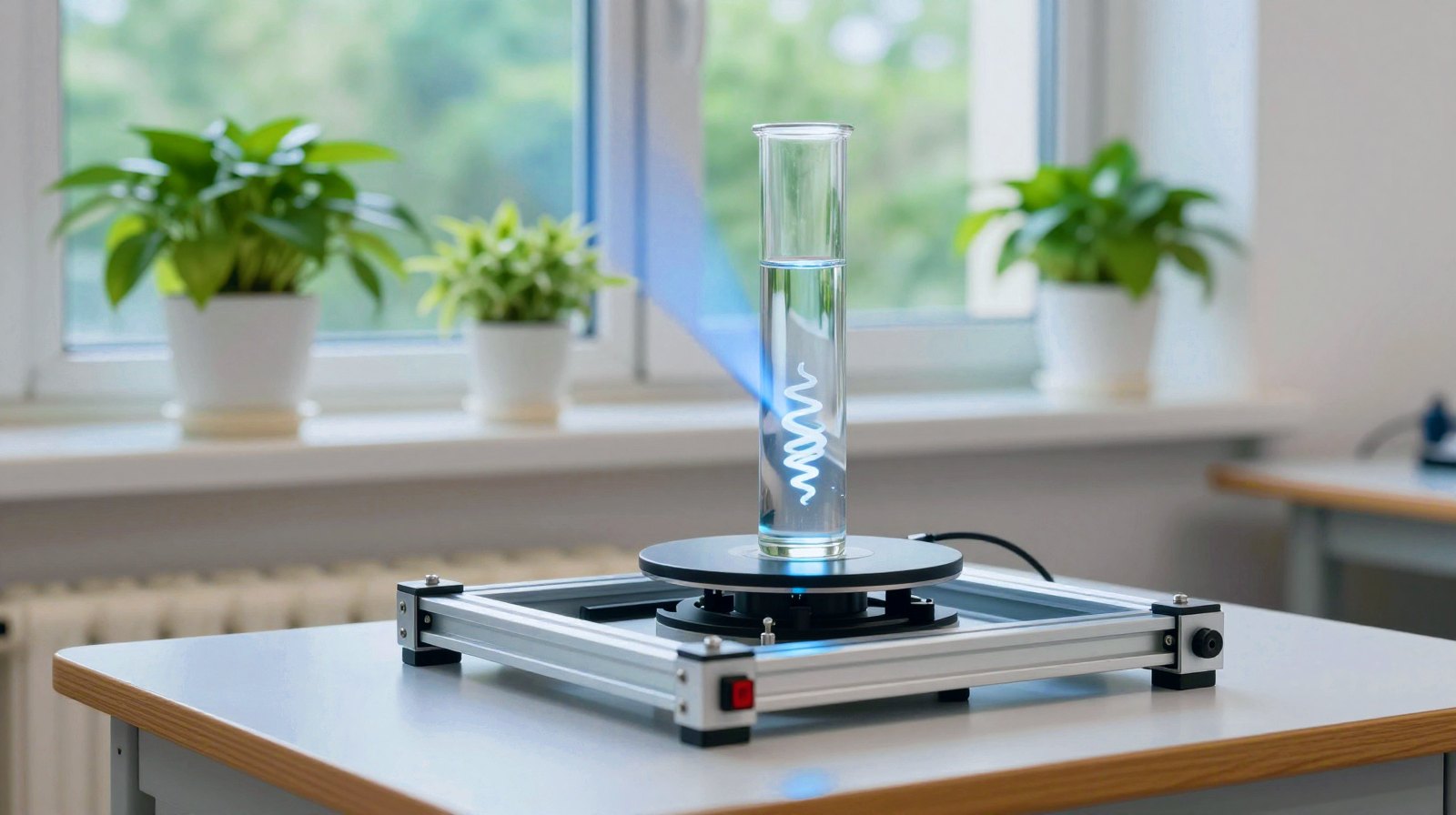
The technique is called Computed Axial Lithography, or CAL. Picture a small glass vial full of a honey-like resin that hardens when it gets enough light. The vial turns slowly on a motor, while a projector shines a changing film of light patterns through it from the side.
Each frame on its own is too weak to harden anything. But the patterns are calculated so that, as the vial spins, the light piles up exactly where your object should be. Wherever the total dose of light crosses a threshold, the resin turns solid. Everywhere else, it stays liquid. You lift out the finished part and wash away the leftover resin.
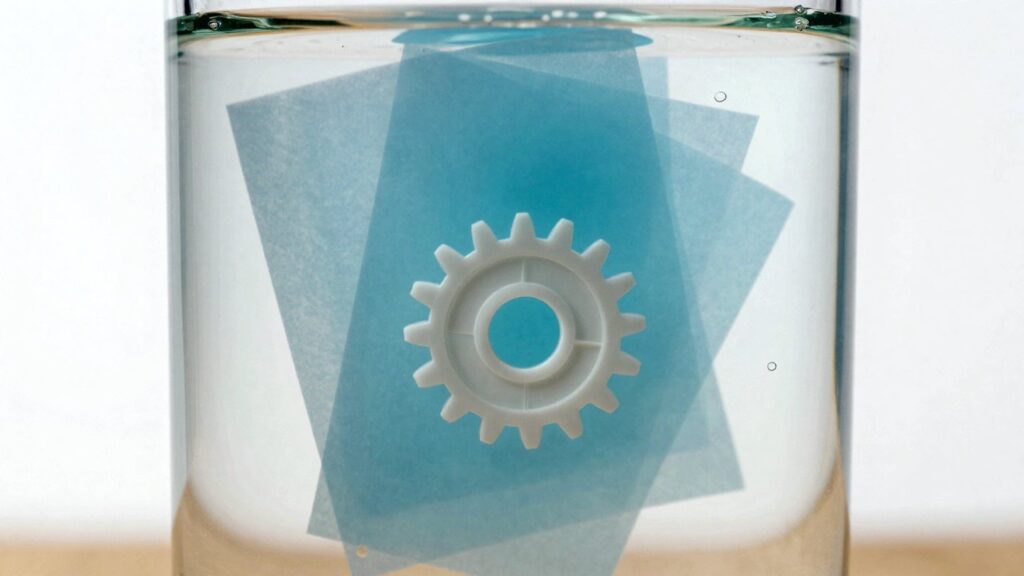
The maths behind it works like a hospital CT scan run backwards. A CT scanner takes pictures from many angles and calculates the 3D shape inside. CAL starts from the 3D shape and calculates the pictures it needs to project. Because the object forms all at once, there are no layers and no support structures to snip off afterwards. The team’s reference print, a small copy of Rodin’s famous Thinker statue, formed in 90 seconds, according to 3D Printing Industry and VoxelMatters.
What is inside the kit
This is the part makers will love: OpenCAL is built from ordinary pieces. According to the project’s published parts list, as summarised by VoxelMatters and 3D Printing Industry, it uses:
- a consumer LED projector for the light patterns;
- a Raspberry Pi 5 as its brain, running open firmware and reading print files from a USB stick;
- a stepper motor that turns the vial;
- an aluminium extrusion frame, laser-cut acrylic panels and 3D-printed parts in PETG, PLA and TPU, which you can print on a normal filament printer.
Assembly takes about 5 to 6 hours for one person once the printed parts are ready. The parts list adds up to roughly $1,600 at June 2026 prices. On the software side, a free Windows app called Tomo turns an ordinary STL file into a print, and it is built on VAMToolbox, an open-source Python library. The code lives on GitHub, and the hardware is shared under Prusa’s Open Community License, which lets you build, modify, repair and share the design.
The resin: made by Formlabs, sold by Prusa, recipe for everyone
Volumetric printing needs a special resin that stays clear so light can pass all the way through. The Berkeley team developed one based on UDMA (a common ingredient in light-curing resins). Formlabs now produces it as OpenCAL Resin in one-litre bottles, and Prusa Research sells it in the US through its Printed Solid store. For readers in Spain and the rest of Europe, note that the reports only mention US sales so far. The good news is that the recipe is published, so labs that want to mix their own can do it.
From one lab to more than 40 contributors
CAL was invented in 2017 in Professor Hayden Taylor’s lab at Berkeley, together with scientists at Lawrence Livermore National Laboratory, and first described in the journal Science in 2019. Turning it into a machine anyone can build took two years and more than 40 contributors, mostly Berkeley students, led by Taylor Waddell. The team also described the platform, including its resin-cleaning steps and a centrifuge module that recovers leftover resin, in an open technical paper.
“CAL has lived in a handful of research labs for almost a decade,” Waddell said in the launch announcement, quoted by VoxelMatters and 3DPrint.com. Machines are already running at MIT, NIST and Purdue University, and the project’s Discord community has passed 2,200 members.
What it can’t do (yet)
Before you clear space on your desk, a few honest limits:
- Small parts. Volumetric printing is limited in object size, and OpenCAL’s figures are quoted for inch-scale parts (a few centimetres).
- Resin only. It works with special clear photopolymer, not the filament spools you already own.
- Resin safety still applies. Liquid resin needs gloves, eye protection, good ventilation and careful cleanup, exactly as with any resin printer.
- It is a build, not a box. This is a kit of open files, aimed at education, research and experienced hobbyists, not a plug-and-play appliance.
What happens next
Berkeley plans a one-day OpenCAL build workshop in February 2027, alongside its volumetric manufacturing symposium, and the printable parts are on Printables with a design contest planned. If you have never designed a printable part before, now is a lovely time to start: the same STL files you make for a normal printer are what OpenCAL eats. Our guide on making 3D models with ChatGPT and AI tools is a gentle first step, and our Domestika picks for makers go deeper.
Learn it yourself
Want to go further? These online courses cover the skills behind this story:
- Introduction to 3D Design and Printing Domestika: Agustín Arroyo's beginner course: model an everyday object in Fusion 360, slice it in Cura and print it, no previous 3D experience needed.
See the course on Domestika
Read next
- How to make 3D models with ChatGPT and AI tools (2026 guide)
- Arduino Ventuno Q: the board that gives robots eyes and a brain
- Gaussian splatting: the 3D photo tech XR fans keep hearing about
The week's best tech stories, free
One email a week with the stories that matter, explained simply. No spam.
Sources
- UC Berkeley releases OpenCAL, an open-source volumetric 3D printer, with Formlabs and Prusa – VoxelMatters, 19 October 2026
- UC Berkeley and Prusa Open Up the World of Volumetric 3D Printing – 3DPrint.com, 20 October 2026
- Build-It-Yourself OpenCAL Volumetric 3D Printer Forms Whole Parts in 90 Seconds for $1,600 – 3D Printing Industry, October 2026
- An Open-Sourced, Community-Driven Volumetric Additive Manufacturing Printer and Post-Processor – T. Waddell et al., arXiv, 2025
- OpenCAL software repository – GitHub, accessed 21 October 2026
- Volumetric additive manufacturing via tomographic reconstruction – B. Kelly et al., Science, 8 March 2019