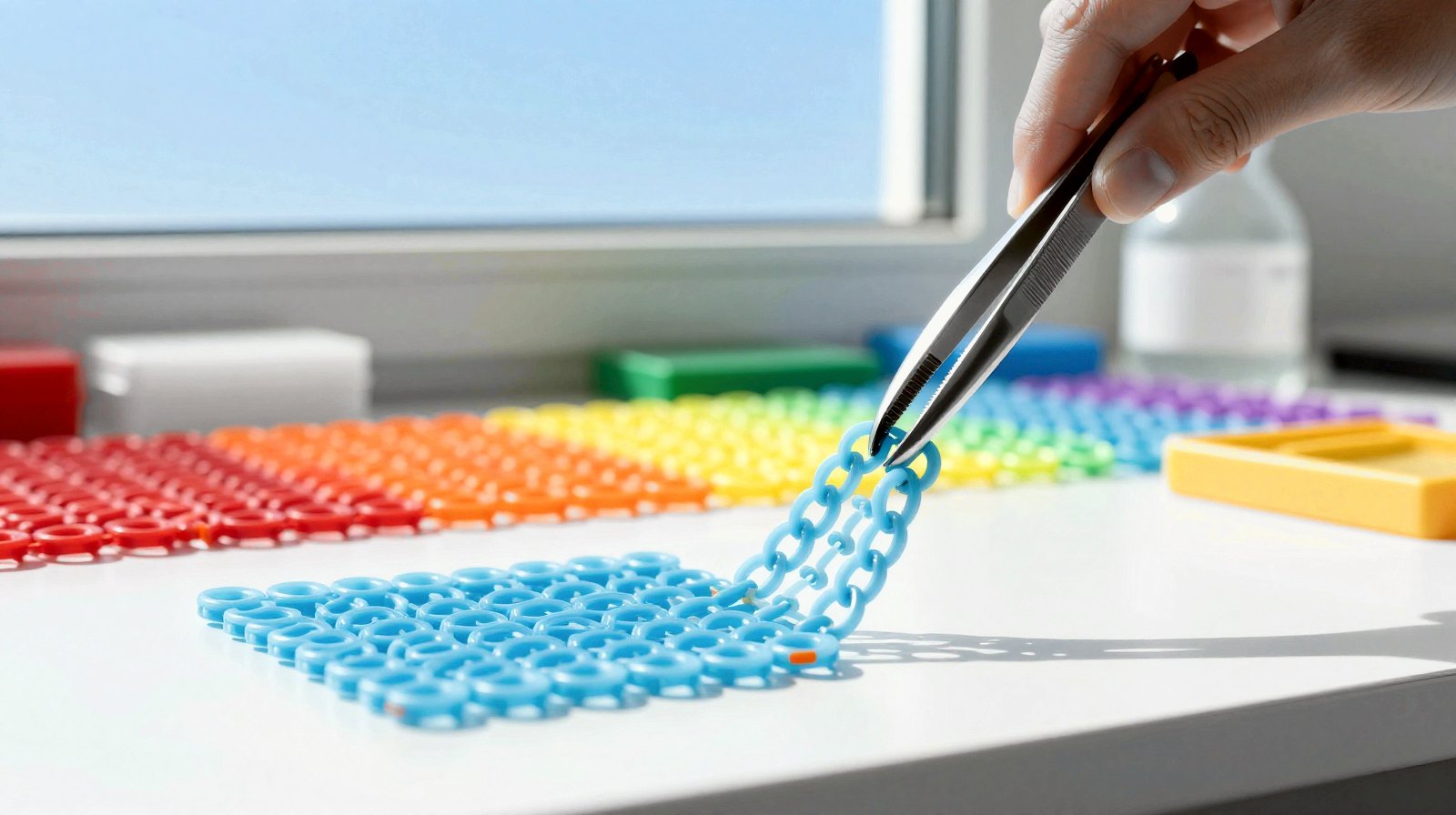
Northwestern University engineers have found a way to 3D print with thick, paste-like inks and the fine detail of light, and it can make delicate, flexible chain mail. Their method, called DIAL, printed one test structure in 30 minutes, compared with 124 minutes for conventional extrusion.
Why should a maker care? Because 3D printing usually forces a choice. Nozzle printers handle thick materials but are limited by the nozzle. Light-based printers give fine detail but generally need thin, free-flowing resin. DIAL tries to give you both at once.
How DIAL works, in four steps
DIAL stands for direct ink additive lithography. If you’ve seen a baker spread icing with a palette knife, you’ve got the first half of the idea.
- A flat nozzle lays thick ink onto a flat surface.
- A blade spreads it into a sheet about 50 microns thick, about half the width of a typical human hair.
- A projector shines patterned light onto the sheet, hardening only the parts you want.
- The process repeats, layer by layer.
The detail now depends on the projector’s pixels and the layer thickness, not on the size of a nozzle. That’s the key shift.
The ink holds itself up
Here’s the part makers will love. The ink is a light-curing resin mixed with tiny particles of fumed silica. According to the team’s announcement, this gives the ink “yield stress”: it stays put like toothpaste on a brush until it is pushed.
So the ink that hasn’t been hardened holds up the parts above it, which means overhangs need no support structures. When the print is done, the extra ink washes off and can be used again.
Chain mail is a good test because its interlocking links are hard to make with either extrusion or light-based printing. If you’ve followed our story on OpenCAL, the open-source printer that works in 90 seconds, you’ll know that light-based printing is full of surprises right now.
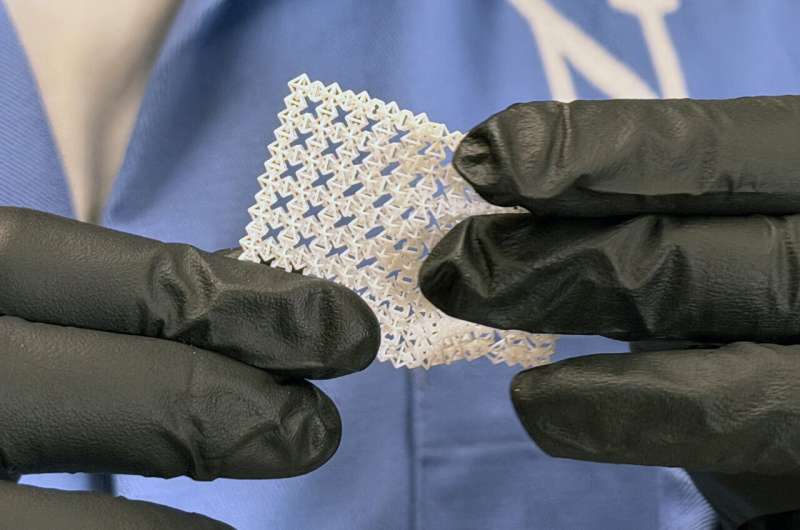
What it printed
- Lattices with very thin walls: walls as thin as 150 microns.
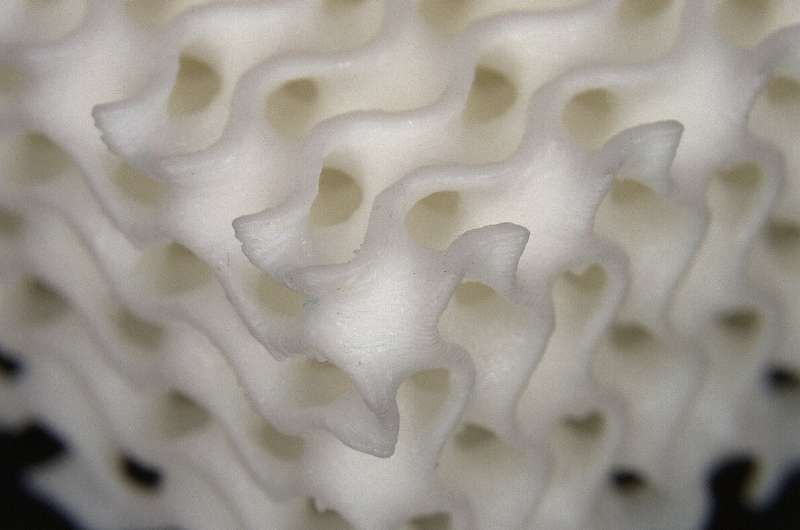
- A gyroid: a curvy, complex, interlocking lattice.
- A multimaterial lattice: more than one material in the same structure.
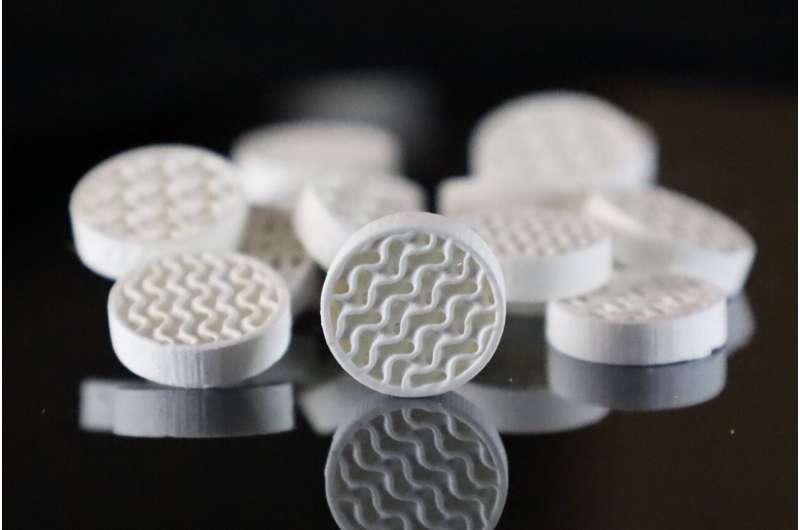
- Fifteen small lattices in one go: each about the size of a coin-cell battery, made from an electrolyte ink in a single 15-minute run.
- Tiny hydrogel containers: with microscopic inverted pyramids, modelled on inserts used to grow cells.
- A large honeycomb: nearly four times the area the projector lights at once, made by moving the projector across overlapping sheets.
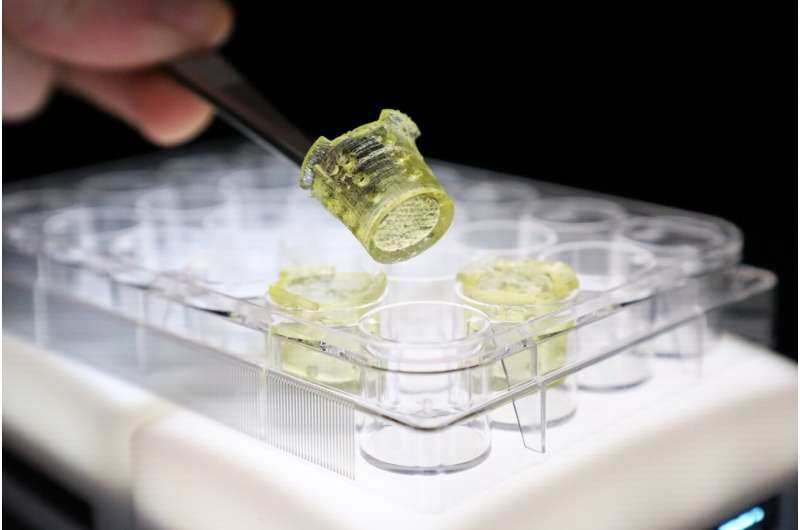
That last one matters. Conventional light-based printers usually work in a vat of resin, and DIAL doesn’t need one, so the team expects it to scale to bigger build areas.
Why it isn’t on your desk yet
This is a lab system, and you can’t buy one. The speed comparison comes from one structure in side-by-side tests, so it isn’t a promise for every print. The team expects it to get faster once it streamlines how the system switches tools, but it hasn’t shown that yet. Uses in space, robotics and medical devices are goals, not results.
What happens next
The work was published in Science Advances. The team expects faster prints and larger builds, so those are the next things to watch. For makers, it’s a good sign that thick, filled materials and fine detail may not have to be a trade-off for much longer. In the meantime, there’s plenty you can print at home, such as our free Universal Bar Sealer.
Read next
- OpenCAL: an open-source 3D printer that prints in 90 seconds
- 3D printing grows metre-long single crystals of metal
- Universal Bar Sealer: a 3D printed bag clip for any pantry bag
The week's best tech stories, free
One email a week with the stories that matter, explained simply. No spam.
Sources
- 3D-printed chain mail and more: New method combines thick inks and patterned light, Northwestern University via Tech Xplore, 5 November 2026
- Kaarthik et al., Rapid, voxel-based 3D printing with yield-stress fluid inks, Science Advances, 2026