Disclosure: this article contains affiliate links to online courses. If you sign up through them, DIGITAL WOXTER TECHNEWS may earn a commission at no extra cost to you. We choose courses for their content, not for payments.
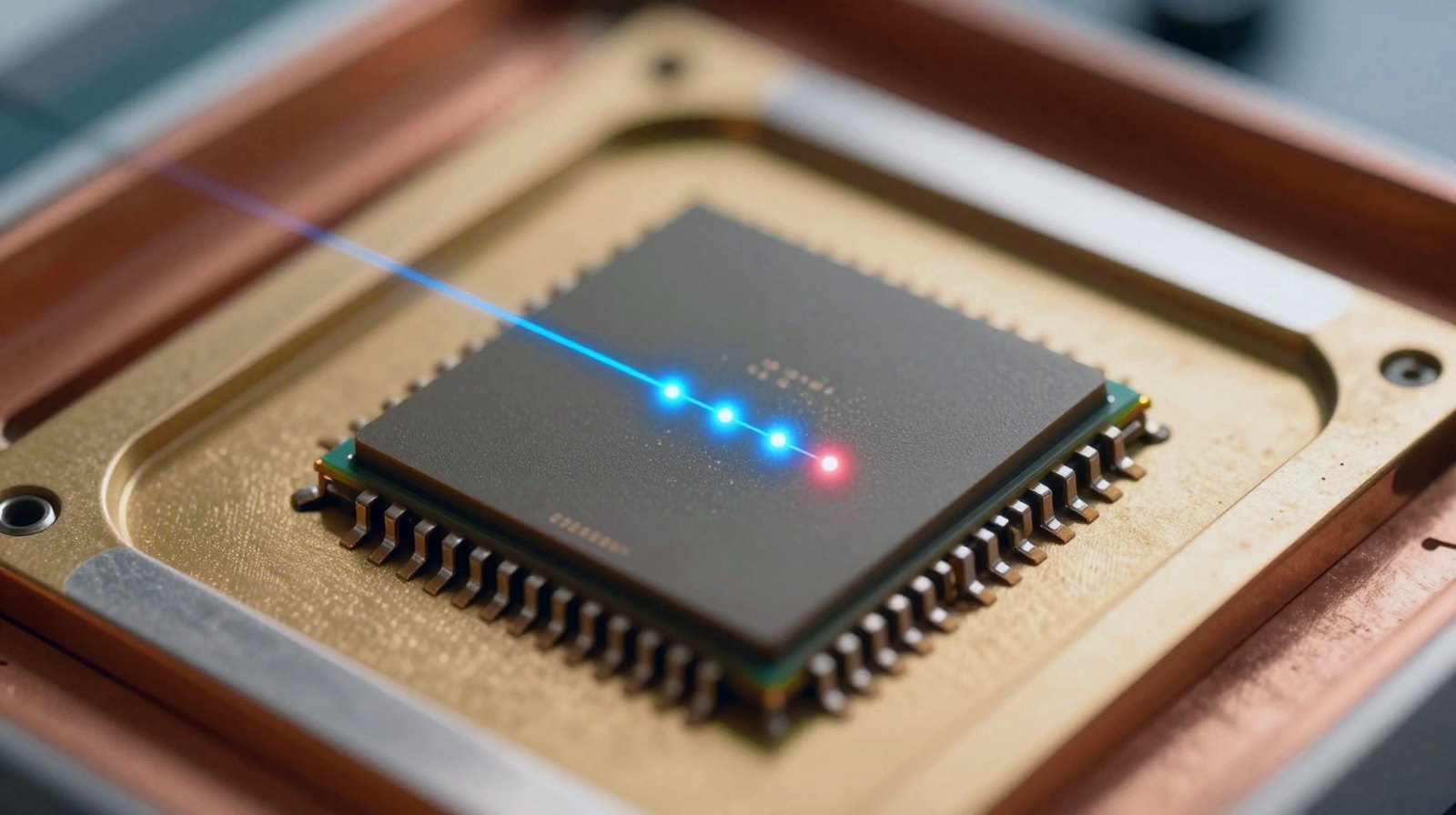
Japanese researchers have run five silicon qubits at the same time through one shared control wire and kept them almost as accurate as when each worked alone. The team at RIKEN, with partners in Taiwan, Switzerland and the Netherlands, reports in Nature Physics that all five stayed at about 99.9 % accuracy when driven together, the level often quoted as the practical threshold for error-corrected quantum computing.
Why it matters: a useful quantum computer will need many thousands, probably millions, of qubits. Giving every single one its own cable is impossible; there is not enough room in the fridge they live in. Sharing wires is the only way to grow, and this result shows that sharing does not have to cost accuracy.
Qubits made the same way as normal chips
A qubit is the quantum version of a bit. A normal bit is 0 or 1; a qubit can hold a blend of both, which is what gives quantum computers their potential power for chemistry, materials and certain maths problems.
There are several ways to build one. In this case each qubit is the spin of a single electron trapped in a tiny cage in silicon called a quantum dot (think of spin as a microscopic compass needle pointing up, down or anywhere in between). The big attraction, as The Quantum Insider notes, is that silicon qubits fit the same manufacturing know-how that makes today’s computer chips, the industry behind stories like Japan’s push to 2 nm chips.

The problem with sharing one wire
Each qubit is steered with microwave pulses, like a radio tuned to its own station. When five qubits listen to the same line, the pulses meant for one nudge the others. Physicists call the main effect the AC Stark shift: a neighbour’s pulse slightly changes a qubit’s tuning, so its internal “clock hand” drifts. In earlier experiments, accuracy dropped from above 99.9 % to about 99.5 % when qubits were driven together, according to Quantum Computing Report. That half a percent sounds small, but over millions of operations it is the difference between a working calculation and noise.
The fix: calibrate in pairs
The good news is that these shifts are predictable. Instead of measuring every possible combination of qubits running together, which explodes as a chip grows, the team measured the effect pair by pair and used those numbers to correct each qubit’s drift. “Our method uses calibrations between pairs of qubits to compensate for the unwanted phase shifts,” first author Yi-Hsien Wu told The Quantum Insider.
The results, from the paper and its preprint:
- One qubit at a time: accuracy well above 99.99 % on all five, the best approaching 99.999 %.
- Up to three at once: still above 99.99 %.
- All five at once: about 99.9 % or better.
What still limits the five-qubit case is not drift but extra noise from the stronger microwave power needed to drive everyone at once. Co-first author Leon Camenzind calls it “a limitation”, adding that better device design could help.
Putting it in perspective
Five qubits will not break codes or design new drugs. Other quantum technologies, such as superconducting circuits and trapped atoms, already run far more qubits. The value here is a building block: a recipe for packing more silicon qubits onto fewer wires without losing quality. Quantum Computing Report notes the team sees future modules of around ten qubits per shared line, a goal, not a result yet.
Seigo Tarucha, who leads a silicon quantum computing project under Japan’s Moonshot research programme, says reliable parallel control is “an essential step” towards a fault-tolerant machine built from silicon spin qubits.
What happens next
Watch for bigger silicon arrays that combine this calibration trick with faster gates and better materials. If silicon qubits keep matching their rivals on accuracy, the chip industry’s huge factories could one day become quantum factories too.
Learn it yourself
Want to go further? These online courses cover the skills behind this story:
- Quantum Computing Brilliant: Qubits, superposition and entanglement with a quantum computer simulated in your browser; best if you know a little about 2×2 matrices.
See the course on Brilliant
Read next
- Rapidus 2nm: Japan’s bid to build the world’s tiniest chips
- First nuclear clocks: thorium atoms now keep time by themselves
- Chip frequency comb: a step toward pocket-size atomic clocks
The week's best tech stories, free
One email a week with the stories that matter, explained simply. No spam.
Sources
- RIKEN demonstrates high-fidelity simultaneous control of silicon spin qubits above 99.9% threshold – Mohamed Abdel-Kareem, Quantum Computing Report, 17 October 2026
- RIKEN team improves parallel control of silicon spin qubits – Matt Swayne, The Quantum Insider, 19 October 2026
- Simultaneous high-fidelity single-qubit gates in a spin qubit array – Y.-H. Wu, L. C. Camenzind et al., Nature Physics, 15 October 2026
- Simultaneous high-fidelity single-qubit gates in a spin qubit array (preprint) – Y.-H. Wu, L. C. Camenzind et al., arXiv