For about a century, physics textbooks said magnets came in two main kinds. Now there is a third. The physicists who showed it, Libor Šmejkal, Jairo Sinova and Tomas Jungwirth, have received the 2026 Europhysics Prize for establishing altermagnetism, as the European Physical Society and Johannes Gutenberg University Mainz announced, and as ScienceDaily reported this weekend.
Why it matters: every bit in a hard drive and in new MRAM memory chips is stored using magnetism. Altermagnets combine strengths that used to belong to two different families of magnets, which could lead to memory and logic chips that are faster, denser and harder to disturb.
The two magnets we knew
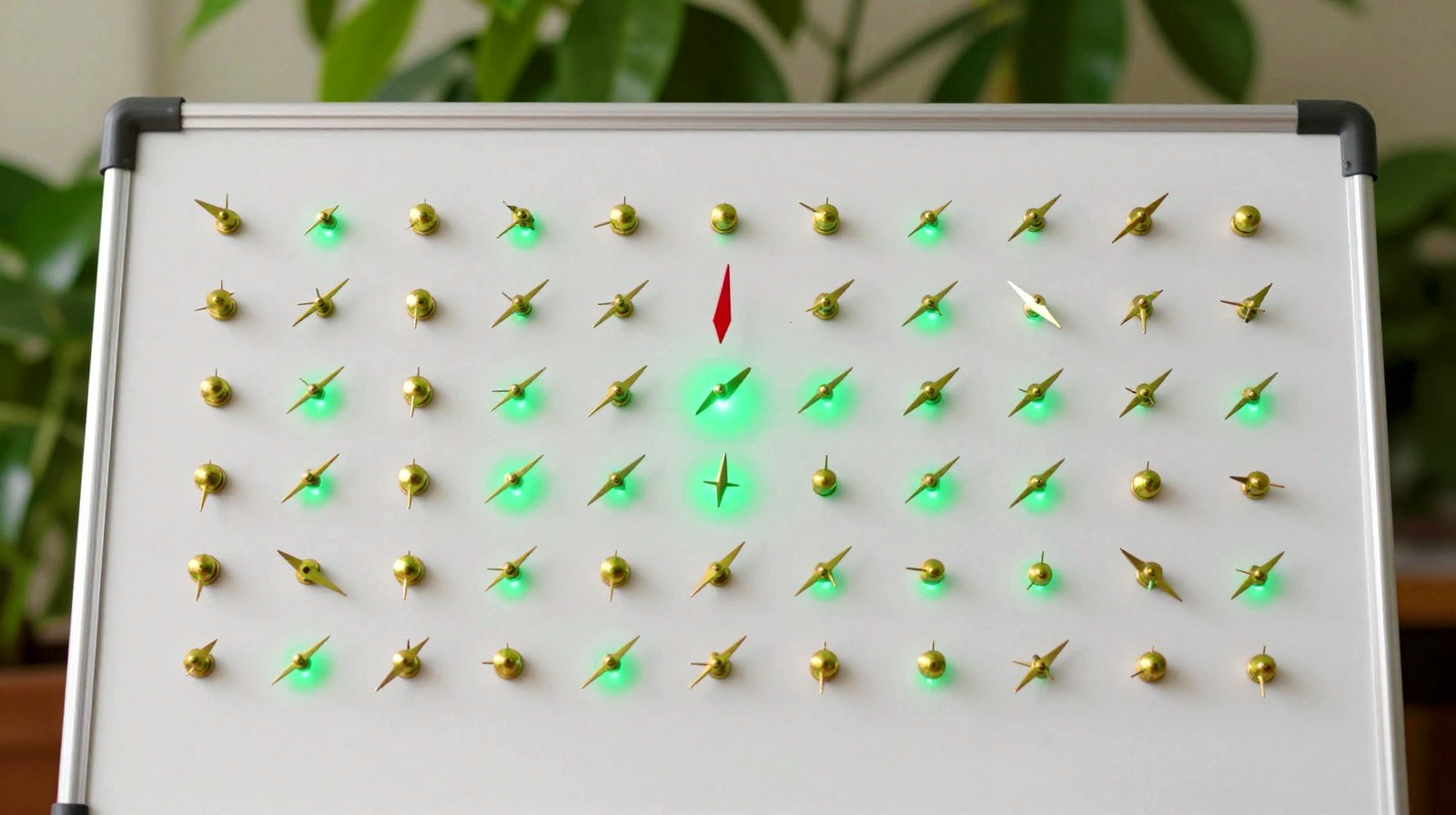
Think of every atom in a magnetic material as a tiny compass needle (its “spin”):
- Ferromagnets, like a fridge magnet, have all their needles pointing the same way. They stick to things, and their electrons carry a strong “spin signal” that electronics can read. That is how today’s magnetic memory works. The downside: their own magnetic field can disturb neighbours, and they switch relatively slowly.
- Antiferromagnets have needles alternating up, down, up, down. They cancel out, so there is no outside magnetic field, and they can flip extremely fast. But because everything cancels, their electrons were thought to carry no useful spin signal.
What makes altermagnets different
In an altermagnet, the needles also alternate and cancel, so there is no net magnetization, like an antiferromagnet. But the neighbouring atoms are arranged in rotated patterns, and that twist in the crystal’s symmetry lets the electrons carry strongly spin-polarized currents, a property previously linked only to ferromagnets. They also show very fast magnetic dynamics, according to Mainz and ScienceDaily.
The theorists published a full symmetry classification in 2022 that pointed to hundreds of candidate materials. Experimental groups then confirmed the behaviour in real crystals using photoemission spectroscopy (shining light on a material and measuring the electrons that fly out) and electrical measurements. One of the first confirmations, in manganese telluride, was reported in Nature in 2024, as later papers recount (arXiv). “An entirely new magnetic phase had remained hidden for more than one hundred years,” Sinova said in the Mainz release.
From physics to chips
The field of spintronics stores and moves information using electron spin instead of (or as well as) electric charge. Altermagnets look like a near-ideal ingredient: a readable spin signal, no stray magnetic field to disturb neighbouring bits, and fast switching. The European Physical Society describes the class as blending traits that were long considered mutually exclusive. The prize, awarded since 1975, also went to the Czech Republic for the first time, as the Czech Academy of Sciences’ Institute of Physics noted.
What happens next
No altermagnet memory chip exists yet. Researchers are now hunting for materials that work well at room temperature and can be grown on chip-making equipment, and hundreds of papers have appeared in just a few years. If they succeed, the next generation of memory could quietly owe its speed to a kind of magnet that physics books didn’t mention a few years ago.
Read next
- Rapidus 2nm: Japan’s bid to build the world’s tiniest chips
- NTT moves data with light, not wires, inside AI data centres
- Nobel Prize in Physics 2026: a telescope made of Antarctic ice
The week's best tech stories, free
One email a week with the stories that matter, explained simply. No spam.
Sources
- 2026 Europhysics Prize honors discovery of altermagnetism as a third fundamental class of magnetism – Johannes Gutenberg University Mainz, 24 July 2026
- 2026 Europhysics Prize – European Physical Society, Condensed Matter Division, 2026
- Scientists who discovered a third form of magnetism win major physics prize – ScienceDaily, 18 October 2026
- The Europhysics Prize goes to the Czech Republic for the first time – Institute of Physics, Czech Academy of Sciences, 2026
- Chiral altermagnon in MnTe (background on the 2024 photoemission confirmations) – arXiv, 2025