Disclosure: this article contains affiliate links to online courses. If you sign up through them, DIGITAL WOXTER TECHNEWS may earn a commission at no extra cost to you. We choose courses for their content, not for payments.
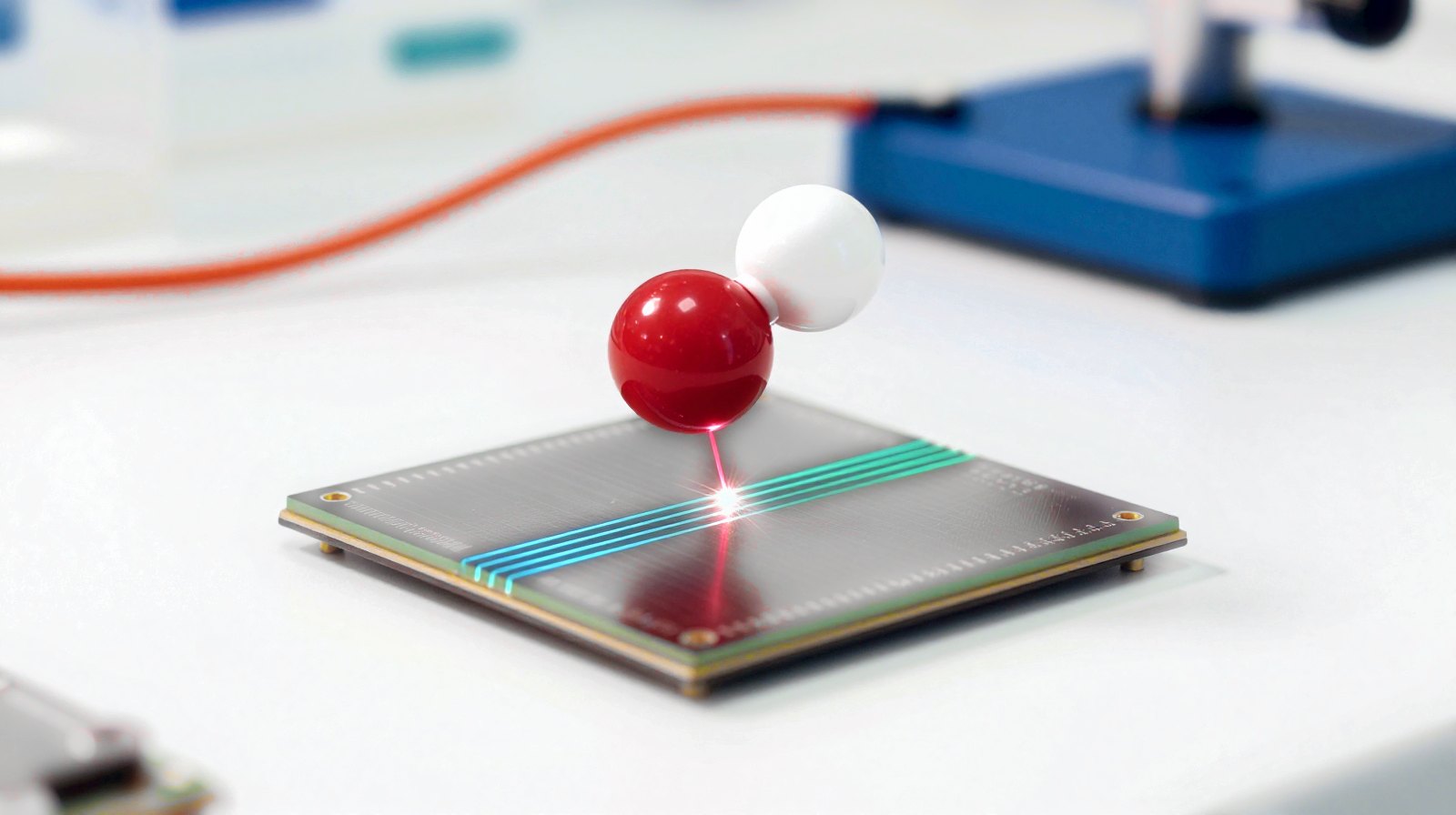
A single molecule has been switched on as a working qubit that can talk in light. Scientists at NVision, a quantum company based in Ulm, Germany, report in Nature the first organic molecule that can be addressed one at a time and that links its quantum state to particles of light. Even better, it is a cousin of the molecules that light up OLED phone screens, so it could be coated onto chips with factory methods we already have.
Why it matters: quantum computers need qubits that are reliable, easy to make in huge numbers and easy to connect. Most of today’s qubits are good at one or two of those. A qubit you can mix up in a chemistry lab and spray onto a chip like a screen coating is a genuinely different route.
First, what is a qubit?
A normal computer bit is a light switch: on or off, 1 or 0. A qubit (quantum bit) can sit in a blend of both at once and link up with other qubits in ways ordinary bits can’t, which is what lets quantum computers attack some problems that are hopeless for normal machines. The catch: that blend is fragile, and the qubits need to “talk” to each other without losing it.
Here, the qubit is the spin of electrons inside a carbon-based molecule. Spin is a tiny magnetic property, a bit like a compass needle that can point up, down or, in the quantum world, a mixture of both.

What the team actually showed
The molecule is a carbene (a carbon compound with two unpaired electrons) tucked into a host crystal that fits it like a glove. According to the team’s preprint of the paper, they managed to:
- pick out and read single molecules with laser light, one at a time;
- keep their light colour stable for over an hour, which matters because qubits that “speak” in light must stay perfectly in tune;
- control the spin and keep its quantum state alive for milliseconds at about 4.5 kelvin (roughly −269 °C). A millisecond sounds short, but it is a long time in the quantum world.
That combination, bright light, a stable colour and a long-lived spin in one molecule, was the missing piece that had kept single molecular qubits out of reach, the authors write. NVision calls it “the first ever individually addressable organic molecular spin-photon interface”: a qubit that can pass its information on to a particle of light.
Why light, and why OLED-style molecules?
If qubits can send their state out as light, they don’t have to sit right next to each other: light can carry quantum information along tiny channels on a chip, or between chips. NVision’s chief technology officer, Ilai Schwartz, sums it up as “connectivity without proximity”.
Making them could also be simpler. The molecule is similar to those used in OLED displays and can be laid down as a thin layer over a chip made with conventional technology, Reuters reports. To find it, the team used AI to simulate candidate molecules, then made about 40 in the lab before finding the “Goldilocks” one, as Schwartz put it. The company says it screened more than 150 designs on the computer, The Quantum Insider notes.
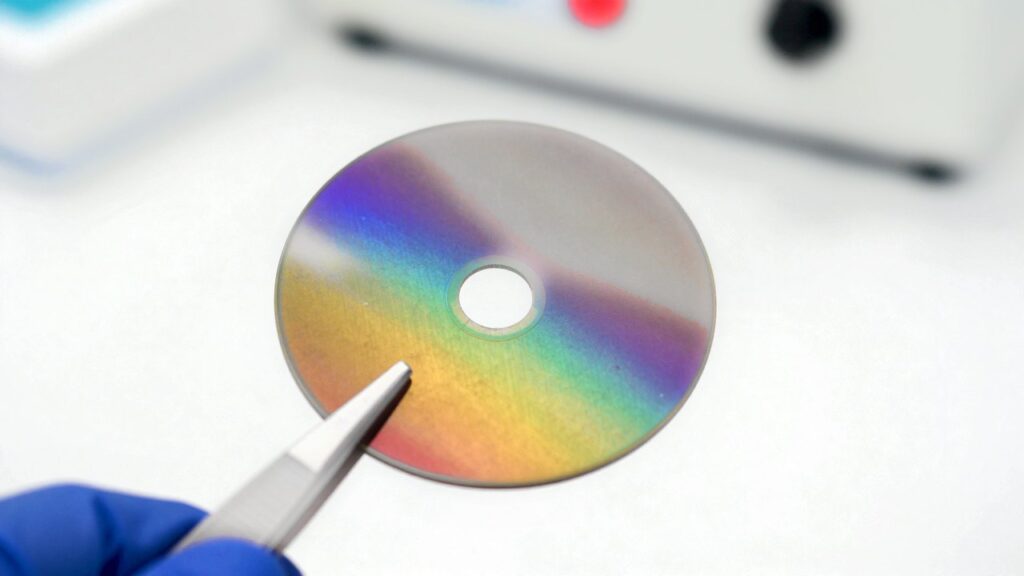
There is a fun backstory: NVision started out in medical imaging, aligning the spins of sugar molecules so MRI scanners can see them about a thousand times more easily, which helps spot fast-growing cancer cells, according to Reuters. That spin know-how led it to these qubits.
Promises to watch, not results yet
Some of the bigger numbers are company plans, not lab results. NVision says its platform can cope with losing up to 70 % of the light, so it could work with standard silicon photonics. With the US photonics company HyperLight, it plans to coat the molecules onto lithium niobate light chips, with first prototype chips expected by the end of 2026, and it aims for 1,000 error-corrected qubits on a chip by 2030. None of that has been shown yet, and the Nature paper is about single molecules, not a working quantum computer.
It is a different path from the silicon qubits we covered last week, which ride on the same material as everyday chips. The race is wide open, and that is good news: more routes, more chances that one of them scales.
What happens next
The next milestone is the first chip with molecular qubits coated on top, talking through light. If it works as planned, quantum chips could one day be built a bit like screens: with chemistry and coatings, not hand-crafted one qubit at a time.
Learn it yourself
Want to go further? These online courses cover the skills behind this story:
- Quantum Computing Brilliant: Qubits, superposition and entanglement with a quantum computer simulated in your browser; best if you know a little about 2×2 matrices.
See the course on Brilliant
Read next
- Silicon qubits: five run on one wire at 99.9% accuracy
- NTT moves data with light, not wires, inside AI data centres
- Chip frequency comb: a step toward pocket-size atomic clocks
The week's best tech stories, free
One email a week with the stories that matter, explained simply. No spam.
Sources
- A Single-Molecule Spin-Photon Interface – Nature, 28 October 2026 (DOI 10.1038/s41586-026-11147-6)
- A Single-Molecule Spin-Photon Interface (preprint) – Roggors, Unden, … Jelezko, … Schwartz, arXiv, 11 May 2026
- NVision Unveils New Quantum Computing Chip Tech in Nature Paper – Reuters (Stephen Nellis), via Global Banking & Finance Review, 28 October 2026
- NVision and HyperLight Partner to Develop Photonic Quantum Chips – The Quantum Insider, 28 October 2026