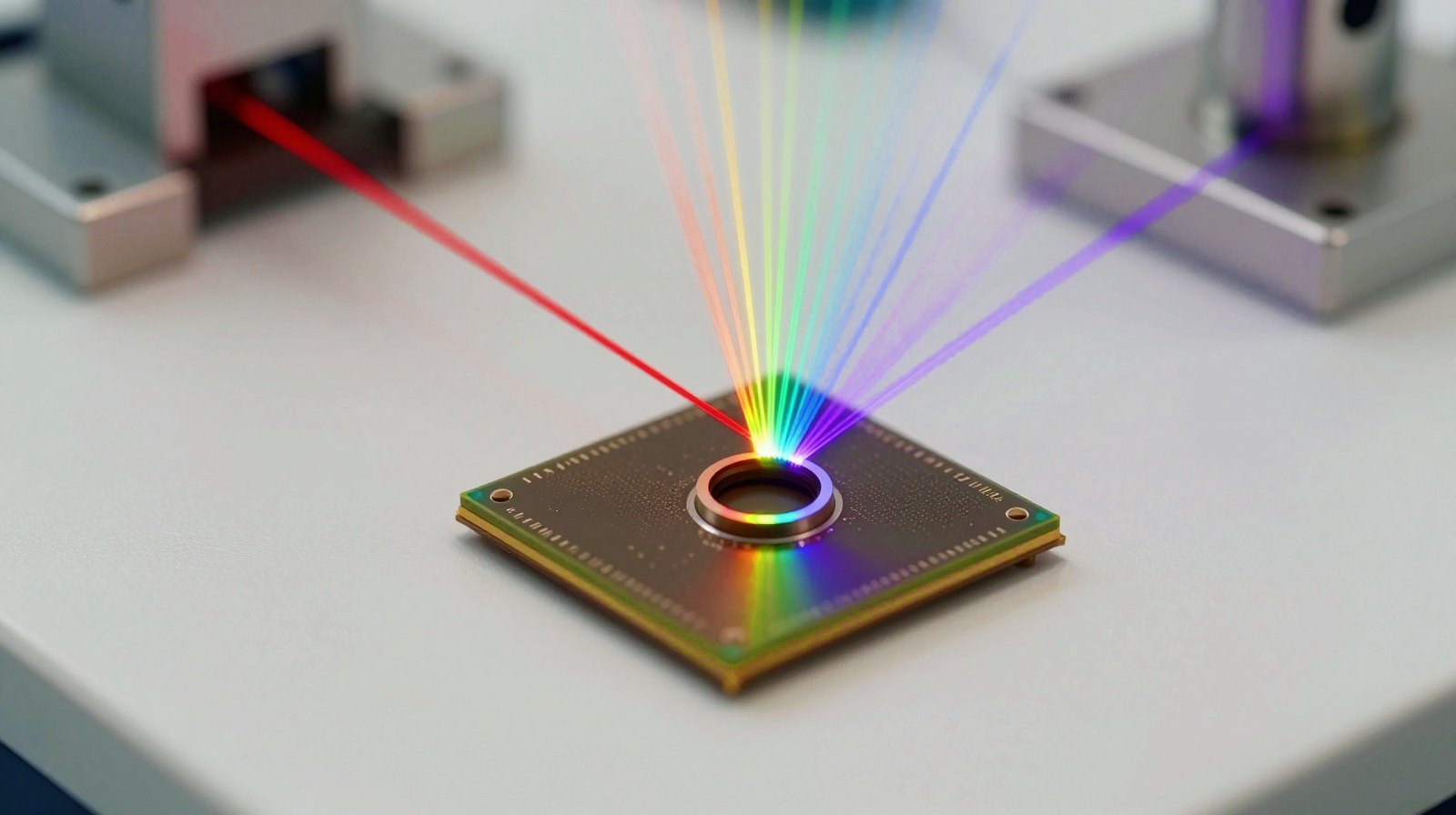
The world’s best clocks fill a lab bench. A new chip could help squeeze one of their most important parts onto something smaller than a fingernail. Researchers at the University of Auckland, the Joint Quantum Institute (JQI), NIST and partners have built a chip-sized optical frequency comb that works in a new way, reported in Nature and described by the University of Auckland and JQI via Phys.org.
Why it matters: frequency combs are what let optical atomic clocks tell time. Small, mass-produced combs could one day mean portable atomic clocks for navigation without GPS, better radar and lidar, and more precise sensors, outside the lab.
First, what is a frequency comb?
Picture a ruler made of light. A frequency comb is a laser source that produces millions of precise, perfectly evenly spaced colours, like the marks on a ruler, as Auckland explains. Optical atomic clocks “tick” hundreds of trillions of times a second, far too fast for electronics to count. The comb acts like a gearbox, turning those ticks into a signal electronics can handle. Its inventors, John Hall and Theodor Hänsch, shared the 2005 Nobel Prize in Physics.
For the comb to work as a ruler, it has to span an octave: from one colour to a colour with exactly twice its frequency. That lets the comb check itself against itself, which is how it stays accurate.

The new trick: two lasers, and the comb fills the gap
Earlier chip combs started from one laser and spread outward, so their outer colours were weak and noisy, and reaching a full octave needed bulky extra equipment. The new design flips that around. Two lasers, one octave apart, shine into a tiny silicon nitride ring, and the comb grows in the space between them, reaching from telecom infrared light all the way to visible light, according to the team’s paper and JQI’s report.
The clever part is that the comb locks itself to both lasers, so they become its first and last teeth. The team calls this a self-aligned parametrically driven cavity soliton, or SParCS (a soliton is a pulse of light that keeps its shape as it circles the ring). The idea was first predicted in 2023 by a team led by Miro Erkintalo in Auckland and shown in a lab in 2024 with NIST and the University of Maryland.
One chip, three jobs
Simply by changing which signals it locked to, the same chip handled three classic comb tasks, report Auckland and the paper:
- Making precise optical frequencies, a building block for ultra-precise measurement.
- Producing low-noise millimetre-wave signals, useful for radar and communications.
- Reading out an atomic clock, where it matched a full-size lab comb within the limits the team could measure, according to JQI and Earth.com.
Just as important for the future, the rings were made in a commercial foundry, and the self-aligned comb appeared across multiple devices, not just one lucky chip, the paper says. That is the first step towards mass production. Lead author Grégory Moille told JQI: “we finally see a viable path for their use in deployable atomic timekeeping.”
The honest caveats
This is still a lab demonstration. The two lasers and the equipment that keeps them stable sit outside the chip, and the team says it still needs to measure the fastest noise in its microwave signals more precisely, as Earth.com and JQI note. The researchers have filed a provisional patent on parts of the design.
What happens next
The team wants to widen the comb further and, eventually, drive both ends with a single laser, which would make the whole system simpler and smaller. If that works, the long road from a lab bench to a clock you could carry in a vehicle, a drone or a field instrument gets a lot shorter.
Read next
- First nuclear clocks: thorium atoms now keep time by themselves
- NTT moves data with light, not wires, inside AI data centres
- Rapidus 2nm: Japan’s bid to build the world’s tiniest chips
Sources
- Self-aligned optical microcomb emerging between octave-separated lasers – G. Moille et al., Nature, 2026
- Self-aligned optical microcomb emerging between octave separated lasers (preprint) – arXiv, February 2026
- University’s research advances ultra-precision laser tech – University of Auckland, 8 October 2026
- New chip-based frequency combs demonstrate potential for portable atomic clocks – Joint Quantum Institute via Phys.org, 6 October 2026
- Breakthrough in chip technology could transform atomic clocks – Earth.com, 18 October 2026